OSHA Sandblasting Safety: Why Silica Sand Is Banned and What to Use Instead
For decades, silica sand was the dominant blasting abrasive in industrial surface preparation. It was cheap, widely available, and effective. It was also killing workers. The progressive replacement of silica sand with safer abrasive alternatives is one of the most significant occupational health improvements in the surface preparation industry over the past 50 years — driven by OSHA regulation, scientific understanding of silicosis pathology, and increasingly rigorous enforcement.
This guide covers the complete regulatory picture for sandblasting operations in the United States, explains why silica sand is functionally prohibited in professional applications, and identifies the compliant abrasive alternatives that have replaced it. It is part of the broader resource at Sandblasting Media Suppliers: The Industrial Buyer’s Complete Guide, published by Jiangsu Henglihong Technology Co., Ltd.
1. Silicosis: The Disease Behind the Ban
Silicosis is a progressive, irreversible, and often fatal fibrotic lung disease caused by inhalation of respirable crystalline silica dust. When a worker inhales silica particles small enough to reach the deep lung (particles smaller than 10 µm aerodynamic diameter, particularly the “respirable” fraction below 4 µm), the particles are engulfed by alveolar macrophages. The macrophages die attempting to neutralize the inert silica, triggering an inflammatory cascade that eventually produces nodular fibrosis — permanent scarring of lung tissue.
There is no cure for silicosis. The lung damage is permanent. Disease progression continues even after exposure ceases. Three clinical forms exist:
- Chronic silicosis: The most common form. Results from 10+ years of low-level exposure. Often asymptomatic until advanced stages. Progressive even after exposure ends.
- Accelerated silicosis: Results from 5–10 years of higher exposure. Progresses faster than chronic form. Increasing dyspnea and respiratory failure.
- Acute silicosis: Results from very high exposure over a short period (months to a few years). Rapidly progressive, almost always fatal within months to years of onset. Associated with sandblasting operations that used silica sand in enclosed spaces without adequate controls.
Silicosis also dramatically increases susceptibility to tuberculosis, lung cancer (IARC Group 1 carcinogen for crystalline silica from occupational sources), and other respiratory diseases. Workers who develop silicosis are typically permanently disabled.
2. History of Silica Sand Blasting Restrictions
The dangers of silica sand in blasting were recognized in the early 20th century. The U.K. prohibited silica sand blasting in enclosed spaces as early as 1949. The U.S. followed a slower regulatory path:
- 1971: OSHA established initial silica dust permissible exposure limits under the Occupational Safety and Health Act, though enforcement was inconsistent.
- 1974: NIOSH (National Institute for Occupational Safety and Health) recommended that silica sand be prohibited as an abrasive blasting material, citing overwhelming evidence of silicosis risk.
- 1992: OSHA reissued a hazard alert explicitly warning against using silica sand in blasting operations and noting that most other developed nations had already banned the practice.
- 2016: OSHA issued its landmark Silica Rule (29 CFR 1910.1053 for general industry; 29 CFR 1926.1153 for construction), establishing a new PEL of 50 µg/m³ as an 8-hour TWA — one-fifth of the previous limit — along with extensive ancillary requirements for medical surveillance, exposure assessment, and hazard communication.
- 2018–2019: OSHA began active enforcement of the 2016 Silica Rule with substantial fines for violations.
3. Key OSHA Regulations (2026)
Two primary OSHA standards govern silica exposure in blasting operations:
29 CFR 1910.1053 — General Industry
Applies to blast rooms, blast cabinets, and any enclosed blasting operations in manufacturing, shipbuilding, foundries, and similar settings. Covers engineering controls, exposure monitoring, medical surveillance, written exposure control plans, and hazard communication requirements.
29 CFR 1926.1153 — Construction
Applies to field blasting operations on construction sites, bridge maintenance, and infrastructure projects. Includes a Table 1 (objective data table) that specifies engineering controls and respiratory protection requirements for listed tasks — including abrasive blasting — that can be used to comply without air monitoring if the listed controls are fully implemented.
Additional Applicable Standards
- 29 CFR 1910.94: Covers general ventilation requirements for abrasive blasting equipment and enclosures — this is the foundational standard for blast room design.
- 29 CFR 1910.134: Respiratory protection standard — governs respirator selection, fit testing, medical evaluation, and the written respiratory protection program required for any blasting operation.
- 29 CFR 1910.1200 (HazCom): Requires Safety Data Sheets (SDS) for all blast media used, and appropriate hazard labeling.
4. Permissible Exposure Limits Explained
| Standard | Limit | Measurement Basis | Trigger |
|---|---|---|---|
| OSHA PEL (2016 Silica Rule) | 50 µg/m³ | 8-hour TWA, respirable fraction | Mandatory compliance |
| OSHA Action Level | 25 µg/m³ | 8-hour TWA, respirable fraction | Triggers medical surveillance, exposure monitoring |
| NIOSH REL | 50 µg/m³ | 10-hour TWA | Recommended limit |
| ACGIH TLV | 25 µg/m³ | 8-hour TWA (more conservative) | Professional guideline |
5. Required Engineering Controls
For any enclosed blasting operation, the following engineering controls are required under 29 CFR 1910.94 and are central to OSHA’s Silica Rule compliance hierarchy:
- Blast enclosure with interlocked access: All blasting must occur within a fully enclosed room or cabinet that prevents uncontrolled dust escape. Doors must interlock with the blast system to prevent exposure when the enclosure is open and operating.
- Local exhaust ventilation (LEV): The blast enclosure must be maintained at negative pressure relative to surrounding areas, with a minimum face velocity at all openings to prevent dust migration. OSHA 1910.94 specifies minimum air velocities based on enclosure type.
- HEPA-rated dust collector: Exhaust air from the blast enclosure must be filtered through a high-efficiency particulate filter (HEPA, ≥99.97% efficiency at 0.3 µm) before discharge, preventing silica particles from re-entering the work environment or being released to the atmosphere.
- Abrasive recovery and classifier: Blast rooms should use a mechanical recovery system that continuously collects spent abrasive, classifies out fines and dust, and recirculates usable media — both for economic efficiency and to reduce dust generation from degraded media in the working mix.
- Wet suppression (where applicable): For operations where wet blasting or water curtains are feasible, they can substantially reduce airborne dust concentrations.
6. Respiratory Protection Requirements
When engineering controls alone cannot reduce exposures below the PEL — which is the case for most active blasting operations — respiratory protection is required under 29 CFR 1910.134. For abrasive blasting, the minimum required respiratory protection is:
- Type CE abrasive blasting respirator (supplied-air respirator designed specifically for blasting) — this is the only respirator type that provides simultaneous protection from blast rebound, abrasive dust, and airborne silica while allowing the worker to see and operate the blast nozzle.
- Standard N95, P100 filtering facepiece respirators (dust masks) are not adequate for active blasting operations. They provide insufficient protection factors and do not protect against blast rebound impact.
- Supplied-air respirators operating in continuous-flow or pressure-demand mode provide Assigned Protection Factors (APF) of 25–1,000× depending on design.
- A written Respiratory Protection Program (RPP) per 29 CFR 1910.134 is required, including fit testing, medical evaluations, and training for all workers who wear respirators.
7. OSHA-Compliant Alternatives to Silica Sand
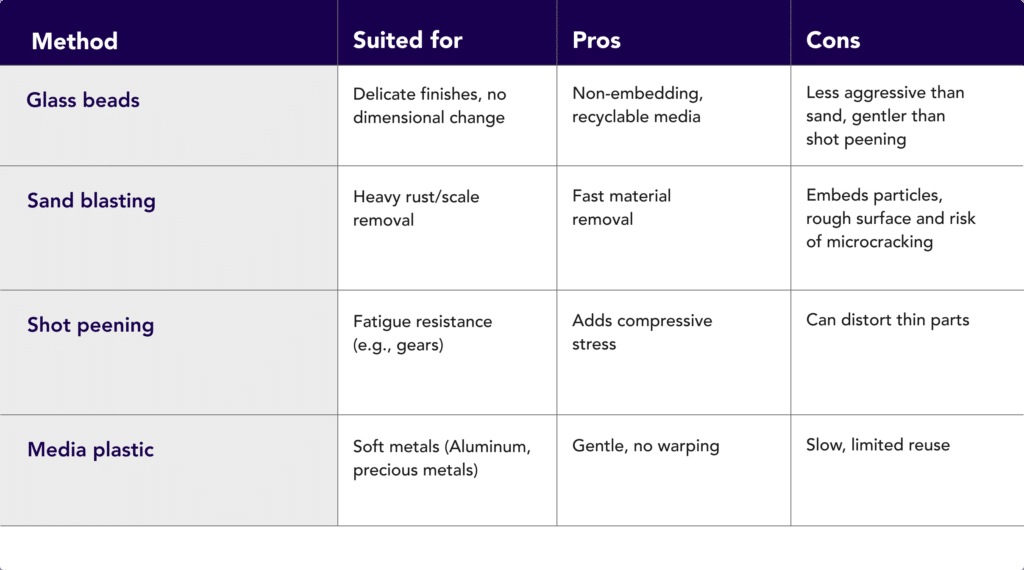
All of the following blast media types contain less than 1% crystalline silica (verified by XRD testing) and are OSHA-compliant alternatives for applications that previously used silica sand. The choice between them depends on substrate, desired surface profile, environmental requirements, and cost. For the complete selection framework, see: How to Choose Sandblasting Media: Step-by-Step.
Steel Grit & Steel Shot
Best replacement for heavy industrial applications requiring Sa 2.5 or Sa 3. Recyclable, low dust, very low silica. Learn more: Steel Grit & Steel Shot Suppliers.
Aluminum Oxide
Near-zero silica, Mohs 9 hardness. Best for hard substrates, stainless steel, thermal spray prep, and precision applications. Learn more: Aluminum Oxide Blasting Media.
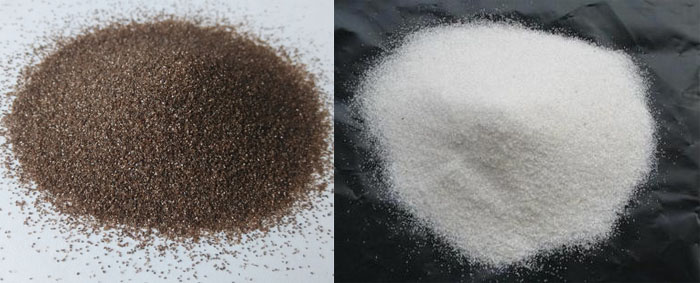
Garnet
Low free silica, low dust generation — the preferred choice for open-air field blasting where worker exposure is hardest to control. Learn more: Garnet Abrasive Suppliers.
Crushed Glass
Amorphous (non-crystalline) silica — OSHA-compliant when crystalline silica is confirmed below 1% by XRD. 100% recycled material with clean environmental profile. Learn more: Crushed Glass Blasting Media.
Coal Slag / Copper Slag
Low crystalline silica when properly tested. Verify by XRD — amorphous SiO₂ content may be high even when crystalline fraction is low. Heavy metal testing also required. Learn more: Coal Slag & Copper Slag Suppliers.
Plastic Media & Organics
Zero silica. For sensitive substrates: aircraft, composites, automotive restoration. Learn more: Plastic & Biodegradable Blast Media.
8. Spent Abrasive Disposal Compliance
OSHA governs worker exposure, but the EPA and state environmental agencies govern spent abrasive disposal. Key disposal considerations:
- Lead paint blasting: If the blasted surface had lead paint (pre-1978 construction, many industrial facilities), the spent abrasive is almost certainly a RCRA hazardous waste requiring licensed hazardous waste disposal. This applies regardless of the abrasive type used.
- Chromate coatings: Spent abrasive from surfaces coated with chromate primers (common in aerospace and military applications) may contain hexavalent chromium and require hazardous waste disposal.
- Coal slag from unknown sources: Some coal slag products contain leachable arsenic or other metals that trigger RCRA hazardous classification for the spent abrasive even before substrate contamination is considered. Always obtain TCLP test data.
- Non-hazardous abrasives (clean substrate): Steel grit, aluminum oxide, and garnet spent from clean carbon steel surfaces are typically non-hazardous solid waste and can be disposed of at licensed solid waste facilities at much lower cost ($40–$100/MT vs. $150–$500/MT for hazardous).
9. Frequently Asked Questions
Source OSHA-Compliant Blast Media
Jiangsu Henglihong Technology Co., Ltd. supplies steel grit, aluminum oxide, and specialty abrasives with full SDS documentation, XRD silica test reports, and ISO 9001:2015 certification. Contact us for compliant supply solutions.
Request Documentation & Quote →Filters