Ceramic Media for Automotive Manufacturing: Deburring, Edge Radiusing & Surface Finishing of Powertrain, Transmission, and EV Components
How ceramic mass finishing media is used across the automotive supply chain — from engine block valve seats and transmission gears to EV motor housings and battery tray components — with media specifications and process parameters for each application.
1. Why Deburring Is Non-Negotiable in Automotive Manufacturing
The automotive industry is the single largest consumer of ceramic mass finishing media globally, accounting for an estimated 35–40% of all vibratory deburring media consumed by volume. This dominance reflects a fundamental characteristic of automotive manufacturing: the combination of extreme production volumes, strict cleanliness specifications, and safety-critical performance requirements that make manual deburring economically impossible and technically inadequate.
The consequences of inadequate deburring in automotive applications are categorically different from those in general manufacturing. A burr fragment that dislodges from a valve body bore and circulates through an automatic transmission’s hydraulic control circuit can cause catastrophic valve sticking, resulting in unintended gear engagement — a field failure with direct safety implications. A burr on a brake caliper bore can prevent full piston retraction, causing brake drag, premature wear, and thermal events. These failure modes are why IATF 16949 and OEM-specific cleanliness standards specify residual particle limits measured in microns, not millimeters.
Ceramic mass finishing with vibratory or centrifugal barrel machines addresses all of these concerns simultaneously: it processes all surfaces — including internal bores, cross-holes, and recessed pockets — in a single automated cycle with documented, repeatable process parameters. The output is a consistent, auditable surface condition that manual deburring cannot achieve at any volume.
2. Ceramic Media Applications by Automotive Component
3. Powertrain Components: Engine & Cylinder Head
Engine block and cylinder head machining generates burrs at every hole intersection, valve seat, and threaded port — hundreds of burr locations per casting. The complexity of the geometry, combined with strict cleanliness requirements for the assembled engine (ISO 16232 / VDA 19 particle counting), makes ceramic mass finishing the only practical deburring method for production volumes above a few hundred engines per day.
Cylinder Head Valve Seats and Ports
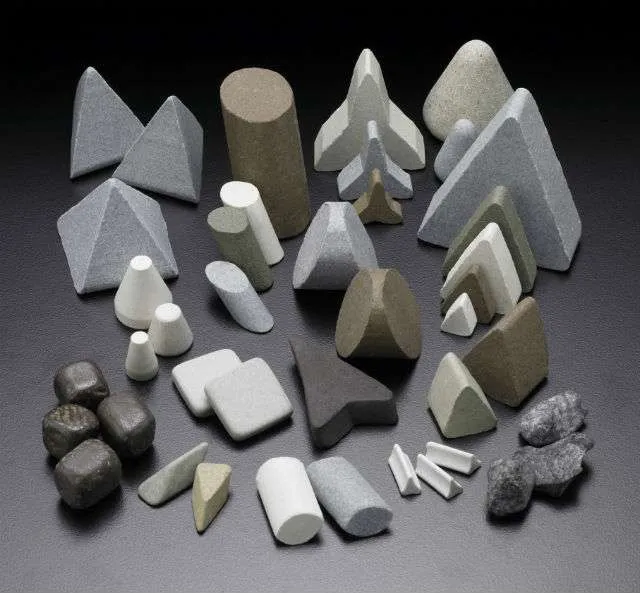
The intake and exhaust ports of a cylinder head present a complex three-dimensional deburring challenge: the port wall transitions abruptly to the valve seat insert, creating a burr at the junction that can break off during engine operation and cause valve-to-seat damage. The adjacent fuel spray or intake charge direction means that a dislodged burr in this area directly affects mixture formation and combustion efficiency. Ceramic media using diagonal cylinders and cones — sized to enter the port without lodging in the valve seat throat — addresses this reliably at production scale.
Oil Galleries and Cross-Bores
Engine block oil galleries are the most critical deburring challenge in powertrain manufacturing. These networks of interconnected drilled passages distribute oil under pressure to bearings, camshaft lobes, and timing chain tensioners. At every intersection of two galleries — which may number 30–50 per block — a burr is formed on the upstream edge of the intersecting hole. Under oil pressure, these burrs act as dams that reduce local oil flow, and any dislodged fragment circulates directly to the bearing film gap where it causes abrasive wear.
The media selection challenge for oil gallery deburring is severe: the galleries are typically 6–12 mm in diameter, requiring media small enough to enter (for cross-bore burr access) but large enough not to lodge in the gallery itself. For many engine designs, no single chip geometry can satisfy both requirements simultaneously — a two-stage approach (large media for external surfaces, then small diagonal cylinder for gallery access with media stops on through-bores) is the standard solution.
Gallery cleanliness verification is mandatory: After ceramic deburring of engine blocks, 100% of production parts must be subjected to high-pressure flushing followed by particle counting per ISO 16232 or the OEM’s internal cleanliness specification before assembly. A single ceramic chip fragment lodged in an oil gallery and dislodged during engine break-in will cause a catastrophic bearing failure within hours of operation — a warranty event with severe financial and reputational consequences.
4. Transmission & Driveline Components
Automatic transmission components represent the most demanding ceramic deburring application in the automotive supply chain, combining the cleanliness requirements of hydraulic systems (NAS 7–9, equivalent to <50 µm particles at <10 particles/mL) with the precision requirements of closely toleranced gear and shaft components, and the production volume requirements of tier-1 automotive supply.
Transmission Valve Bodies
The valve body is the hydraulic control heart of an automatic transmission — a precision-machined aluminum casting containing dozens of metering orifices, check valves, and solenoid bores connected by an intricate network of internal passages. Every machined passage terminates in another passage or a valve bore, creating a cross-bore burr at each intersection. The hydraulic fluid that flows through these passages controls clutch pack engagement pressure and therefore gear shift timing and quality — any partial obstruction from a burr causes shift hesitation, delayed engagement, or in severe cases, clutch slip and transmission failure.
Ceramic deburring of valve bodies uses small diagonal cylinder media (8–10 mm) combined with a neutral compound and a long, controlled vibratory cycle. The media must be sized to enter the larger passages but cannot enter the metering orifices — a precise size window determined by the valve body’s internal geometry. After ceramic deburring, valve bodies are subjected to high-pressure flushing and particle count verification before assembly.
Gear Finishing: Two-Stage Ceramic + Steel
Automotive transmission gears undergo a two-stage mass finishing process that delivers both the deburring specification and the surface quality required for NVH (noise, vibration, harshness) performance and gear contact fatigue life. Stage 1 uses cone or tri-star ceramic media to access and remove burrs at the gear tooth root — the critical stress concentration area where tooth bending fatigue cracks initiate. Stage 2 uses hardened steel satellite media to burnish the tooth flanks to a bright finish and introduce compressive residual stress in the contact zone, extending pitting resistance (surface fatigue) by a documented 20–30% in gear endurance testing.
📄 Related: Ceramic Media Shapes Guide — Cone and Tri-Star Selection for Gear Tooth Root Access Including lodging risk assessment and size calculation for common automotive gear module ranges5. Electric Vehicle Components — New Demands, New Specifications
The shift from internal combustion to battery-electric powertrains is creating new ceramic media application categories while simultaneously changing the requirements for traditional ones. EV drivetrains eliminate the engine block and camshaft but introduce new high-volume, precision-critical components — motor housings, rotor shafts, battery trays, and power electronics heat sinks — that require mass finishing at automotive production rates with specifications informed by electrical and thermal performance requirements, not just mechanical ones.
Aluminum dominance in EV structures shifts the compound chemistry requirement across the board. Where a traditional ICE drivetrain is predominantly ferrous (cast iron blocks, steel shafts, steel gears), an EV powertrain is predominantly aluminum — motor housings, gear reducers, battery trays, and thermal management components. This means non-ferrous-safe ceramic media and mildly acidic brightening compounds are the standard specification for EV component finishing, not the exception as in ICE production.
EV Motor Housing and Stator Can
The motor housing of a battery-electric vehicle is a precision-machined aluminum die-casting that must meet tight dimensional tolerances on the stator bore (for motor air gap control), bearing seat, and coolant passage connections. Parting line flash and machining burrs on coolant passages are the primary finishing challenges. Non-ferrous-safe ceramic media in a mildly acidic compound removes these efficiently without the galvanic staining that standard ceramic would cause, and leaves the aluminum surface in an optimal condition for the thermal interface material or anodizing that follows.
Battery Tray and Structural Components
High-voltage battery trays in BEVs are large, thin-wall aluminum die-castings or extruded aluminum weldments that require edge deburring and surface conditioning before assembly. The cell modules and busbars mounted inside the tray operate at voltages up to 800 V in modern platforms — any conductive burr or metallic particle that migrates into the cell space creates a risk of internal short circuit. Post-deburring cleanliness verification for battery tray components therefore extends beyond particle size to include particle composition (aluminum fragments are acceptable; conductive metallic particles are not).
Rotor Shaft and Reduction Gear for E-Axle
The single-speed or two-speed reduction gear in an electric drive unit (e-axle) operates at much higher rotational speeds than its ICE transmission counterpart — rotor speeds of 15,000–20,000 RPM are common in modern BEV drive units, compared to 4,000–6,000 RPM for ICE transmissions. At these speeds, the consequences of gear tooth root burrs (fatigue initiation) and inadequate surface finish (increased friction and heat generation) are amplified. The two-stage ceramic + steel burnishing process used for ICE gears applies directly to e-axle reduction gears, with the added specification that the final surface roughness target is typically 30–40% lower than for comparable ICE gears due to the higher speed regime.
6. Body, Chassis & Suspension Components
Body, chassis, and suspension components represent the highest-volume ceramic deburring application in automotive manufacturing by part count — stampings, forgings, and castings that number in the hundreds of millions annually across the global automotive supply chain. The finishing requirements are less demanding than powertrain cleanliness specifications, but the volume and the need for consistent coating adhesion make automated ceramic mass finishing the only viable approach.
Stamped Body Components
Laser-cut and stamped steel and aluminum body components — door reinforcements, A-pillar structures, floor pan sections, and cross-members — develop rollover burrs at all punched hole edges and shear faces. These burrs must be removed before spot welding (to prevent burn-through at burr points), before adhesive bonding (burrs create stress concentrations in adhesive joints), and before e-coat painting (burrs cause paint bleedout and rust initiation points under the paint film). Triangle ceramic media in a tub vibratory machine is the standard approach for batch deburring of stamped body components, with cycle times of 20–35 minutes for standard steel gauges.
Suspension Knuckles and Control Arms
Aluminum forged and cast suspension components — steering knuckles, control arms, and subframe brackets — carry both dynamic loads and safety-critical functions in the chassis system. Forging parting line flash and machining burrs at bolt hole intersections must be fully removed, and edge radii must be consistently within specification to ensure bearing and bushing seating force is distributed correctly. The combination of aluminum workpiece material and complex geometry with multiple machined features makes this application well-suited to non-ferrous-safe ceramic diagonal cylinders in a mildly acidic compound.
7. Automotive Process Specifications Summary
| Component | Material | Media Shape & Size | Abrasive Grade | Compound pH | Machine | Cycle Time |
|---|---|---|---|---|---|---|
| Transmission gear | Case-hardened steel | Cone / tri-star, 10–15 mm → steel balls | Medium (80–120 mesh) | 8.5 – 10 | Vibratory + steel burnish | 30–45 min + 15–20 min |
| Valve body | Aluminum die-cast | Diagonal cylinder, 8–10 mm | Fine (120–150 mesh), NF-safe | 6.0 – 7.5 | Round bowl vibratory | 45 – 90 min |
| Connecting rod | Forged steel | Triangle 20 mm → cylinder 15 mm | Coarse then medium alumina | 8.5 – 10 | Tub vibratory | 20–30 + 20–30 min |
| Brake caliper (Al) | Aluminum die-cast | Diagonal cylinder, 10–12 mm, NF-safe | Medium (80–100 mesh), NF-safe | 5.5 – 6.5 | Round bowl vibratory | 25 – 40 min |
| Stamped body panel | HSLA steel / aluminum | Triangle, 15 mm (steel) / NF-safe (Al) | Medium (80–120 mesh) | 8.5–10 (steel) / 5.5–6.5 (Al) | Tub vibratory | 20 – 35 min |
| EV motor housing | Aluminum die-cast | Diagonal cylinder, 10–15 mm, NF-safe | Medium-fine (100–150 mesh), NF-safe | 5.5 – 6.5 | Round bowl vibratory | 30 – 50 min |
| E-axle reduction gear | Case-hardened steel | Cone 10 mm → steel satellites | Medium-fine → non-abrasive steel | 8.5 – 10 | CBF + steel burnish | 15–20 min CBF + 15 min steel |
| Fuel injector body | Steel | Cone / sphere, 5–8 mm | Very fine (320–400 mesh) | 7.0 – 8.5 | CBF | 10 – 20 min |
8. Quality Standards & Cleanliness Requirements
Automotive ceramic deburring processes operate within a framework of international and OEM-specific quality standards that define acceptable residual particle levels, surface condition requirements, and process control documentation expectations. Understanding these standards is essential for suppliers to the automotive industry operating under IATF 16949.
| Standard | Scope | Key Requirement | Applicable Component Types |
|---|---|---|---|
| ISO 16232 / VDA 19 | Cleanliness of functional components in automotive powertrain | Particle extraction, filtration, and gravimetric or microscopic counting; defines particle size classes and limits by component category | Engine, transmission, hydraulic, fuel system |
| IATF 16949 | Quality management for automotive supply chain | Process parameters must be documented, monitored, and controlled; SPC on key quality characteristics; MSA for measurement systems | All automotive components |
| NAS 1638 / ISO 4406 | Hydraulic fluid cleanliness classification | Particle count per mL at defined size thresholds (6 µm, 14 µm, 25 µm); valve bodies typically specified NAS 7–9 | Valve bodies, hydraulic control units |
| OEM-specific (e.g., GM, VW, Toyota internal specs) | Component-specific surface and cleanliness specifications | Typically stricter than ISO standards; may specify maximum burr height (often < 0.05–0.1 mm), Ra limits, edge radius range, and post-process verification method | Safety-critical and precision components |
IATF 16949 process documentation requirement: Under IATF 16949, any ceramic mass finishing process used on automotive components must be documented as a validated special process with defined critical parameters (media lot, machine settings, compound specification, cycle time), a control plan that specifies measurement frequency and accept/reject criteria, and a reaction plan for out-of-specification results. Contact our engineering team for process documentation templates aligned with IATF 16949 requirements for ceramic deburring operations.
9. Frequently Asked Questions
Cone-shaped or tri-star ceramic media is the standard choice for automotive transmission gear finishing. The tapered geometry allows the chip tip to enter the gear tooth root valley and present abrasive surface directly to the root fillet — the critical stress concentration area where tooth bending fatigue cracks originate. The cone or tri-star must be sized so that the tip width is narrower than the tooth space at root diameter but the body dimension prevents the chip from passing completely through the tooth space and lodging. After the ceramic cone stage removes root burrs and radii the root fillet, a steel satellite or ball burnishing stage follows to improve the tooth flank surface finish and introduce compressive residual stress for contact fatigue resistance.
Ceramic mass finishing is a critical step in achieving ISO 16232 and NAS cleanliness specifications, but it is not a standalone cleanliness process — it is a deburring and surface preparation process. After ceramic finishing, parts still require high-pressure rinsing (typically above 40 bar for internal passages) and verification by particle extraction and counting per ISO 16232 procedure. Ceramic finishing ensures that burrs have been removed so they cannot generate particles during assembly or service; the subsequent cleaning and verification steps confirm that the part exits the process chain below the specified particle count limits.
Under IATF 16949, ceramic mass finishing is classified as a special process because its output quality (burr-free surface, edge radius, Ra) cannot be fully verified by downstream inspection alone — the process must be controlled at the input and parameter level. The control plan for a ceramic deburring operation should define: the critical input characteristics (incoming burr height range, part cleanliness), the process parameters (media specification with lot traceability, machine amplitude setting, compound specification and pH range, media-to-parts ratio, cycle time), the measurement system for outputs (profilometer calibration, inspection method for burr presence, Ra acceptance criterion), the sampling frequency, and the reaction plan if any output parameter falls outside the acceptance window.
Yes. Jiangsu Henglihong Technology Co., Ltd. supplies ceramic finishing media to automotive Tier 1 suppliers globally, with lot-specific documentation including dimensional inspection reports, material certificates, and for contamination-sensitive applications, ICP-OES analysis confirming trace element levels. Our quality system supports the documentation requirements of IATF 16949 customer-specific requirements. Contact our sales engineering team to discuss your specific component, process specification, and documentation requirements.
Automotive Finishing Challenge? Let’s Solve It Together.
From transmission valve bodies to EV motor housings, Jiangsu Henglihong Technology Co., Ltd. has the media specification and process expertise to meet your automotive surface finishing requirements — with samples and full documentation support.
Request Automotive Media Samples →Filters