Ceramic Media: The Complete Industrial Guide to Grinding, Finishing & Surface Treatment
Everything engineers and procurement teams need to know — from material science and shape selection to application-specific recommendations for ball milling, vibratory deburring, and mass finishing.
1. What Is Ceramic Media?
Ceramic media refers to manufactured abrasive or non-abrasive bodies — formed from inorganic, non-metallic compounds and fired at high temperatures — that are used to grind, deburr, polish, and surface-treat a wide range of industrial parts and raw materials. Unlike metallic media, ceramic media is chemically inert, dimensionally stable, and capable of delivering highly consistent results over millions of processing cycles.
The term covers two fundamentally different product families that share a common raw material heritage but serve very different processes: grinding media (small beads or balls used inside mills to reduce particle size) and mass finishing media (shaped chips used in vibratory, centrifugal, and tumble finishing machines to deburr and polish metal, plastic, and ceramic parts). Understanding this distinction is the first step toward selecting the right product for your application.
Why “ceramic”? The word comes from the Greek keramos (potter’s clay). In industrial contexts, it now encompasses a broad family of engineered materials — from traditional aluminum oxide to advanced zirconia composites — all sharing key traits: high hardness (Mohs 7–9.5+), high compressive strength, low contamination risk, and excellent thermal stability.
For a foundational deep-dive into what ceramic media is, how it is manufactured, and what differentiates it from other abrasive categories, visit our dedicated resource: What Is Ceramic Media? — Full Explainer.
2. Two Major Product Families
Ceramic media is not a single product — it is a category that spans two distinct engineering disciplines. At Jiangsu Henglihong Technology Co., Ltd., we manufacture both, and understanding their differences will save you weeks of trial-and-error in process development.
High-density beads and balls for wet and dry milling inside ball mills, bead mills, attritors, and sand mills. The goal: particle size reduction.
Learn more below →Shaped chips (triangles, cylinders, cones, stars) for mass finishing machines. The goal: deburring, edge radiusing, descaling, and surface polishing of workpieces.
Learn more below →2a. Ceramic Grinding Media (Ball Milling)
Ceramic grinding media are precision-engineered spheres, cylinders, or irregular bodies with densities ranging from 3.6 g/cm³ (standard alumina) to 6.0 g/cm³ (yttria-stabilized zirconia). They operate inside rotating or vibrating mills, where repeated ball-on-ball and ball-on-wall collisions generate impact and shear forces that break down solid particles.
The critical performance parameters for grinding media are: specific gravity (higher density = more impact energy per unit), hardness (Vickers or Rockwell, determines resistance to wear), wear rate (measured as grams of media lost per kilogram of material processed), and size distribution (smaller beads create finer final particles but require more energy input per pass).
Modern ceramic grinding media is used across dozens of industries where contamination from iron or heavy-metal sources would compromise product purity. Applications include pigment dispersion in high-performance coatings, active pharmaceutical ingredient (API) milling, lithium battery cathode material processing, ink and toner production, and advanced ceramics powder preparation.
📄 Deep Dive: Ceramic Grinding Media — Alumina, Zirconia & Silicon Carbide Beads Detailed specs, density tables, mill compatibility, and application-by-application recommendations2b. Ceramic Tumbling & Mass Finishing Media
Where grinding media works inside a mill to reduce the feedstock itself, ceramic tumbling media works around the workpiece — the part to be finished. In a vibratory or centrifugal finishing machine, thousands of ceramic chips tumble against metal, plastic, or ceramic components, performing controlled material removal from the workpiece surface.
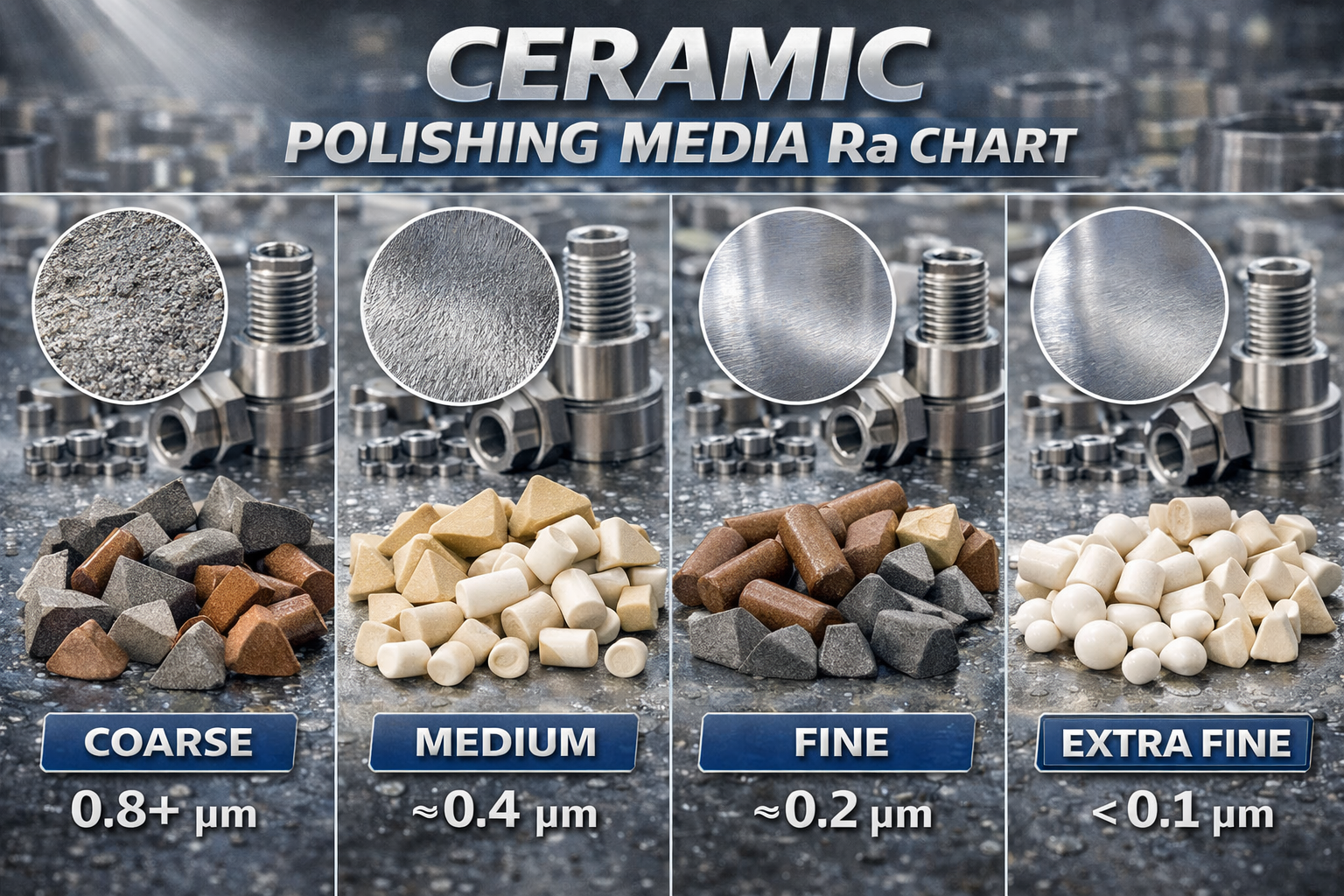
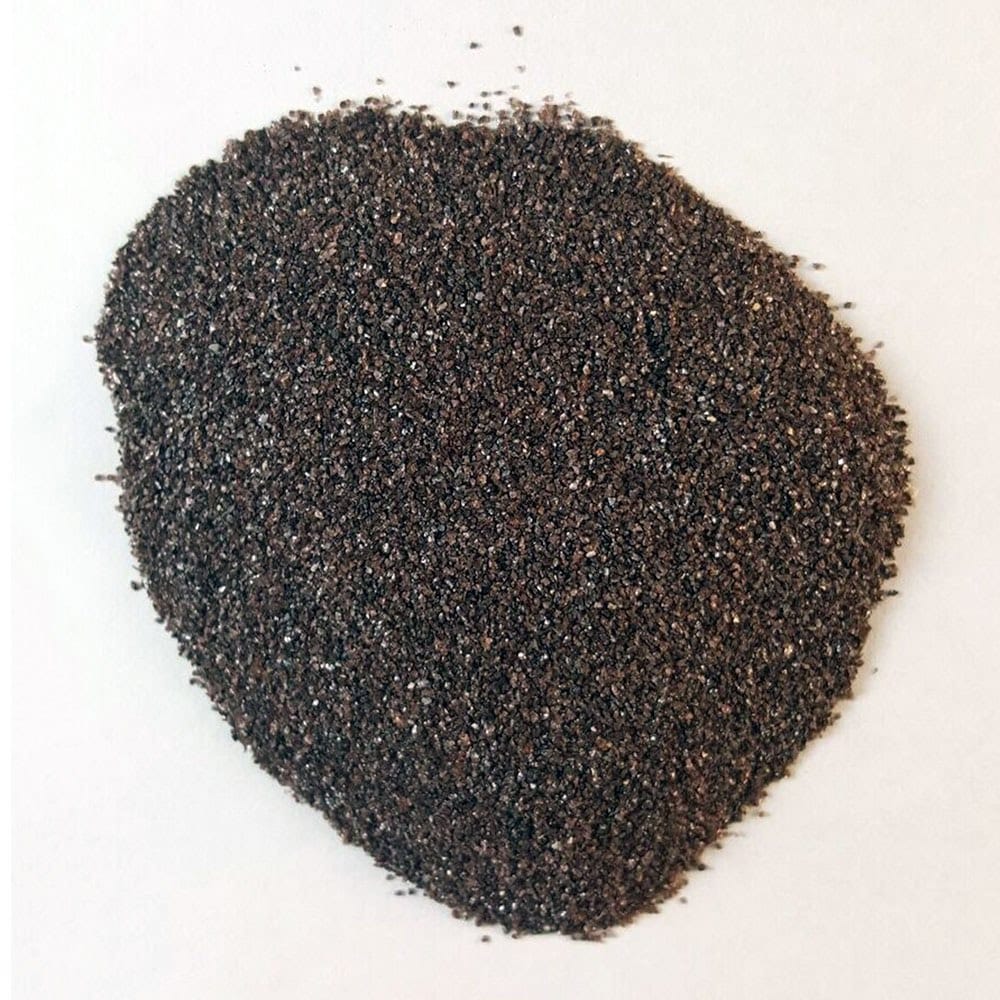
The ceramic matrix in finishing media typically consists of an aluminum oxide abrasive grain bonded in a vitrified (fired) or resin-bonded ceramic body. The abrasive content, grain size, and bond hardness determine the cut rate (how aggressively material is removed) and the final surface finish (Ra value). A coarser grit / harder bond gives a heavy cut; a finer grit / softer bond gives a finer, more reflective finish.
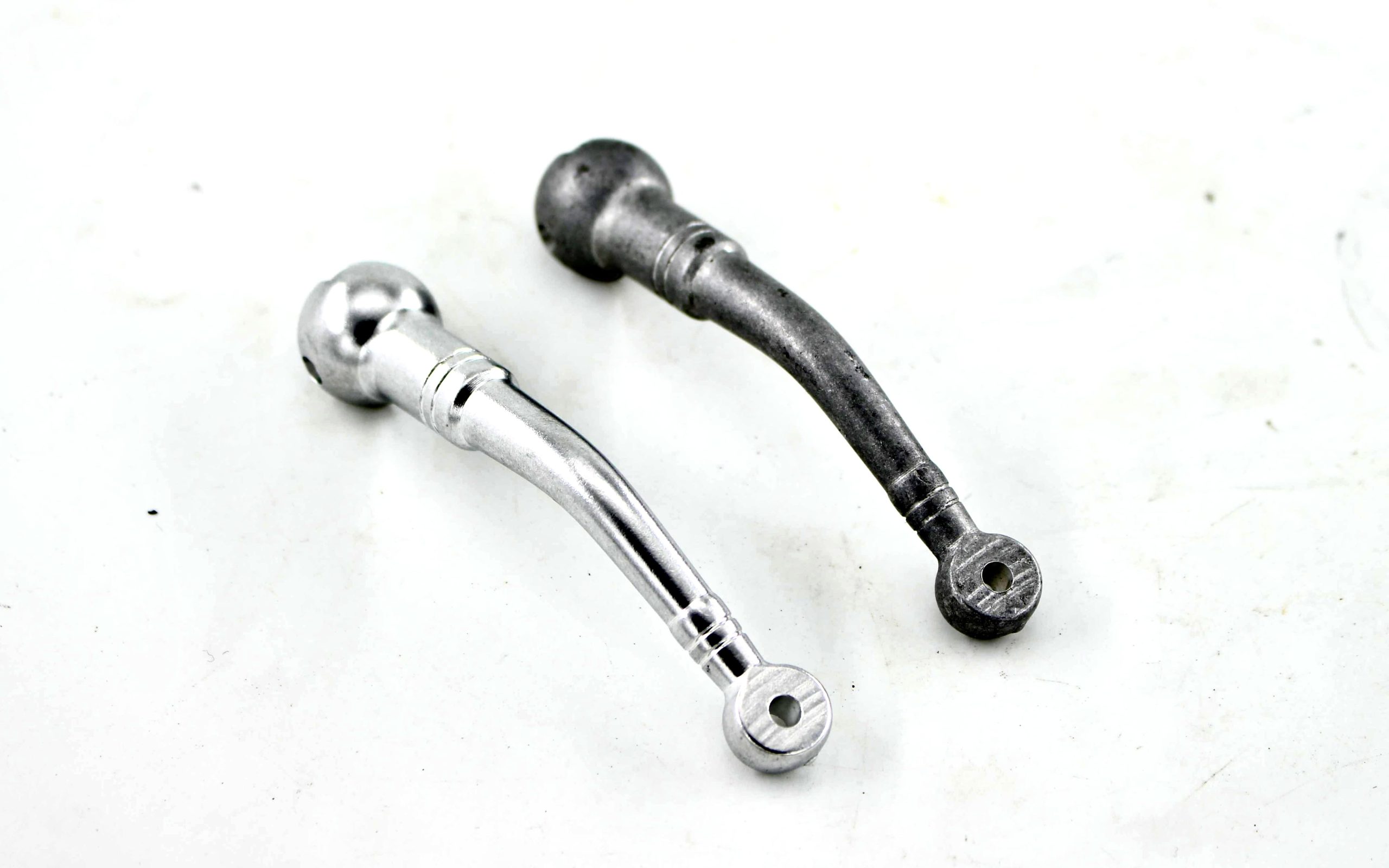
Ceramic finishing media is suitable for processing steel, stainless steel, titanium, aluminum, copper alloys, brass, and even some engineering plastics. It can remove weld seams, scale, casting flash, machined burrs, and tool marks, while simultaneously imparting a uniform surface texture measured in microinches or micrometers Ra.
📄 Deep Dive: Ceramic Tumbling Media — Shapes, Cut Rates & Machine Compatibility Vibratory, centrifugal barrel, and rotary tumbler process guides with media load ratios3. Material Types: Alumina, Zirconia, SiC & More
The base ceramic material is the single most important variable in media selection, because it governs hardness, density, wear rate, chemical compatibility, and cost. Here is a clear comparison of the four principal families used in industrial ceramic media:
| Material | Density (g/cm³) | Hardness (Mohs) | Typical Wear Rate | Best For | Cost Index |
|---|---|---|---|---|---|
| Aluminum Oxide (Al₂O₃) 92–95% | 3.60–3.70 | 8.5–9.0 | Medium | General milling, coatings, ceramics powder | Low |
| High-Purity Alumina 99%+ | 3.75–3.85 | 9.0 | Low–Medium | Pharma, food, electronics, low-contamination | Medium |
| Zirconia (ZrO₂, Y-TZP) | 5.80–6.10 | 8.5 | Very Low | High-energy milling, nanomaterial, battery | High |
| Silicon Carbide (SiC) | 3.10–3.20 | 9.5 | Very Low (self) | Hard-material cutting, non-ferrous metals | High |
| Vitrified Bonded (Finishing) | 1.80–2.20 | 7.0–8.0 | Controlled (designed-in) | Deburring, surface finishing, polishing | Low–Med |
Alumina is the workhorse of both grinding and finishing. Its balance of hardness, moderate density, and low cost makes it the default choice for processes where contamination-free results are needed but ultra-high precision is not required. Zirconia wins in high-energy milling applications where its superior density translates directly into grinding efficiency; its extremely low wear rate also means less contamination of the final product, a critical advantage in battery and pharmaceutical manufacturing.
Silicon carbide media occupies a specialized niche: its exceptional hardness (second only to diamond and boron carbide among commercial ceramics) makes it ideal for cutting hard, difficult materials. However, SiC can contaminate products with silicon and carbon, so it is reserved for applications where those elements are acceptable or even beneficial. For a detailed breakdown of how these materials compare in real-world processing scenarios, see our Ceramic Media Materials comparison guide.
4. Shapes & Sizes Explained
For mass finishing media, shape is arguably as important as material. The geometry of the ceramic chip determines which surfaces of the workpiece it can reach, how aggressively it cuts, and whether it will lodge inside holes or internal channels — a costly and time-consuming problem called media lodging.
| Shape | Cut Rate | Best Access | Watch Out For | Typical Size Range |
|---|---|---|---|---|
| Triangle | Heavy–Medium | Flat surfaces, external edges | Can lodge in slots ≤ media size | 5 – 50 mm |
| Cylinder (straight) | Medium | Flat surfaces, bores ≥ 2× media dia. | Lodging in blind holes | 6 – 40 mm |
| Diagonal Cylinder | Medium–Light | Recessed areas, complex geometry | Orientation sensitive | 8 – 30 mm |
| Cone / Tri-Star | Light–Medium | Valleys, grooves, internal radii | Lower cut rate on flat faces | 10 – 40 mm |
| Sphere / Ball | Light | Gentle finishing, polishing | Poor cutting on edges | 5 – 30 mm |
| Angle Cut Cylinder | Medium | Mixed geometry, general purpose | May not reach tight recesses | 8 – 25 mm |
The lodging rule of thumb: Select a media size where the smallest dimension of the chip is larger than the largest hole, slot, or recess in the workpiece. For complex parts with multiple feature sizes, use a mix of two media sizes — a primary cutting size and a secondary finer size that can reach recesses the larger media cannot.
Size selection also directly impacts cycle time. Smaller media provides more contact points per unit volume, enabling finer finishes but extending cycle time. Larger media removes stock faster but may not reach fine detail. In high-volume production environments, the right shape-size combination can reduce cycle time by 30–50% compared to a poorly matched specification. For a comprehensive shape-by-shape reference with part geometry decision trees, see our Ceramic Media Shapes Guide.
5. Ceramic Media for Deburring & Edge Finishing
Deburring is the most widespread application for ceramic tumbling media. After machining, stamping, laser cutting, casting, or forging, metal parts carry burrs — sharp projections of material that protrude beyond the intended geometry. These burrs cause assembly problems, accelerate mating-part wear, create stress concentration points, and in some cases, cause injury during handling.
Ceramic media removes burrs through a fundamentally different mechanism than manual or robotic deburring: rather than applying cutting force directionally, mass finishing applies omnidirectional abrasive action across every exposed surface simultaneously. A single load of 500 complex machined parts can be fully deburred in 20–90 minutes, with no operator involvement beyond loading and unloading the machine.
Matching Media Aggressiveness to Burr Type
The key variable is the cut rate — how much material the media removes per unit time. Cut rate is determined by abrasive grit size, abrasive content (as a percentage of the ceramic bond), and bond hardness. Three categories cover the majority of industrial applications:
- Heavy cut: Coarse grit (36–60), high abrasive content. For heavy casting flash, forging scale, and weld bead blending. Typically produces a matte surface finish of Ra 1.6–3.2 µm after processing.
- Medium cut: Medium grit (80–120). For general CNC-machined parts — turning, milling, drilling burrs. Achieves Ra 0.8–1.6 µm. The most commonly used category in manufacturing environments.
- Light cut / Burnishing: Fine grit (180–400+) or non-abrasive media. For delicate parts, thin-wall stampings, and pre-plating or pre-coating surface preparation. Achieves Ra <0.8 µm or a bright, burnished appearance.
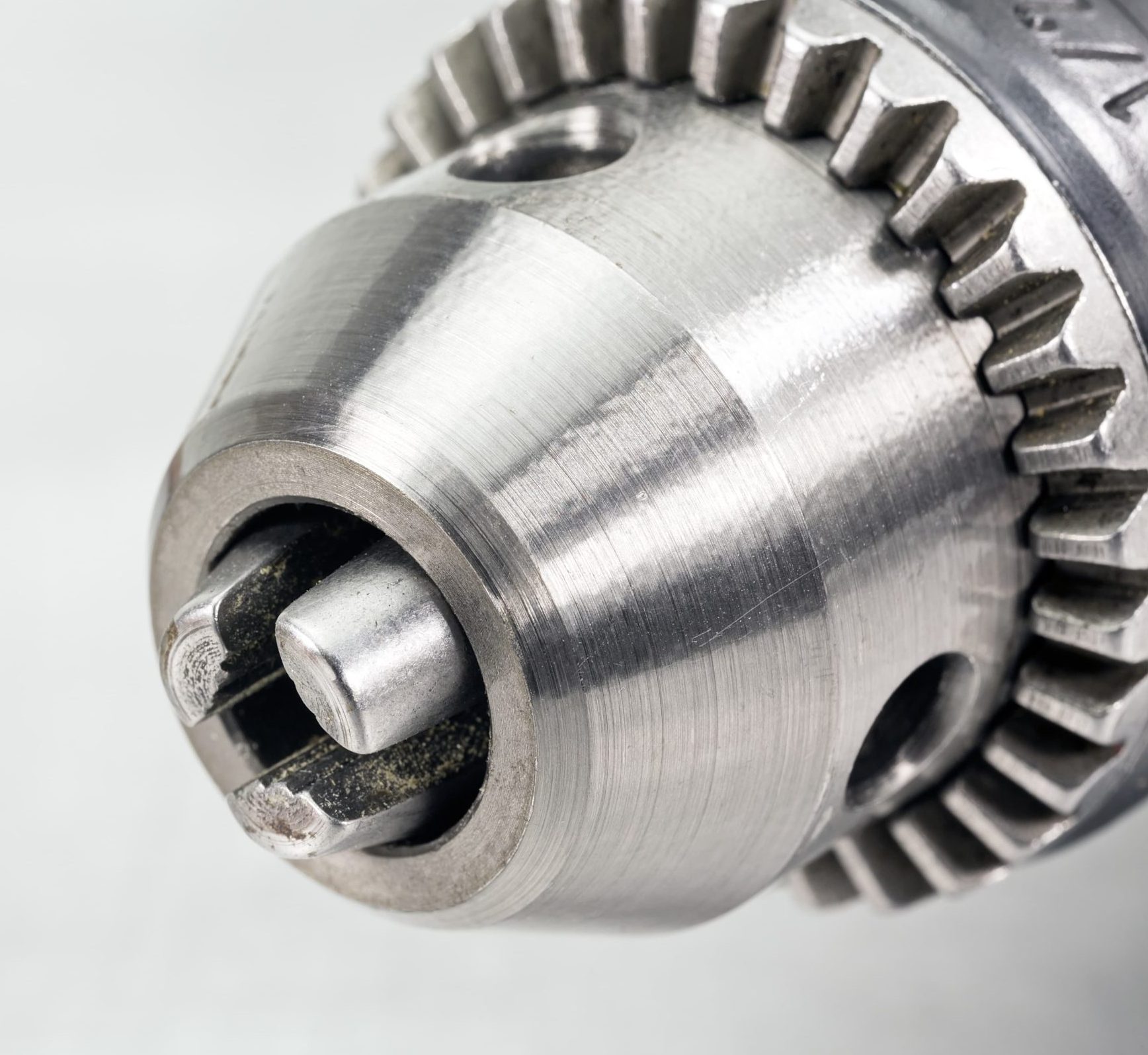
Beyond standard batch deburring, ceramic media is increasingly used in aerospace and medical applications for a specific process called isotropic superfinishing — a combination of chemical accelerators and fine ceramic media that eliminates surface directionality entirely, producing mirror-smooth gear flanks, bearing races, and implant surfaces with Ra values below 0.1 µm.
📄 Full Guide: Ceramic Media for Deburring — Process Parameters, Media Selection & Cycle Time Optimization Including case studies for laser-cut stainless steel, die-cast aluminum, and CNC-machined titanium6. Industry Applications
Ceramic media — across both its grinding and finishing forms — serves a remarkably broad range of industries. The common thread: a need for consistent, high-quality, contamination-controlled material processing at production scale.
| Industry | Application | Media Type Used | Key Requirement |
|---|---|---|---|
| Automotive | Deburring transmission gears, connecting rods, valve bodies | Ceramic tumbling media | High throughput, tight dimensional tolerance |
| Aerospace | Edge finishing turbine blades, landing gear components, fasteners | Ceramic finishing + isotropic | AS9100 traceability, no surface damage |
| Medical Devices | Implant polishing, instrument finishing, burr-free internal channels | Non-contaminating alumina/zirconia | Biocompatibility, zero metallic contamination |
| Coatings & Inks | Pigment grinding, dispersion of colorants, varnish production | Ceramic grinding beads (Al₂O₃ / ZrO₂) | Narrow particle size distribution, low iron |
| Battery / Energy | Cathode material milling (LFP, NMC), electrode paste dispersion | Zirconia grinding beads | Ultra-low wear, no heavy metal contamination |
| Pharmaceuticals | API micronization, excipient milling | 99%+ alumina or zirconia beads | FDA/GMP compliance, validated cleaning |
| Electronics | Ferrite grinding, ceramic substrate polishing | High-purity alumina beads | No ionic contamination, <1 ppm metal |
| Metal Hardware | Fastener finishing, stampings, castings | Ceramic vibratory media | Cost efficiency, volume throughput |
Across these industries, Jiangsu Henglihong Technology Co., Ltd. supplies customers worldwide, providing both standard catalog media and custom-formulated products engineered to specific process parameters. Our global supply capability ensures consistent batch-to-batch quality for high-volume manufacturing environments, backed by full material certifications and traceable production records.
7. How to Choose the Right Ceramic Media
Media selection is a systematic process, not a guess. The following five-step framework covers the vast majority of industrial applications. Working through each step sequentially eliminates the most common sources of incorrect media selection — and the wasted time, scrap, and reprocessing costs that come with it.
-
1Define the Process Type
Are you reducing particle size inside a mill (grinding), or finishing the surface of a manufactured part (mass finishing)? This determines whether you need grinding media or tumbling/finishing media. They are fundamentally different products despite sharing the “ceramic media” label.
-
2Select the Base Material
For grinding: match density to your mill’s energy input (high-energy mill → zirconia; standard ball mill → alumina). For finishing: consider the workpiece material hardness and any contamination sensitivity. Soft metals like aluminum and copper typically require non-ferrous-safe ceramic formulations to prevent discoloration or galvanic reactions.
-
3Determine the Required Cut Rate
For finishing media: assess the burr height, the amount of material to be removed, and the target surface finish (Ra value). Heavy burrs on hard steel require aggressive, coarse-grit media. Pre-plate finishing on thin brass stampings requires the lightest possible cut. Match the grit size and abrasive content accordingly.
-
4Choose Shape and Size
For finishing: map the workpiece geometry. Identify the smallest hole, slot, or recess the media must not enter. Select a media minimum dimension larger than that critical feature. For complex parts, use a two-stage process: aggressive larger media for bulk removal, followed by smaller media for detail finishing. See our shape selection guide for decision trees.
-
5Validate with a Trial Run
Even the most carefully chosen media should be validated in a small-batch trial before full production deployment. Monitor: cycle time to achieve target finish, media wear rate, part-to-media ratio (typically 1:3 to 1:6 by volume for vibratory), and compound usage (pH, concentration). Adjust one variable at a time to dial in results systematically.
8. Ceramic Media vs. Plastic Media vs. Steel Media
Ceramic media is the dominant choice in industrial mass finishing, but it is not the only option. Plastic media and steel media each occupy legitimate niches. Understanding when ceramic is the right call — and when it is not — saves both money and process time.
| Property | Ceramic Media | Plastic Media | Steel Media |
|---|---|---|---|
| Density (approx.) | 1.8 – 2.2 g/cm³ | 1.2 – 1.5 g/cm³ | 7.8 – 8.0 g/cm³ |
| Cut Rate | Medium–Heavy (adjustable) | Light–Very Light | None (burnishing only) |
| Workpiece Materials | Steel, stainless, Ti, Al, Cu, brass | Soft metals, plastics, zinc die-cast | Steel and iron (burnishing) |
| Surface Finish | Ra 0.05 – 3.2 µm | Ra 0.4 – 1.6 µm | Bright burnish, no Ra reduction |
| Contamination Risk | Low (ceramic inert) | Very Low | Iron / rust if uncoated |
| Media Wear Rate | Low–Medium | High | Very Low |
| Cost per kg | Medium | Low–Medium | Medium–High |
| Ideal When… | Burr removal + finish in one step | Delicate parts, color parts, non-metals | Bright finish on ferrous parts only |
In practice, approximately 70–75% of all industrial mass finishing applications use ceramic media because it delivers the best combination of cut rate versatility, surface finish range, and process economy. Plastic media is preferred where part weight sensitivity is critical (very thin stampings or hollow formed parts that could be damaged by the weight of ceramic chips) or where soft metals like zinc die-cast would be scratched by ceramic abrasive. Steel media is not abrasive at all — it works by cold-working and burnishing the surface to create a compressive layer and bright finish, which is valuable for spring components and bearing races but does nothing to remove burrs.
For an in-depth cost-per-part analysis and a side-by-side processing trial comparison, visit our complete resource: Ceramic Media vs. Plastic vs. Steel — Full Comparison Guide.
9. Frequently Asked Questions
Ceramic grinding media are dense beads or balls used inside mills to reduce the particle size of solid materials through impact and attrition. Ceramic finishing media are shaped chips (triangles, cylinders, cones, etc.) used in mass finishing machines to improve the surface quality of manufactured parts through controlled abrasion. They serve completely different processes — the first processes the material itself; the second processes the surface of a finished part.
Yttria-stabilized zirconia (Y-TZP) offers the lowest contamination risk in pharmaceutical milling. Its extremely low wear rate (typically 1–3 mg/kg of material processed) and chemical inertness ensure that contamination levels remain far below any pharmacopoeial limit. High-purity alumina (99%+ Al₂O₃) is an acceptable alternative at lower cost, though its slightly higher wear rate requires validation against product specifications.
Lifespan depends heavily on process conditions: abrasive type, compound pH, workpiece hardness, and machine energy. In well-managed vibratory finishing operations, ceramic media typically lasts 800–2,000 hours of processing time before it wears to the point where it must be replaced. The key indicator is not time but media size — once chips wear below the minimum functional size (usually 50–60% of original size), they lose effectiveness and lodging risk increases. Regularly screening the media load removes fines and extends the usable life of the remaining media.
Yes — ceramic media is widely used on aluminum, but formulation matters. Standard ceramic media with iron-containing binders can cause galvanic darkening on aluminum surfaces. For aluminum, specify ceramic media formulated with non-ferrous-safe binders (alumina or silica-based bond systems, not iron oxide). Additionally, use a pH-neutral or mildly alkaline compound to prevent chemical attack on the aluminum surface during wet processing.
The standard media-to-parts volume ratio for vibratory finishing is 3:1 to 6:1 (media:parts). A 3:1 ratio is appropriate for robust, heavy parts that can withstand part-on-part contact. Delicate parts with thin walls or critical surfaces require a 5:1 or 6:1 ratio to create sufficient media cushioning and prevent workpiece-to-workpiece impacts. Total bowl fill (media + parts) should be 80–90% of bowl volume to ensure adequate flow and circulation.
Yes. Jiangsu Henglihong Technology Co., Ltd. offers custom formulation services for both grinding media and finishing media. Custom parameters include base material composition, abrasive content and grit size, bond hardness, shape and dimensional tolerances, and surface chemistry for specialized applications. Custom orders are supported by in-house laboratory testing and full material certification documentation.
Ready to Find the Right Ceramic Media for Your Process?
Our engineering team at Jiangsu Henglihong Technology Co., Ltd. can recommend the optimal media grade, shape, and size based on your specific application — at no cost.
Request a Free Consultation →Filters