Aluminum Oxide vs Steel Grit Sandblasting
The most common abrasive selection decision in industrial surface preparation. Side-by-side analysis of aluminum oxide and steel grit across profile depth, equipment requirements, recyclability, cost, and substrate compatibility — so you choose right the first time.
Overview: Two Different Tools for Different Operations
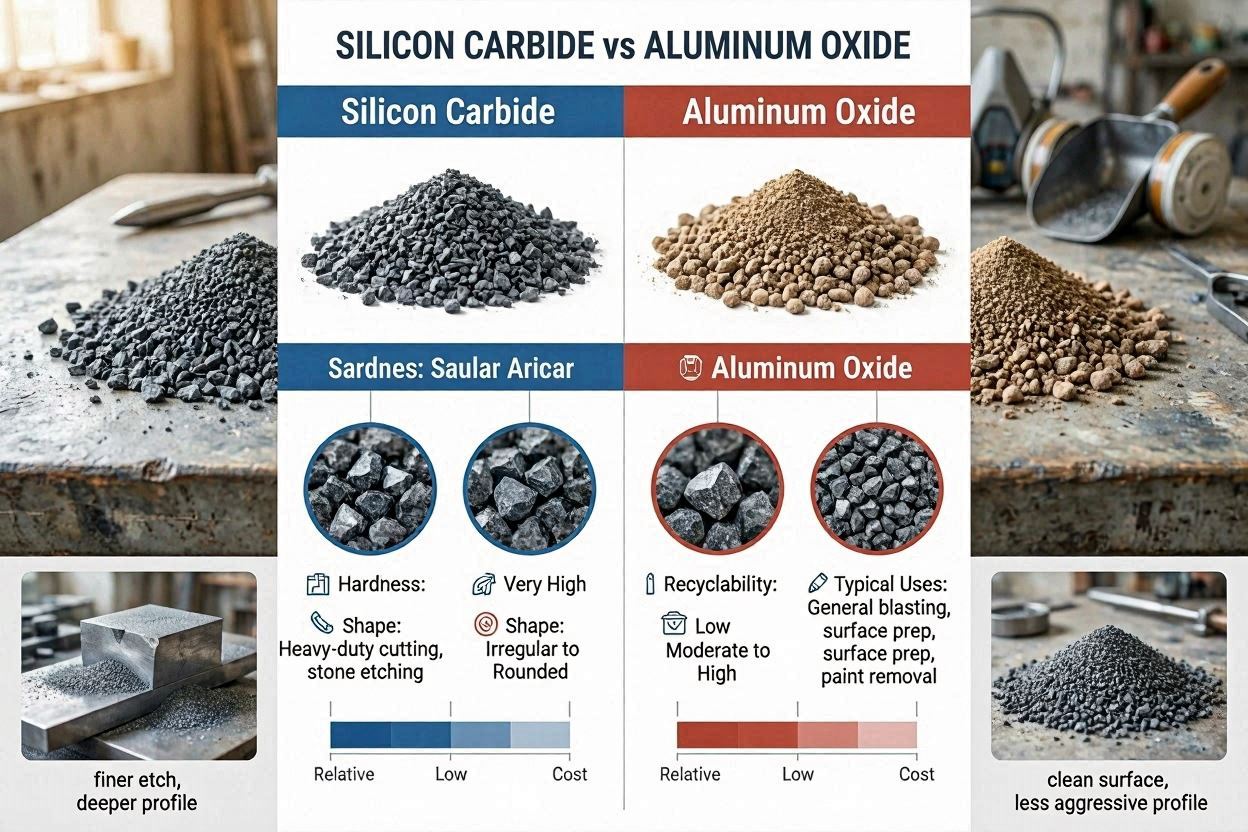
Aluminum oxide and steel grit are both angular, high-hardness abrasives that produce deep surface profiles on carbon steel — which is why they are frequently compared. But they are fundamentally different products designed for different operating environments. Choosing between them is not primarily a question of which produces better results; it is a question of which fits your equipment, your volume, and your substrate.
Aluminum oxide is a mineral abrasive that works in virtually any blasting system — portable pressure pots, blast cabinets, blast rooms — and accepts any substrate from carbon steel to aluminium to glass. Steel grit is a metallic abrasive optimised for centrifugal wheel blast machines in high-volume fixed-facility operations on ferrous substrates. Understanding this fundamental difference resolves most of the apparent comparison complexity.
Full Comparison Table
| Factor | Aluminum Oxide | Steel Grit |
|---|---|---|
| Hardness | Mohs 9 | HRC 40–66 |
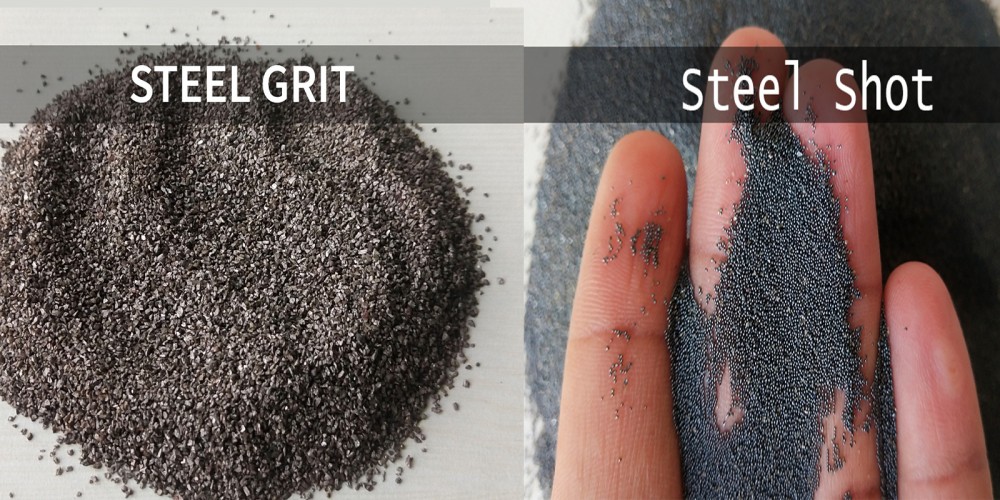
| Shape | Angular, blocky | Angular, sharp-edged |
| Profile Depth | 1.5–4.0 mil | 2.0–5.0 mil |
| Recyclability | 20–30 cycles | 100–200+ cycles |
| Equipment | Any air-blast system | Centrifugal wheel blast (primarily) |
| Substrate Range | Steel, Al, glass, ceramics | Ferrous metals only |
| Free Silica | <1% | None |
| Iron Contamination | None (WFA) / Trace (BFA) | Yes — ferrous only substrate required |
| Purchase Price/lb | $0.30–0.45 | $0.40–0.65 |
| Cost/cycle (effective) | $0.014–0.020/lb | $0.003–0.007/lb |
| Min. Cleanliness | Sa 3 achievable | Sa 3 achievable |
| Best Application | Flexible, multi-substrate | High-volume structural steel |
Surface Profile & Cleanliness Comparison
Both aluminum oxide and steel grit can achieve Sa 2.5 and Sa 3 cleanliness to ISO 8501-1 on carbon steel. The primary difference lies in profile depth capability: steel grit in coarser sizes (G10–G18) produces profiles of 3.5–5.0 mil, exceeding what aluminum oxide can reliably achieve. For standard protective coating systems requiring 1.5–3.0 mil profiles — the majority of industrial coating applications — both media perform equally well, and the profile depth advantage of steel grit is irrelevant.
Where the profile difference matters is in very high-build coating systems: glass flake epoxy (typically 500–1,000 µm DFT), thermal spray zinc, and organic zinc-rich primers for offshore structures all specify minimum anchor profiles of 3.0–4.5 mil. These applications genuinely benefit from steel grit’s deeper profile capability, particularly in sizes G14–G18.
Practical note: Profile depth measurements should always be verified with replica tape (Testex Press-O-Film) on actual blasted panels during process qualification — nominal profile values from media data sheets assume specific blast pressures, nozzle distances, and media working mixes that may not match your operating conditions.
Equipment Requirements
Aluminum oxide is completely agnostic about delivery system. It works in portable pressure pots for field work, blast cabinets for precision component work, and blast rooms for mid-volume structural fabrication. The only equipment considerations are: (1) nozzle material — tungsten carbide nozzles are strongly preferred over ceramic at pressures above 80 psi due to the abrasive’s hardness; and (2) separator efficiency — a good cyclone or air-wash classifier is essential to remove fines and maintain working mix grit distribution for consistent profile results.
Steel grit, by contrast, is economically viable only in centrifugal wheel blast machines. The reason is simple: at $0.50+/lb purchase price, using steel grit in an air-blast pot where recovery is impractical or impossible eliminates its entire cost advantage. Purpose-built wheel-blast machines include integrated magnetic separation, air-wash classifiers, and media elevators that maintain the working mix and extract fines automatically — precisely the infrastructure that makes steel grit’s 100+ cycle recyclability achievable in practice.
Cost-Per-Cycle Analysis
This is where the comparison decisively favours steel grit for high-volume fixed operations — and equally decisively favours aluminum oxide for everything else.
| Factor | Aluminum Oxide (Air Blast) | Steel Grit (Wheel Blast) |
|---|---|---|
| Purchase price/lb | $0.38 (BFA 36#) | $0.52 (GH G25) |
| Avg. usable cycles | 22 | 150 |
| Effective cost/lb/cycle | $0.017 | $0.0035 |
| Consumption lb/100 ft² | ~40 lb (cabinet, recycled) | ~8 lb (wheel, recycled) |
| Media cost/100 ft² | ~$0.68 | ~$0.028 |
| Equipment investment | Low–Medium | High (wheel blast line) |
| Break-even volume | Any volume | High volume only |
The break-even analysis is clear: steel grit’s media cost advantage (approximately 24× lower per 100 ft²) pays back the higher equipment investment only at high production volumes. For small fabricators, maintenance contractors, and field blasting operations, aluminum oxide in an air-blast system is the rational choice. For structural steel fabricators producing hundreds of tonnes of blasted steel per week, a wheel-blast line with steel grit is the only economically viable option. For the full multi-media cost comparison, see Recyclable Sandblasting Media Comparison.
Substrate Compatibility
Carbon Steel
Both media perform well. Steel grit preferred in high-volume fabrication; aluminum oxide preferred for field work, smaller volumes, and where wheel-blast equipment is unavailable.
Stainless Steel
White aluminum oxide (WFA) is the correct choice — iron-free, no contamination risk. Steel grit embeds ferrous particles in the stainless surface, causing rust spots and passivation failure.
Aluminium & Non-Ferrous
WFA aluminum oxide or glass beads only. Steel grit is completely unsuitable — galvanic contamination and surface damage are certain outcomes.
Glass & Ceramics
Aluminum oxide or silicon carbide only. Steel grit cannot be used on non-metallic substrates.
Which Should You Choose?
Choose aluminum oxide if: you use portable or cabinet blast equipment; you blast non-ferrous substrates (aluminium, stainless, glass); you have variable volume requiring flexible media; you need to profile glass or ceramics; or you cannot justify the capital cost of a wheel-blast installation.
Choose steel grit if: you operate a fixed wheel-blast facility; you blast exclusively ferrous substrates at high volume; you have maintenance infrastructure for a magnetic separator and classifier system; and your production volume justifies the equipment investment.
In many operations, both media are used simultaneously — aluminum oxide in portable pots for field maintenance and complex geometries, steel grit in the wheel-blast line for high-volume flat plate and structural section pre-treatment. This is not a contradiction; it is rational equipment matching.
For in-depth technical guides on each media, see Aluminum Oxide guide and Steel Grit guide.
FAQ
Technically yes, but it is not economically justifiable. Steel grit’s cost advantage depends entirely on high-cycle recyclability in a closed wheel-blast system. In a pressure pot without recovery infrastructure, each cycle of steel grit costs nearly as much as the purchase price — eliminating the recyclability advantage entirely. Use aluminum oxide or garnet in pressure pot applications.
For most standard coating systems (1.5–3.0 mil anchor profile requirement), both media produce equivalent coating adhesion results when properly applied to Sa 2.5 cleanliness. Steel grit’s advantage in profile depth (up to 5.0 mil) is relevant only for very high-build coating systems that specify minimum profiles above 3.0 mil — glass flake epoxy, thermal spray zinc, and heavy-duty offshore systems. For the majority of industrial protective coating applications, the adhesion performance of aluminum oxide and steel grit is comparable.
Need Help Choosing Between Aluminum Oxide and Steel Grit?
Jiangsu Henglihong Technology Co., Ltd. supplies both media types globally. Contact our technical export team for a free media selection consultation and formal quotation.
Filters