Jiangsu Henglihong Technology Co., Ltd.
Sandblasting Media Safety: Silica Health Risks, OSHA Rules & Safe Alternatives
A complete occupational health and regulatory reference for abrasive blasting operations — covering silicosis risk, OSHA permissible exposure limits, EU REACH restrictions, PPE requirements, engineering controls, and the safe media alternatives that eliminate the crystalline silica hazard entirely.
The Silicosis Hazard: What It Is and Why It Matters
Silicosis is an irreversible, progressive, and potentially fatal fibrotic lung disease caused by inhaling fine particles of crystalline silica dust over time. In abrasive blasting, the hazard is acute: when silica-containing abrasives (natural sand, certain slag abrasives) shatter on impact with the blasted surface, they generate enormous quantities of ultra-fine respirable dust — particles smaller than 10 microns that penetrate deep into the alveolar region of the lung where they trigger a chronic inflammatory response and progressive scarring (fibrosis).
Silicosis is incurable. There is no medical treatment that reverses the lung damage once it has occurred. The only effective intervention is prevention — eliminating or controlling the source of exposure before it occurs. Regulatory agencies worldwide have moved strongly in this direction, with increasingly strict exposure limits and in many jurisdictions an effective prohibition on silica sand for enclosed-space blasting.
This page is part of Henglihong’s complete blasting media resource hub. For the full media type overview, see our complete guide to sandblasting material types and selection.
Silicosis is not a historical or theoretical risk. Cases of acute silicosis — a rapidly progressing, fatal form that can develop within weeks to months of very high silica exposure — continue to be documented among abrasive blast operators in industries where silica sand is still in use. OSHA estimates that 2.3 million workers in the United States alone are exposed to crystalline silica at work, and that approximately 100 U.S. workers die from silicosis each year. The risk is entirely preventable by switching to safe alternative abrasives and implementing proper engineering controls.
What Is Respirable Crystalline Silica (RCS)?
Crystalline silica is silicon dioxide (SiO₂) in a crystalline (ordered atomic structure) form. The most common form encountered in abrasive blasting is quartz — the primary mineral component of natural silica sand. When quartz-containing materials are blasted at high velocity, they shatter into particles across a wide size range. Particles larger than approximately 10 microns are filtered by the nose and upper respiratory tract and do not reach the lung. Particles smaller than 10 microns — and especially those smaller than 4 microns — are “respirable” and penetrate into the alveoli, where they cannot be removed by mucociliary clearance.
The critical distinction: amorphous silica (glass, fused silica, some silica-containing slags) does not carry the same hazard as crystalline silica. The crystalline structure of quartz is what triggers the inflammatory response in the lung. This is why glass bead blasting media — which contains amorphous silica (SiO₂) — does not carry the same silicosis risk as silica sand, even though both contain silicon dioxide. The atomic arrangement, not the chemical formula, determines the hazard.
The Three Forms of Silicosis
- Chronic silicosis: Develops after 10+ years of exposure to lower concentrations of RCS. The most common form. Progressive even after exposure ends.
- Accelerated silicosis: Develops within 5–10 years of exposure to higher concentrations. Faster progression than chronic form.
- Acute silicosis: Develops within weeks to 5 years of exposure to very high concentrations (e.g., unprotected sandblasting with silica sand in enclosed spaces). Rapidly fatal. Has been documented in abrasive blast operators.
OSHA Silica Standard: Key Requirements for Abrasive Blasting
The U.S. Occupational Safety and Health Administration’s Respirable Crystalline Silica standard (29 CFR 1910.1053 for general industry; 29 CFR 1926.1153 for construction) took effect in 2018 and significantly strengthened the regulatory requirements for all industries with crystalline silica exposure, including abrasive blasting.
Key Requirements
- Permissible Exposure Limit (PEL): 50 µg/m³ as an 8-hour time-weighted average (TWA). This replaced the previous PEL of 250 µg/m³ — a fivefold reduction.
- Action Level (AL): 25 µg/m³ as an 8-hour TWA. When exposures at or above the Action Level are anticipated, employers must implement an exposure monitoring program and medical surveillance.
- Written Exposure Control Plan: Employers must develop, implement, and maintain a written exposure control plan identifying tasks that involve silica exposure and specifying the engineering controls, work practices, and PPE to be used.
- Medical Surveillance: Employees exposed at or above the Action Level for 30 or more days per year must be offered medical examinations including chest X-ray and pulmonary function testing at defined intervals.
- Hazard Communication: Employers must communicate silica hazards to employees through training, warning labels, and Safety Data Sheets (SDS).
- Recordkeeping: Exposure monitoring records must be maintained for 30 years; medical surveillance records for the duration of employment plus 30 years.
OSHA identifies abrasive blasting as one of the highest-risk activities for crystalline silica exposure. The agency’s Table 1 (29 CFR 1926.1153) does not include abrasive blasting as a task where specified controls are presumed sufficient to meet the PEL — because exposures from silica sand blasting in enclosed spaces can exceed the PEL by factors of 10 to 100 even with nominal dust controls. The only reliably compliant approach is to eliminate silica sand as the blasting abrasive and substitute a safe alternative.
Global Regulatory Overview
| Jurisdiction | RCS PEL / OEL | Silica Sand Status | Key Regulation |
|---|---|---|---|
| United States (OSHA) | 50 µg/m³ (8-hr TWA) | Severely restricted — PEL very difficult to meet in blasting | 29 CFR 1910.1053 / 1926.1153 |
| European Union | 0.1 mg/m³ (8-hr TWA) | Dry blasting in enclosed spaces effectively prohibited under REACH; Social Partner Agreement bans it | REACH Regulation (EC) 1907/2006; EU OEL Directive 2017/164/EU |
| United Kingdom (HSE) | 0.1 mg/m³ (8-hr TWA) | Use prohibited unless no suitable substitute exists; enclosed-space ban enforced | COSHH Regulations 2002; EH40 Workplace Exposure Limits |
| Australia (Safe Work) | 0.05 mg/m³ (8-hr TWA) | Dry abrasive blasting with silica sand prohibited nationally since 2020 | WHS Regulations 2017 (nationally harmonized) |
| Canada | 0.025–0.1 mg/m³ (varies by province) | Strongly restricted; many provinces prohibit silica sand for blasting | Provincial OHS regulations (varies) |
| Japan | 0.03 mg/m³ (8-hr TWA) | Silica sand blasting banned in enclosed environments | Industrial Safety and Health Law (ISHL) |
The global regulatory direction is clear and consistent: jurisdictions worldwide are moving toward increasingly stringent silica exposure limits and, in many cases, effective prohibitions on natural silica sand in abrasive blasting. Operations that continue to use silica sand face growing regulatory risk and liability in addition to the health hazard to workers.
Silica Content by Media Type: Risk Comparison
| Media Type | Free Silica Content | RCS Exposure Risk | Regulatory Status |
|---|---|---|---|
| Natural Silica Sand | 95–99% crystalline SiO₂ | 🔴 Extreme | Banned/severely restricted in most markets |
| Coal Slag | 1–5% free silica | 🟡 Moderate | Restricted in some jurisdictions; heavy metal concerns |
| Copper/Nickel Slag | 1–3% free silica | 🟡 Moderate | Heavy metal content creates additional hazard |
| Garnet (almandine) | <1% free silica | 🟢 Low | Accepted in virtually all jurisdictions |
| Crushed Glass | 0% free crystalline silica (amorphous only) | 🟢 Very Low | Accepted — no crystalline silica hazard |
| Aluminum Oxide | 0% | 🟢 Very Low | Accepted — no silica content |
| Silicon Carbide | 0% | 🟢 Very Low | Accepted — no silica content |
| Steel Shot / Grit | 0% | 🟢 Very Low | Accepted — no silica content |
| Glass Beads | 0% crystalline (amorphous SiO₂ only) | 🟢 Very Low | Accepted — no crystalline silica hazard |
| Walnut Shell / Corn Cob | 0% | 🟢 Very Low | Accepted — organic dust hazard only |
Safe Alternatives to Silica Sand: Technical Overview
The following media types eliminate the crystalline silica hazard entirely while delivering equivalent or superior surface preparation performance for all common blasting applications. Each links to a full technical guide.
Aluminum Oxide
The best-performing replacement for silica sand in industrial steel preparation. Harder, faster cleaning, highly recyclable, zero free silica. The default choice for blast cabinet and blast room operations replacing sand.
Garnet
The preferred open-blast alternative for outdoor and confined-space operations. Low dust generation, <1% free silica, eco-compliant. Standard choice for bridge and marine maintenance blasting.
Crushed Glass
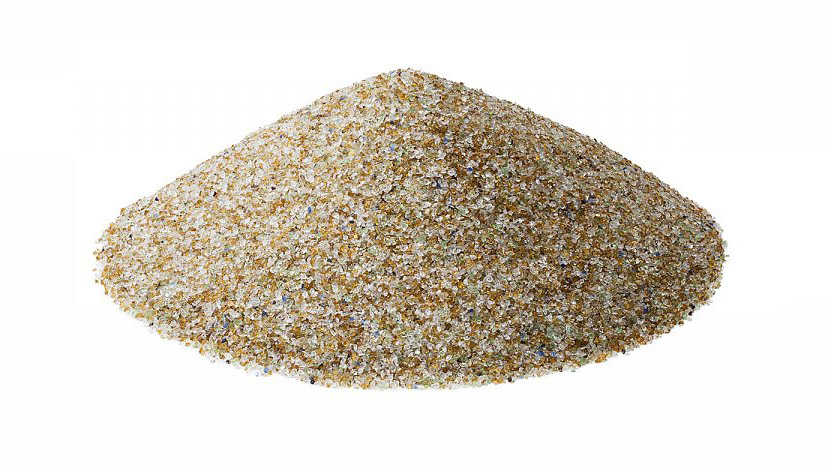
100% post-consumer recycled, zero crystalline silica, zero heavy metals. Cost-effective single-use alternative for light-to-moderate rust removal, concrete profiling, and eco-sensitive job sites.
Steel Shot & Grit
Zero silica, very low dust, lowest cost/m² in closed-loop systems. The natural replacement for sand in blast rooms and automated blast equipment with reclaim systems.
Glass Beads
Amorphous silica — no crystalline silica hazard. Preferred for peening, polishing, and smooth-finish applications on stainless steel and precision components.
Silicon Carbide
Zero silica. For applications requiring maximum hardness — ceramics, carbide tooling, glass — where no other alternative achieves the required performance.
Engineering Controls for Abrasive Blasting Operations
Engineering controls — physical measures that reduce or eliminate exposure at the source — are the most effective means of protecting blast operators. OSHA’s hierarchy of controls mandates that engineering controls be implemented before relying on administrative controls or PPE.
Enclosed Blast Cabinets and Blast Rooms
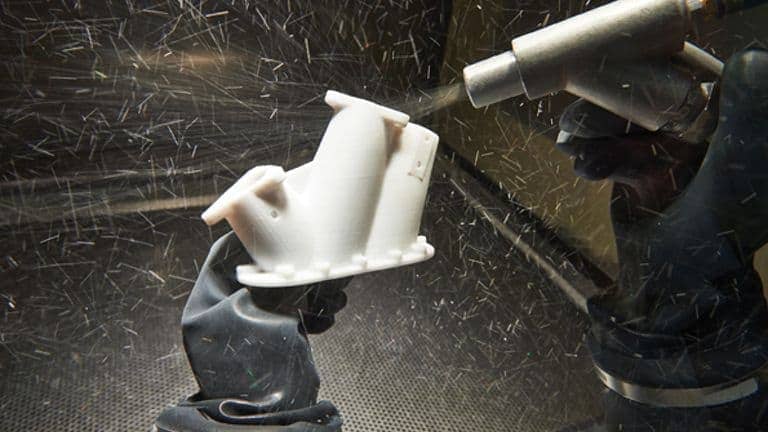
Fully enclosed blast cabinets contain the dust generated during blasting within a sealed compartment, equipped with a dust collector (cartridge filter or baghouse) that continuously removes fine particles from the cabinet air. Operators work through gloved porthole openings without entering the dust-laden atmosphere. This is the most effective engineering control for small to medium parts. Blast rooms are enclosed walk-in chambers where operators wear supplied-air respirators and full blast suits — the room is ventilated with continuous fresh air supply and exhaust through the dust collection system.
Local Exhaust Ventilation (LEV)
For open-surface blasting where full enclosure is impractical, LEV systems capture dust close to the blast nozzle before it disperses into the general work environment. Effectiveness depends on capture velocity — the LEV system must generate adequate airflow velocity at the blasting point to entrain dust particles before they escape. LEV must be designed by a qualified industrial hygienist and tested regularly to verify capture efficiency.
Wet Blasting / Vapor Blasting
Adding water to the blast stream suppresses dust generation dramatically — by 85–95% compared to dry blasting — by wetting the dust particles before they become airborne. Wet blasting is a highly effective engineering control for RCS exposure. However, it introduces other considerations: the slurry produced requires collection and treatment, the blasted metal surface must be treated with corrosion inhibitor immediately to prevent flash rust, and the process is slower than dry blasting. Vacuum blasting (blast-and-vacuum systems) offers another approach, capturing dust at the nozzle through a surrounding vacuum shroud.
Water Curtains and Misting Systems
Water curtain systems installed around the blasting area suppress fugitive dust in the surrounding atmosphere by wetting airborne particles and causing them to settle. These are supplementary controls — they do not eliminate RCS generation at the source but reduce the ambient concentration in the surrounding work area.
PPE Requirements for Blasting Operators
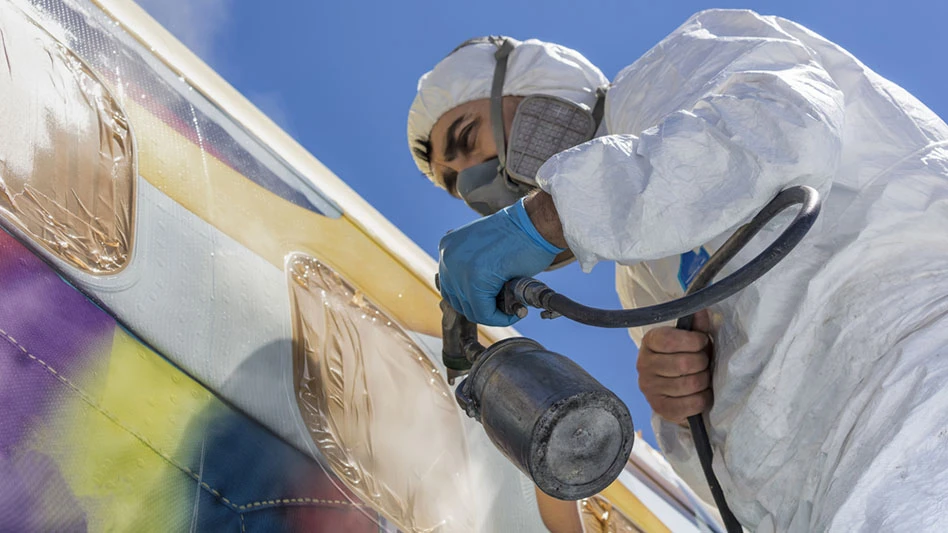
Supplied-air respirator (SAR / airline respirator) is the minimum for enclosed blasting. For outdoor low-dust operations with safe alternative abrasives: half-face elastomeric respirator with P100 (HEPA) filters, subject to site exposure assessment. Filtering facepiece (N95) is NOT sufficient for abrasive blasting.
Hard-shell blast helmet with fresh-air supply protects the face, head, and neck from abrasive rebound and airborne particles. Required for all operator-entry blast room work. Must be rated for abrasive blasting (not general welding or grinding helmets).
Heavy-duty leather or canvas blast suit (or purpose-made abrasive-resistant coverall) covering the entire body. Protects skin from abrasive rebound that can cause lacerations and embeds abrasive particles in skin.
Abrasive blasting generates noise levels typically in the range of 90–110 dB(A). OSHA’s PEL for noise is 90 dB(A) as an 8-hour TWA. Foam earplugs or earmuffs rated to the appropriate Noise Reduction Rating (NRR) must be worn under the blast helmet.
Heavy-duty leather gloves protect hands from abrasive rebound and vibration. Steel-toed safety boots protect feet from falling abrasive containers and rebound. Chemical-resistant gloves may be required when handling media with heavy metal contamination potential.
Under the blast helmet, safety glasses or goggles provide additional eye protection if the helmet is removed or lifted momentarily. Do not substitute safety glasses for a blast helmet — they provide no face protection against abrasive rebound at operating pressures.
All tight-fitting respirators (half-face and full-face) must be fit-tested annually for each operator in accordance with OSHA 29 CFR 1910.134. Operators with facial hair, significant scarring, or other facial features that prevent a proper seal must use loose-fitting alternatives (hoods, helmets with supplied air). Medical surveillance — including baseline pulmonary function tests and periodic chest X-rays — is required by OSHA for workers exposed at or above the silica Action Level for 30+ days per year.
Spent Media Disposal & Environmental Rules
Spent blasting media may be classified as hazardous waste requiring special handling, transport, and disposal — or as non-hazardous waste suitable for general disposal or beneficial reuse — depending on two factors: the composition of the media itself, and the contaminants it has picked up from the blasted surfaces.
TCLP Testing (Toxicity Characteristic Leaching Procedure)
In the United States, spent blasting media must be subjected to TCLP testing (EPA Method 1311) before disposal to determine whether it fails RCRA toxicity thresholds for lead, chromium, cadmium, arsenic, barium, and other regulated metals. If the spent media was used to blast surfaces coated with lead paint, chromate primer, or other regulated metal coatings, it is very likely to fail TCLP and must be disposed of as RCRA hazardous waste — regardless of whether the media itself (garnet, aluminum oxide, etc.) would otherwise be non-hazardous.
Slag-Based Abrasives — Special Concerns
Coal slag, copper slag, and nickel slag abrasives frequently contain elevated levels of heavy metals (arsenic, lead, chromium, selenium) that can cause the spent media to fail TCLP even when used on clean, unpainted surfaces. This is one of the most important reasons to transition away from slag-based abrasives toward garnet, crushed glass, or aluminum oxide — whose spent media from unpainted surface blasting is typically classified as non-hazardous.
Beneficial Reuse of Spent Media
Non-hazardous spent blasting media (confirmed by TCLP) can often be beneficially reused rather than landfilled: as road base aggregate, concrete fill, roofing granules, or in asphalt. Many municipalities and waste management programs accept clean spent blasting media for these purposes, reducing disposal cost to zero or near-zero and keeping the material out of landfill entirely.
Frequently Asked Questions
Aluminum oxide and garnet contain no free crystalline silica — the specific substance that causes silicosis. This eliminates the primary occupational health hazard associated with traditional silica sand blasting. However, “safe” does not mean “zero risk.” Both media generate fine abrasive dust during blasting that is an inhalation hazard causing respiratory irritation and potential long-term lung damage from high cumulative exposure. Appropriate respiratory protection (supplied-air respirator or at minimum P100 filter respirator for outdoor low-exposure operations), dust collection engineering controls, and regular exposure monitoring remain mandatory for all blasting operations regardless of the media type used.
OSHA’s Permissible Exposure Limit (PEL) for respirable crystalline silica is 50 µg/m³ as an 8-hour time-weighted average (TWA), established under 29 CFR 1910.1053 (general industry) and 29 CFR 1926.1153 (construction). The Action Level is 25 µg/m³. Industrial hygiene monitoring studies have consistently found that abrasive blasting with natural silica sand in enclosed spaces generates airborne RCS concentrations in the range of 1,000–10,000 µg/m³ or higher — 20 to 200 times above the OSHA PEL. No amount of engineering controls or PPE reliably reduces silica sand blasting exposures to below the PEL in enclosed environments. Eliminating silica sand as the blasting abrasive is the only reliable compliance strategy.
Even in outdoor settings, silica sand generates dangerously high RCS concentrations in the breathing zone of the operator — open-air dispersion reduces ambient concentrations in the surrounding area, but not in the immediate blast zone where the operator works. OSHA’s silica standard applies equally to outdoor blasting operations. Additionally, many jurisdictions restrict or prohibit the use of silica sand for blasting regardless of the setting, and spent silica sand may be classified as hazardous waste requiring costly disposal. The practical and regulatory conclusion is the same outdoors as indoors: substitute a safe alternative abrasive (garnet, crushed glass, aluminum oxide) and implement appropriate respiratory protection for all operators.
For enclosed blast room or cabinet operations with operator entry: supplied-air respirator (airline respirator) providing Grade D breathing air, full blast helmet with fresh-air supply, heavy-duty blast suit, leather gloves, steel-toed boots, and hearing protection. For outdoor blasting with safe alternative abrasives and documented low RCS exposure: half-face elastomeric respirator with P100 (HEPA) filter cartridges (minimum — subject to site-specific exposure assessment), safety glasses, hearing protection, appropriate body protection. A supplied-air respirator is always the recommended choice for any blasting operation — it eliminates the filter maintenance and fit issues associated with air-purifying respirators. Never use a disposable dust mask (N95 or similar) as the primary respiratory protection for abrasive blasting.
Request a Quote
Ready to replace silica sand with a safer, high-performance alternative? Tell us your application and annual volume — we’ll recommend the right media and provide pricing within 24 hours.
Get a Free Quote →Talk to a Technical Advisor
Need help selecting a silica sand replacement that meets your surface preparation performance requirements and environmental compliance constraints? Our team can help.
Contact Our Team →Filters