Plastic Media vs Glass Bead: Pros and Cons
Plastic blast media and glass bead are both used on aluminum, steel, and other metal substrates without the substrate-destruction risk of mineral abrasives. They appear in the same equipment catalogs, are specified by similar mesh size systems, and both produce surfaces that are ready for coating or further processing. For operators encountering both options for the first time, the question of which to choose — and why — is genuinely non-obvious.
The answer lies in a fundamental mechanical difference between the two media that shapes everything downstream: plastic media cuts and fractures coatings through angular impact, removing material from the substrate surface. Glass bead peens and compresses the surface through spherical impact, producing a compressive stress layer without removing base material. These are not variations of the same process — they are two different surface engineering operations that share the same equipment and the same loose category label of “abrasive blasting.”
Understanding that difference — its causes, its consequences for surface finish, its implications for coating adhesion, fatigue life, and regulatory acceptance — is what this guide delivers. By the end, you will know exactly when plastic media is the right choice, exactly when glass bead is the right choice, and exactly when operators mistakenly substitute one for the other at cost to their results.
For the complete plastic media type guide, see: Plastic Blast Media Types Compared: Urea vs Melamine vs Acrylic.For a broader overview of the full plastic media category, see: What Is Plastic Media? The Complete Guide.
The Fundamental Difference: Cutting vs. Peening
The most important fact about this comparison is that plastic blast media and glass bead are not competing solutions to the same problem — they are solutions to two different problems that are sometimes confused with each other. Getting this straight is the prerequisite for everything else.
- Primary action: Material removal (coating and sometimes a thin layer of substrate)
- Net surface change: Rougher than pre-blast; defined Ra and Rz
- Stress state introduced: Neutral to slight tensile at surface
- Best when: You need to remove something (coating, oxide, contamination)
- Primary action: Surface compressive deformation (peening), not removal
- Net surface change: Smoother or unchanged Ra; compressive stress layer introduced
- Stress state introduced: Compressive — extends fatigue life of the component
- Best when: You need to change surface properties (stress state, appearance, cleanliness) without removing material
Physical Properties Head-to-Head
Performance Comparison Across Key Dimensions
Surface Finish: What Each Media Actually Does to the Substrate
The surface condition produced by plastic media and glass bead are so different that they serve distinct downstream applications. Understanding the difference in quantitative terms — Ra values, surface texture character, and stress state — is essential for specifying the right media for a given application.
The practical implication of these different Ra values: if your application specifies a surface profile of 50–100 µin Ra for mechanical coating adhesion (a common range for epoxy primer over blasted steel), plastic media can hit this target directly with the appropriate mesh selection. Glass bead cannot approach this Ra at standard operating conditions — it will produce 20–40 µin at most, leaving the surface underprofile for thick coating systems. Conversely, if your application specifies a decorative satin finish on bare aluminum hardware at 16–32 µin Ra (common for aerospace and medical device components), glass bead hits this target precisely while plastic media would leave the surface too rough and directionally textured for the appearance specification.
Coating Adhesion: Where Each Media Has the Advantage
The relationship between surface preparation media and coating adhesion is one of the most practically important dimensions of this comparison — and one where operators most often make costly mistakes by using the wrong media for the coating system that follows.
Plastic Media and Mechanical Coating Adhesion
Coatings adhere to metal surfaces through a combination of mechanical interlocking (paint resin flowing into surface profile peaks and valleys, then curing around them) and chemical bonding (primer chemistry reacting with the metal oxide surface layer). Plastic media blasting optimizes the mechanical adhesion component by producing the angular surface profile — defined peaks and valleys — that maximizes mechanical interlocking contact area. The Ra produced by plastic media (32–250 µin) is well-matched to the profile requirements of epoxy primers, polyurethane topcoats, powder coatings, and other structural coating systems that specify a “blast-cleaned” surface with defined minimum anchor profile.
Glass Bead and Coating Adhesion
Glass bead’s smooth, dimpled surface profile produces lower mechanical adhesion than plastic media for coatings that rely on anchor profile. This is not a limitation in applications where glass bead is correctly specified — decorative satin finishes on bare hardware, fatigue-treated components that will not be coated, or components where a thin clear lacquer or conversion coating (chromate, anodize) will be applied over the beaded surface. It becomes a problem when glass bead is used as a substitute for plastic media in coating preparation applications. A glass-beaded surface with 20 µin Ra under an epoxy primer specified for 50–100 µin anchor profile will show premature adhesion failure — not because the primer is bad or the application was wrong, but because the surface was not prepared to the mechanical specification the primer requires.
Fatigue Life: The Glass Bead Advantage
Shot peening with glass bead — properly controlled with Almen strip intensity verification — is one of the most widely used and well-documented methods of improving the fatigue life of metal components subjected to cyclic stress. The mechanism is straightforward: the compressive residual stress layer introduced by the spherical impact of glass bead acts to counteract the tensile stress at the surface that drives fatigue crack initiation and propagation. A crack cannot initiate or grow in a region that is under compressive stress because compression closes crack faces rather than opening them.
The magnitude of fatigue life improvement from glass bead peening depends on the base material, component geometry, and peening intensity — but documented improvements range from 20% for modestly stressed steel components to 200% or more for high-strength titanium or aluminum structures with stress concentration features (holes, fillets, transitions). Aerospace landing gear, turbine disks, and spring components are routinely glass-bead peened in production as a defined life-extension step in the manufacturing process.
Plastic media blasting does not provide meaningful shot peening effect. The combination of lower density (1.2–1.5 g/cm³ vs. glass bead’s 2.45–2.55 g/cm³), lower hardness, and angular geometry means plastic media impact produces little of the uniform plastic deformation at the surface that generates compressive stress. If fatigue life improvement is the objective of the blasting operation, glass bead is the correct media. Plastic media cannot substitute for it.
Substrate Compatibility Guide
| Substrate | Plastic Media | Glass Bead | Recommended Choice |
|---|---|---|---|
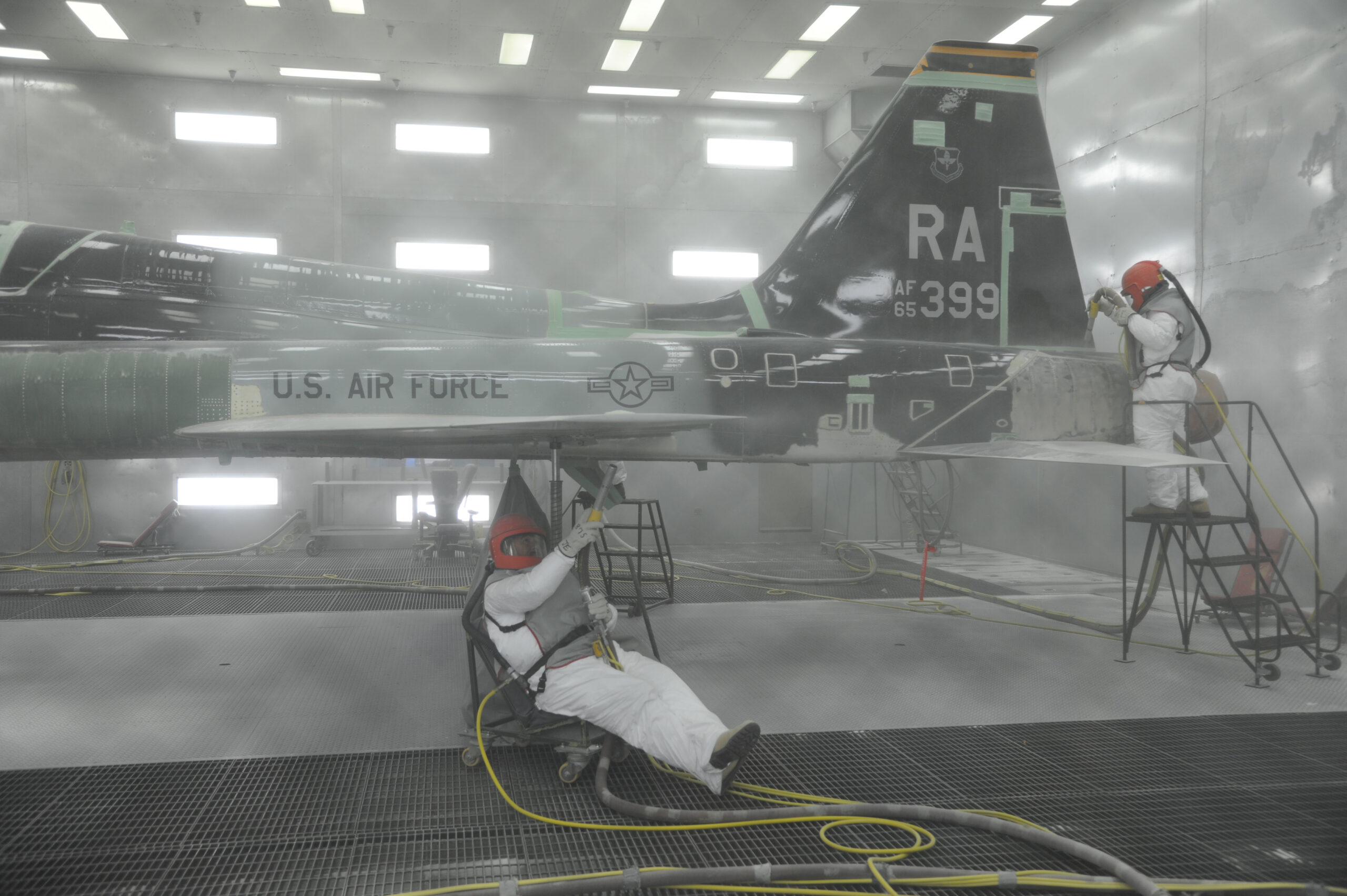
| Aluminum aircraft structure (coating removal) | ✅ Excellent — purpose designed; MIL-P-85891A; zero iron contamination; qualifiable by Almen strip | ⚠️ Will not reliably remove well-adhered coating; may polish loose areas. Mohs 5.5–6.5 harder than aluminum — requires carefully controlled low pressure to avoid surface erosion. | Plastic Media |
| Aluminum aircraft structure (fatigue treatment, no coating removal) | ❌ Inadequate peening action — does not produce meaningful compressive stress layer | ✅ Excellent — standard aerospace process; MIL-G-9954A; Almen intensity documented; compressive stress layer verified | Glass Bead |
| Stainless steel hardware (decorative satin finish) | ⚠️ Achieves matte finish but too rough for premium satin appearance; directional texture visible | ✅ Excellent — produces uniform satin finish; standard for medical device, food equipment, and architectural stainless; no surface directionality | Glass Bead |
| Steel automotive panels (paint stripping) | ✅ Excellent — designed for this application; produces correct anchor profile for primer | ❌ Not suitable for removing well-adhered automotive paint; will not achieve complete strip; incorrect surface profile for primer adhesion | Plastic Media |
| Titanium aerospace components (fatigue treatment) | ❌ Insufficient peening intensity — does not generate required compressive stress in titanium | ✅ Standard treatment for titanium springs, fasteners, structural components; documented improvement in high-cycle fatigue performance | Glass Bead |
| CFRP / composite (coating removal) | ✅ Type V acrylic only — the sole approved media for composite depainting in most aerospace specs | ❌ Glass bead Mohs 5.5–6.5 significantly harder than carbon fiber epoxy matrix — high risk of fiber damage; not approved for composite depainting | Plastic Media (Type V only) |
| Injection mold tool steel (cleaning) | ✅ Type V acrylic preferred — zero residue, controlled Ra, approved for cavity cleaning | ⚠️ Glass bead Mohs 5.5–6.5 harder than P20 (HRC 28–34) — at even moderate pressures can alter Ra of polished cavity surfaces; use only with extreme care at very low pressure and fine mesh | Plastic Media |
| Spring steel / coil springs (fatigue treatment) | ❌ Will not produce fatigue-life improvement | ✅ Standard treatment for high-stress spring components; improves fatigue life 50–150% in well-controlled shot peen processes | Glass Bead |
| Brass / copper hardware (decorative cleaning) | ⚠️ Can remove oxidation but leaves rough texture; may alter color uniformity of brass | ✅ Excellent for brass, copper, and bronze — gentle cleaning action with uniform satin finish; widely used in trophy, musical instrument, and decorative hardware finishing | Glass Bead |
Health and Safety: The Silica Question
One of the most frequently misunderstood aspects of the plastic media vs. glass bead comparison is the health and safety distinction — specifically around silica exposure. The concern arises from glass bead’s glass composition, which is primarily silica (SiO₂). The critical distinction, however, is between crystalline silica and amorphous silica — and it matters enormously for regulatory classification and occupational health risk.
- Zero silica content — thermoset polymer (urea, melamine, or acrylic resin)
- No silicosis risk from the media itself — completely silica-free
- Respirable dust from plastic media fracture is classified as nuisance dust under OSHA standards
- Coating residue in blast stream carries its own hazard profile (chromate, lead) — separate from media hazard
- Respiratory protection still required: P100 half-face for cabinet; supplied-air for blast room
- No special handling requirements for the media material itself beyond standard PPE
- Composed of amorphous (non-crystalline) silica — borosilicate glass is an amorphous solid
- OSHA does NOT classify glass bead dust as a crystalline silica hazard under 29 CFR 1910.1053 — the silicosis hazard rule applies to crystalline (quartz/cristobalite) silica, not amorphous glass
- However: fractured glass bead produces sharp glass shards at respirable particle size — laceration risk at cut points in skin and respiratory epithelium
- NIOSH recommends treating fine glass bead dust as a nuisance dust but notes that some epidemiological studies suggest long-term heavy exposure to amorphous glass fibers warrants caution
- Respiratory protection required: P100 half-face minimum for cabinet; supplied-air for blast room
- Eye protection mandatory — fractured glass bead produces sharp shards at high velocity; standard safety glasses are the minimum; blast hood with polycarbonate face shield for all active blasting
- Fractured glass bead in spent media: higher laceration risk during handling than spent plastic media
Reusability and Media Life
Both plastic media and glass bead are reusable through reclaim systems, but the reclaim dynamics are meaningfully different — primarily because of the different ways they fracture during use.
Plastic media fractures into smaller angular fragments that maintain their useful cutting geometry through multiple cycles. The reclaim air wash separates fine plastic media fracture products cleanly from usable particles because the density and size differential between the two fractions is relatively consistent. Plastic media achieves 4–8 productive cycles in a well-maintained reclaim operation.
Glass bead fractures into sharp glass shards — irregular fragments with very different air resistance than intact spheres. This creates two reclaim challenges. First, fractured glass shards are a laceration hazard during media handling, recycled media screening, and air wash maintenance — operators working with spent glass bead must use cut-resistant gloves in addition to standard blast PPE. Second, glass shards have inconsistent density and drag coefficients compared to intact spheres, making air wash calibration less precise — some intact beads are carried over into waste while some shards pass through to the clean media output. The reclaim efficiency for glass bead is lower than for plastic media, typically 2–4 productive cycles before the shard content and fine fraction make further reclaim impractical.
Additionally, glass bead loses its spherical geometry as it fractures — once a bead cracks, the resulting fragment no longer produces the smooth peening action of an intact sphere. If the application requires controlled peening intensity (Almen strip verification), spent glass bead with high shard content cannot maintain the required Almen intensity at the same operating parameters as fresh bead, requiring pressure adjustment or media replacement to maintain the process specification.
Cost Comparison
| Cost Factor | Plastic Media | Glass Bead | Advantage |
|---|---|---|---|
| Purchase price per pound | $1.20–$1.80 (Type II urea) | $0.50–$1.10 | Glass Bead (lower purchase price) |
| Reuse cycles (reclaim) | 4–8× | 2–4× | Plastic Media (more cycles) |
| Effective cost per cycle | $0.18–$0.45/lb used | $0.15–$0.55/lb used | Roughly comparable at volume |
| Reclaim system complexity | Standard air wash + screen classifier | Standard air wash + screen classifier; cut-resistant gloves for media handling | Slight edge to Plastic Media (simpler handling) |
| Spent media disposal (non-hazardous coating) | Non-hazardous solid waste | Non-hazardous solid waste — sharp glass shard content requires puncture-resistant waste bags | Slight edge to Plastic Media (safer handling) |
| Equipment wear (nozzle, hose) | Low — soft polymer causes minimal equipment wear | Moderate — glass (Mohs 5.5–6.5) wears nozzles faster than plastic media at the same pressure and flow rate | Plastic Media (lower equipment wear) |
| Cost of incorrect application | High if used where glass bead is specified (fatigue not improved; decorative finish too rough) | High if used where plastic media is specified (coating not removed; wrong anchor profile) | Tie — both media types costly when misapplied |
Application-by-Application Decision Guide
Overall Scorecard
Frequently Asked Questions
Can glass bead remove paint from aluminum or steel if I use high enough pressure?
Glass bead can remove loose, poorly adhered, or flaking paint at sufficiently high pressure — the impact energy physically dislodges paint that is already failing. However, it cannot reliably remove well-adhered, intact coating systems from metal substrates at any practical blast pressure. The fundamental constraint is geometric, not energetic: spherical particles distribute impact energy over their entire contact area rather than concentrating it at edges or corners. Well-adhered paint requires concentrated stress at the coating-substrate interface to fracture the adhesion bond — and a sphere cannot provide that stress concentration regardless of how fast it is traveling. What happens when operators try to strip well-adhered paint with glass bead at high pressure is one of three outcomes: the paint is partially removed in areas where adhesion happened to be marginal, leaving a patchy result that looks stripped but retains a thin residual coating film; the paint is polished to a smooth, intact surface that looks clean but has not been removed; or — at very high pressure — the aluminum substrate underneath begins to erode before the well-adhered paint is removed. None of these outcomes is acceptable for coating preparation. For well-adhered coating removal, use angular plastic media.
Is glass bead safe to use on aluminum without causing surface damage?
Glass bead can be used safely on aluminum at correctly qualified low pressures, but it requires more careful parameter control than plastic media because glass bead is significantly harder than aluminum. At Mohs 5.5–6.5, glass bead is approximately 2× the hardness of aluminum (Mohs 2.5–3.5) — meaning the hardness margin that protects aluminum from surface erosion and scoring is much smaller with glass bead than with plastic media (Mohs 2.5–4.0, which is comparable to or only slightly harder than aluminum). The practical consequence is that the safe operating pressure window for glass bead on aluminum is narrower than for plastic media, and the consequences of exceeding it are more severe. Properly qualified glass bead peening on aluminum (per MIL-G-9954A with Almen strip intensity documentation) is a well-established aerospace production process that does not damage the aluminum substrate. However, that qualification is specific to the bead size, pressure, and coverage parameters being used. Never assume that glass bead parameters qualified for steel or titanium are safe for aluminum — aluminum requires separate, specific qualification at lower intensity.
Can I apply an epoxy primer directly over a glass-bead-finished aluminum surface?
Applying epoxy primer directly over glass-bead-finished aluminum without additional surface preparation is a common cause of premature coating adhesion failure. The problem is the surface profile mismatch: glass bead produces a smooth, dimpled surface at Ra 8–32 µin with rounded peaks, while most epoxy primers specify a minimum anchor profile of 50–100 µin Ra with angular, sharp-edged peaks to maximize mechanical interlocking. When epoxy primer is applied over a glass-beaded surface that is below the minimum profile specification, the coating may appear well-applied and initially adhered — but it has insufficient mechanical interlocking contact area, and peel or flake adhesion failures develop within months under service stress, moisture cycling, or thermal cycling. The correct sequence for aluminum that requires both shot peening (fatigue treatment) and coating (corrosion protection) is: glass bead peen at the specified Almen intensity → apply conversion coating (chromate or non-chromate per specification) → apply epoxy primer per profile specification → apply topcoat. The conversion coating provides chemical adhesion that partly compensates for the lower mechanical profile from the glass bead surface. If an angular anchor profile is also required by the coating specification, a very light plastic media blast after glass bead peening (to develop the anchor profile without removing the compressive stress benefit) may be specified in some process documents — consult your coating system specification before proceeding.
How do I know if my application requires glass bead or plastic media — the process engineer who specified it is not available?
Ask two questions about the objective of the blast operation. First: is the goal to remove something from the surface (coating, oxide, contamination) or to change the surface properties without removing material (improve fatigue life, create a decorative finish, clean bare metal)? If removal is the objective, plastic media. If surface property modification is the objective, glass bead. Second: what will happen to the surface after blasting — will it be coated with a structural primer, or will it be left as bare metal or receive a thin conversion coating/clear lacquer? If a structural primer with a specified anchor profile will follow, plastic media. If the bare metal surface or thin conversion coating is the final condition, glass bead. If both conditions apply — coating to be removed AND fatigue life to be improved — the correct process is two steps: plastic media first for stripping, glass bead second for peening after the coating has been removed and any required NDI has been completed. Do not attempt to accomplish both objectives with a single media type; neither plastic media nor glass bead can do both correctly simultaneously.
Does glass bead blasting qualify as shot peening, and do I need Almen strip testing?
Glass bead blasting and glass bead shot peening are related but distinct operations. Glass bead blasting at uncontrolled parameters — whatever pressure and coverage happens to be convenient — produces a decorative or cleaning effect but does not qualify as controlled shot peening for fatigue life purposes. Controlled shot peening is a precisely defined process where media size, hardness, velocity (expressed as Almen intensity), coverage, and coverage uniformity are all specified and verified. Almen strip testing — using calibrated metal coupons that deflect in proportion to the compressive stress introduced — is the standard method for verifying that the peening intensity meets the process specification. Whether Almen strip testing is required for a specific application depends on what the part will be used for. Decorative satin finishing of stainless hardware? No Almen testing needed — glass bead is just a surface finishing process in that context. Fatigue treatment of aerospace landing gear, turbine compressor disk, or high-strength fastener? Almen strip documentation is mandatory — it is the quality record that demonstrates the peening intensity was within the specified range and that the fatigue life benefit has actually been introduced. If you are unsure whether your application requires controlled shot peening with Almen documentation, assume that any safety-critical, fatigue-loaded aerospace or automotive component does require it, and verify with the component’s design or process specification before blasting.
Filters