Abrasive Media for Sandcarving & Glass Etching
Sandcarving — the art and craft of blasting abrasive particles through a resist mask to create designs cut into glass, stone, or solid surface materials — is one of the most technically demanding precision applications for abrasive media. Unlike industrial blasting where the goal is maximum coverage and surface profile, sandcarving requires micrometer-level control of cutting depth, edge definition, and surface texture. The abrasive media selected determines not only whether the design can be executed at all, but the visual quality of the finished etch: the clarity of edges, the consistency of the frosted or carved texture, and the range of artistic effects achievable within the composition.
This guide covers media selection for sandcarving studios, architectural glass fabricators, award and trophy engravers, and decorative glass artists — from the physics of how abrasive particles cut glass, to grit size selection for different depth and visual effects, to managing media in a reclaimer system. For the full abrasive media supply context, see the Abrasive Media Supplies Buyer’s Guide.
How Abrasive Particles Cut Glass
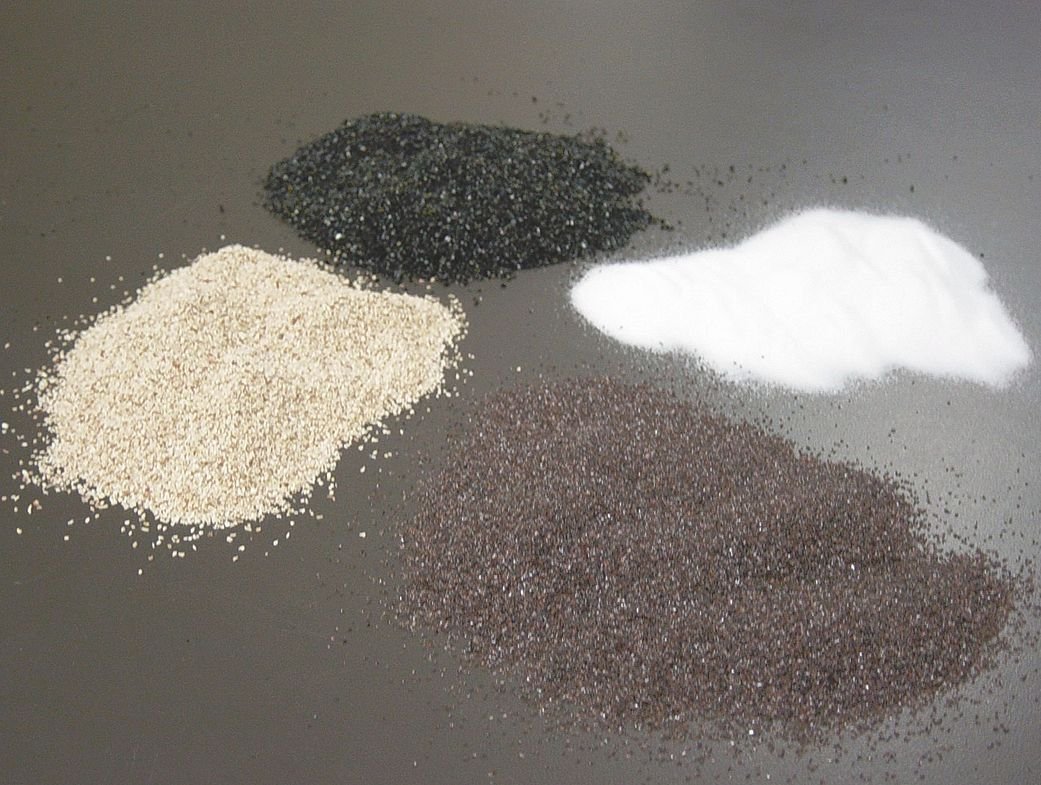
Glass is an amorphous solid with a Mohs hardness of approximately 5.5 — hard enough to resist most common materials, but far below the hardness of both silicon carbide (9.5 Mohs) and aluminum oxide (9.0 Mohs). When an abrasive particle traveling at blast velocity strikes a glass surface, the concentrated stress at the particle’s cutting edge exceeds the glass’s fracture toughness locally, initiating a micro-crack that propagates briefly before being arrested by the compressive stress field surrounding the impact site. The result of millions of these micro-fracture events across the impact zone is a matte, frosted surface texture — the characteristic visual signature of glass that has been blasted.
The depth of each impact event — and therefore the cumulative depth achievable in a given blast time — depends on the kinetic energy of the particle (a function of its mass and velocity), the sharpness and number of active cutting edges (determined by particle geometry and hardness), and the fracture toughness of the glass being etched. Harder, sharper particles cut more deeply per impact cycle; larger particles carry more kinetic energy; higher blast pressure increases particle velocity. The sandcarving artist controls these parameters through grit size selection, blast pressure, nozzle distance, and exposure time to achieve the desired visual effect.
Silicon Carbide vs Aluminum Oxide for Sandcarving
Both silicon carbide and aluminum oxide are used in professional sandcarving, and the choice between them is one of the most frequently debated topics among working glass artists. The decision hinges on several trade-offs:
| Factor | Silicon Carbide (Black) | Aluminum Oxide (Brown/White) |
|---|---|---|
| Mohs Hardness | 9.5 | 9.0 |
| Cutting Speed on Glass | Faster | Moderate |
| Self-Sharpening | Yes — maintains sharp edges | Partial |
| Edge Definition | Very clean, sharp-edged cuts | Good |
| Reuse Cycles | 30–50 in a reclaimer | 50–100 |
| Unit Cost | Higher (~20–40% premium) | Lower |
| Surface Texture | Bright, clean frost | Slightly softer frost |
| Best for | Stage carving, deep relief, fine detail on hard glass | Surface etching, shading, high-volume studios |
Silicon carbide is the preferred choice for the most demanding sandcarving work: deep-relief sculptural carving (stage carving), fine-line detail work on hard glass substrates, and any application where the sharpness of cut edges and speed of material removal are the primary performance criteria. Its self-sharpening behavior means the working mix maintains consistent cutting performance throughout the reclaim cycle, producing predictable results across a production run.
Aluminum oxide is the economical alternative for surface etching, shading techniques, and high-volume commercial sandcarving operations where the premium cost of SiC cannot be absorbed in the unit price of finished products. Brown aluminum oxide in F 80–F 120 grit is a common choice in studios producing high-volume engraved awards, signage panels, and decorative architectural glass, where the slightly lower cutting speed is offset by the better cost-per-cycle economics. For full SiC technical detail: Silicon Carbide Abrasive Media: The Hardest Grit for Precision Work.
Grit Size Selection Guide
Grit size is the primary variable the sandcarving artist uses to control the visual character and depth of the etch. As a general principle: coarser grit cuts faster, deeper, and with a more pronounced surface texture; finer grit cuts more slowly, more shallowly, and produces a finer, silkier frost.
| Grit Size | Cutting Speed | Achievable Depth | Visual Effect | Best Application |
|---|---|---|---|---|
| F 36–F 46 | Very Fast | Deep (3–10+ mm) | Coarse, aggressive texture | Stage carving first pass, rough-in deep relief |
| F 60 | Fast | Medium-deep (1–5 mm) | Medium texture, good edge | Stage carving, base layer removal |
| F 80 | Moderate | Medium (0.5–2 mm) | Standard frost, clean edges | Most common grit; surface etch and moderate carving |
| F 100–F 120 | Moderate-Slow | Shallow–Medium | Fine frost, smooth feel | Shading, fine detail, second-stage refinement |
| F 150–F 220 | Slow | Very shallow | Very fine, silky frost | Shading effects, feathering edges, background texture |
Multi-Grit Technique: Professional sandcarvers routinely use multiple grit sizes on a single piece — beginning with a coarser grit to rough in the design and remove material quickly, then switching to finer grits to refine edges, develop shading, and create visual depth through texture variation. Each grit change requires purging the blast system and reclaimer to prevent cross-contamination of grit sizes.
Etching Different Substrate Materials
Float Glass (Window and Mirror Glass)
Standard float glass (Mohs ~5.5) is the most common sandcarving substrate. Silicon carbide F 80 or aluminum oxide F 80–F 100 at 40–80 psi produces reliable results across the full range of artistic effects — surface frost, stage carving, and shading. Mirror glass requires special attention: blasting the mirror backing rather than the glass face will destroy the reflective coating. Always verify which side the backing is on and mask the backing appropriately before any mirror work.
Crystal and Lead Crystal
Crystal glass (which contains lead oxide or other modifiers that increase its refractive index and brilliance) is slightly softer and more easily fractured than standard float glass. Finer grit (F 100–F 120) at lower pressures (40–60 psi) reduces the risk of stress cracking around deep-carved areas, and slower, more controlled carving is advised for sculptural work on crystal blanks. The brilliant surface quality of crystal rewards fine grit selection — the contrast between carved and uncarved surfaces is visually more striking on crystal than on float glass.
Granite and Natural Stone
Natural stone surfaces require coarser grit and higher pressure than glass — granite in particular (Mohs 6–7) demands silicon carbide F 36–F 60 at 80–100 psi for productive material removal. The heterogeneous mineral composition of granite means that cutting rates vary across the surface depending on which mineral is being abraded at any given point, so visual consistency requires experience and careful technique. Aluminum oxide is less effective on granite than SiC due to the hardness differential — SiC’s 9.5 Mohs vs granite’s average ~6.5 Mohs provides a more effective cutting margin than Al₂O₃’s 9.0 Mohs.
Solid Surface and Acrylic Materials
Engineered solid surface materials (Corian and equivalents) and clear acrylic (Perspex, Plexiglas) can be sandcarved with softer grit than glass — aluminum oxide F 80–F 120 at 40–60 psi is sufficient for controlled carving in these materials. Acrylic in particular can develop heat from friction during blasting if pressure is too high or dwell time too long, causing localized surface crazing — lower pressure and shorter burst durations are advisable.
Reclaimer Systems and Media Management
A reclaimer (separator) system attached to the blast cabinet separates usable abrasive media from fine dust and broken particles, returning acceptable grit to the working mix for reuse. Efficient reclaimer operation is critical to the economics of a sandcarving studio: SiC or Al₂O₃ in F 80 grit used in a well-managed reclaimer system with 40–60 cycle reclaim life costs a fraction of single-use media per square meter etched.
Key reclaimer management practices for sandcarving media:
- Set the separator air flow to match the specific gravity and particle size of the grit in use — a separator calibrated for F 80 SiC should be recalibrated if grit size is changed significantly
- Monitor the working mix grit size distribution periodically by sieve analysis — as the mix breaks down toward finer particles, cutting speed and edge definition will deteriorate
- Keep blast cabinet humidity controlled — moisture causes grit clumping, separator blockage, and erratic blast patterns. Drain air line moisture separators daily
- Never mix SiC and Al₂O₃ in the same reclaimer working mix — the different densities make clean separation impossible and the resulting mix produces unpredictable results
Frequently Asked Questions
For most glass etching and sandcarving work with F 80 silicon carbide or aluminum oxide, a starting pressure of 50–80 psi is typical. Surface etching (shallow frost, one layer only) works well at 50–65 psi; stage carving (deep relief, multiple layers) typically requires 70–90 psi for productive material removal rates. Lower pressure gives finer control over depth and edge definition; higher pressure cuts faster but requires more precise mask adhesion to prevent undercutting. Always start at lower pressure when working on a new glass type or with a new grit size, and increase only after confirming the result on a test piece.
Undercutting — where abrasive particles penetrate beneath the mask edge and etch an area outside the intended design boundary — is caused by blast particles arriving at angles that allow them to slip under the resist edge. To minimize undercutting: ensure the resist is firmly adhered across the entire masked area with no lifted edges (use a squeegee after application); maintain a perpendicular blast angle rather than sharp oblique angles; avoid excessively high blast pressure; and use finer grit for detail areas where edge definition is critical. In deep-carving stage work, some undercutting is inevitable in deeper layers — experienced sandcarvers compensate for this in the original design artwork by slightly undersizing interior design elements that will be carved to depth.
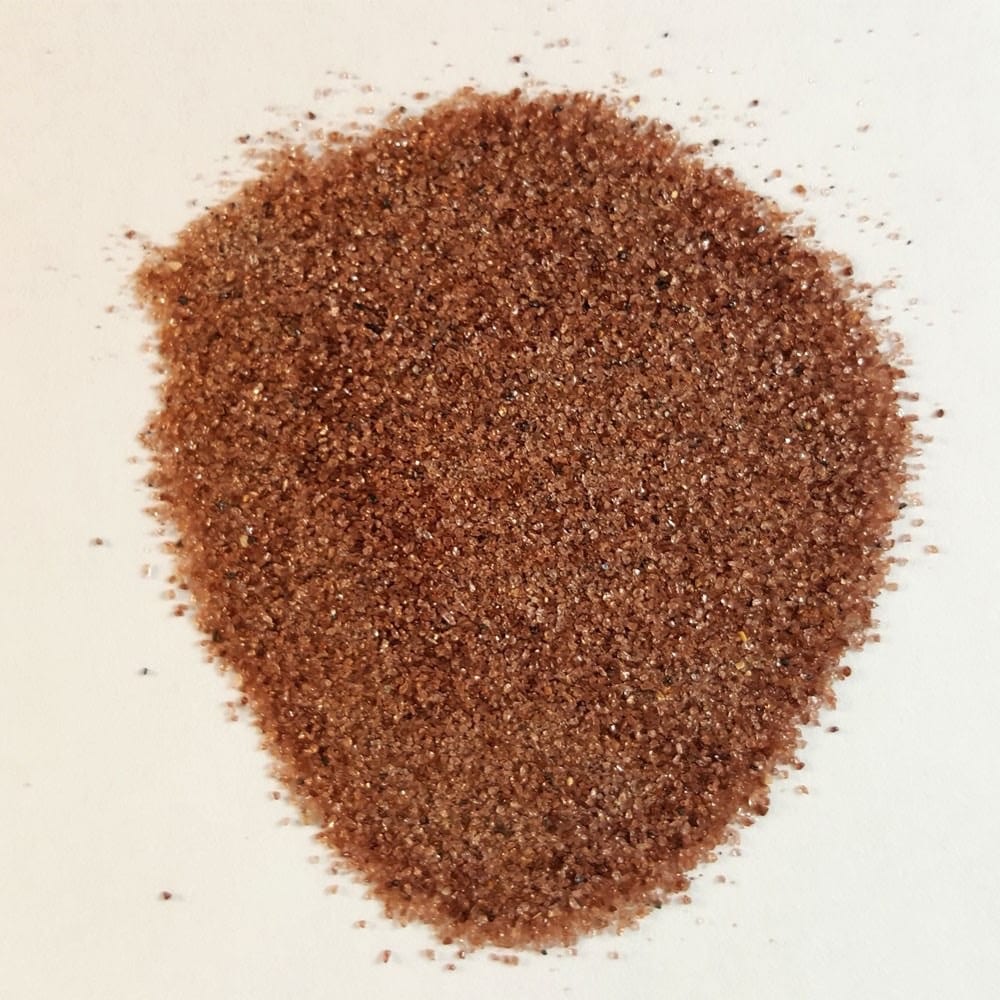
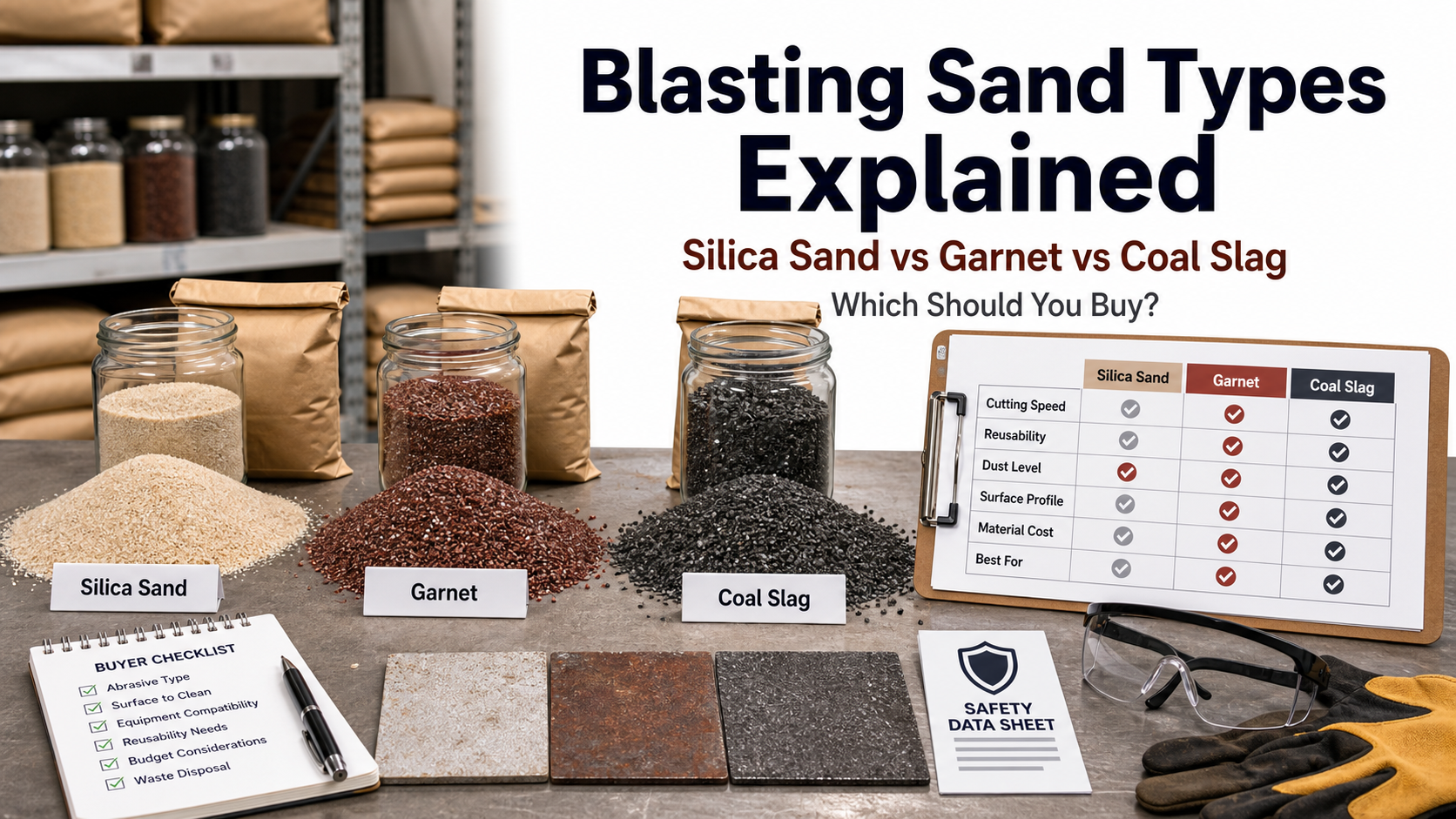
Garnet (Mohs 7.5–8.5) can etch glass, but it is not the professional standard for sandcarving. Its lower hardness compared to SiC or Al₂O₃ results in a slower cut rate, less sharp edge definition, and faster particle degradation in a reclaimer system. Garnet’s primary industrial advantage — low dust, consistent profile on steel — does not translate into a meaningful benefit in glass etching. For sandcarving studios, silicon carbide or aluminum oxide invariably deliver better results at equivalent or lower cost per piece. Garnet is best reserved for its designed application in industrial surface preparation. See our full garnet guide: Garnet Blast Media: Why Professionals Choose It for Surface Prep.
Silicon Carbide & Aluminum Oxide for Sandcarving
Henglihong supplies black and green SiC and brown/white Al₂O₃ in sandcarving grit sizes (F 36–F 220). Consistent particle size distribution for predictable, repeatable results. Factory-direct pricing.
Get a Free QuoteFilters