Zirconia Beads for Coating Removal: Selective Stripping Without Substrate Damage
How YSZ zirconia beads strip thermal barrier coatings, hard chrome, anodizing, paint, and powder coatings from aerospace, industrial, and automotive components — with dimensional fidelity and zero substrate contamination.
📅 Updated 2026
⏰ ~16 min read
🏭 Jiangsu Henglihong Technology Co., Ltd.
1. Why Coating Removal Matters in Precision Manufacturing
Coatings are not permanent. Every industrial coating — however well applied — reaches the end of its service life through wear, thermal cycling, impact damage, corrosion undercutting, or simply scheduled maintenance interval. When that moment arrives, the coating must be removed completely and the substrate returned to a defined condition before re-coating or return to service.
This is rarely straightforward. The challenge in coating removal is not simply stripping the coating — it is stripping it selectively: removing the coating fully while preserving the substrate’s dimensional integrity, surface metallurgy, and mechanical properties. Fail on the first count, and residual coating causes adhesion failure of the replacement coating. Fail on the second, and the substrate is eroded below minimum thickness tolerance, requiring expensive rework or scrap.
✈
The Aerospace Maintenance Challenge
A commercial turbine blade undergoes thermal barrier coating (TBC) removal and re-application every 12,000–25,000 flight hours as part of its overhaul cycle. Over a blade’s service life of 60,000–100,000 hours, it may be stripped and re-coated four to six times. Each strip cycle must remove the TBC completely without eroding the bond coat or nickel superalloy substrate. Cumulative substrate material loss must remain within the OEM’s dimensional limits across all strip cycles combined — typically a total allowance of 25–75 µm on critical airfoil surfaces.
The method of coating removal is therefore a critical process engineering decision, not a maintenance afterthought. Zirconia bead blasting has become the preferred method for coating removal on precision, high-value components because it achieves full coating removal with the lowest substrate erosion rate of any mechanical stripping method — and without the chemical hazards, environmental liabilities, and hydrogen embrittlement risks of wet chemical stripping.
2. How Zirconia Bead Blasting Removes Coatings
Coating removal by bead blasting exploits a fundamental difference in mechanical properties between the coating and the substrate. Most industrial coatings are harder or more brittle than the metallic substrate they protect — TBC ceramic top coats, hard chrome plating, anodized aluminium oxide layers, and cured paint all fracture and spall when subjected to repeated impact energy. The metallic substrate, being ductile, deforms plastically rather than fracturing under the same impact conditions.
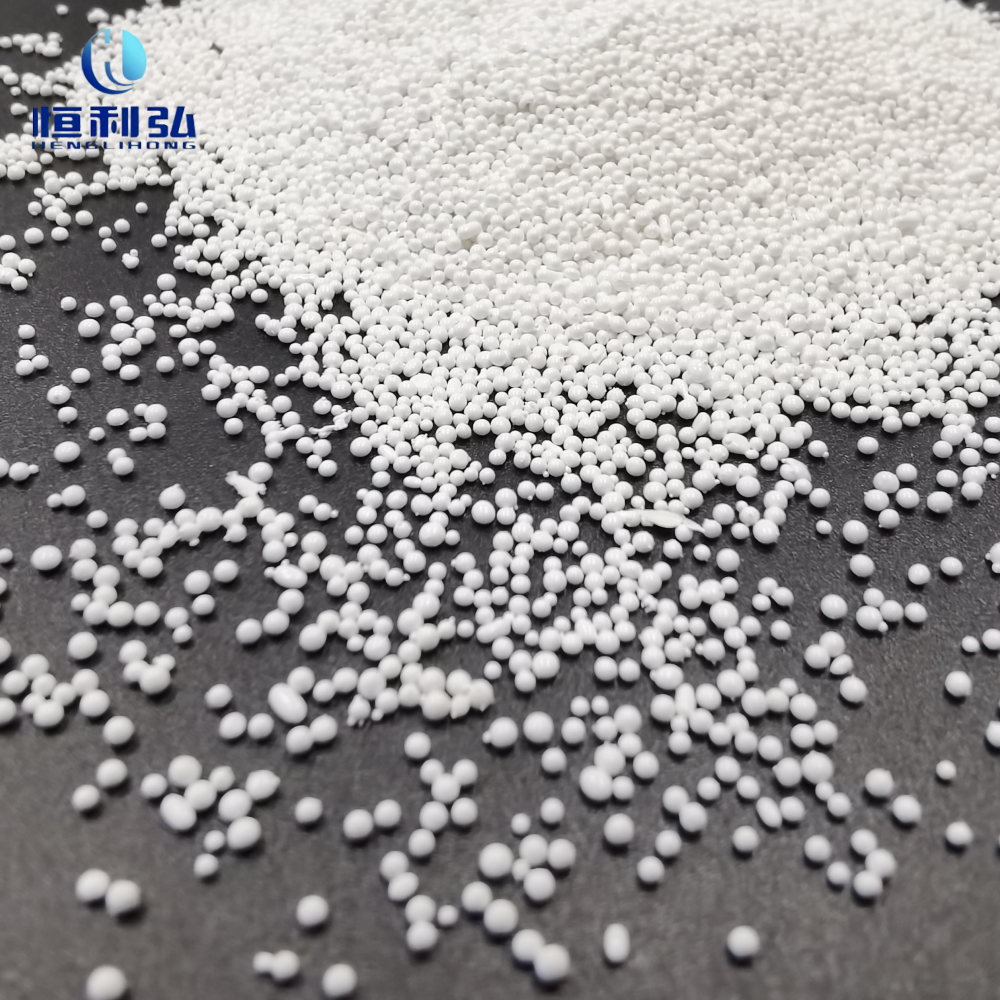
YSZ beads, directed at a coated surface at controlled velocity, deliver impact energy that exceeds the fracture threshold of the coating while remaining below the yield stress of the substrate. The coating shatters and spalls away in fragments; the substrate dimples slightly but retains its dimensions. The key process variables — bead size, velocity (blast pressure), angle, and dwell time — are tuned to maximise coating removal rate while minimising substrate material loss.
🔬
The Selectivity Mechanism: Hardness and Fracture Toughness
Ceramic TBC top coats (typically yttria-stabilised zirconia — the same material as the bead, but in a different form) have low fracture toughness (K₁c ≈ 1–2 MPa·m½). Metallic substrates such as IN-738 nickel superalloy have K₁c of 20–50 MPa·m½. This 10–25× difference in crack resistance means that at a given impact energy, the coating fractures and is removed while the substrate plastically deforms and survives. YSZ beads at 6–12 MPa·m½ fracture toughness are hard enough to fracture the coating but tough enough to survive thousands of impact cycles themselves.
3. Coating Types and YSZ Stripping Parameters
Different coating systems have different adhesion strengths, thicknesses, hardnesses, and fracture characteristics — all of which affect the optimal YSZ stripping parameters. The six most common coating types encountered in industrial maintenance and aerospace overhaul are covered below.
🔥
Aerospace / Power Generation
Thermal Barrier Coatings (TBC)
Ceramic top coats (typically 7–8 wt% YSZ, 100–300 µm thick) applied by air plasma spray (APS) or electron-beam physical vapour deposition (EB-PVD) over a metallic bond coat. Brittle, low fracture toughness — ideal candidate for bead blast stripping. Bond coat (MCrAlY, 50–150 µm) must be preserved or stripped separately depending on refurbishment scope.
YSZ Bead Parameters
Size: 0.2 – 0.6 mm | Pressure: 2.0 – 3.5 bar | Angle: 60–80° | Substrate loss: <5 µm per strip cycle
🔸
Industrial / Aerospace
Hard Chrome Plating
Electrodeposited chromium (typically 12–250 µm thick, 800–1000 HV) applied for wear and corrosion resistance on hydraulic rods, landing gear, and industrial shafting. Removal traditionally required toxic chromic acid bath stripping. YSZ bead blasting provides a chemical-free alternative that removes chrome mechanically without hydrogen embrittlement risk to high-strength steel substrates.
YSZ Bead Parameters
Size: 0.3 – 0.8 mm | Pressure: 3.0 – 4.5 bar | Angle: 75–90° | Note: multiple passes required for thick deposits
🔴
Aerospace / Automotive / Electronics
Anodizing (Type II & III)
Aluminium oxide layer formed electrochemically on aluminium alloys. Type II (decorative): 5–25 µm. Type III (hard anodize): 25–75 µm, very high hardness (HV 400–600). Removal required before re-anodizing, welding, or dimensional rework. YSZ blasting strips the anodize layer without removing measurable aluminium substrate at correct parameters.
Organic coating systems — epoxy primers, polyurethane topcoats, powder coatings — typically 50–300 µm total system thickness. Generally lower adhesion than metallic coatings; respond well to bead blasting at moderate pressures. Important for automotive refinishing, aviation livery change, and industrial equipment maintenance without solvent stripping.
YSZ Bead Parameters
Size: 0.3 – 1.0 mm | Pressure: 2.0 – 3.5 bar | Angle: 45–75° | Most efficient at 45–60° impact angle
🔥
Industrial / Power Generation
Thermal Spray Coatings (HVOF / Plasma)
Metallic or cermet coatings (WC-Co, Cr₂C₃, NiCrAlY) applied by HVOF or plasma spray for wear and oxidation protection. Typically 100–500 µm thick, high hardness (WC-Co: 1000–1200 HV). Requires higher bead energy for removal; coarser YSZ beads at higher pressure combined with robotic blasting for consistent coverage.
YSZ Bead Parameters
Size: 0.5 – 1.2 mm | Pressure: 3.5 – 5.0 bar | Angle: 80–90° | Multiple passes; monitor substrate temperature
🔮
Tooling / Industrial Machinery
PVD / CVD Hard Coatings (TiN, TiAlN, DLC)
Ultra-thin (1–10 µm) but very hard (HV 2000–3000) coatings applied to cutting tools, molds, and precision components. Removal typically required before tool re-sharpening or mould repair. Requires fine YSZ beads at very controlled pressure — the thin coating means the process window between full removal and substrate damage is narrow.
YSZ Bead Parameters
Size: 0.05 – 0.15 mm | Pressure: 1.5 – 2.5 bar | Angle: 60–75° | Tightest process window — trial strips mandatory
4. Zirconia Beads vs Chemical Stripping vs Angular Grit
Three principal methods exist for industrial coating removal. Each has a defined cost-performance profile. Understanding the trade-offs is essential for selecting the right method — or the right combination of methods — for a specific application.
● Evaluation Criterion
Substrate material loss
Dimensional tolerance preservation
Hydrogen embrittlement risk
Environmental / HSE impact
Contamination introduced
Complex geometry access
Processing speed
Equipment capital cost
Cost per component
■ YSZ Bead Blasting
<5 µm/cycle
Excellent
None
Low (dry process)
None (ZrO₂ only)
Good with robotics
Medium–Fast
Medium
Low–Medium
■ Chemical Stripping
Near zero
Excellent
High (acid baths)
Very high (hazmat)
Chemical residues
Excellent (immersion)
Slow (bath time)
Medium
High (disposal)
Criterion
YSZ Zirconia Beads
Angular Alumina Grit
Silicon Carbide Grit
Substrate material loss per pass
<5 µm
15 – 50 µm
20 – 60 µm
Surface Ra after stripping
0.4 – 1.2 µm
2.5 – 6 µm
3 – 8 µm
Embedded abrasive contamination
Minimal
Significant
Significant
Suitable for Ti / Ni alloys
Yes
With cleaning
With cleaning
Re-coatable after stripping without additional prep?
Often yes
Additional cleaning required
Additional cleaning required
📈
Regulatory Driver: Eliminating Hexavalent Chromium
EU REACH regulation and US EPA standards are progressively restricting or banning hexavalent chromium (Cr⁶⁺) compounds used in chrome plating baths and acid-based chrome stripping solutions. Many aerospace and automotive manufacturers are proactively converting to mechanical chrome stripping with YSZ beads to eliminate Cr⁶⁺ from their facilities ahead of regulatory deadlines — reducing environmental liability while simultaneously improving process control and worker safety.
5. Process Parameters for Coating Removal
The four primary variables controlling coating removal rate and substrate loss in YSZ bead blasting are blast pressure, bead size, impact angle, and stand-off distance. These interact and must be optimised together rather than independently.
Parameter
Effect on Coating Removal Rate
Effect on Substrate Loss
Recommended Starting Point
Blast pressure
↑ pressure = faster removal
↑ pressure = more substrate erosion
Start at 2.5 bar; increase in 0.5 bar increments while monitoring substrate loss
Bead size
Larger beads = faster macro-removal
Larger beads = deeper substrate indentation
Match to coating thickness: thin coatings (<50 µm) → 0.1–0.3 mm; thick (>200 µm) → 0.5–1.0 mm
TBC and anodize: 60–75°. Paint and powder: 45–60°. Hard chrome: 75–90°
Stand-off distance
Shorter distance = higher velocity at surface
Shorter distance = more substrate impact
100–200 mm; verify with Almen strip equivalent test piece for each setup
Traverse speed
Slower traverse = more exposure per area
Slower traverse = more substrate loss
Robotically controlled; set to achieve single-pass coating removal without multi-pass substrate erosion
Nozzle type
Focused nozzle for precision stripping; wide fan for large areas
Fan nozzle distributes energy; lower peak substrate erosion per pass
Fan nozzle for flat panels; focused nozzle for complex geometries and localised stripping
6. Substrate Protection — How to Avoid Damage
The most critical risk in coating removal is over-blasting — continuing past the point of complete coating removal into the substrate. On thin-walled components such as turbine blades, this risk is compounded by the fact that wall thickness may be as low as 0.5–1.5 mm, leaving very little margin for substrate erosion. Four risk levels exist, from controllable to severe:
● Low Risk
Thick-walled structural parts
Wall thickness >5 mm. Dimensional tolerance >50 µm. Substrate loss per pass <5 µm presents negligible dimensional risk. Standard parameter control sufficient.
● Low Risk
Flat panel paint stripping
Aircraft fuselage skins, automotive body panels. Substrate loss per pass of 2–5 µm is negligible relative to panel thickness (>1 mm). Angle control (45–60°) maintains low substrate erosion rate.
▲ Medium Risk
Anodized aluminium precision parts
Thin-walled aluminium components with tight dimensional tolerances. Process window between full anodize removal and substrate over-erosion is 5–15 µm. Requires parameter qualification and first-article measurement.
▲ Medium Risk
TBC bond coat preservation
Stripping ceramic TBC top coat while preserving MCrAlY bond coat requires stopping within a 50–100 µm depth window. Requires process simulation on test coupons before production stripping.
▼ High Risk
Turbine blade trailing edges
Wall thickness as low as 0.3–0.5 mm. Cumulative substrate loss across multiple strip cycles must stay within OEM tolerance (typically 25–50 µm total). Robotic blasting with real-time thickness monitoring is mandatory.
▼ High Risk
PVD/CVD tool coating removal
Coating thickness of 1–5 µm on cutting edges where substrate material loss >2 µm changes tool geometry. Extremely narrow process window — only fine YSZ beads (0.05–0.1 mm) at lowest effective pressure are acceptable.
Masking and Fixturing
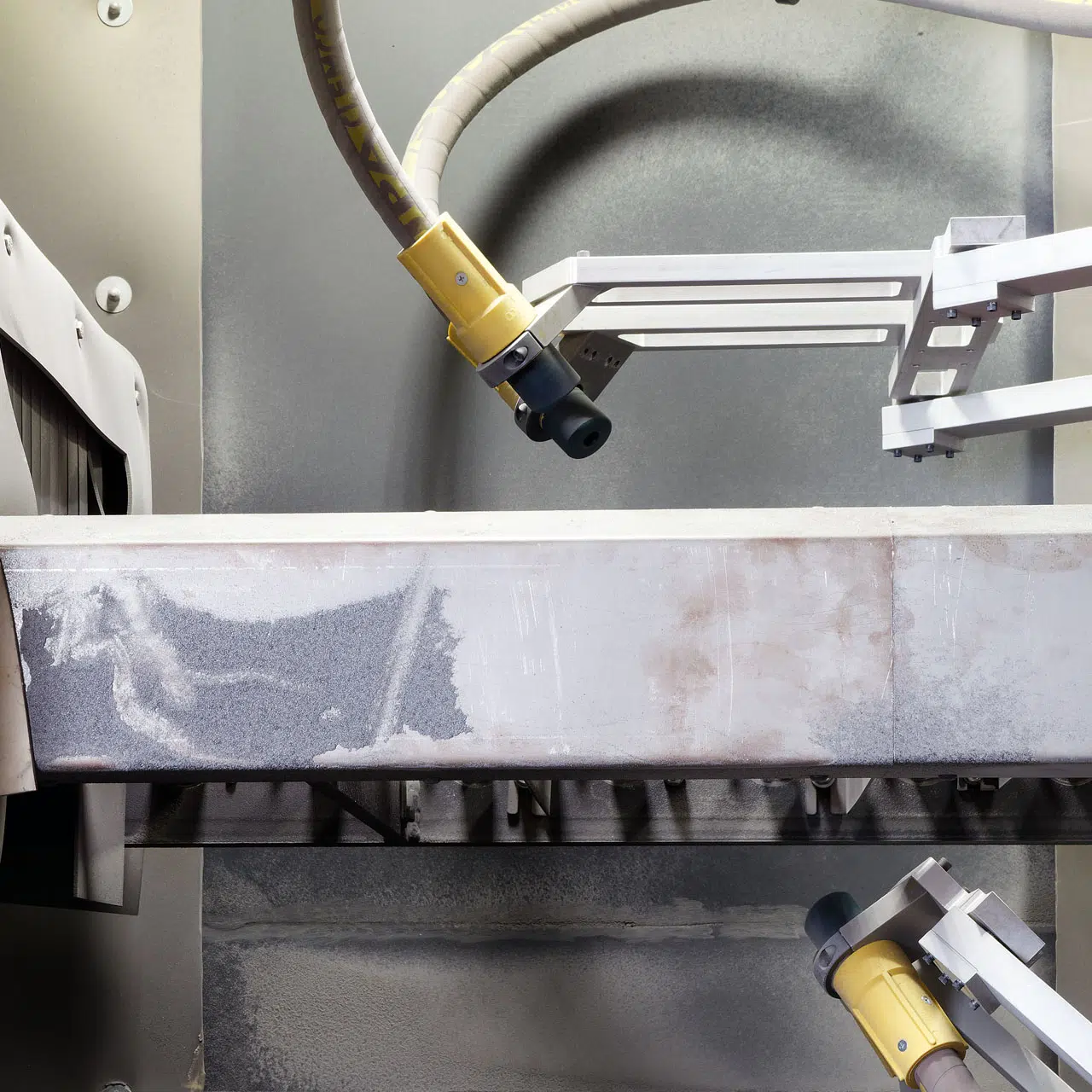
Areas of the component that must not be stripped — cooling holes, trailing edge slots, threaded bores, bearing surfaces — should be masked with sacrificial tape, rubber plugs, or metal tooling fixtures before blasting begins. For turbine blades, precision-machined fixturing that fills cooling passages with sacrificial inserts is standard practice. Always inspect masking integrity before and after blasting; any masking failure that allows bead access to a protected feature can cause localised substrate damage that is expensive to remediate.
Robotic Blasting for Consistent Results
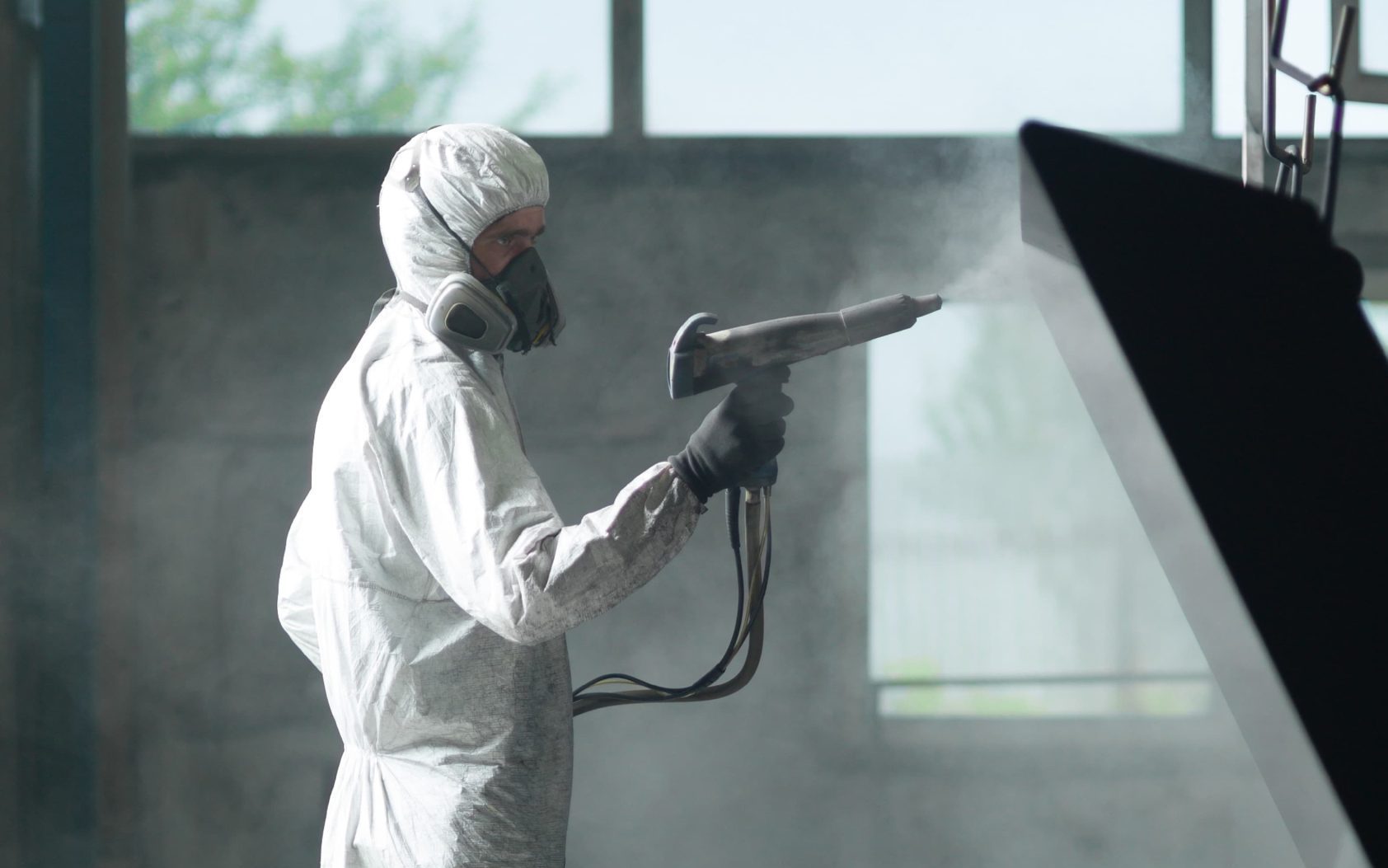
Manual blasting introduces human variability in stand-off distance, traverse speed, and angle — the primary drivers of substrate erosion rate. For safety-critical components undergoing repeated coating removal cycles, robotic blasting with a programmed path, constant velocity, and real-time nozzle position feedback is strongly recommended. Robotic systems reduce cycle-to-cycle variation in substrate loss from ±30% (manual) to ±5%, significantly extending the usable life of critical components.
7. Post-Strip Surface Preparation
The condition of the substrate surface immediately after coating removal determines the adhesion quality of the replacement coating. The post-strip sequence must be defined and controlled as rigorously as the stripping process itself.
Visual and Dimensional Inspection
Inspect the stripped surface at 10× magnification for complete coating removal — residual coating appears as colour variation or sheen differences against the bare substrate. Measure critical dimensions (wall thickness, bore diameter, airfoil chord) against the OEM drawing limits. Document all measurements for the component’s life history record.
Fluorescent Penetrant Inspection (FPI)
For aerospace components, FPI per ASTM E1417 is typically required after TBC stripping to detect any substrate cracking that may have been masked by the coating during service. The clean, contamination-free surface left by YSZ bead stripping responds more reliably to penetrant than chemically-stripped surfaces, which may retain residual bath chemistry that interferes with penetrant uptake.
Surface Cleaning
Degrease with an approved solvent (typically isopropanol or acetone) to remove residual finger oils, masking adhesive residues, and blasting compound. For titanium and nickel superalloy components, a final aqueous alkali clean followed by DI water rinse ensures the surface is free of ionic contamination before coating. Validate cleanliness by water break test — water sheeting evenly indicates a clean, contamination-free surface.
Surface Profile Verification
Many coating specifications — particularly thermal spray and plasma spray coatings — require the substrate to present a defined surface profile (Ra or Rz) before application to ensure mechanical adhesion. YSZ bead stripping typically leaves Ra 0.4–1.2 µm depending on bead size and pressure. If the coating spec requires a coarser profile (Ra 2–5 µm), a separate grit blasting step is needed after YSZ stripping. If a finer profile is needed, a polishing stage with finer YSZ beads may be performed before re-coating.
Shot Peening (Where Specified)
Some OEM repair specifications require the substrate to be shot peened after coating removal to restore compressive residual stresses that may have relaxed during coating exposure to service temperatures. In this case, the YSZ bead stripping process feeds directly into a shot peening operation, often using the same YSZ bead type at a larger size and higher energy. Define this as a separate, independently qualified process step with its own Almen certification.
8. Industry Applications
Aerospace MRO (Maintenance, Repair & Overhaul)
TBC stripping from turbine blades and vanes is the highest-value, most technically demanding coating removal application for YSZ beads. Engine MRO facilities performing hot section refurbishment on commercial and military gas turbines specify YSZ bead blasting as their standard TBC removal method, replacing grit blasting and chemical stripping processes that caused excessive substrate loss and introduced hazardous waste streams. The requirement for contamination-free substrate surfaces before FPI — which YSZ bead blasting consistently delivers — makes it uniquely suited to the aerospace MRO environment.
Automotive Refinishing
Aircraft livery changes, automotive fleet repaint programmes, and industrial equipment repainting all require complete removal of the existing paint system before applying new coatings. YSZ bead blasting at 45–60° removes multi-layer paint systems (primer + basecoat + clearcoat) from aluminium and steel panels without distorting thin sheet metal or creating the surface contamination that makes solvent stripping environmentally burdensome. The stripped surface presents an ideal anchor profile for new primer adhesion.
Industrial Equipment Maintenance
Pump impellers, heat exchanger tubes, compressor casings, and valve bodies accumulate worn thermal spray, ceramic, or metallic protective coatings over years of service. YSZ bead stripping restores the substrate surface without the dimensional concerns of grit blasting or the chemical disposal costs of wet stripping, enabling cost-effective coating renewal programmes that extend equipment life beyond conventional overhaul intervals.
🔗
This article is part of Henglihong’s complete surface treatment knowledge base. For a full overview of YSZ zirconia bead properties, grades, and the complete range of surface treatment applications — including shot peening, deburring, polishing, and industrial cleaning — refer to our complete zirconia beads guide.
How many strip cycles can a turbine blade substrate withstand before reaching dimensional limits?
+
This depends on the OEM’s dimensional limits for the specific component, the substrate wall thickness, and the substrate loss per strip cycle with YSZ beads. A typical YSZ TBC stripping process removes <5 µm of substrate per cycle. If the OEM allows a cumulative substrate loss of 50 µm over the blade’s service life, the blade can theoretically undergo 10 strip cycles — enough for the full maintenance life of most commercial turbine blades before retirement on dimension. In practice, blades are retired earlier due to thermal fatigue cracking or tip erosion. Document substrate loss per cycle from the first strip to track cumulative loss against the OEM limit.
Can YSZ bead blasting selectively remove the TBC top coat while leaving the bond coat intact?
+
Yes — this is one of the most technically valuable capabilities of YSZ bead stripping. The ceramic TBC top coat (YSZ, K₁c ≈ 1–2 MPa·m½) fractures readily at bead impact energies that do not fracture the tougher metallic MCrAlY bond coat (K₁c ≈ 15–25 MPa·m½). By optimising bead size, pressure, and impact angle — typically 0.2–0.4 mm beads at 2.0–3.0 bar — the top coat can be fully removed while the bond coat surface is only lightly dimpled. This selective stripping capability is critical for component refurbishment programmes where the bond coat is still serviceable and replaces the cost of full coating system removal and reapplication.
Does YSZ bead blasting cause hydrogen embrittlement in high-strength steel components?
+
No — hydrogen embrittlement is a risk specific to electrochemical processes (acid pickling, electrolytic chrome stripping, cadmium plating) where nascent hydrogen is generated at the cathode and can diffuse into the steel lattice. YSZ bead blasting is a purely mechanical, dry process with no electrochemical reactions — no hydrogen is generated, and no hydrogen can enter the steel. This makes YSZ bead stripping the preferred method for removing hard chrome from high-strength steel components (landing gear, high-tensile fasteners, helicopter rotor shafts) where the minimum yield strength exceeds 1,000 MPa and hydrogen embrittlement is a disqualifying failure mode.
How do I verify that all coating has been completely removed?
+
The verification method depends on the coating type. For TBC ceramic coatings, visual inspection under raking light at 10× magnification detects residual ceramic (matte white appearance) against the bare metallic substrate. For hard chrome, a copper sulphate (CuSO₄) test swab is used — copper deposits on bare steel (indicating chrome removal) but not on residual chrome. For anodize, an electrical conductivity test or eddy current measurement detects the insulating anodize layer against the conductive aluminium substrate. For paint, visual inspection under UV light using fluorescent dye added to the primer layer during original application is the standard aerospace method. Always define the acceptance criteria before stripping begins, not after.
Can the same YSZ bead charge used for coating removal be used for subsequent shot peening?
+
This is not recommended for certified aerospace shot peening operations. The media charge used for coating removal will contain coating fragments (ceramic, metallic, or organic particles) and will have a broader size distribution than the original specification. Using this contaminated charge for shot peening would compromise the Almen certification and introduce foreign material contamination into the peened surface. Maintain separate, dedicated media charges for coating removal and shot peening operations, with separate lot documentation. The coating removal charge can be recycled for general-purpose blasting or cleaning applications before disposal.
HLH
Jiangsu Henglihong Technology Co., Ltd.
YSZ zirconia bead specialist for precision coating removal in aerospace MRO, automotive refinishing, and industrial maintenance. Providing substrate-safe TBC stripping media, chrome removal solutions, and full technical process support for life-limited component refurbishment programmes.
Strip Coatings Without Damaging What’s Underneath
Share your coating type, substrate material, and dimensional tolerance — our engineers will recommend the correct YSZ bead size and process parameters for minimum substrate loss and complete coating removal.