Mil-Spec Plastic Media: What MIL-P-85891A Means for Buyers
MIL-P-85891A is a four-letter shorthand that appears constantly in aerospace blast media purchasing — on purchase orders, process specifications, quality records, and supplier certifications. Most buyers who encounter it know that it means something important about the media they are buying, but few have actually read the document or understand what its requirements mean in concrete terms: what properties it specifies, what testing it requires, what the type and class designations mean, and critically, how to verify that a supplier’s “MIL-P-85891A compliant” claim is genuine rather than a marketing label attached to untested commercial-grade product.
This guide decodes MIL-P-85891A completely. It covers the document’s structure, every physical and chemical requirement it specifies with the actual limit values, what a genuinely compliant Certificate of Conformance must contain, the type and class designation system and what each combination means for purchasing, the difference between a compliant product and a “per specification” marketing claim, and exactly when MIL-P-85891A compliance is legally and contractually required versus when it is optional but prudent. By the end, you will be able to read a supplier’s CoC and know immediately whether it demonstrates genuine MIL-spec compliance or whether it is a conformance statement with no underlying substance.For a broader overview of the full plastic media category, see: What Is Plastic Media? The Complete Guide.
What MIL-P-85891A Is and Why It Exists
MIL-P-85891A is a United States military performance specification issued by the Department of Defense (DoD), specifically under the Naval Air Systems Command (NAVAIR). Its full title is Plastic Media, Blasting, Cleaning and Paint Stripping. The “A” suffix designates the first revision to the original MIL-P-85891 document. It is a performance specification — meaning it defines the required properties of the end product (the media) rather than specifying the manufacturing process used to make it.
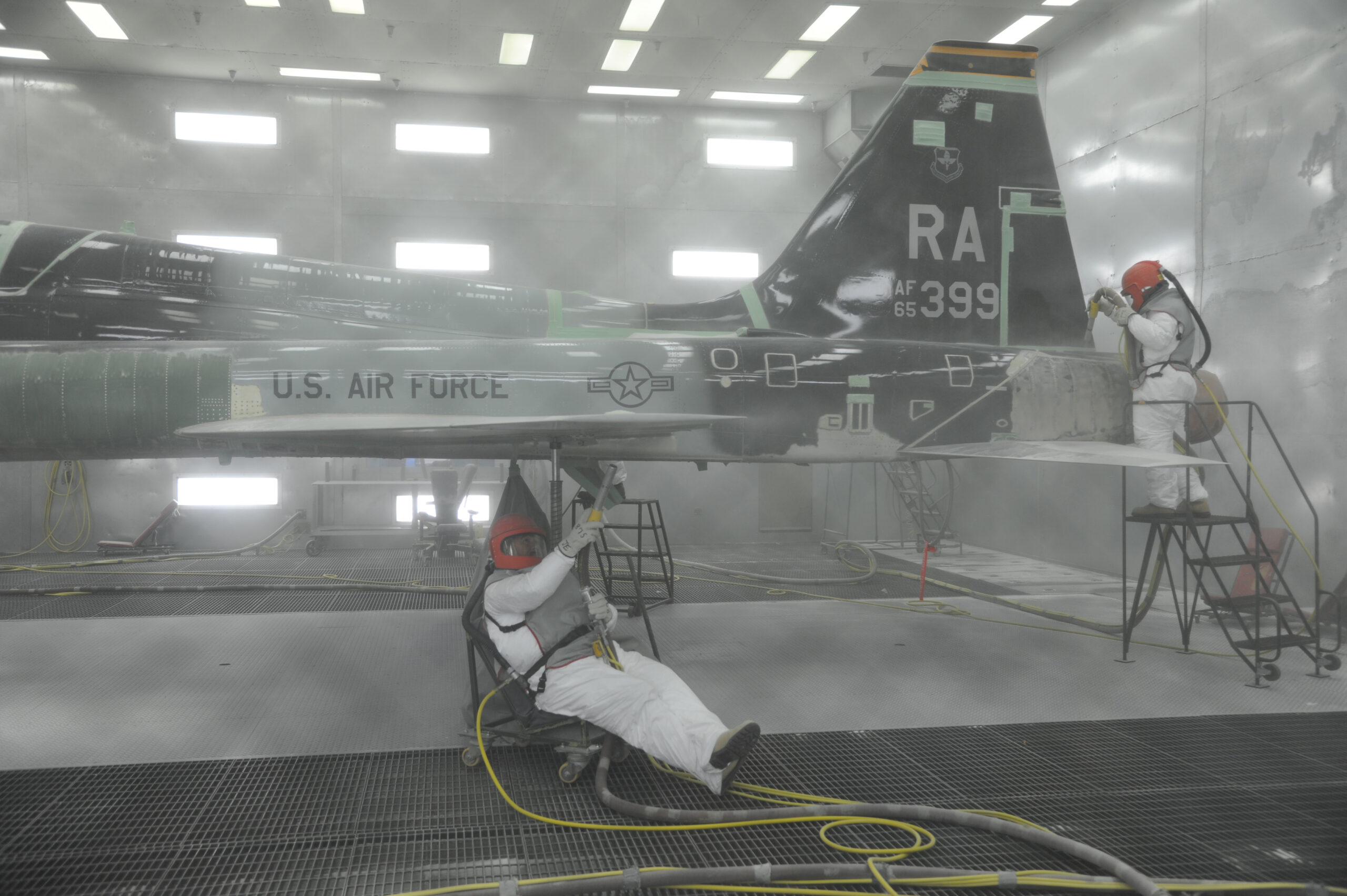
The specification exists because plastic blast media was developed specifically for aerospace depainting applications where the substrate — primarily aluminum aircraft structure — cannot tolerate the surface damage that mineral abrasives (silica sand, aluminum oxide) cause. Before plastic media and its governing specification existed, aerospace depainting relied on chemical strippers with significant environmental and health hazards. The military needed a mechanical stripping method that was environmentally preferable, faster, and controllable — and the specification was written to ensure that any media marketed for this purpose actually had the properties needed to strip coatings without damaging the aircraft structure.
Today MIL-P-85891A is the de facto industry standard for any high-quality plastic blast media, used well beyond its original military context. Commercial aerospace MRO, industrial manufacturing, and precision finishing operations specify it because it provides the most complete set of documented property requirements available for this material category — not because their customer is the U.S. Navy.
Document Structure: What the Spec Actually Contains
MIL-P-85891A is organized into six sections. Understanding what each section covers helps buyers navigate the document and understand which sections are most relevant to purchasing and quality verification.
Type and Class Designation System
MIL-P-85891A organizes plastic blast media into five Types based on polymer chemistry and two Classes based on particle shape. Every fully specified MIL-spec purchase order must state both Type and Class.
The Five Types
The Two Classes
| Class | Description | Particle Shape | When Specified |
|---|---|---|---|
| Class 1 | Irregular angular particles | Angular, irregular — sharp edges and corners; the standard blast media form | All coating removal, surface preparation, and deflashing applications. The default class for the vast majority of applications. If not otherwise specified, assume Class 1. |
| Class 2 | Spherical or rounded particles | Round to sub-round — reduced angularity; some specialized applications requiring lower surface profile impact | Specialty applications where reduced surface profile is required along with low substrate hardness. Rarely specified in practice; most peening applications use glass bead rather than Class 2 plastic media. |
Correct Ordering Designation Format
A fully specified MIL-P-85891A purchase order designation reads: MIL-P-85891A, Type [Roman numeral], Class [Arabic numeral], Mesh [size]. Example: “MIL-P-85891A, Type II, Class 1, Mesh 20-30.” Any purchase order that omits Type, Class, or mesh size is ambiguous and gives the supplier latitude to ship a product that may not match your process specification.
Every Physical Requirement — With the Actual Limit Values
This is the section of MIL-P-85891A that most buyers never read directly but need to understand to evaluate CoC compliance. The following covers every property requirement in Section 3 of the specification with the actual limit values as written in the document.
Particle Size Distribution (Section 3.3)
The particle size distribution requirement is the most detailed and most frequently checked requirement in the specification. For each nominal mesh designation, MIL-P-85891A specifies the minimum percentage of particles that must be retained on a series of standard ASTM sieves. The specification sets limits in both directions: a maximum for oversize particles (which would indicate insufficient classification on the upper end) and a minimum for the primary fraction (which defines the tightness of the size distribution).
| Nominal Mesh Designation | Maximum Retained on Upper Screen | Minimum Retained on Nominal Screen | Maximum Passing Lower Screen |
|---|---|---|---|
| Mesh 14 (14/20) | 5% max on No. 10 screen | 90% min on No. 14 screen | 5% max passing No. 20 screen |
| Mesh 20 (20/30) | 5% max on No. 14 screen | 90% min on No. 20 screen | 5% max passing No. 30 screen |
| Mesh 30 (30/40) | 5% max on No. 20 screen | 90% min on No. 30 screen | 5% max passing No. 40 screen |
| Mesh 40 (40/50) | 5% max on No. 30 screen | 90% min on No. 40 screen | 5% max passing No. 50 screen |
| Mesh 50 (50/60) | 5% max on No. 40 screen | 90% min on No. 50 screen | 5% max passing No. 60 screen |
The critical design intent: at least 90% of the media must be retained on the nominal screen, with no more than 5% oversize (retained on the next coarser screen) and no more than 5% undersize (passing the next finer screen). This 90/5/5 distribution is significantly tighter than most commercial-grade media specifications, which often allow 80% on the nominal screen and 10% each for over- and undersize. The tighter distribution produces more consistent blast performance because the energy per particle impact varies with particle size — a wide distribution means high-energy large particles and low-energy small particles blasting simultaneously, producing uneven results.
All Physical and Chemical Requirements at a Glance
Testing Methods: How Each Property Is Measured
MIL-P-85891A Section 4 specifies the test methods to be used for each property. A CoC from a compliant supplier references these methods (or their commercial equivalents) to demonstrate that testing was conducted correctly. Understanding the test methods also helps you evaluate whether a supplier’s internal testing is genuinely equivalent to the specification-required methods.
| Property | Specified Test Method | What the Test Measures | In-House vs. Third-Party |
|---|---|---|---|
| Particle size distribution | ASTM E11 sieves; mechanical sieve shaker with defined agitation time and sample weight | Percentage by weight retained on each screen in the test series; completed for at least the three screens spanning the nominal mesh (one coarser, nominal, one finer) | In-house — requires calibrated sieves and sieve shaker; minimal equipment investment; can be done quickly per lot |
| Moisture content | Gravimetric method: weigh sample, dry at 220°F (104°C) for 2 hours, reweigh; moisture % = weight loss/initial weight × 100 | Total moisture present in the media as a percentage of total weight; measures both surface moisture and absorbed moisture | In-house — requires precision balance and drying oven; simple and fast; should be performed on every lot before release |
| pH (Type II Urea) | Media-water paste tested with calibrated pH meter per ASTM E70 or equivalent | Acidity or alkalinity of the media surface chemistry; determines whether the urea formaldehyde matrix has been compromised by acid contamination or degradation | In-house — calibrated pH meter required; straightforward procedure; per lot |
| Bulk density | ASTM B329 or equivalent; fill a known volume container with media by a standardized pour method; calculate lb/ft³ from weight | Apparent bulk density — confirms the media is the expected polymer type and that density-altering substitution or contamination has not occurred | In-house — requires calibrated scale and standard measure; quick; per lot |
| Hardness | Mohs scratch hardness or Vickers microhardness equivalent; some specifications accept Shore D hardness correlation with Mohs range | Resistance of the particle to plastic deformation — determines the upper boundary of substrate materials that can be safely blasted without surface damage | In-house or third-party; requires hardness tester; often tested quarterly per production batch rather than every lot |
What a Genuine Compliant CoC Must Contain
The Certificate of Conformance is the primary quality document for each lot of plastic blast media. For a CoC to demonstrate genuine MIL-P-85891A compliance, it must contain specific elements — not just a conformance statement. Below is an annotated example of a compliant CoC vs. common non-compliant variations.
No. 20 screen (nominal): 94.1% retained (limit: ≥90%)
No. 30 screen (undersize): 2.3% passing (limit: ≤5%)
Test method: ASTM E11, 5-min mechanical shaker
Test method: Gravimetric, 2 hr at 220°F
Test method: ASTM E70, calibrated pH meter
How to Spot a Non-Compliant “MIL-Spec” Claim
The most commercially consequential gap in the plastic blast media market is between suppliers who genuinely test and certify each lot to MIL-P-85891A requirements and suppliers who use “MIL-spec” as a marketing label without the underlying testing. The distinction is not always obvious from a sales conversation or a product data sheet — it becomes clear only when you examine the CoC. These are the specific markers that distinguish genuine compliance from a conformance claim:
| CoC Element | Genuine MIL-P-85891A Compliance | Non-Compliant Marketing Claim |
|---|---|---|
| Specification citation | “MIL-P-85891A, Type II, Class 1” — full document number with revision, type, and class | “Meets military specification” or “MIL-spec grade” without the document number |
| Particle size result | Three percentage values: oversize %, nominal screen %, undersize % — with the screen designations stated | “Particle size meets specification” or the nominal mesh designation with no percentages |
| Moisture content result | A specific measured percentage (e.g., “0.38%”) with test method cited | “≤1.0%” (the specification limit, not a measurement) or “dry” |
| pH result (Type II) | A specific measured value (e.g., “8.2”) with test method cited | “7.0–9.0” (the specification range) or not stated |
| Lot traceability | Unique lot number tied to a specific production batch, matching bag markings; lot number cross-referenceable to actual production records | Generic lot number, date-based lot codes that apply to entire months of production, or no lot number |
| Certifying party | Signed by quality representative of the manufacturer with their company name and title | Signed only by the distributor; or signed by the distributor claiming manufacturer quality on their behalf without underlying test data |
| Test method reference | References ASTM or specification test methods (e.g., “ASTM E11 sieve analysis”) for each parameter | No test method reference; or “per our internal standard” without citing the underlying method |
When MIL-P-85891A Is Required vs. Optional
- The applicable process specification (e.g., Boeing BSS 7439, Airbus ABP 1-2061, Navy WS 6536, USAF TO 1-1-8) explicitly cites MIL-P-85891A as the governing media specification
- The customer’s purchase order, contract, or statement of work requires media conformance to MIL-P-85891A by name
- Your quality system (AS9100, Nadcap audit requirements) mandates full material traceability with lot-level CoC documentation, and no commercial equivalent specification provides equivalent coverage
- The application involves U.S. military aircraft, military vehicles, or defense-related equipment subject to DoD quality requirements
- An audit or quality authority has specifically required MIL-P-85891A-compliant media for the application
- Your contract requires that all materials meet applicable military specifications, and no approved alternative is listed
- The application is commercial aerospace MRO where your process specification references “plastic blast media meeting the requirements of MIL-P-85891A” — the performance requirements apply, but no QPL qualification may be required
- The application is industrial manufacturing, automotive restoration, or general industrial blasting where no military or aerospace specifications govern the process
- Your customer has not specified a media specification but requires documented lot-level traceability — MIL-P-85891A compliance is the most comprehensive documentation framework available
- You want to differentiate your quality management from competitors by demonstrating traceable material use, even without a regulatory requirement
- You are qualifying a new blast process and want to establish a consistent baseline with the most rigorous available media specification before moving to less documented sources
Qualified Products List (QPL): What It Is and Whether You Need It
The Qualified Products List (QPL-85891) is a DoD-maintained list of plastic blast media products and manufacturers that have undergone formal qualification testing by an independent laboratory to verify that their product meets all MIL-P-85891A requirements. Qualification is distinct from lot-level conformance: a manufacturer who is on the QPL has demonstrated that their manufacturing process can consistently produce compliant product, while lot-level CoC documentation demonstrates that a specific lot actually did meet the requirements.
When QPL Qualification Is Required
QPL qualification is explicitly required when the purchase order, contract, or process specification states “QPL-qualified product” or “product must be listed on QPL-85891.” This is most common in direct military procurement — orders placed by U.S. military facilities or prime contractors working under DFARS requirements. Commercial aerospace applications typically require “MIL-P-85891A compliant” media — meaning the properties must meet the specification requirements — without requiring QPL listing specifically. The distinction matters because QPL qualification has a cost and administrative burden for the manufacturer that is reflected in product pricing; if your application requires only specification compliance rather than QPL listing, you have a wider supplier selection.
How to Verify QPL Status
The current QPL-85891 is maintained by the Defense Logistics Agency (DLA) and can be accessed through the DLA’s online catalog system. When a supplier claims QPL qualification, ask for their QPL listing number and the product designation under which they are qualified. Cross-reference against the current published QPL before accepting the claim — QPL status must be maintained through periodic requalification testing, and manufacturers whose qualification has lapsed may not update their marketing materials immediately.
Compliance Flow: From Process Spec to Purchase Order
Understanding how MIL-P-85891A fits into the full compliance chain helps buyers trace the requirement back to its source and confirm whether their specific application genuinely requires MIL-spec media or whether a commercial equivalent is permissible.
Governing Technical Requirement (Customer / Aircraft OEM / Military Authority)
The chain starts with the governing process document — the Boeing process specification, Airbus engineering order, USAF technical order, or equivalent document that defines how a specific coating removal or surface preparation operation must be performed on a specific aircraft or component. This document either specifies MIL-P-85891A by name (making it a hard requirement) or specifies performance requirements that MIL-P-85891A media meets (making it a compliant choice among possibly others).
Maintenance Organization / MRO Process Specification
The MRO or manufacturing facility translates the governing technical requirement into their own process specification or work instruction. This document specifies the approved media type, the blast parameters, the qualification requirements, and the documentation requirements for each blast operation. If the governing authority’s document references MIL-P-85891A, the facility’s process specification should echo that requirement.
Quality System Material Requirements
The facility’s quality system (typically AS9100 or equivalent) requires that all materials used in regulated processes be procured with documented traceability — lot number, manufacturer, CoC with measured test results. The quality system establishes the incoming inspection requirements and the records retention requirements for material CoCs. This is where the CoC format requirements become enforceable internal quality policy.
Purchasing Specification on the Purchase Order
The purchasing department translates all of the above into a purchase order with a complete material specification: “MIL-P-85891A, Type II, Class 1, Mesh 20-30, with CoC containing actual measured lot test values for particle size distribution, moisture content, and pH. QPL qualification required / not required [specify].” The completeness of the PO specification determines what the supplier delivers and what documentation they must provide.
Supplier CoC and Lot Release
The supplier tests the lot per the specification’s lot acceptance requirements, generates a CoC with the actual measured values, and ships the media with the CoC. The CoC becomes the primary quality record linking the specific lot of media to the specific blast operation records maintained by the facility.
Receiving Inspection and Quality Record Retention
The facility’s quality system performs incoming inspection (field checks per their receiving inspection procedure) and files the CoC against the purchase order and the work order for the blast operation where the lot was used. These records are retained for the period specified by the governing quality system — typically 7–10 years for aerospace quality records, longer for life-limited part records. In the event of an audit or investigation, this traceability chain from the CoC through to the work order and the aircraft maintenance record is the documented evidence that the correct, specified material was used.
Has MIL-P-85891A Been Superseded? Current Document Status
MIL-P-85891A was issued under the DoD’s military specification system and is classified as an “active” specification — meaning it has not been formally cancelled or superseded by a newer document as of the most recent review. Unlike many Cold War-era military specifications that were cancelled during the 1990s DoD acquisition reform (MIL-SPEC Reform), MIL-P-85891A survived as an active specification because no commercial standard fully covers its scope, and because it governs a process (aircraft depainting) that remains active in military aviation maintenance.
However, buyers should be aware of two nuances. First, the DoD periodically reviews military specifications for continued need, and the status of MIL-P-85891A should be verified against the current DLA ASSIST database before relying on it for a new contract or process qualification. Second, some commercial aerospace process specifications have begun referencing the media’s performance requirements using their own internal specification language rather than MIL-P-85891A directly — in these cases, the requirements are typically equivalent to MIL-P-85891A but the document citation differs. When in doubt about the current document status or the relationship between your process specification’s media requirements and MIL-P-85891A, consult the DLA ASSIST document database or your organization’s technical library.
Frequently Asked Questions
Does “meets MIL-P-85891A” on a data sheet mean the same thing as “certified to MIL-P-85891A” on a CoC?
No — these phrases have meaningfully different implications. “Meets MIL-P-85891A” on a product data sheet is a manufacturer’s claim that their product is formulated and manufactured to comply with the specification’s requirements. It is a marketing claim that has not necessarily been verified by independent testing of a specific lot. “Certified to MIL-P-85891A” on a Certificate of Conformance, when backed by actual measured lot test results, is a quality record asserting that a specific, identified lot of media was tested and found to meet the specification requirements. The data sheet claim matters for initial supplier qualification — it tells you the manufacturer intends their product to meet the spec. The CoC with measured values is what matters for quality system compliance — it provides evidence that the actual lot you received was tested and met the requirements. For regulated applications, the data sheet claim is not sufficient; you need the lot-specific CoC with measured values every time you receive a shipment.
Our process specification says “plastic blast media” without specifically citing MIL-P-85891A. Do we still need MIL-spec media?
If your process specification does not cite MIL-P-85891A by document number, you technically do not have a contractual requirement for MIL-spec media — only a requirement for “plastic blast media” meeting whatever performance requirements your process document states. However, before sourcing commercial-grade media, check three things. First, does your process specification specify any measurable properties for the media — particle size distribution, moisture content, hardness? If so, ensure your commercial-grade supplier can document that their product meets those specific requirements, even if under a commercial specification rather than the military one. Second, does your quality system require documented material traceability with lot-level CoC for all materials used in regulated processes? If yes, the CoC format requirements from MIL-P-85891A are a useful template for what your commercial CoC must contain, even if the document itself is not required. Third, does your customer’s higher-level document (the aircraft OEM’s maintenance manual, for example) reference MIL-P-85891A even if your process specification does not? If the OEM’s document requires MIL-spec media, your process specification’s silence on the point does not supersede the OEM’s requirement — you still need to comply with the higher-level governing document.
What is the difference between MIL-P-85891A Type II Class 1 and Type II Class 2? Which should I order?
Class 1 and Class 2 differ in particle shape: Class 1 is angular and irregular (the standard blast media shape that produces cutting action on coatings), while Class 2 is spherical or rounded (which produces a peening rather than cutting action). For essentially all coating removal, surface preparation, mold cleaning, and deflashing applications — which represents the overwhelming majority of plastic blast media use — you want Class 1. Class 2 is specified for a narrow set of applications where a rounded particle is needed for a very controlled peening effect without the angular cutting action. In practice, most purchasers ordering for coating removal never encounter Class 2; if your process specification says only “Type II” without specifying Class, assume Class 1 and confirm with the process engineer if uncertain. Class 1 is also far more commonly stocked by suppliers — Class 2 may require special order with longer lead times and potentially higher minimum quantities.
Can I use MIL-P-85891A media for non-aerospace applications, and is there any reason not to?
Yes, MIL-P-85891A media can be used for any application where plastic blast media is appropriate — aerospace, automotive, mold cleaning, electronics, or industrial. There is no restriction on using MIL-spec media for non-aerospace applications; the specification defines minimum quality standards, and those standards produce good media regardless of the application context. The only reason not to specify MIL-P-85891A for non-aerospace applications is cost: the testing, documentation, and quality system overhead required to produce genuinely compliant MIL-spec media adds 15–30% to the per-pound price compared to equivalent commercial-grade media. If your application does not require lot-level documentation, pH testing, or any of the other MIL-spec requirements, you are paying for documentation you will never use. For high-volume commercial operations where the primary goal is blast performance rather than quality records, well-characterized commercial-grade media from a supplier with good lot-to-lot consistency may be the economically rational choice. For applications where you need the documentation — AS9100 quality systems, regulated aerospace work, any situation where material traceability is auditable — the premium for MIL-spec media is justified and well worth paying.
A supplier says they are “qualified” to MIL-P-85891A. What does that mean, and how do I verify it?
When a supplier says they are “qualified” to MIL-P-85891A, they may mean one of three things with very different implications. First, they may mean they are listed on the Qualified Products List (QPL-85891) — their product has been submitted for formal DoD qualification testing by an independent laboratory, passed all requirements, and their product designation appears in the QPL maintained by DLA. This is the strongest form of qualification and is verifiable by checking the current QPL-85891 on the DLA ASSIST database. Second, they may mean their product has been internally validated to meet the specification’s technical requirements and they produce lot-level CoC documentation accordingly — they are “self-certified” to the standard rather than formally QPL-listed. This is meaningful and appropriate for many commercial applications, but is not the same as QPL listing for contract purposes. Third, they may mean simply that they are familiar with the specification and believe their product meets it — the weakest claim, which requires you to verify through CoC examination. To determine which meaning applies, ask specifically: “Is your product listed on the current DoD QPL-85891?” If yes, request their QPL product designation and verify it on DLA ASSIST. If no, ask for a sample CoC with actual measured lot test values to assess whether their documentation meets the specification’s evidence requirements.
Filters