Ceramic Tumbling Media: Shapes, Cut Rates & Machine Compatibility — Complete Mass Finishing Guide
The definitive technical reference for selecting ceramic vibratory, centrifugal, and tumble finishing media — covering chip geometry, abrasive grades, machine types, workpiece materials, and process setup for deburring, edge radiusing, and surface finishing.
1. What Is Ceramic Tumbling Media?
Ceramic tumbling media — also called ceramic vibratory media, ceramic finishing chips, or ceramic mass finishing media — are manufactured abrasive bodies made from aluminium oxide abrasive grains bonded in a fired ceramic matrix. Unlike ceramic grinding beads, which reduce the feedstock to fine particles inside a mill, ceramic tumbling media acts on the surface of the finished workpiece, removing burrs, sharp edges, scale, and surface defects through controlled, omnidirectional abrasion.
The process in which ceramic tumbling media is used is called mass finishing — a family of automated surface treatment processes where large numbers of parts and media chips are processed simultaneously in a machine that creates relative motion between them. Mass finishing with ceramic media can replace manual deburring, hand filing, bench grinding, and manual polishing — operations that are slow, inconsistent, ergonomically harmful, and difficult to scale.
Scale and consistency: A single vibratory finishing machine loaded with ceramic media can process hundreds or thousands of parts per cycle with surface finish consistency that manual methods cannot achieve. Once a process is dialed in and validated, every part in every batch receives identical treatment — a critical advantage for automotive, aerospace, and medical component manufacturing.
For context on how ceramic tumbling media fits within the broader landscape of ceramic media products — including ceramic grinding beads for particle size reduction — see our complete Ceramic Media guide.
2. How Mass Finishing Works
In mass finishing, the machine creates a controlled, repeatable pattern of relative motion between the media chips and the workpieces. This motion causes each ceramic chip to slide, roll, and impact across every exposed surface of every part simultaneously. The abrasive grains embedded in the ceramic body act like miniature cutting tools, each removing a microscopic amount of material from the workpiece surface with every contact event.
Over the course of a processing cycle — typically 20 minutes to several hours depending on the application — millions of these micro-cutting events accumulate to:
- Remove burrs — the projections of material created during machining, stamping, casting, or laser cutting
- Radius sharp edges — converting knife-edge corners to controlled radii (typically 0.05–0.5 mm), improving fatigue resistance and eliminating cut hazards
- Descale and clean — removing heat scale, rust, oxide layers, and light contamination from part surfaces
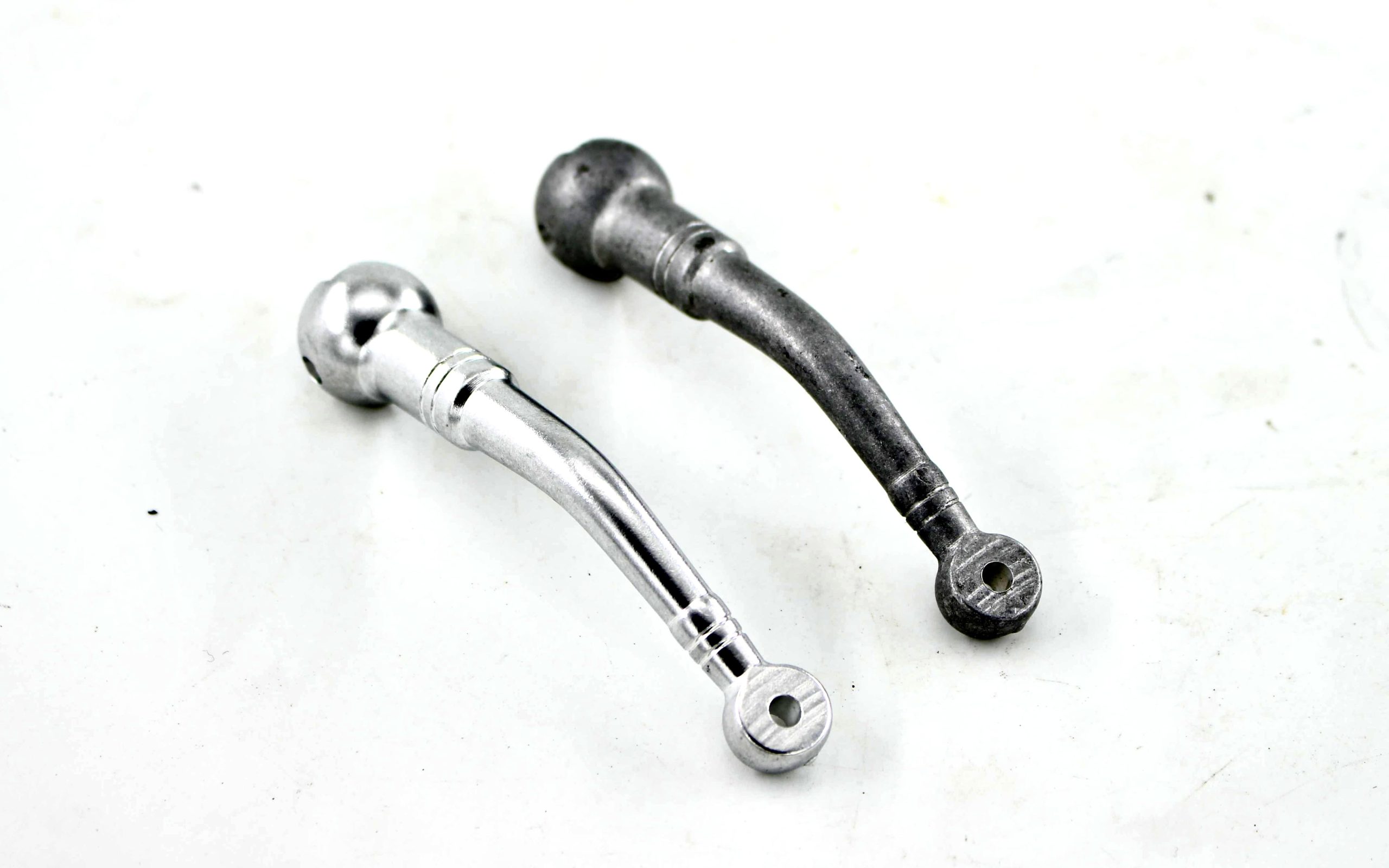
- Reduce surface roughness — smoothing machined or cast surfaces to a lower Ra value, improving sealing performance and coating adhesion
- Pre-treat for coating — creating a uniform surface texture that improves mechanical adhesion of plating, paint, anodizing, or PVD coatings
The liquid compound used during wet mass finishing is a critical process variable. The compound serves simultaneously as a lubricant (controlling the cut rate by modulating the friction between media and workpiece), a cleaning agent (suspending and flushing removed material from the bowl), and a surface conditioner (influencing the final surface chemistry, particularly important before plating or anodizing).
3. Ceramic Media Shapes — Function & Selection
The geometry of the ceramic chip is the most immediately impactful selection variable in mass finishing. Shape determines which surfaces the media can reach, how aggressively the cutting edges contact the workpiece, and critically, whether the media will become lodged inside holes, slots, or internal channels — a problem that can halt production and damage parts.
For a detailed decision guide that maps workpiece geometry to optimal media shape — including lodging risk assessment and two-stage process design — see our dedicated Ceramic Media Shapes Guide.
The Anti-Lodging Rule
Media lodging occurs when a chip enters a hole, bore, slot, or pocket in the workpiece and becomes wedged. Removing lodged media manually is time-consuming and can damage precision surfaces. The rule is straightforward: the smallest dimension of the media chip must be larger than the largest opening in the workpiece. If a part has a 10 mm bore, the minimum media dimension must exceed 10 mm — typically by a safety margin of 20–30%.
For parts with multiple feature sizes — some small, some large — where one media size cannot serve both, consider using a media stop (a plug that temporarily fills holes during processing) or a two-load approach: run a larger media for bulk deburring, then switch to a smaller media only for specific feature access in a second stage.
Never mix dramatically different media sizes in a single bowl. Large and small chips migrate differently under vibratory action — the small chips tend to sink to the bottom and concentrate under the parts, while large chips float to the top. This creates uneven processing and can cause part-on-part contact at the bottom of the bowl, leading to surface damage or dimensional change on delicate features.
4. Cut Rates, Abrasive Grades & Surface Finish
The cut rate of ceramic tumbling media — measured as the weight of material removed from a standard test coupon per unit time — is the most important process variable for cycle time and final surface finish. Cut rate is determined by three independent variables within the media formulation: abrasive type, abrasive grit size, and bond hardness. Understanding each allows you to specify the right media rather than relying on generic “fast cut” or “light cut” descriptions.
| Formulation Variable | Higher Value → | Lower Value → | Interaction Note |
|---|---|---|---|
| Abrasive Grit Size | Coarser grit = higher cut rate, rougher finish | Finer grit = lower cut rate, smoother finish | Dominant variable for final Ra value |
| Abrasive Content (%) | More abrasive = more cutting edges per chip = higher cut rate | Less abrasive = smoother cutting action, longer media life | Also affects media density and bowl loading weight |
| Bond Hardness | Harder bond = slower wear of chip, more consistent cut rate over time | Softer bond = faster exposure of fresh abrasive grains, higher initial cut rate | Soft bond better for hard workpieces; hard bond for soft workpieces |
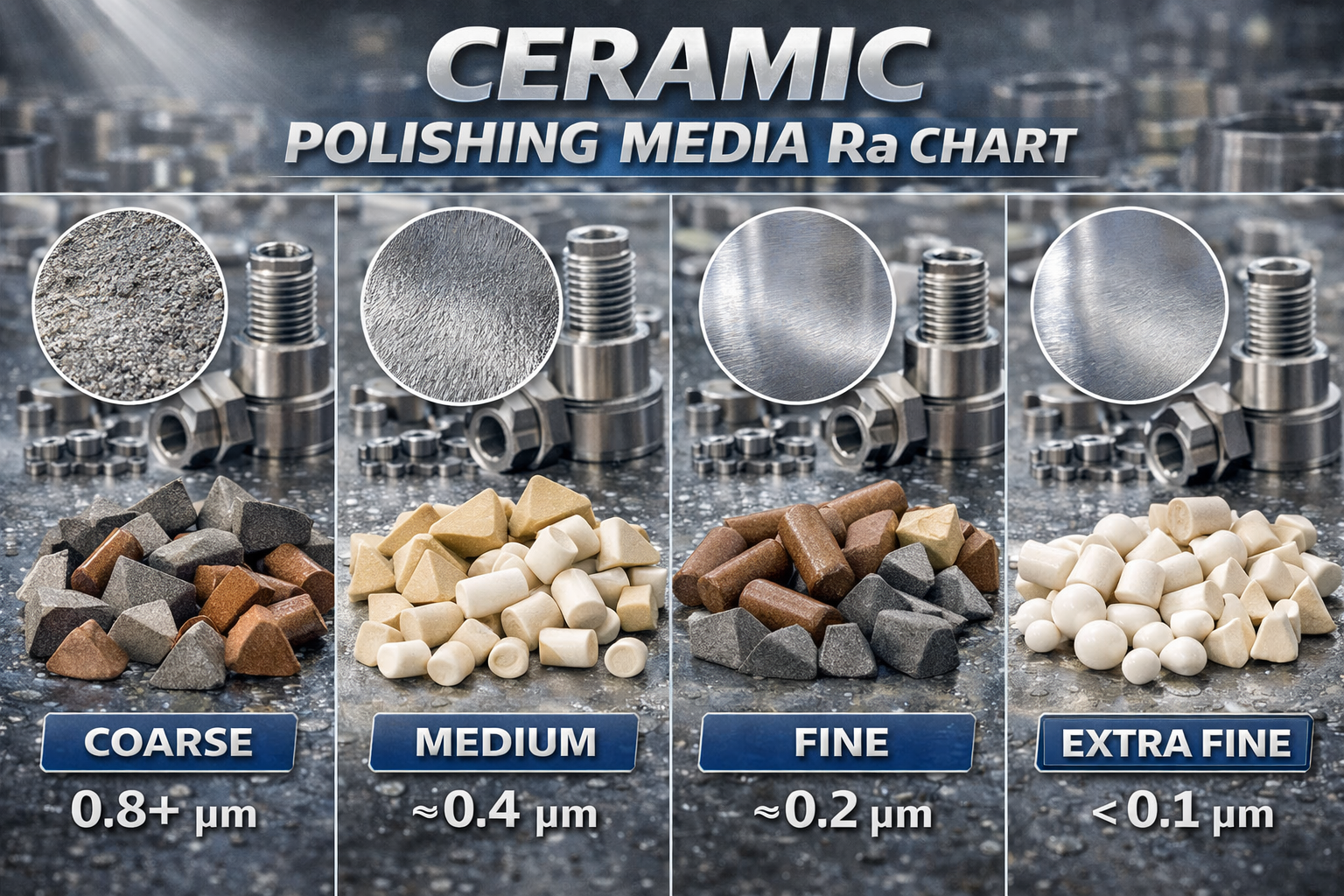
Target Surface Finish vs. Recommended Media Grade
| Application Stage | Burr / Stock to Remove | Target Ra (µm) | Recommended Grade | Typical Cycle Time |
|---|---|---|---|---|
| Heavy Deburring / Deflashing | Casting flash, forging scale, weld spatter (>0.5 mm height) | 1.6 – 3.2 | Coarse grit (36–60), high abrasive content, triangle or cylinder shape | 45 – 120 min |
| Standard Deburring | CNC machining, stamping, drilling burrs (0.1–0.5 mm) | 0.8 – 1.6 | Medium grit (80–120), balanced abrasive content, triangle or cylinder | 20 – 60 min |
| Pre-Plate / Pre-Coat Finishing | Light burrs, surface conditioning | 0.4 – 0.8 | Fine grit (150–220), lower abrasive content, cone or ball shape | 30 – 90 min |
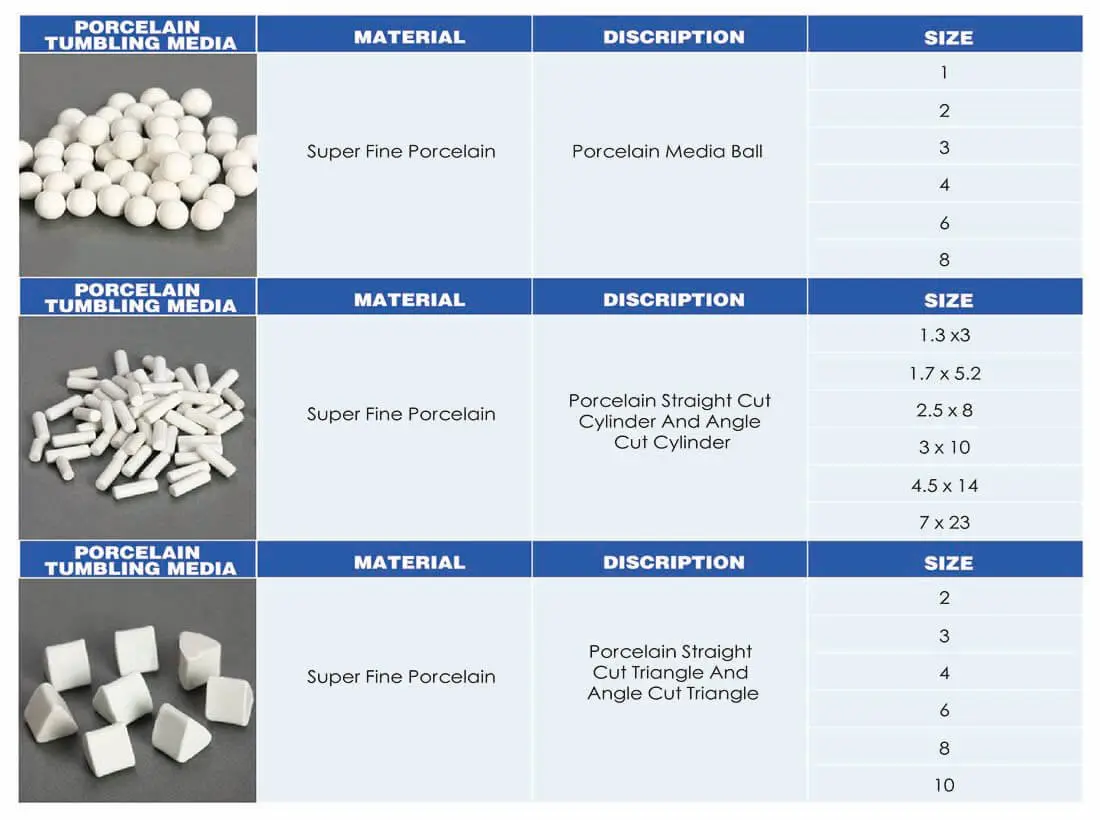
| Fine Finishing / Pre-Polish | Surface refinement, no burr removal | 0.1 – 0.4 | Very fine grit (320–400) or non-abrasive porcelain, ball or sphere shape | 60 – 180 min |
| Burnishing / Bright Finish | Cosmetic only, no stock removal | < 0.1 (bright) | Non-abrasive steel or porcelain media with burnishing compound | 20 – 60 min |
In multi-stage processes — common in aerospace and medical device finishing — parts progress through two, three, or even four sequential media loads, each progressively finer. The first stage handles bulk burr removal; subsequent stages refine the surface incrementally. While multi-stage processing adds handling time between cycles, it allows each stage to be independently optimized and produces surface finishes impossible to achieve in a single operation.
📄 Related: Ceramic Media for Deburring — Process Parameters, Media Selection & Cycle Time Optimization Including specific recommendations for laser-cut stainless steel, die-cast aluminum, and CNC-machined titanium5. Machine Types & Media Load Ratios
The machine type determines the motion pattern of the media-workpiece mass, which in turn controls the contact pressure, contact frequency, and the range of part sizes and geometries that can be safely processed. Selecting the wrong machine for an application wastes energy and produces inconsistent results; selecting the right machine combined with the appropriate ceramic media creates a repeatable, scalable industrial process.
5a. Vibratory Finishing Machines
Vibratory finishing is the most widely used mass finishing method globally. The eccentric weights on the machine motor create a three-dimensional vibratory motion that causes the entire media-part mass to circulate in a toroidal (doughnut-shaped) pattern. This gentle, continuous relative motion is suitable for most part sizes and geometries, including delicate thin-wall stampings that would be damaged in higher-energy machines. The primary advantage of vibratory finishing is process versatility: the same machine can run fine jewelry parts and heavy steel castings, with appropriate media and compound changes between jobs.
The key process parameter is amplitude (the peak-to-peak displacement of the vibratory motion, typically 2–8 mm) and frequency (60 Hz in North America, 50 Hz in Europe, though variable-frequency drives are common on modern machines). Higher amplitude increases cut rate but also increases the risk of part-on-part contact damage for delicate workpieces.
5b. Centrifugal Barrel Finishing (CBF)
Centrifugal barrel machines mount four or six barrels on a rotating turret. As the turret rotates, each barrel counter-rotates on its own axis. The resulting centrifugal forces — typically 5–25 times gravity — dramatically accelerate the grinding action compared to vibratory machines. What takes 2–4 hours in a vibratory machine can be accomplished in 10–30 minutes in a CBF machine with the same ceramic media formulation.
The higher energy also enables processing of harder workpiece materials (including hardened steel and titanium alloys) that are difficult to finish effectively in vibratory machines. The primary limitation is barrel volume: CBF barrels are small (typically 5–40 liters each), making the process unsuitable for large parts. It is the preferred process for high-value, precision small parts in aerospace fastener and medical implant manufacturing.
5c. Centrifugal Disc Finishing
Centrifugal disc machines feature a stationary tub with a high-speed rotating disc on the bottom. The disc flings the media-part mass upward and outward against the stationary tub wall, creating a high-energy toroidal flow at 3–6 G. Cycle times are 3–10× faster than vibratory finishing. The continuous-flow design — where media and parts can be added and removed through a separation screen while the machine runs — makes centrifugal disc ideal for high-volume, continuous production lines. Ceramic media used in disc machines should be dense (alumina 95%+ or zirconia) and relatively small (5–15 mm) to maintain proper flow dynamics in the high-centrifugal-force environment.
5d. Rotary Tumble Finishing
Rotary tumble barrels — the simplest and most economical mass finishing method — are horizontal rotating drums in which parts and media tumble together under gravity. Cut rates are the lowest of all machine types, and cycle times can range from hours to days for aggressive stock removal. However, rotary tumblers excel in applications where extremely gentle action is needed (preventing part-on-part impact), or where very large parts that cannot fit in vibratory bowls must be processed. Ceramic media selection for rotary tumblers favors larger chip sizes (20–80 mm) with dense, hard bond systems that survive the repeated impact of the tumbling action.
6. Workpiece Material Compatibility
Ceramic tumbling media is compatible with a wide range of workpiece materials, but each material has specific considerations that affect media selection, compound choice, and process parameters.
| Workpiece Material | Media Grade | Key Consideration | Compound Requirement |
|---|---|---|---|
| Carbon Steel / Alloy Steel | Standard alumina, medium grit | Rust can form if parts are left wet after processing — dry or oil-coat immediately | Rust-inhibiting compound essential |
| Stainless Steel (304, 316, 17-4) | Alumina or high-density alumina, fine to medium grit | Work-hardening means cutting action slows at higher Ra — plan for incremental media steps | Non-ferrous-safe, neutral to mildly alkaline |
| Titanium Alloys (Ti-6Al-4V) | Dense alumina or zirconia, medium grit; CBF machine preferred | Low thermal conductivity — high-energy processes can cause surface discoloration; control amplitude | Neutral pH, high lubricity compound |
| Aluminum (6061, 7075, die-cast) | Non-ferrous-safe alumina, medium to fine grit; avoid iron-oxide binder | Soft material — over-processing removes too much stock; monitor cycle time closely | Acidic brightening compound for die-cast; neutral for wrought |
| Copper / Brass / Bronze | Non-ferrous-safe, fine grit alumina or burnishing media | High ductility — burrs roll rather than fracture; may need aggressive media with longer cycle | Non-ferrous brightening compound |
| Hardened Tool Steel (>55 HRC) | Dense alumina or SiC, coarse–medium grit; CBF required for meaningful cut rate | Standard vibratory action is too gentle — centrifugal barrel is typically necessary | Standard alkaline deburring compound |
For an in-depth comparison of how ceramic media stacks up against plastic and steel media for each of these workpiece materials, see our resource: Ceramic vs. Plastic vs. Steel Media — Full Comparison Guide.
7. Compounds, Water Chemistry & pH
The liquid compound used in wet mass finishing is not an afterthought — it is an active process variable that modulates cut rate, controls surface chemistry, and protects both the workpiece and the media from undesired chemical attack. Running ceramic tumbling media with plain water, or with an incompatible compound, produces inconsistent results and can accelerate media wear by an order of magnitude.
The Five Functions of a Mass Finishing Compound
- Lubrication: Reduces friction between media and workpiece, controlling how aggressively the abrasive cuts. Without lubrication, ceramic media cuts faster but leaves a rougher, more torn surface.
- Flushing: Suspends the swarf (removed material) and carries it out of the bowl through the drain, preventing it from redepositing onto parts or embedding into the media surface.
- Cleaning: Emulsifies oils, coolants, and release agents from the workpiece surface — particularly important after CNC machining where cutting oil must be removed before finishing.
- Surface protection: Rust inhibitors protect ferrous parts from flash rusting during and after wet processing. Anti-stain agents protect copper and brass from oxidation discoloration.
- pH control: The compound buffers the slurry pH to a range compatible with both the ceramic media and the workpiece material. Most alumina ceramic media performs best between pH 7 and pH 10.
Water hardness matters more than most users realize. Hard water (high Ca²⁺ and Mg²⁺) forms insoluble calcium and magnesium salts when it reacts with alkaline compounds, depositing a white scale on parts and media that is difficult to remove and reduces process consistency. For production environments with water hardness above 200 ppm CaCO₃, use a softened water supply or a compound specifically formulated for hard water — or install a water softener on the machine supply line.
8. Process Setup: A Step-by-Step Framework
Setting up a new ceramic tumbling media process from scratch follows a logical sequence. Skipping steps — particularly the trial validation phase — is the most common cause of production problems that take weeks to diagnose and resolve.
-
1Define the Starting Condition and the Target
Document the incoming part: material, hardness, manufacturing process (cast, machined, stamped, laser-cut), burr height and location, current surface roughness Ra, and any features at risk of lodging. Define the target: burr-free (yes/no), target Ra value, acceptable edge radius range, and any downstream process requirements (plating bath compatibility, dimensional tolerances).
-
2Select Machine Type Based on Part Size and Required Energy
Parts larger than 200 mm in any dimension typically require a tub vibratory or rotary tumbler. Parts smaller than 100 mm with moderate burrs are well-served by round bowl vibratory. Hardened parts or aggressive cycle-time targets point toward centrifugal barrel or disc. Match the machine to the application before selecting media.
-
3Select Media Shape, Size, and Grade
Apply the anti-lodging rule to determine the minimum acceptable media dimension. Select shape based on workpiece geometry (see Section 3 and our Shapes Guide). Select grit and abrasive content based on burr severity and target Ra. When uncertain, start with a medium-cut, general-purpose grade and adjust based on trial results.
-
4Set the Media-to-Parts Load Ratio
For vibratory machines: begin with a 4:1 volume ratio (media:parts). Total bowl fill should be 80–85% of bowl volume. For CBF: follow the machine manufacturer’s barrel fill specifications — typically 60–80% of barrel volume total, with parts not exceeding 25% of barrel volume. Adjust ratio based on trial results: if parts damage each other, increase the ratio; if cut rate is too slow, slightly reduce the ratio (more parts per unit of media = more cutting contacts per part per unit time, up to a limit).
-
5Run a Timed Trial and Measure at Intervals
Run the first trial at the expected cycle time, then pull representative parts at 25%, 50%, 75%, and 100% of the cycle. Measure burr height, Ra, and edge radius at each point. Plot the results to understand the process curve — most mass finishing processes show rapid initial improvement that slows asymptotically. Identify the point of diminishing returns and set the production cycle time there, not at 100% of the initial estimate.
-
6Document the Validated Process as a Work Instruction
Record: media grade and lot, media load weight, part load count and weight, compound type and concentration (mL/min flow rate or batch concentration), machine amplitude and frequency settings, cycle time, and accept/reject criteria. In regulated industries (aerospace, medical), this process specification becomes part of the formal process control documentation and cannot be changed without a formal engineering change notice.
9. Frequently Asked Questions
Ceramic tumbling media are shaped chips used in mass finishing machines to improve the surface quality of manufactured parts — removing burrs, radiusing edges, and reducing surface roughness. Ceramic grinding media are high-density beads used inside mills to reduce solid materials to fine particles. They are entirely different products used in entirely different processes. The shared “ceramic” label reflects their common raw material base (aluminum oxide, zirconia, or silicon carbide), not their function.
In a well-managed vibratory finishing operation running typical medium-cut ceramic media against steel or stainless steel workpieces, a media charge typically lasts 800–2,000 hours of processing time. Lifespan depends heavily on the aggressiveness of the process (cut rate, machine energy, compound pH), the hardness and abrasiveness of the workpiece material, and whether fines are regularly screened out of the bowl. Operating below pH 6 or above pH 11 dramatically accelerates chemical dissolution of the ceramic bond and shortens media life significantly.
Yes, dry vibratory finishing with ceramic media is possible and used in specific applications — particularly for deburring parts that cannot be exposed to water (certain electronics assemblies, parts that would corrode immediately on water contact, or pre-sintered ceramic blanks). However, dry processing generates significantly more dust, creates higher frictional heat, and produces a less consistent surface finish than wet processing. Media wear rates in dry operation are also typically 3–5 times higher than in wet operation. If wet processing is feasible for the application, it is strongly preferred.
For thin-wall stampings or delicate formed parts where part-on-part contact must be prevented, use a media-to-parts volume ratio of at least 5:1, and consider 6:1 or higher for the most fragile geometries. The high media volume ensures that parts are always cushioned by media chips and cannot collide directly with each other. Also reduce machine amplitude to its minimum effective setting, and use a lighter-cut, smaller-chip media to reduce the force of individual chip-to-part contacts. Running with a light, high-lubricity compound further reduces the force of each contact event.
Yes. Jiangsu Henglihong Technology Co., Ltd. manufactures ceramic tumbling media in all standard shapes (triangles, cylinders, diagonal cylinders, cones, tri-stars, and spheres) across a full size range from 5 mm to 80 mm, and in multiple abrasive grades from heavy-cut to non-abrasive porcelain. Custom formulations — including specific grit size, abrasive content, bond hardness, shape modifications, and dimensional tolerances — are available for applications with performance requirements that standard grades cannot meet. Contact our technical team with your part specifications and finishing targets for a custom recommendation.
Get the Right Ceramic Tumbling Media for Your Process
Share your part drawing, workpiece material, and finishing target with our team at Jiangsu Henglihong Technology Co., Ltd. We will recommend the optimal media grade and shape — and provide samples for a trial run at no cost.
Request Media Samples & Process Support →Filters