Blasting Media Grit Size & Mesh Size Guide: How to Read & Convert
A complete cross-standard reference for abrasive blasting media particle sizing — covering FEPA, ANSI, US MESH, JIS, and SAE standards with full conversion tables, surface profile data, and application-based grit size selection guidance.
- Why Particle Sizing Matters
- How Abrasive Sizing Works
- Major Sizing Standards Explained
- FEPA Grit Size Chart (Al₂O₃ & SiC)
- US Mesh Size Chart (Glass Bead & Garnet)
- SAE Size Chart (Steel Shot & Grit)
- Cross-Standard Conversion Table
- Grit Size vs Surface Profile Depth
- Application-Based Grit Size Selection
- Frequently Asked Questions
Why Particle Sizing Matters
Grit size is the parameter that most directly controls surface profile depth in abrasive blasting — and surface profile depth is one of the most critically specified variables in industrial coating application and shot peening. Selecting the wrong grit size produces a profile either too shallow for adequate coating adhesion, or unnecessarily deep — wasting abrasive and creating coating thickness variation that compromises service life.
Despite being critically important, abrasive particle sizing is one of the most frequently misunderstood aspects of blasting media specification. Different industries, regions, and media types use different sizing standards — FEPA, ANSI, US Mesh, JIS, SAE — that are not directly interchangeable. Specifying “60 grit” without naming the standard invites the wrong media: FEPA F60 and US Mesh 60 are different particle sizes, and using one where the other is intended will produce incorrect results.
This guide resolves that ambiguity by covering all major standards, providing full conversion tables, and mapping grit sizes to the surface profiles and applications they produce. For broader context on media selection beyond sizing, see: Abrasive Blasting Media Complete Guide.
How Abrasive Particle Sizing Works
Abrasive particle size is determined by sieve analysis — passing the material through a series of standardized wire mesh screens with precisely defined opening sizes. Particles that pass through a given sieve but are retained on the next finer sieve are classified as belonging to that size fraction.
The fundamental unit is the sieve opening size in microns (µm), the actual physical dimension of particles in a given fraction. All sizing standards ultimately reference micron dimensions, even though they label products differently.
The single most important principle to remember: higher grit or mesh number = smaller particles = finer finish and shallower profile. Lower number = larger particles = coarser, deeper profile. This inverse relationship is consistent across all standards, even though the numbers themselves differ.
The number represents sieve openings per linear inch — more openings per inch means smaller openings, meaning only smaller particles pass through. So F120 grit is finer than F36, just as US 120 mesh is finer than US 36 mesh. The intuition that “bigger number = bigger particle” is wrong for all abrasive sizing systems.
Major Sizing Standards Explained
FEPA (Federation of European Producers of Abrasives) — F-Series
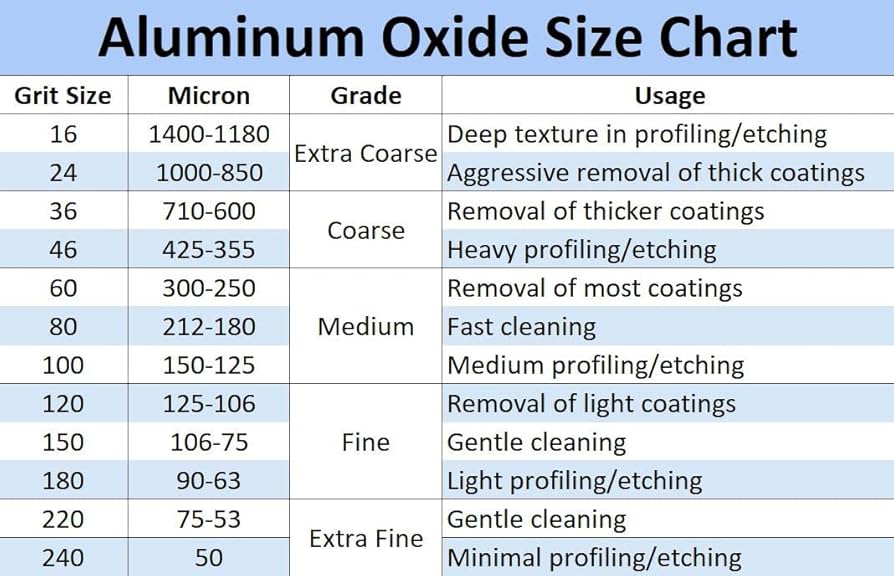
FEPA is the primary standard for synthetic abrasives — aluminum oxide and silicon carbide — in Europe and internationally. The F-series (free abrasive grain) applies to blasting, lapping, and polishing applications. FEPA F-grit sizes run from F4 (very coarse, ~4,000 µm) through F1200 (ultra-fine, ~4 µm). Jiangsu Henglihong Technology uses FEPA for all aluminum oxide and silicon carbide product specifications.
ANSI (American National Standards Institute) — B74.12
ANSI B74.12 defines abrasive grain sizes for the US market. ANSI grade designations (ANSI 36, 60, 80, etc.) roughly correspond to FEPA F-series numbers in nominal particle size, but particle size distribution requirements differ slightly. For most industrial applications the two are functionally interchangeable at the same grade number, but strict compliance specifications require confirming which standard governs.
US Mesh (ASTM E11 / Tyler Mesh)
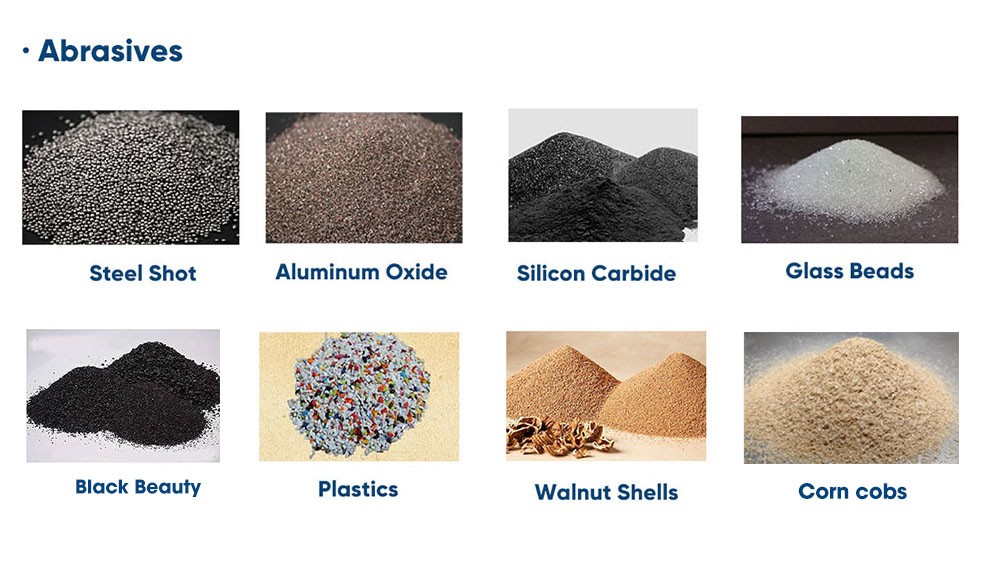
US mesh sizing is used primarily for glass beads, garnet, walnut shell, corn cob, and other non-synthetic media. The mesh number equals openings per linear inch in the sieve screen. Blasting applications use US mesh from approximately 6 (coarse, ~3,360 µm) through 400 (ultra-fine, ~37 µm). Garnet is commonly specified in double-fraction notation (e.g., 30/60 — retained on US 30, passing US 60 — equivalent to 250–600 µm particle range).
SAE (Society of Automotive Engineers)
SAE standards govern steel shot and steel grit sizing. Steel shot grades are designated S-110 through S-780; steel grit grades G-10 through G-120. SAE J827 (shot) and SAE J1993 (grit) define each grade’s size distribution. ISO equivalents are ISO 11124-2 (steel grit) and ISO 11124-3 (steel shot).
JIS (Japanese Industrial Standard) — R6001
JIS R6001 is closely aligned with FEPA F-series for most commercial blasting grades. JIS uses the same grade designation numbers as FEPA at common sizes (JIS #36 ≈ FEPA F36). For cross-border procurement involving Japanese manufacturers or specifications, JIS and FEPA are largely interchangeable at equivalent grade numbers.
FEPA Grit Size Chart — Aluminum Oxide & Silicon Carbide
| FEPA Grade | Nominal D50 (µm) | Sieve Range (µm) | ANSI Equiv. | JIS Equiv. | Profile Ra (µm) | Primary Blasting Use |
|---|---|---|---|---|---|---|
| F12 | 1,700 | 1,400–2,360 | ANSI 12 | #12 | 100–160 | Very heavy scale, extreme profiling |
| F16 | 1,180 | 1,000–1,700 | ANSI 16 | #16 | 80–130 | Heavy mill scale removal |
| F24 | 710 | 600–850 | ANSI 24 | #24 | 60–100 | Aggressive rust/scale removal |
| F30 | 589 | 500–710 | ANSI 30 | #30 | 50–85 | Heavy coating prep |
| F36 | 500 | 425–600 | ANSI 36 | #36 | 40–75 | Standard coating prep (Sa 2.5), thermal spray |
| F46 | 390 | 355–500 | ANSI 46 | #46 | 35–60 | General industrial blasting |
| F54 | 340 | 300–425 | ANSI 54 | #54 | 28–50 | Medium-duty coating prep |
| F60 | 268 | 250–355 | ANSI 60 | #60 | 22–42 | Precision coating prep, light deburring |
| F80 | 196 | 180–250 | ANSI 80 | #80 | 14–28 | Precision deburring, pre-plate conditioning |
| F100 | 154 | 125–180 | ANSI 100 | #100 | 10–20 | Fine surface prep, lapping prep |
| F120 | 127 | 106–150 | ANSI 120 | #120 | 8–15 | Fine deburring, pre-anodizing |
| F150 | 97 | 75–125 | ANSI 150 | #150 | 5–12 | Satin surface conditioning |
| F180 | 78 | 63–90 | ANSI 180 | #180 | 4–9 | Fine finishing, pre-polish prep |
| F220 | 58 | 45–75 | ANSI 220 | #220 | 3–7 | Ultra-fine conditioning |
| F280–F1200 | 4–40 | — | ANSI 240–1200 | #240+ | <5 | Lapping, polishing, optical surface finishing |
US Mesh Size Chart — Glass Bead & Garnet
| US Mesh Size | Sieve Opening (µm) | Approx. Particle Dia. (µm) | FEPA Approx. | Profile Ra (µm) | Primary Use |
|---|---|---|---|---|---|
| US 16 | 1,190 | 1,000–1,400 | F16 | 80–130 | Coarse garnet — heavy scale removal |
| US 20 | 841 | 710–1,000 | F20–F24 | 65–100 | Garnet heavy duty; large glass bead peening |
| US 30 | 595 | 500–710 | F30 | 50–80 | Garnet 20/30 blend — marine heavy duty |
| US 40 | 420 | 355–500 | F36–F46 | 35–65 | Garnet standard; glass bead medium peening |
| US 60 | 250 | 212–300 | F54–F60 | 25–45 | Garnet 30/60 marine coating prep |
| US 80 | 177 | 150–212 | F80 | 14–26 | Standard glass bead industrial peening |
| US 100 | 149 | 125–177 | F100 | 10–18 | Glass bead decorative finish (stainless) |
| US 120 | 125 | 106–149 | F120 | 7–14 | Glass bead fine satin finish |
| US 170 | 88 | 74–106 | F150 | 4–9 | Glass bead ultra-fine; garnet waterjet cutting |
| US 200 | 74 | 63–88 | F180 | 3–7 | Fine glass bead — medical/aerospace finishing |
| US 270 | 53 | 44–63 | F220 | 2–4 | Ultra-fine glass bead; precision lapping prep |
| US 325 | 44 | 37–53 | F230 | 1–3 | Finest standard blasting; semiconductor component cleaning |
| US 400 | 37 | 30–44 | F240+ | <2 | Ultra-fine precision applications |
SAE Size Chart — Steel Shot & Steel Grit
| SAE Shot Grade | Nominal Dia. (mm) | Equivalent Grit Grade | ISO 11124 Equiv. | Grit Profile Ra (µm) | Shot — Typical Almen Intensity |
|---|---|---|---|---|---|
| S-110 | 0.30 | G-120 | S170 / G120 | 2–5 (grit) | Very light — precision aerospace peening |
| S-170 | 0.43 | G-80 | S230 / G80 | 3–8 | Light — precision component peening |
| S-230 | 0.60 | G-50 | S280 / G50 | 4–10 | Standard — automotive spring peening |
| S-280 | 0.71 | G-40 | S330 / G40 | 5–12 | Medium — crankshaft and gear peening |
| S-330 | 0.86 | G-25 | S390 / G25 | 6–15 | Heavy — structural peening |
| S-390 | 1.00 | G-18 | S460 / G18 | 8–18 | Very heavy — shipyard and bridge work |
| S-460 | 1.18 | G-14 | S550 / G14 | 10–20 | Maximum standard intensity |
| S-550 | 1.40 | G-10 | S660 / G10 | 12–25 | Heavy industrial applications |
| S-660 | 1.70 | — | S780 | — | Extra heavy structural / foundry |
| S-780 | 2.00 | — | S930 | — | Maximum shot size — foundry cleaning |
Cross-Standard Conversion Table
The table below provides approximate cross-standard equivalents based on median particle size (D50). These are approximations — the actual particle size distribution requirements defined by each standard differ, so always consult the full standard document for critical applications.
| Particle D50 (µm) | FEPA Grade | ANSI Grade | US Mesh | JIS Grade | Application Zone |
|---|---|---|---|---|---|
| 1,700 | F12 | ANSI 12 | US 12 | #12 | Very coarse — extreme profiling |
| 1,180 | F16 | ANSI 16 | US 16 | #16 | Coarse — heavy mill scale |
| 710 | F24 | ANSI 24 | US 25 | #24 | Coarse — aggressive rust removal |
| 500 | F36 | ANSI 36 | US 35 | #36 | Medium-coarse — standard coating prep |
| 390 | F46 | ANSI 46 | US 45 | #46 | Medium — general industrial blasting |
| 268 | F60 | ANSI 60 | US 60 | #60 | Medium-fine — precision coating prep |
| 196 | F80 | ANSI 80 | US 80 | #80 | Fine — deburring, pre-plate conditioning |
| 127 | F120 | ANSI 120 | US 120 | #120 | Fine — surface conditioning |
| 78 | F180 | ANSI 180 | US 170 | #180 | Very fine — finishing |
| 58 | F220 | ANSI 220 | US 230 | #220 | Ultra-fine — polishing prep |
| 29 | F320 | ANSI 320 | US 400 | #320 | Polishing grade |
| 15 | F500 | ANSI 500 | — | #500 | Lapping grade |
Cross-standard conversions based on D50 (median) particle size are approximations only. Each standard defines a complete particle size distribution — the permitted range from minimum to maximum — not just a single number. A FEPA F36 and an ANSI 36 have similar D50 but may differ in their maximum allowed particle size (D99), which affects peak profile depth and blasting consistency. For critical specifications (aerospace, marine corrosion protection, thermal spray), always obtain and compare the full particle size distribution data sheet from your supplier under the governing standard.
Grit Size vs Surface Profile Depth
The table below maps grit sizes to achievable surface profiles for the three most common industrial blasting media. Values represent typical results at 60–90 PSI, 15–30 cm standoff distance, and 75–90° impingement angle on carbon steel. Actual profiles vary with pressure, nozzle type, standoff, angle, and substrate hardness — always measure actual profiles with replica tape or a contact profilometer before committing to production blasting parameters.
| Grit / Mesh Size | Al₂O₃ Ra (µm) | Al₂O₃ Rz (µm) | Steel Grit GL Ra (µm) | Steel Grit Rz (µm) | Garnet Ra (µm) | Garnet Rz (µm) |
|---|---|---|---|---|---|---|
| F16 / US 16 / G-14 | 12–20 | 80–150 | 15–24 | 95–170 | — | — |
| F24 / US 25 / G-18 | 8–14 | 55–100 | 10–18 | 65–130 | 7–12 | 50–90 |
| F36 / US 35 / G-25 | 5–10 | 35–72 | 6–12 | 40–85 | 5–9 | 35–65 |
| F46 / US 45 / G-40 | 4–8 | 27–58 | 5–10 | 32–68 | 4–8 | 26–55 |
| F60 / US 60 / G-50 | 3–6 | 20–44 | 4–9 | 25–60 | 3–6 | 20–42 |
| F80 / US 80 / G-80 | 2–4 | 12–28 | 3–7 | 18–45 | 2–4 | 12–28 |
| F100–F120 / US 100–120 | 1–3 | 6–18 | 2–5 | 10–30 | 1–3 | 6–18 |
| F150–F220 / US 150–230 | 0.5–2 | 3–10 | — | — | 0.5–2 | 3–10 |
If there is one grit size zone to memorize, it is the F36–F60 range for angular media. This zone produces Ra 3–10 µm and Rz 20–72 µm — the profile depth range specified by the vast majority of industrial protective coating systems for Sa 2.5 surface preparation. More blasting operations worldwide are specified in this zone than any other. F36 or G-25 is the most commonly specified single grit size in heavy industrial coating contracts globally.
Application-Based Grit Size Selection Guide
Use this table to directly look up the recommended grit size for common industrial applications. For applications not listed, use the profile data tables above to identify the grit size that achieves the required Ra or Rz, then confirm with a test blast before production.
| Application | Required Profile | Al₂O₃ Grit | Steel Grit | Garnet Mesh | Glass Bead Mesh |
|---|---|---|---|---|---|
| Heavy mill scale removal (Sa 3) | Rz 80–150 µm | F16–F24 | G-14–G-18 GH | 16/20 | Not suitable |
| Epoxy/polyurethane coating prep (Sa 2.5) | Rz 40–75 µm | F36–F60 | G-25–G-50 GL | 20/40–36/60 | Not suitable |
| Zinc-rich primer prep | Rz 50–100 µm | F24–F46 | G-25–G-40 GL/GH | 16/20–20/40 | Not suitable |
| Thermal spray bond coat prep | Ra 5–12 µm | F46–F60 | G-40–G-50 GL | 30/60 | Not suitable |
| Precision deburring (carbon steel) | Ra 2–5 µm | F80–F120 | G-50–G-80 GP | 60/100 | US 80–120 |
| Pre-plate / pre-anodize conditioning | Ra 1–3 µm | F100–F150 | Not typical | 80/120 | US 100–170 |
| Stainless steel satin finish | Ra 0.4–1.5 µm | White F150–F220 | Not suitable | Not typical | US 100–170 |
| Shot peening — automotive components | Almen 0.15–0.30A | Not suitable | S-230–S-330 | Not suitable | US 70–100 (AMS 2431) |
| Shot peening — aerospace precision | Almen 0.006–0.012A | Not suitable | S-110–S-170 | Not suitable | US 170–230 |
| Marine hull prep (NORSOK M-501) | Rz 40–70 µm, Sa 2.5 | F36–F60 | G-25–G-50 GL | 20/40–36/60 | Not suitable |
| Concrete floor surface prep | CSP 3–5 profile | F24–F46 | G-25–G-40 | 20/40 | Not suitable |
| Garnet waterjet cutting abrasive | N/A — cutting | Not typical | Not suitable | 80/120–120/200 | Not suitable |
| Glass etching / engraving | Controlled depth | F80–F180 | Not suitable | Not typical | US 80–170 |
| Engine carbon deposit removal | No profiling | Not suitable | Not suitable | Not typical | US 80–120 or Walnut shell |
For media-specific grit size guidance, refer to the individual media type guides: Aluminum Oxide Grit Sizes · Silicon Carbide Grit Sizes · Glass Bead Mesh Sizes · Steel Shot & Grit SAE Sizes.
Need Grit Size Specifications for Your Application?
Jiangsu Henglihong Technology supplies aluminum oxide (F12–F1200), silicon carbide (F16–F1200), glass beads (US 20–US 400), and steel shot/grit (full SAE range), with complete particle size distribution certificates per FEPA/ANSI/SAE for every production batch. Contact us with your required surface profile and we will recommend the optimal grade.
Request a Grit Size RecommendationFrequently Asked Questions
Filters