Abrasive Media Grit & Mesh Size Chart: Complete Reference Guide
Specifying abrasive media grit size sounds simple until you realize that the same number — “80 grit,” for example — means a different particle size depending on whether the supplier is using FEPA, ANSI, JIS, or mesh standards. A procurement engineer ordering aluminum oxide “80 grit” without specifying the applicable standard may receive a product with a mean particle diameter 20–30% different from what the process specification requires. For industrial blasting, lapping, sandcarving, and lapidary applications where the grit size directly determines the surface profile or finish quality achieved, this discrepancy is not a minor inconvenience — it is a root cause of surface preparation failures, profile non-conformances, and rejected blasting inspection results.
This complete reference guide explains the major grit sizing standards in use globally, provides cross-reference tables between standards, and includes media-specific size charts for each principal abrasive family. For the full abrasive media purchasing context, see the Abrasive Media Supplies Buyer’s Guide.
Major Grit Sizing Standards
Four primary standards govern abrasive grit size classification in industrial and precision applications:
- FEPA (Federation of European Producers of Abrasives) — the dominant standard in Europe and most international industrial applications. The F-series (loose grain for blasting and lapping) and P-series (coated abrasive products) use the same number system but define different particle size windows. FEPA F 80 ≠ FEPA P 80.
- ANSI B74.12 — the US standard for bonded and coated abrasive grain, maintained by the American National Standards Institute. Numbers broadly correspond to FEPA at coarser sizes but diverge significantly at finer grits.
- JIS R6001 — the Japanese Industrial Standard for abrasive grain sizing. Used for alumina and SiC products manufactured or specified in Japan, Taiwan, and South Korea. Follows FEPA closely at most sizes but with slightly different sieve window definitions.
- US Mesh (Tyler and US Standard) — wire sieve mesh number = number of wires per inch. Used for natural minerals (garnet, copper slag) and for coarser grain sizes where FEPA numbers are not applied. Higher mesh number = smaller particle. Not the same as grit number.
Always specify the standard when ordering: When issuing a purchase order for abrasive media, always state the applicable standard — “80 grit FEPA F”, “80 mesh US Standard”, or “SAE J827 S-230”. Never rely on grit number alone.
FEPA vs ANSI Cross-Reference Table
| FEPA F Grade | ANSI Grit | Mean Particle Size (µm) | Approx. US Mesh |
|---|---|---|---|
| F 12 | 12 | ~1,700 µm | 12 |
| F 16 | 16 | ~1,200 µm | 14 |
| F 20 | 20 | ~850 µm | 18 |
| F 24 | 24 | ~710 µm | 20 |
| F 30 | 30 | ~590 µm | 25 |
| F 36 | 36 | ~500 µm | 30 |
| F 46 | 40 | ~370 µm | 40 |
| F 54 | 46 | ~310 µm | 45 |
| F 60 | 54 | ~265 µm | 50 |
| F 70 | 60 | ~225 µm | 60 |
| F 80 | 70 | ~190 µm | 70 |
| F 90 | 80 | ~154 µm | 80 |
| F 100 | 90 | ~129 µm | 100 |
| F 120 | 100 | ~109 µm | 120 |
| F 150 | 120 | ~82 µm | 150 |
| F 180 | 150 | ~69 µm | 180 |
| F 220 | 180 | ~58 µm | 220 |
| F 240 | 220 | ~44 µm | 270 |
| F 280 | 240 | ~36 µm | 325 |
| F 320 | 280 | ~29 µm | 400 |
| Note: Mean particle sizes are nominal midpoints; actual distributions vary by material and manufacturer. FEPA and ANSI numbers diverge progressively at finer grits — never assume equivalence without checking this table. | |||
Mineral & Synthetic Abrasives: Full Size Chart
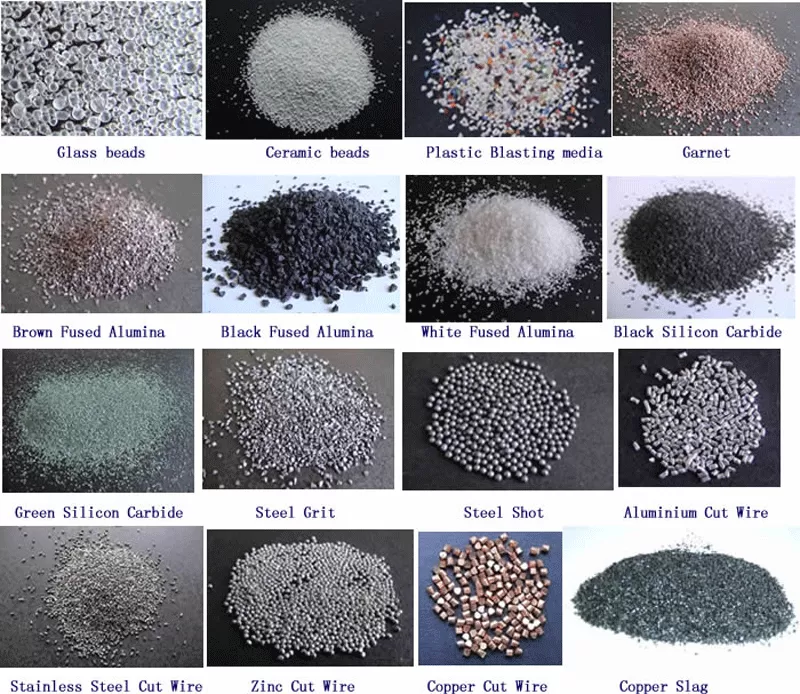
The following chart covers aluminum oxide and silicon carbide — the two main synthetic abrasives available from Jiangsu Henglihong Technology Co., Ltd. — across the commercially significant FEPA F-series range, with approximate achievable surface profile (Rz) on carbon steel under moderate blast conditions (80 psi, #6 nozzle). For full Al₂O₃ details: Aluminum Oxide Abrasive Media Guide. For SiC details: Silicon Carbide Abrasive Media Guide.
| FEPA F Grit | Mean Size (µm) | Al₂O₃ Profile Rz (steel) | SiC Profile Rz (steel) | Primary Use Category |
|---|---|---|---|---|
| F 16–F 20 | 850–1,200 µm | 80–120 µm | 90–130 µm | Aggressive profiling, heavy scale removal |
| F 24–F 30 | 590–710 µm | 65–90 µm | 70–100 µm | Heavy industrial coating prep, Sa 3 |
| F 36–F 46 | 370–500 µm | 45–70 µm | 50–80 µm | Standard industrial blast, Sa 2.5 |
| F 60–F 80 | 190–265 µm | 25–45 µm | 30–50 µm | Sandcarving, general purpose, thin coatings |
| F 100–F 120 | 109–154 µm | 15–28 µm | 18–32 µm | Precision surface prep, aluminum, stainless |
| F 150–F 220 | 58–82 µm | 8–15 µm | 10–18 µm | Pre-lapping, thermal spray prep, fine finishing |
| F 240–F 320 | 29–44 µm | 4–8 µm | 5–10 µm | Lapping, optics, semiconductor prep |
Metallic Blast Media: SAE Shot and Grit Standards
| SAE Designation | Type | Mean Diameter (mm) | Hardness (HRC) | Standard | Typical Profile Rz |
|---|---|---|---|---|---|
| S-70 | Shot | 0.18 mm | 40–51 | SAE J827 | 15–25 µm |
| S-110 | Shot | 0.30 mm | 40–51 | SAE J827 | 20–35 µm |
| S-170 | Shot | 0.43 mm | 40–51 | SAE J827 | 25–40 µm |
| S-230 | Shot | 0.60 mm | 40–51 | SAE J827 | 30–50 µm |
| S-330 | Shot | 0.85 mm | 40–51 | SAE J827 | 35–55 µm |
| S-460 | Shot | 1.18 mm | 40–51 | SAE J827 | 40–65 µm |
| S-550 | Shot | 1.40 mm | 40–51 | SAE J827 | 45–70 µm |
| S-780 | Shot | 2.00 mm | 40–51 | SAE J827 | 55–85 µm |
| GL 120 | Grit | 0.18 mm | 54–65 | SAE J1993 | 20–35 µm |
| GL 80 | Grit | 0.30 mm | 54–65 | SAE J1993 | 30–50 µm |
| GL 40 | Grit | 0.60 mm | 54–65 | SAE J1993 | 50–80 µm |
| GL 25 | Grit | 0.85 mm | 54–65 | SAE J1993 | 65–100 µm |
| GL 16 | Grit | 1.40 mm | 54–65 | SAE J1993 | 80–130 µm |
Natural Abrasives: Mesh Size Reference
| Media | US Mesh Designation | Particle Size Range | Typical Profile Rz | Application |
|---|---|---|---|---|
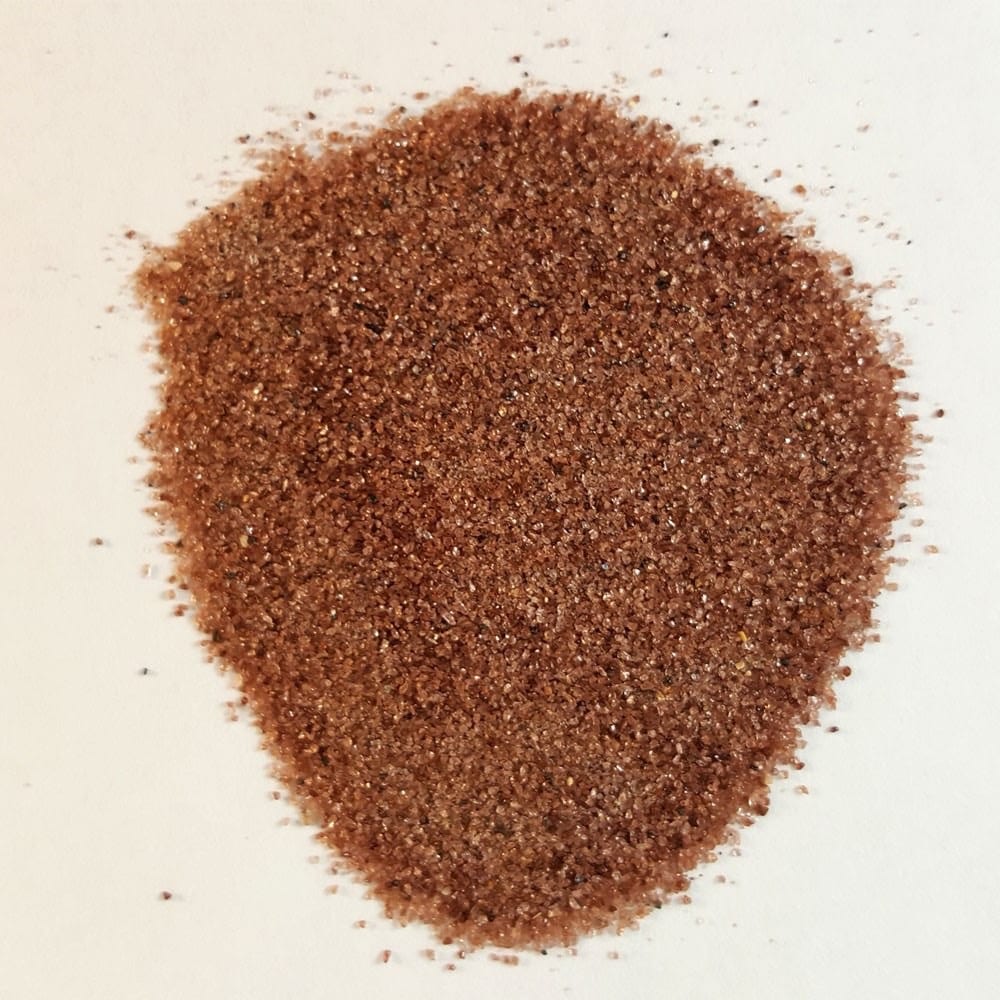
| Garnet | #12 / #20 | 850–1,700 µm | 80–120 µm | Heavy scale / thick coating removal |
| Garnet | #20 / #40 | 420–850 µm | 55–90 µm | Industrial surface prep, Sa 2.5–Sa 3 |
| Garnet | #30 / #60 | 250–600 µm | 40–70 µm | Pipeline, marine, infrastructure (most common) |
| Garnet | #80 | 150–210 µm | 25–45 µm | Thin-film coating systems, aluminum structures |
| Copper Slag | Coarse (12–30) | 600–1,700 µm | 65–100 µm | Shipyard, tank farm, heavy industrial |
| Copper Slag | Medium (20–50) | 300–850 µm | 45–75 µm | General industrial blasting |
| Walnut Shell | 6/10 | 1,680–3,360 µm | Surface cleaning only | Turbine blades, large delicate castings |
| Walnut Shell | 12/20 | 840–1,680 µm | Surface cleaning only | Delicate alloys, antique metal parts |
| Walnut Shell | 20/40 | 420–840 µm | Surface cleaning only | Fine cleaning, food equipment |
Grit Size vs Surface Profile (Rz) Reference
The relationship between abrasive grit size and achievable surface profile on carbon steel (approximately 200 HV hardness) under standard blast conditions (80 psi, #6 nozzle, 200 mm stand-off distance) can be summarized as follows for practical guidance:
| Target Profile Range (Rz) | Garnet Recommendation | Al₂O₃ Recommendation | Steel Grit Recommendation |
|---|---|---|---|
| 25–45 µm | #80 mesh | F 80–F 100 | GL 80 |
| 40–65 µm | #30/60 mesh | F 46–F 60 | GL 40 |
| 55–80 µm | #20/40 mesh | F 30–F 36 | GL 25 |
| 75–110 µm | #12/20 mesh | F 16–F 24 | GL 16 |
These are working approximations. Actual profile achieved varies with blast pressure, nozzle wear, substrate hardness, and media breakdown state. Always measure achieved profile on a test panel under your specific equipment conditions before committing to a production blast specification.
Frequently Asked Questions
The FEPA grit number defines the particle size — the physical dimensions of the abrasive grain — not the cutting energy or profile depth it will produce. The actual cutting outcome depends on both particle size and the hardness differential between the abrasive and the substrate. The same F 80 aluminum oxide grain that produces Rz 25–40 µm on mild carbon steel (200 HV) will produce a shallower profile on hardened tool steel (600+ HV) and a deeper profile on soft aluminum alloy (60–80 HV), because the substrate’s resistance to plastic deformation is what determines how deeply each particle penetrates on impact. Always specify and verify profiles on the actual substrate material under the production blast conditions.
No. FEPA uses two parallel numbering series for the same grit number range. The F-series (Federation grain) defines particle size distribution for loose abrasive grain used in blasting, lapping, and bonded abrasives manufacturing. The P-series (Precision grain) defines particle size distribution for grain used in coated abrasive products (sandpaper, abrasive belts). At the same number — for example, F 80 vs P 80 — the P-series grain is actually finer than the F-series grain. P 80 has a maximum particle size approximately equivalent to F 100. Never use F-series specifications to order P-series product or vice versa.
Abrasive Media in Any Grit Size from Henglihong
Al₂O₃ and SiC in F 12 through F 320, garnet in #12 through #120 mesh, steel shot and grit in the full SAE range. All with COA confirming particle size distribution to standard. Factory-direct pricing.
Get a Free QuoteFilters