What Is Ceramic Media? A Plain-Language Explanation for Engineers, Buyers, and First-Time Users
Ceramic media is used in two completely different industrial processes — grinding and surface finishing. This guide explains both, covers the main material types and shapes, and helps you identify which type you actually need.
1. The Short Answer: What Is Ceramic Media?
Ceramic media are manufactured bodies made from sintered ceramic materials — primarily aluminum oxide, zirconia, or silicon carbide — used in industrial processes to either grind solid materials into fine particles (ceramic grinding media / beads) or improve the surface quality of manufactured parts by removing burrs, sharp edges, and surface roughness (ceramic finishing media / tumbling chips). The two types look different, work in different machines, and serve entirely different purposes — but both are called “ceramic media” because they share the same raw material base.
If you searched for “what is ceramic media” because you encountered the term in a manufacturing context and weren’t sure which type was being discussed — you are not alone. The same two-word phrase is used across industries as different as pharmaceutical milling, automotive parts finishing, jewelry polishing, and aerospace component manufacturing. The rest of this guide clarifies exactly what each type is, how it works, and which one applies to your situation.
2. The Two Product Families — Grinding vs. Finishing
Understanding that ceramic media divides into two fundamentally different product families is the single most important conceptual step for anyone new to the topic. The two families work differently, look different, and are used in completely different machines. Getting them confused leads to ordering the wrong product — a surprisingly common and expensive mistake.
(beads / balls)
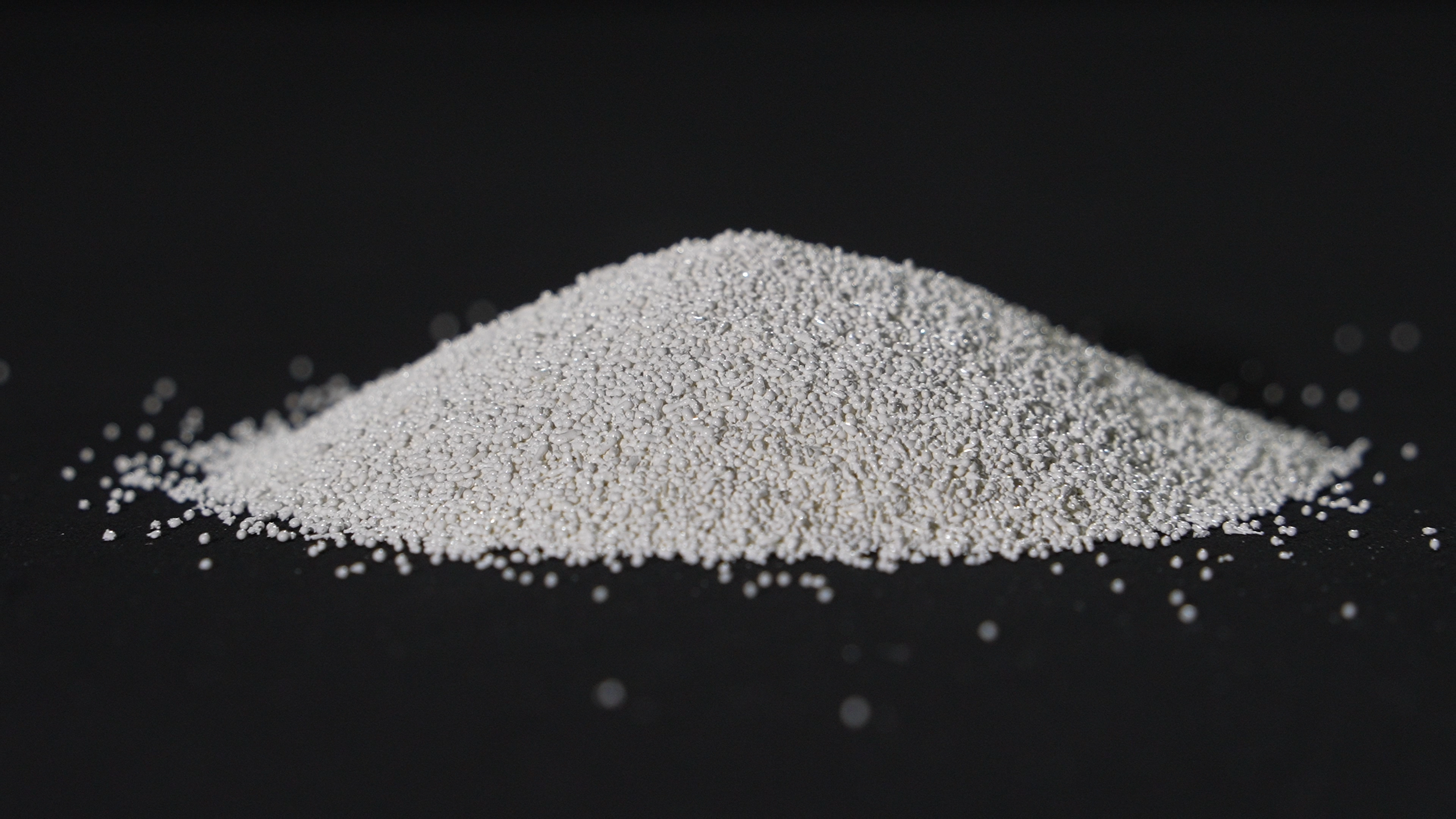
Small, dense spheres or beads loaded inside a ball mill or bead mill. The mill agitates them at high speed. The beads collide with each other and with the solid material in the feed slurry, crushing and grinding it down to fine or ultra-fine particles.
The workpiece is the feedstock material itself — the product you want to make smaller and finer. The part that comes out is not a shaped object; it is a finely ground powder or dispersion.
Common shapes: Sphere / ball (almost always)
Used for: Pigments, minerals, battery materials, pharmaceuticals, ceramics
(chips / tumbling media)
Larger, shaped chips loaded into a vibratory or centrifugal finishing machine together with manufactured parts. The machine creates motion that causes the chips to rub against every surface of every part simultaneously, removing burrs, sharp edges, and surface roughness.
The workpiece is a manufactured part — a machined component, a stamping, a casting — that exits the process with improved surface quality but its original shape and dimensions intact.
Common shapes: Triangle, cylinder, cone, sphere, star
Used for: Deburring, edge radiusing, pre-plate finishing, surface conditioning
If you are trying to make a material finer — turning a solid into a powder, or reducing a particle size — you need ceramic grinding media. Read our dedicated guide: Ceramic Grinding Media — Complete Technical Guide.
If you are trying to improve the surface of a finished part — removing burrs, smoothing edges, or preparing a surface for plating — you need ceramic tumbling/finishing media. Read: Ceramic Tumbling Media — Complete Mass Finishing Guide.
3. How Ceramic Media Works
In Grinding Applications
The physics of ceramic grinding media is straightforward: a hard, dense ceramic bead collides with a solid particle in the feedstock slurry. The collision generates a compressive stress that exceeds the tensile strength of the particle, causing it to fracture into smaller fragments. Repeat this billions of times per minute in a mill chamber, and the particle size distribution of the slurry progressively shifts toward smaller values until the target particle size is reached.
The efficiency of this process depends critically on two bead properties: density (denser beads carry more kinetic energy per collision at the same speed) and hardness (harder beads must be harder than the material being ground, otherwise the bead wears instead of the feedstock). This is why zirconia beads — with their density of nearly 6.0 g/cm³ — dominate demanding milling applications despite their premium cost: they deliver more grinding work per unit of mill energy than any other commercial ceramic media type.
In Mass Finishing / Surface Finishing Applications
The mechanism in mass finishing is different: abrasive grain particles embedded within the ceramic chip body act as thousands of microscopic cutting tools. Each time a chip slides or rolls against the workpiece surface under the motion generated by the machine, these grains remove a tiny amount of material by micro-cutting — the same mechanism as grinding, but at an extremely small scale and distributed uniformly across all exposed surfaces of the part simultaneously.
The key advantage over conventional abrasives (sandpaper, grinding wheels) is this omnidirectionality: every surface of every part is abraded equally, including recessed areas, internal radii, and intersecting features that a manual tool cannot reach. A vibratory machine loaded with ceramic chips and parts circulates its entire contents in a toroidal pattern — each chip contacts each part from multiple angles over the course of the process cycle, producing a uniform, isotropic surface improvement that manual methods cannot replicate.
Why “ceramic”? The term refers to the manufacturing process and material class, not the end use. A ceramic is any inorganic, non-metallic solid that has been shaped and then hardened by firing at high temperature — the same definition that covers pottery, bricks, and spark plug insulators. Industrial ceramic media uses the same fundamental material science but in engineered formulations optimized for specific mechanical and chemical performance requirements.
4. What Ceramic Media Is Made Of
The “ceramic” in ceramic media is not a single material — it is a family of engineered inorganic compounds, each with a different balance of hardness, toughness, density, and chemical stability. The four most important material families in industrial ceramic media are:
The material choice affects not just how aggressively the media cuts, but which elements it introduces into the product (contamination), how long it lasts before replacement (wear rate), and which chemicals it can safely operate in (pH and chemical resistance). For a full technical comparison of all four materials across these dimensions, see our Ceramic Media Materials guide.
5. Common Shapes and What They Do
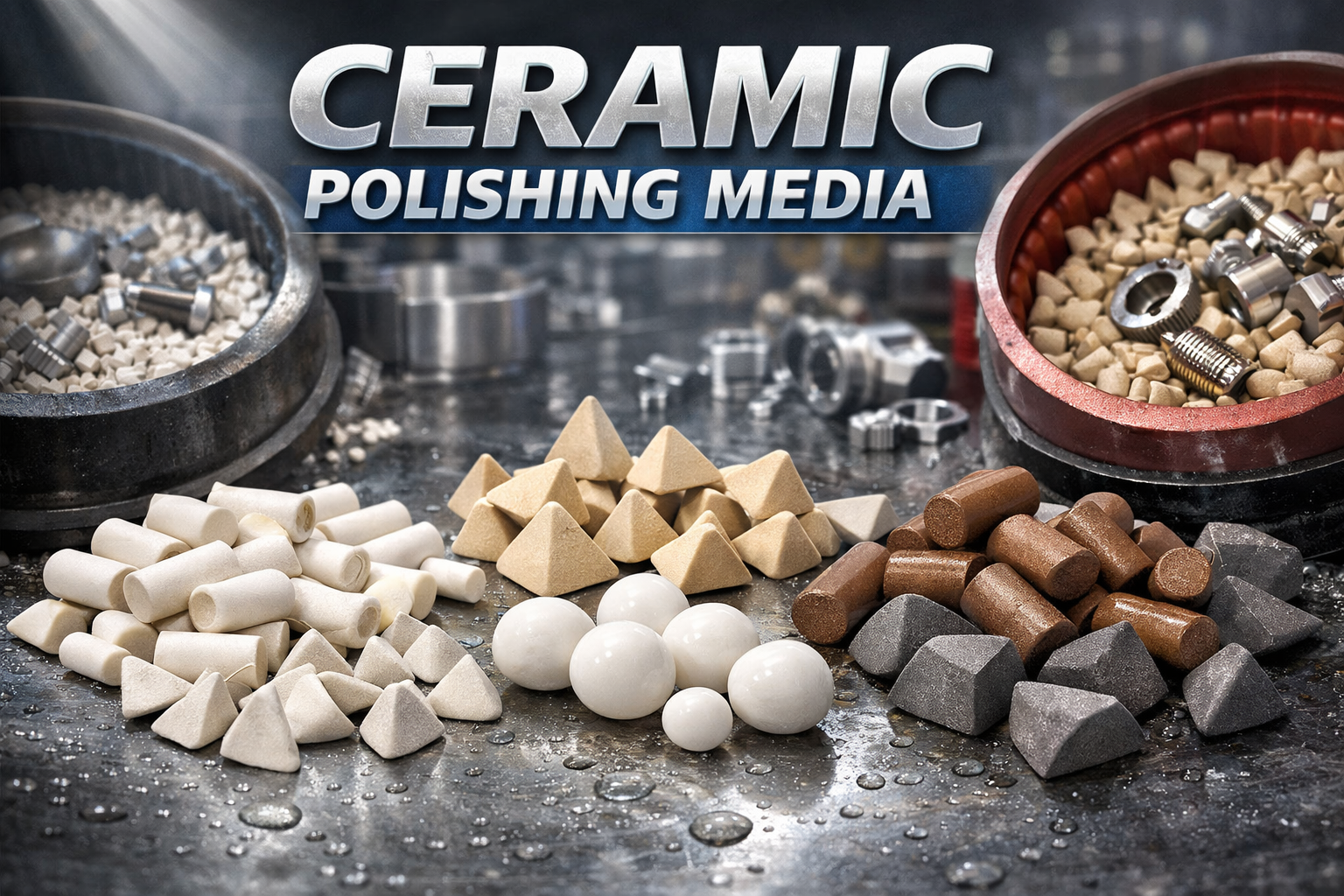
Ceramic grinding media (beads) are almost always spherical — the sphere is the optimal geometry for bead-to-bead energy transfer in a mill. Ceramic finishing media (chips), however, comes in a wide range of shapes, because different shapes are optimized for reaching different surface features on the workpiece.
| Shape | Key Characteristic | Best Used For | Lodging Risk |
|---|---|---|---|
| Triangle △ | Three sharp working ridges; highest cut rate | Heavy deburring, flat surfaces, external edges | High (avoid slots & bores) |
| Cylinder ▮ | Flat end faces + cylindrical side; versatile | Turned parts, flat faces, all-around deburring | Medium |
| Diagonal Cylinder ⸻ | Angled face penetrates recesses | Complex castings, cross-bores, intersecting features | Low–Medium |
| Cone / Tri-Star ▿ | Tapered tip reaches grooves and slots | Gear tooth roots, splines, keyways | Low |
| Sphere ● | No sharp edges; gentle point contact | Polishing, burnishing, delicate thin-wall parts | Very Low |
Selecting the wrong shape for the workpiece geometry is one of the most common — and most avoidable — mistakes in mass finishing process specification. A triangle chip tumbling against a part with deep internal bores provides minimal useful work on those bores and high lodging risk. A cone chip applied to a simple flat-faced stamping cuts slowly where a triangle would cut efficiently. Shape selection should always begin with an analysis of where the burrs are located and what features of the workpiece the chip must be able to access. Our Ceramic Media Shapes Guide covers this decision in full detail.
6. Which Industries Use Ceramic Media?
Ceramic media is used wherever two industrial needs exist: the need to reduce solid materials to fine particles (grinding media applications), and the need to improve the surface of manufactured parts at scale (finishing media applications). The industries that depend on one or both of these needs are broad:
Aerospace: Deburring of turbine blade roots and structural fasteners. Edge radiusing of flight-critical components to reduce fatigue stress concentrations. Surface conditioning of landing gear components before hard chrome plating.
Medical Devices: Finishing of surgical instruments, orthopedic implants, and stent components. Ceramic grinding media for pharmaceutical API particle size reduction under GMP conditions.
Electronics: Ceramic bead milling for conductive ink particle size and dispersion. Deburring of copper and aluminum heat sink and connector components.
Battery Manufacturing: Zirconia bead milling of lithium cathode materials (LFP, NMC) to target particle size distributions. Ultra-low contamination requirements make zirconia the only viable media choice.
Coatings & Pigments: Ball milling of TiO₂, carbon black, iron oxide, and organic pigments for paint, ink, and coating formulations.
General Manufacturing: Vibratory deburring of CNC-machined, stamped, and cast parts across hardware, hydraulics, pneumatics, and consumer products manufacturing.
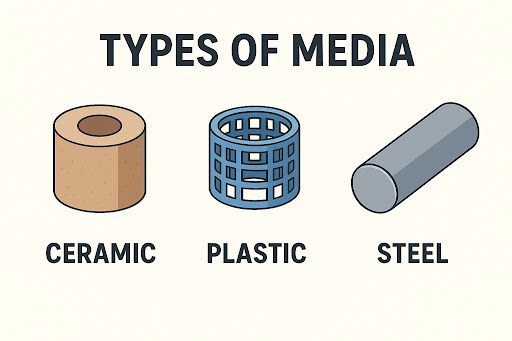
7. Ceramic vs. Plastic vs. Steel Media — At a Glance
In mass finishing applications, ceramic media competes with two other principal media types: plastic (resin-bonded abrasive or non-abrasive) and steel (hardened carbon steel shot, pins, or balls). Each has a role, and understanding the trade-offs prevents expensive process mismatches.
| Property | Ceramic | Plastic | Steel |
|---|---|---|---|
| Cut rate (deburring speed) | Medium – High | Light – Medium | Burnishing only (no cut) |
| Best workpiece hardness range | Soft to hardened steel (up to ~55 HRC) | Soft metals (Al, Cu, Zn) and plastics | Any metal (non-abrasive) |
| Surface finish achievable | Ra 0.1 – 3.2 µm (wide range) | Ra 0.4 – 1.6 µm | Bright burnish (< 0.1 µm) |
| Part damage risk on soft metals | Moderate (can cause surface imprinting) | Low | Low (no abrasive) |
| Media wear rate | Low – Medium | High (degrades faster) | Very Low |
| Contamination introduced | Al or Zr (low to trace levels) | Resin residue (minimal) | Iron (can cause rust on non-ferrous parts) |
| Relative cost | Medium | Low – Medium | Low (long service life) |
The practical selection rule: ceramic media when burr removal or surface roughness reduction is the primary goal; plastic media when the workpiece is too soft or delicate for ceramic contact pressure; steel media (burnishing pins or balls) when the goal is a bright cosmetic finish with no stock removal. Many production processes use all three in sequence — ceramic for bulk deburring, then plastic for light finishing, then steel for final burnishing.
📄 Full Comparison: Ceramic vs. Plastic vs. Steel Media Detailed analysis including workpiece material compatibility, cost modeling, and process design recommendations8. How Do You Choose the Right Ceramic Media?
Choosing the right ceramic media involves answering a sequence of questions in the right order. Jumping straight to “which grade should I order?” before answering the upstream questions is the most common cause of first-trial failures that require expensive re-specification.
The decision sequence for finishing media is: (1) What is the burr type and location? → (2) What machine type do I have or will I use? → (3) Which shape can reach the burr location without lodging? → (4) Which abrasive grade delivers the required cut rate for this burr type and workpiece material? → (5) Which compound and process parameters complete the specification?
The decision sequence for grinding media is: (1) What material am I grinding and to what target particle size? → (2) What mill type am I using? → (3) Does my product have contamination sensitivity that limits which ceramic material I can use? → (4) What bead size is appropriate for my mill gap and target particle size? → (5) What is the cost-of-ownership trade-off between material options?
📄 Full Guide: How to Choose Ceramic Media — 5-Step Selection Framework Covers both grinding and finishing media selection with decision trees, trial protocols, and common mistakes to avoid 📄 Master Reference: Ceramic Media — The Complete Industrial Guide The full pillar page covering all aspects of ceramic media in a single comprehensive reference9. Frequently Asked Questions
Ceramic media is used for two primary industrial purposes. In milling applications, ceramic grinding beads are loaded into ball mills or bead mills to grind solid materials — such as pigments, minerals, pharmaceutical compounds, and battery materials — into fine or ultra-fine particles. In mass finishing applications, ceramic tumbling chips are loaded into vibratory or centrifugal finishing machines together with manufactured parts to remove burrs, radius sharp edges, reduce surface roughness, and prepare surfaces for downstream coating or plating processes.
Ceramic grinding media (beads) are small, dense spheres loaded inside a mill to grind bulk solid materials into fine particles — the workpiece is the material being ground into smaller pieces. Ceramic tumbling media (chips) are larger, shaped bodies loaded into a vibratory or centrifugal machine together with finished manufactured parts — the workpiece is the part, and the chips improve its surface by removing burrs and reducing roughness without changing its overall shape or dimensions. The two types are not interchangeable.
Yes. Ceramic media — both grinding beads and finishing chips — is designed for repeated use over an extended service life. Ceramic grinding beads are typically replaced when their diameter has worn below a threshold size (usually 60–70% of original diameter), which may take hundreds or thousands of hours of milling depending on the application and ceramic material. Ceramic finishing chips are replaced when they have worn below the anti-lodging minimum size for the workpiece, or when their cut rate has dropped below the level needed to meet cycle time targets. Zirconia grinding media typically lasts 3–5 times longer than alumina before replacement is needed.
Ceramic grinding beads are manufactured by forming the raw ceramic powder (alumina, zirconia, or SiC) into spherical green bodies — typically by spray drying a slurry into droplets that solidify as spheres — and then sintering them at high temperature (typically 1,400–1,700°C) to achieve the final density and hardness. Ceramic finishing chips are manufactured by mixing abrasive grain with a bonding agent (vitrified ceramic or resin), pressing or extruding the mixture into the desired chip shape, and firing in a kiln at lower temperature. The firing fuses the bond around the abrasive grains, creating the porous, controlled-hardness chip structure that releases fresh abrasive grain as the outer surface wears.
Industrial ceramic media — both grinding beads and mass finishing chips — is available directly from manufacturers like Jiangsu Henglihong Technology Co., Ltd., which produces a full range of alumina, zirconia, and SiC grinding beads as well as ceramic finishing chips in all standard shapes and abrasive grades. Purchasing directly from the manufacturer rather than through distributors allows access to technical support for process specification, custom formulations for non-standard applications, and lot-specific analytical documentation for contamination-sensitive applications. Contact us through our website to discuss your requirements.
Ready to Specify the Right Ceramic Media for Your Process?
The team at Jiangsu Henglihong Technology Co., Ltd. can help you identify the right product — from first inquiry through trial validation — at no cost.
Talk to Our Engineering Team →Filters