Zirconia Beads for Industrial Cleaning & Surface Preparation: The Engineer’s Complete Guide
How YSZ zirconia beads remove scale, oxides, corrosion, and surface contamination from metal components — delivering ISO 8501-compliant cleanliness and controlled anchor profiles for coating, bonding, welding, and thermal spray applications.
📅 Updated 2026
⏰ ~16 min read
🏭 Jiangsu Henglihong Technology Co., Ltd.
1. What Is Industrial Surface Preparation and Why Does It Matter?
Surface preparation is the process of cleaning and conditioning a metal surface to a defined state of cleanliness and texture before the application of a coating, adhesive bond, weld, or thermal spray deposit. It is the single most influential factor determining the adhesion strength and service life of any subsequent surface treatment — more important than the choice of coating material, application method, or curing regime.
The steel structure industry has understood this for decades: studies consistently show that inadequate surface preparation is responsible for 60–80% of premature coating failures in corrosion protection applications. The same principle applies across industries. A plasma spray coating applied over a contaminated substrate will delaminate prematurely regardless of how well the coating itself was applied. An adhesive bond formed over a mill-scale-covered surface will fail in shear at a fraction of the strength of a properly prepared joint.
📊
The Economic Case for Proper Surface Preparation NACE International (now AMPP) estimates that corrosion costs the global economy over $2.5 trillion annually, of which a substantial fraction is attributable to coating failures that stem from inadequate surface preparation. The marginal cost of upgrading surface preparation from Sa 2 to Sa 2.5 (one ISO cleanliness grade) is typically 5–15% of total coating project cost — but the improvement in coating service life is consistently 30–50%. On a lifecycle cost basis, proper surface preparation is the highest-return investment in any coating programme.
Surface preparation encompasses two distinct objectives that must both be met simultaneously: achieving a defined level of surface cleanliness (removal of all contaminants that would impair adhesion) and establishing a defined surface profile (a micro-roughness that provides mechanical keying for the coating). Zirconia bead blasting achieves both objectives in a single process step — and does so without introducing the contamination that grit blasting or steel shot cleaning can leave behind.
2. Contaminant Types and Removal Mechanisms
Understanding the nature of the surface contamination present is essential for selecting the correct YSZ bead size and process parameters. The six principal contaminant types encountered in industrial surface preparation are:
🫠
Mill Scale
Dense iron oxide (Fe₃O₄ / Fe₂O₃) layer formed on hot-rolled steel during manufacturing. Thickness 50–200 µm. Very hard (HV 500–700) and brittle — fractures under bead impact. Galvanic coupling with steel accelerates corrosion if present under coatings.
YSZ: 0.5–1.2 mm beads | 3.0–4.5 bar | Multiple passes on heavy scale
🧳
Rust & Corrosion Products
Hydrated iron oxides (FeOOH, Fe(OH)₃) and other corrosion deposits on steel, aluminium, and magnesium. Loose and friable — relatively easy to remove. Pitting corrosion beneath rust requires sufficient blast energy to reach the base metal.
YSZ: 0.3–0.8 mm beads | 2.5–3.5 bar | Verify pit cleaning at 10× magnification
🔥
Heat Tint / Oxidation
Thin oxide films formed during welding heat-affected zones, heat treatment, or high-temperature service exposure. Particularly problematic on stainless steel and titanium — these oxide films deplete chromium at the surface, reducing corrosion resistance.
YSZ: 0.1–0.4 mm beads | 1.5–2.5 bar | Preferred over pickling for Ti/stainless
💧
Machining Oils & Coolants
Metalworking fluids embedded in surface pores and roughness features. Invisible to naked eye but critically impair coating adhesion and weld quality. Must be removed by degreasing before bead blasting — blasting over oiled surfaces embeds contamination.
Remove by solvent degreasing BEFORE bead blasting, not after
♿
Casting Sand & Investment
Silica sand, ceramic investment, or die-release compounds adhering to cast component surfaces after mould removal. Mechanically bonded — requires sufficient impact energy to fracture and detach. YSZ blasting is preferred over chemical cleaning for porous castings.
YSZ: 0.5–1.5 mm beads | 3.0–4.0 bar | Fan nozzle for complex casting geometry
🔮
Weld Spatter & Slag
Metallic droplets and flux slag deposited around weld beads. Hard and tenacious — conventional cleaning leaves residues that create coating holidays. YSZ bead blasting simultaneously removes spatter and smooths the weld toe geometry, reducing the stress concentration at the weld-parent metal junction.
YSZ: 0.4–1.0 mm beads | 3.0–4.5 bar | Weld toe dressing effect as secondary benefit
3. Surface Cleanliness Standards: ISO 8501, SSPC & NACE
Surface cleanliness after blasting is assessed and specified using internationally recognised visual standards. Understanding these standards allows process engineers to specify and verify the correct cleaning outcome for each application.
Most mill scale, rust and coatings removed. Residues visible only as light staining on no more than 33% of surface.
✓ Achievable with single pass
Sa 2.5
Near-White Blast Cleaning
Very thorough removal. Residues visible only as slight stains on no more than 5% of surface. Standard for protective coatings.
✓ Primary YSZ target — single/double pass
Sa 3
White Metal Blast Cleaning
Complete removal of all mill scale, rust, coatings, and foreign matter. Uniform metallic colour. Highest specification.
✓ Achievable with optimised multi-pass YSZ
The equivalent SSPC (Society for Protective Coatings) and NACE designations are: Sa 2 = SSPC-SP 6 / NACE 3; Sa 2.5 = SSPC-SP 10 / NACE 2; Sa 3 = SSPC-SP 5 / NACE 1. Most industrial protective coating specifications for steel structures, offshore equipment, and pipeline components require Sa 2.5 as the minimum. Aerospace and medical applications typically specify Sa 3 or equivalent for maximum coating adhesion reliability.
📌
YSZ Advantage at Sa 2.5 and Sa 3 Achieving Sa 2.5 with steel shot is straightforward but introduces iron contamination that must be removed by additional solvent cleaning before coating — adding a process step. With YSZ beads, the same Sa 2.5 cleanliness is achieved without introducing any ferrous contamination, allowing direct coating application after simple air blow-down and visual inspection. For stainless steel, titanium, and aluminium substrates where any iron contamination is a coating adhesion or corrosion risk, YSZ beads are the only blast media that can deliver Sa 2.5 without a mandatory post-blast decontamination step.
4. Surface Profile and Anchor Texture for Coating Adhesion
Surface profile — the peak-to-valley height (Rz or Ry) of the blast-cleaned surface — is the second critical parameter of surface preparation, governing the mechanical adhesion of the applied coating. Too smooth, and the coating has insufficient keying area; too rough, and high peaks project through thin coatings, creating early rust initiation sites.
Coating System
Required Surface Profile (Rz)
YSZ Bead Size to Achieve
Profile Measurement Standard
Thin film epoxy (<100 µm DFT)
Rz 25 – 50 µm
0.3 – 0.6 mm YSZ
ISO 8503 / ASTM D4417
Heavy-duty epoxy / polyurethane
Rz 50 – 75 µm
0.6 – 1.0 mm YSZ
ISO 8503 / ASTM D4417
Thermal spray coating (HVOF / APS)
Rz 50 – 100 µm (angular preferred)
0.8 – 1.5 mm YSZ then grit if Ra > 3 µm needed
ISO 8503 / EN 13507
Adhesive bonding
Rz 15 – 40 µm
0.2 – 0.5 mm YSZ
ISO 4287 / ASTM D2651
Anodizing pre-treatment (aluminium)
Ra ≤ 0.8 µm (smooth)
0.1 – 0.3 mm YSZ
ISO 4287
TBC application (aerospace)
Ra 3 – 8 µm (coarse — usually requires grit after YSZ clean)
YSZ for contamination removal; grit blast for final profile
OEM specification
For most coating systems except thermal spray, YSZ bead blasting produces the surface profile directly — no additional grit blasting step is needed. The spherical impact geometry produces a dimpled, rounded-peak profile that is particularly favourable for adhesive bonding and thin-film coatings, where angular grit profiles can create stress concentrations at sharp peak tips that initiate adhesive peel.
5. Why YSZ Zirconia Beads Excel at Surface Preparation
Sa 3
ISO 8501 cleanliness Achievable with multi-pass
0
Fe contamination On Ti / SS / Al substrates
Rz 15
– 100 µm profiles Achieved by varying bead size
>98%
Sphericity Consistent profile generation
✕ Before YSZ Blast Cleaning
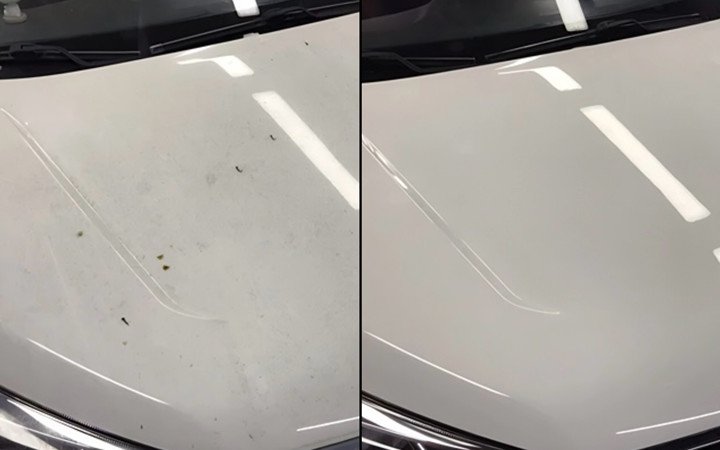
Contaminated Surface Condition
⚠Mill scale / oxide layer present
⚠Rust and corrosion products in pits
⚠Weld spatter and heat tint at joints
⚠Surface roughness uncontrolled
⚠Adhesion inadequate for coating
⚠Fails ISO 8501 visual standard
✓ After YSZ Blast Cleaning
Prepared Surface Condition
✓All scale and oxides removed
✓Corrosion products removed to bare metal
✓Weld toe smoothed and cleaned
✓Defined Rz profile for coating adhesion
✓Zero iron contamination (no steel shot used)
✓Meets Sa 2.5 – Sa 3 per ISO 8501
The Contamination-Free Advantage
The most significant advantage of YSZ beads over steel shot or grit for surface preparation is the absence of ferrous contamination. Steel shot leaves microscopic iron particles embedded in or deposited on the substrate surface. On stainless steel, these iron particles rust within hours of application, creating rust staining and potential under-film corrosion that defeats the purpose of the coating. On titanium aerospace components, iron contamination can create galvanic couples that initiate pitting at stress concentrations. On aluminium, iron particles cause accelerated galvanic corrosion in humid or marine environments. YSZ beads, being composed of ZrO₂, deposit no iron and do not rust — delivering a genuinely clean surface ready for immediate coating.
Consistent Profile Generation
Because YSZ beads maintain their spherical geometry far longer than steel shot (which deforms and shatters over time), the surface profile generated by a YSZ bead charge is more consistent across the life of the charge. A steel shot charge that has been in service for 10,000 cycles contains a mix of round, deformed, and angular fragments — each producing a different surface texture. A YSZ charge of the same age still contains predominantly spherical beads, producing reproducible Rz values from batch to batch of processed components.
6. Process Parameters for Cleaning & Surface Preparation
Parameter
Typical Range
Effect on Cleanliness
Effect on Profile (Rz)
Bead size
0.1 – 1.5 mm
Larger beads remove heavier scale faster
Larger beads → deeper profile; primary profile control lever
Surface preparation rarely stands alone — it is one step in a multi-stage pre-treatment sequence that prepares the substrate for the downstream process. The sequence below represents best practice for a precision aerospace or industrial component moving from machined or service-returned condition to coating-ready.
Initial Degreasing
Remove all machining oils, coolant residues, finger oils, and release agents by solvent wipe (isopropanol or acetone) or aqueous alkali degreasing. This step is non-negotiable: bead blasting over oiled surfaces embeds contamination into the substrate rather than cleaning it. Verify cleanliness by water break test — water should sheet evenly across the entire surface. Do not proceed to blasting until the water break test passes.
Masking of Protected Features
Mask all threaded bores, precision bearing surfaces, cooling holes, electrical contacts, and optical surfaces that must not be blast-cleaned. Use dedicated rubber plugs for threaded features, sacrificial tape for flat surfaces, and precision-machined inserts for complex passages. Inspect masking before blasting and document masked areas on the route card.
YSZ Bead Blast Cleaning
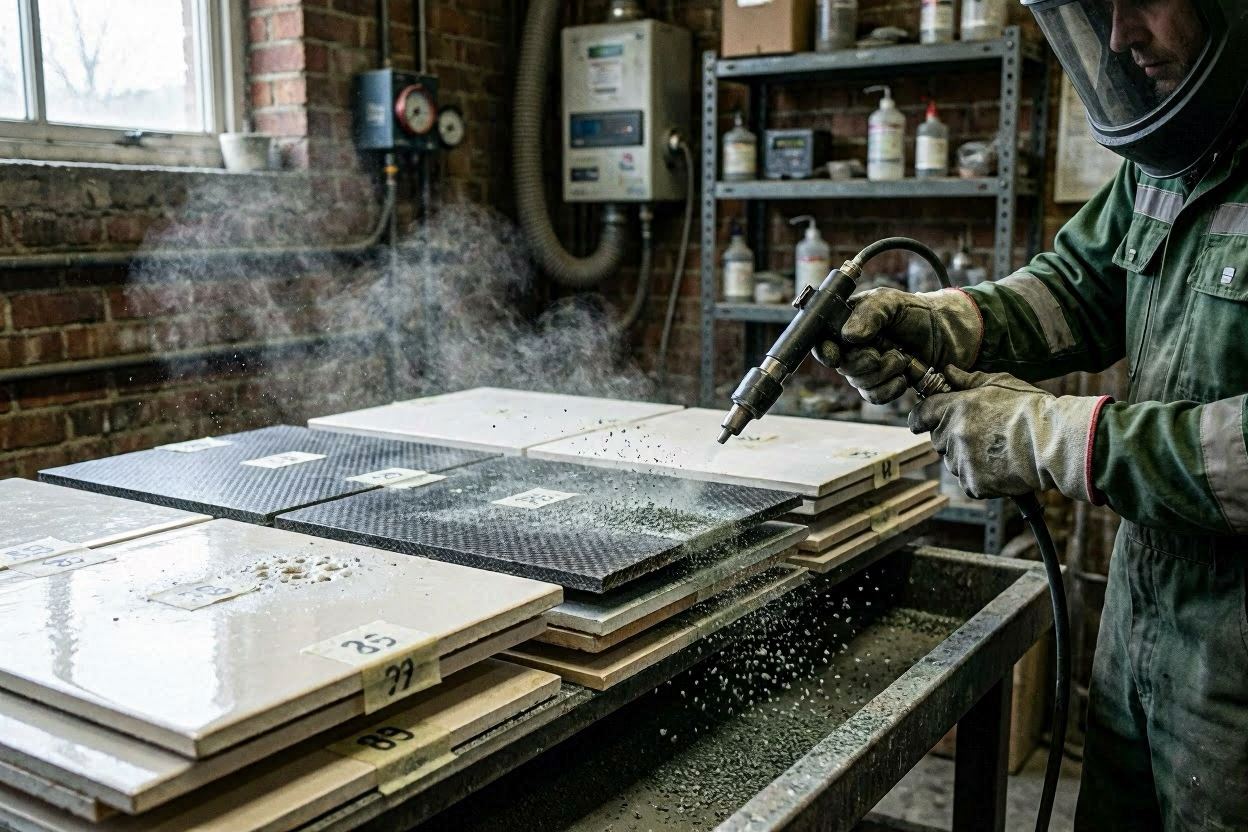
Blast the degreased, masked surface with the appropriate YSZ bead size and pressure for the target ISO 8501 cleanliness grade and Rz profile. Use systematic overlapping passes to ensure 100% coverage. For complex geometries, use robotic blasting or a multi-nozzle set-up to prevent shadowing of recessed features. The same YSZ bead technology used for coating removal can be configured for cleaning of heavily contaminated surfaces.
Post-Blast Inspection
Visually inspect the cleaned surface against ISO 8501 photographic reference standards to confirm the achieved cleanliness grade. Measure surface profile (Rz) with a calibrated contact profilometer or replica tape per ISO 8503. For aerospace and high-value components, conduct a fluorescent contamination check under UV light and verify iron contamination absence by ferroxyl test swab on stainless steel and titanium.
Compressed Air Blow-Down
Remove all loose bead fragments, blasting dust, and displaced contamination with filtered, oil-free compressed air. Blow through all passages and features. Inspect for any residual bead fragments in recesses. For medical and aerospace components, use HEPA-filtered air supply to prevent re-contamination of the cleaned surface.
Coating / Bonding Within Maximum Recontamination Time
A blast-cleaned surface begins to oxidise immediately on exposure to air and humidity. ISO 8501 and most coating specifications define a maximum time between blast cleaning and coating application — typically 4 hours in controlled indoor environments, 2 hours in high-humidity conditions, and 1 hour for stainless steel (which develops a passive oxide layer rapidly). Plan the production sequence to minimise this interval; if the time limit is exceeded, the surface must be re-blasted before coating.
9. Industry Applications
✈
Aerospace Structural Components
Titanium airframe brackets, aluminium wing skins, and nickel alloy engine mounts require Sa 2.5 – Sa 3 surface preparation before primer application. YSZ bead cleaning ensures zero iron contamination on titanium, eliminating the galvanic corrosion risk that steel shot or iron-bearing grit would introduce. Pre-bonded aluminium adherends for structural adhesive joints are cleaned to Ra 0.4–0.8 µm with fine YSZ beads before film adhesive application.
🚗
Automotive Body & Powertrain
Steel body stampings require Sa 2.5 surface preparation before electrocoat (e-coat) priming in automotive production. Aluminium cylinder heads and engine blocks require oxide removal and controlled surface profile before thermal spray cylinder bore coating. YSZ bead cleaning is specified where post-blast iron contamination from steel shot would interfere with adhesion of e-coat over aluminium.
🚗
Stainless Steel Fabrication
Welded stainless steel vessels, piping, and food-contact equipment require removal of heat tint and weld oxides before passivation and service. YSZ bead blasting replaces acid pickling paste — achieving equal or better chromium-depleted-layer removal without the HSE risks of hydrofluoric / nitric acid compounds, and without the subsequent acid residue removal steps required after chemical treatment.
⚙
Oil & Gas Equipment
Wellhead components, valve bodies, and subsea equipment require Sa 2.5 – Sa 3 surface preparation before high-performance corrosion-protective coatings. YSZ bead blasting provides a chloride-free, contamination-free surface essential for the adhesion of fusion-bonded epoxy (FBE) and multi-layer coatings on components destined for sour service environments.
🔮
Electronics & PCB Manufacturing
Precision metal substrates for power electronics, lead frames, and heat sinks require controlled surface preparation before solder, silver-sintering, or thermal interface material application. Fine YSZ beads (0.05–0.15 mm) clean oxide films and provide the micro-roughness needed for optimal thermal and electrical contact, without leaving conductive metallic contamination that could cause short circuits.
⚡
Power Generation
Gas and steam turbine components require scale and oxide removal between overhaul cycles, plus surface profile preparation before thermal barrier re-coating. YSZ bead cleaning is used alongside deburring operations in comprehensive turbine refurbishment sequences, ensuring clean, dimensionally accurate substrate surfaces before re-coating.
🔗
This article is part of Henglihong’s complete surface treatment knowledge base. For a full overview of YSZ zirconia bead properties, available grades, and all surface treatment applications — including shot peening, deburring, polishing, and coating removal — refer to our complete zirconia beads guide.
Related Guides in This Series
⚡
Shot Peening GuideFatigue life enhancement after surface prep
🔧
Deburring & Edge FinishingComplete burr removal before coating
🛡
Coating Removal GuideSelective stripping without substrate damage
⚖
Media Comparison GuideFull cost & performance comparison
10. Frequently Asked Questions
Can YSZ bead blasting achieve Sa 3 (white metal) cleanliness on heavily rusted steel? +
Yes, but it requires optimised parameters and multiple passes. For heavily rusted steel (rust grade C or D per ISO 8501), use larger YSZ beads (0.6–1.2 mm) at higher pressure (3.5–4.5 bar) with multiple overlapping passes until the visual standard is met. The key advantage of YSZ over steel shot for Sa 3 cleaning is that the absence of iron contamination means the achieved cleanliness is a true Sa 3 — no ferrous residues are left behind that would compromise the coating adhesion test results. For extremely heavy rust or corrosion, a preliminary mechanical descaling step (needle gun, angle grinder) may be needed before bead blasting to reduce blast time and media consumption.
How quickly does a YSZ-blasted surface re-oxidise, and what is the maximum time before coating? +
Re-oxidation rate depends heavily on the substrate material and ambient conditions. Carbon steel in normal workshop conditions (20°C, RH 50–60%) shows visible re-rusting within 4–8 hours. In humid coastal environments, visible rust can appear within 1–2 hours. For carbon steel, coat within 4 hours of blasting in controlled conditions. Stainless steel re-passivates within minutes of blast cleaning — the passive chromium oxide layer reforms rapidly, which is actually beneficial for corrosion resistance; coat within 2–4 hours. Titanium also passivates rapidly (TiO₂ layer); coat within 2 hours. Aluminium forms a thin natural oxide within hours; prime within 4 hours. These are conservative guidelines — always refer to the coating manufacturer’s specification for the maximum allowed interval for the specific primer system being applied.
Can YSZ bead blasting replace acid pickling for weld oxide removal on stainless steel? +
In most applications, yes — and with significant advantages. Acid pickling with HF/HNO₃ mixtures removes weld heat tint and restores the passive layer effectively, but generates hazardous waste, requires strict PPE and containment infrastructure, and can cause over-etching on thin-section stainless components. YSZ bead blasting removes weld heat tint and chromium-depleted oxide layers mechanically, restoring the corrosion-resistant surface without chemical hazards, and can be immediately followed by electropolishing or passivation if required. The main limitation is geometric: acid pickling via immersion can reach all internal surfaces of complex fabrications, while bead blasting is limited to line-of-sight access. For internal passages, electrochemical cleaning wands combined with YSZ external blasting offer a comprehensive solution.
What surface profile (Rz) does YSZ bead blasting produce, and is it suitable for thermal spray coatings? +
YSZ bead blasting produces Rz values from approximately 15 µm (fine beads, low pressure) to 100 µm (coarse beads, high pressure). The profile is dimple-shaped — rounded peaks and valleys — rather than the angular profile produced by grit blasting. For most organic coating systems (epoxy, polyurethane, zinc-rich primers), the YSZ-produced profile is optimal. For thermal spray coatings (HVOF, APS), some coating specifications require an angular surface profile — particularly for WC-Co and Cr₂C₃ cermet coatings — because angular peaks provide better mechanical interlocking with the splat structure of sprayed deposits. In these cases, YSZ bead blasting is used first for contamination removal and deburring, followed by a light grit blast to generate the required angular profile before thermal spray application.
How do I validate that my YSZ bead blast cleaning process consistently achieves the specified cleanliness grade? +
Process validation involves three elements: (1) Process qualification — establish the minimum number of passes, bead size, pressure, and stand-off distance required to achieve the specified ISO 8501 grade on representative test coupons of the same alloy and initial surface condition as production components. Document this as a controlled process specification. (2) In-process monitoring — verify blast parameters against the specification at the start of each shift and after any equipment change. Check media charge condition by sieve analysis monthly. (3) Post-blast inspection — inspect each component (or statistical sample in high-volume production) against ISO 8501 photographic standards immediately after blasting, before the re-oxidation window expires. Record inspection results on the route card. For NADCAP-audited aerospace facilities, all three elements must be documented and accessible to the auditor.
HLH
Jiangsu Henglihong Technology Co., Ltd.
YSZ zirconia bead specialist for precision industrial cleaning and surface preparation. Supporting aerospace, automotive, stainless fabrication, and power generation customers with contamination-free blast cleaning media and complete surface preparation process guidance from initial cleaning to coating-ready substrate.
Prepare Your Surfaces to the Highest Standard
Tell us your substrate material, contamination type, and required cleanliness grade — our engineers will recommend the right YSZ bead size and process to achieve it reliably in production.