Plastic Blast Media Types Compared: Urea vs Melamine vs Acrylic
If you’ve ever searched for plastic blast media and found yourself staring at a spec sheet listing “Type II,” “Type III,” and “Type V” with no clear explanation of what that means for your application — you’re not alone. Most suppliers list media by MIL-SPEC type without explaining why the chemistry matters, how aggressiveness differs between types, or which situations demand one resin over another.
This guide cuts through the confusion. We compare the three most widely used plastic blast media types — Urea (Type II), Melamine (Type III), and Acrylic (Type V) — across every dimension that matters for real-world blasting operations: hardness, surface profile, coating removal speed, substrate safety, reuse cycle, cost, and ideal application scenarios.
By the end, you’ll know exactly which type to specify — and why. For a broader overview of all plastic media types including tumbling media, start with our Complete Guide to Plastic Media.
Quick Summary: The Three Types at a Glance
Before diving into the details, here’s the one-sentence positioning for each type:
The all-rounder. Best balance of stripping power, substrate safety, reusability, and cost. The default choice for most aerospace and automotive applications.
The heavy-hitter. Hardest and most aggressive of the three. Use it when throughput matters more than substrate protection — steel, titanium, and thick mil-spec coatings.
The precision tool. Softest of the three. Irreplaceable when working on CFRP composites, plastic components, and surfaces where zero dimensional change is mandatory.
What the Resin Chemistry Actually Means
The performance differences between urea, melamine, and acrylic media are not arbitrary — they follow directly from the molecular structure of each resin. Understanding this helps you predict behavior in edge cases that no spec sheet covers.
Thermosetting Resins: Why They Break Down the Way They Do
Both urea formaldehyde and melamine formaldehyde are thermosetting resins — once cured, they cannot be re-melted. They fracture through a brittle fracture mechanism on impact, which is exactly what you want in a blast abrasive: each fracture exposes fresh, sharp edges that continue cutting until the particle becomes too small to be effective. This fracture behavior also means media breakdown is relatively predictable, making reuse cycle estimation reliable.
The key structural difference is that melamine has three amino groups per molecule compared to urea’s two. This additional cross-linking density is why cured melamine resin is harder, more chemically resistant, and more thermally stable than cured urea resin. In practical blasting terms: melamine particles require more kinetic energy to fracture, which translates directly into higher aggressiveness on coatings.
Acrylic (PMMA): A Different Class Entirely
Acrylic media is manufactured from polymethyl methacrylate (PMMA), a thermoplastic rather than a thermosetting resin. This fundamental difference changes its failure mode: instead of brittle fracture, PMMA particles tend to deform slightly on impact before breaking. This cushioned impact is what makes acrylic uniquely gentle — it transfers less peak stress to the substrate surface than urea or melamine of equivalent particle size and velocity.
PMMA also has a lower density (~1.18 g/cm³) compared to urea (~1.5 g/cm³) and melamine (~1.5 g/cm³), which means acrylic particles carry less kinetic energy at the same velocity, further reducing substrate impact force.
Urea Formaldehyde (Type II) — Deep Dive
Physical Properties
| Property | Specification |
|---|---|
| Resin Type | Urea formaldehyde (thermosetting) |
| MIL-SPEC Designation | MIL-P-85891A, Type II |
| Mohs Hardness | ~3.5 |
| Bulk Density | ~55–65 lb/ft³ (880–1,040 kg/m³) |
| Color | Off-white / cream |
| Particle Shape | Angular, irregular |
| Available Mesh Sizes | 12, 16, 20, 30, 40, 50, 60, 80 |
| Typical Reuse Cycles | 3–6 passes (with reclaim system) |
| pH (10% slurry) | 7.0–9.0 |
| Moisture Content | ≤ 1.0% |
Performance Characteristics
Type II urea is the most versatile plastic blast abrasive available. Its medium hardness gives it enough cutting authority to strip standard aerospace coating systems (MIL-PRF-85285 polyurethane topcoat over MIL-PRF-23377 epoxy primer) in a single pass with proper nozzle pressure and standoff, while remaining well below the hardness threshold where aluminum alloy surface damage begins. On 2024-T3 and 7075-T6 aluminum — the two alloys most commonly encountered in aircraft skin depaint work — Type II urea leaves a surface profile of less than 1 mil (25 microns), which meets most re-prime specifications without additional surface conditioning.
Reusability is a practical strength of Type II. With a properly sized air wash separator and screen deck to remove fines and paint debris after each cycle, urea media typically delivers 3 to 6 usable passes before particle breakdown reduces effective grit size below specification. This makes the per-part abrasive cost genuinely competitive with alternatives that appear cheaper on a per-pound basis but cannot be reused.
Ideal Applications for Type II Urea
- Aircraft exterior depaint and recoat cycles (aluminum and titanium structures)
- Automotive panel paint stripping (steel and aluminum body panels)
- General metal surface preparation prior to coating
- Stripping of standard epoxy + polyurethane coating systems
- Military vehicle maintenance (compliant with MIL-P-85891A)
- Job shop blast operations requiring a single media to handle varied substrate types
Limitations
Type II urea is not optimal for stripping powder coat or very hard baked enamel systems, where its medium hardness may require multiple passes and high pressure to achieve complete removal. For these applications, melamine (Type III) provides significantly faster strip rates. Urea also performs below expectations on CFRP composite surfaces, where its angular particle geometry at standard blast pressures can damage surface fibers — acrylic (Type V) should be used instead.
For a dedicated guide, see: Type II Urea Plastic Abrasive: When and Why to Use It.
Melamine Formaldehyde (Type III) — Deep Dive
Physical Properties
| Property | Specification |
|---|---|
| Resin Type | Melamine formaldehyde (thermosetting) |
| MIL-SPEC Designation | MIL-P-85891A, Type III |
| Mohs Hardness | ~4.0 |
| Bulk Density | ~60–70 lb/ft³ (960–1,120 kg/m³) |
| Color | White to light gray |
| Particle Shape | Angular, irregular |
| Available Mesh Sizes | 12, 16, 20, 30, 40, 50 |
| Typical Reuse Cycles | 4–8 passes (with reclaim system) |
| pH (10% slurry) | 8.0–10.0 |
| Moisture Content | ≤ 0.5% |
Performance Characteristics
Melamine formaldehyde is the highest-hardness option in the mainstream plastic blast media lineup. Its extra 0.5 Mohs hardness point over urea translates into a meaningfully higher strip rate on hard coating systems, particularly powder coat, catalyzed epoxy, and thick polyurethane systems over steel and titanium substrates. In controlled tests comparing equal mesh sizes and blast parameters, Type III melamine typically achieves 30–50% faster coating removal rates than Type II urea on powder-coated steel panels.
Melamine’s higher bulk density and hardness also result in better media longevity per blast cycle. Fewer particles fracture per pass compared to urea under identical conditions, which extends the working life of the media charge. This durability advantage partially offsets the typically higher per-pound purchase price of melamine versus urea.
The tradeoff is reduced substrate flexibility. Melamine operates closer to the hardness threshold of common aluminum alloys, and at blast pressures above 50 PSI or with coarse mesh sizes (12–20), it can create measurable anchor profiles on 2024-T3 aluminum — potentially exceeding maximum profile specifications for some coating systems. Process control is therefore more critical with Type III than with Type II.
Ideal Applications for Type III Melamine
- Stripping powder coat from steel substrates
- Heavy baked enamel or catalyzed epoxy removal
- Surface preparation of titanium alloy components
- Industrial equipment and heavy machinery recoat operations
- Applications where throughput speed is the primary concern
- Stripping of multi-coat military paint systems from steel armored vehicles
Limitations
Type III melamine should not be used on bare CFRP or thin aluminum skins (below 0.060 inches) without extensive process qualification testing. Its higher impact energy also makes it less suitable for dimensionally critical mold surfaces or precision components where any material removal from the substrate itself would be problematic.
Acrylic / PMMA (Type V) — Deep Dive
Physical Properties
| Property | Specification |
|---|---|
| Resin Type | Polymethyl methacrylate / PMMA (thermoplastic) |
| MIL-SPEC Designation | MIL-P-85891A, Type V |
| Mohs Hardness | ~3.0 |
| Bulk Density | ~45–55 lb/ft³ (720–880 kg/m³) |
| Color | Clear to translucent white |
| Particle Shape | Sub-angular to irregular |
| Available Mesh Sizes | 20, 30, 40, 50, 60, 80 |
| Typical Reuse Cycles | 2–4 passes (with reclaim system) |
| pH (10% slurry) | 6.5–8.0 |
| Moisture Content | ≤ 0.5% |
Performance Characteristics
Acrylic (PMMA) media occupies a unique niche in the plastic blast abrasive family. Its thermoplastic nature and lower density produce a fundamentally different impact dynamic compared to the thermosetting alternatives. Where urea and melamine particles fracture sharply and deliver focused cutting force, acrylic particles absorb some impact energy through micro-deformation before breaking — creating a gentler, more distributed force transfer to the substrate surface.
In practice, this means Type V acrylic can be used on CFRP and carbon fiber composite structures at controlled pressures (20–40 PSI) without causing the fiber breakout or inter-ply delamination that urea or melamine would produce. It is the only plastic blast media type routinely specified for depaint operations on CFRP aerostructures such as fairings, control surfaces, and radome assemblies.
Acrylic is also the media of choice for stripping plastic substrates — removing paint or surface films from thermoplastic injection-molded parts that need to be recoated without any surface distortion. Its low hardness means it cuts coating without generating the friction heat that can warp or stress-whiten thermoplastic surfaces.
Ideal Applications for Type V Acrylic
- Depaint of CFRP and carbon fiber composite aerospace structures
- Paint removal from fiberglass and composite boat hulls
- Stripping and surface preparation of thermoplastic injection-molded parts
- Cleaning of optical-quality or polished mold tool surfaces
- Electronics deflashing where substrate damage must be zero-tolerance
- Light surface scuffing/adhesion promotion on plastic substrates prior to painting
- Stripping of aircraft radomes and other composite antenna covers
Limitations
The tradeoffs for acrylic’s gentleness are real. It is the slowest-cutting of the three types, the least recyclable (2–4 cycles versus 4–8 for melamine), and typically the most expensive per pound. On steel or titanium substrates with hard coating systems, acrylic’s strip rate is impractically slow — urea or melamine will always be more economical in those applications. Acrylic media also requires more careful moisture control during storage, as PMMA is more hygroscopic than the thermosetting alternatives and moisture uptake can affect particle breakage behavior.
Full application detail: Acrylic (Type V) Plastic Media for Sensitive Surfaces.
Head-to-Head Comparison
Here is a direct side-by-side comparison of all three types across the dimensions that drive real purchasing and process decisions:
| Attribute | Type II — Urea | Type III — Melamine | Type V — Acrylic |
|---|---|---|---|
| Mohs Hardness | ~3.5 | ~4.0 | ~3.0 |
| Aggressiveness | Medium | High | Very Low |
| Aluminum Safety | Excellent | Moderate | Excellent |
| CFRP / Composite Safety | Fair (low PSI only) | Not Recommended | Excellent |
| Steel / Titanium Suitability | Good | Excellent | Slow / Impractical |
| Strip Rate (Rel.) | Medium (baseline) | 30–50% faster | 40–60% slower |
| Surface Profile Left | < 1 mil (25 µm) | Up to 2 mil (50 µm) | Near-zero |
| Reuse Cycles | 3–6 | 4–8 | 2–4 |
| Cost Per Pound | Lowest | Medium | Highest |
| MIL-SPEC Available | Yes (MIL-P-85891A) | Yes (MIL-P-85891A) | Yes (MIL-P-85891A) |
| Moisture Sensitivity | Low | Low | Moderate (PMMA hygroscopic) |
| Best Pressure Range | 25–65 PSI | 20–55 PSI | 15–45 PSI |
Mesh Size Selection Guide
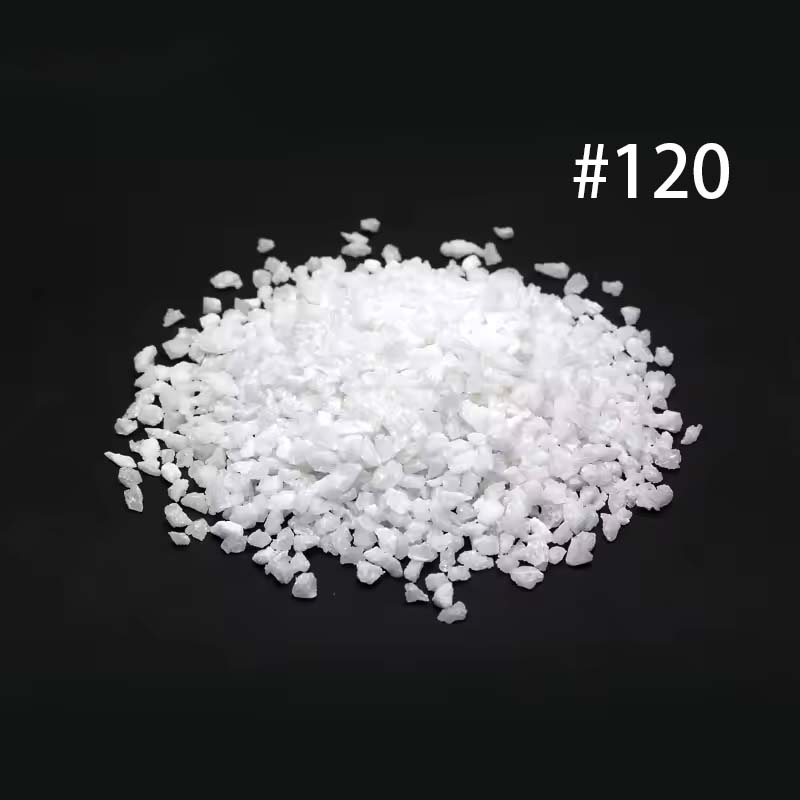
Beyond media type, mesh (grit) size is the second most important variable in plastic blast media selection. Coarser mesh = larger particles = more aggressive material removal and higher surface profile. Finer mesh = smaller particles = gentler action, finer finish, slower strip rate.
Which Type for Which Scenario?
Real-world application requirements don’t always fit neatly into a comparison table. Here’s how to map common blasting scenarios to the right media type:
Recommended: Type II Urea, Mesh 20–30
- Safe for 2024-T3 and 7075-T6 aluminum alloys
- Removes standard MIL-SPEC primer + topcoat systems efficiently
- Meets most DoD depaint process specifications
- Use 30–50 PSI, 6–8 inch standoff, 80° impingement
Recommended: Type III Melamine, Mesh 16–20
- Fastest strip rate for powder coat and baked enamel
- Steel substrates tolerate the higher profile
- Maximizes throughput for high-volume recoat operations
- Use 35–55 PSI with adequate dust collection
Recommended: Type V Acrylic, Mesh 30–50
- Only viable plastic blast media for bare CFRP surfaces
- Use 20–40 PSI, perpendicular fiber angle, 8–10 inch standoff
- Monitor for fiber whitening as early warning of excess pressure
- Qualify process per applicable composite repair manual
Recommended: Type II Urea, Mesh 20–30
- Removes multi-layer factory paint without warping thin sheet metal
- Preserves panel gauge on doors, hoods, and quarter panels
- Ideal replacement for chemical stripping or heat guns
- Use 25–40 PSI, keep nozzle moving, watch thin metal edges
Recommended: Type V Acrylic or Type II Fine Grade (Mesh 50–80)
- Removes carbon deposits and release agent without altering cavity dimensions
- Preserves polished tool steel surface finish
- Low pressure (15–30 PSI) to protect cavity geometry
- See full guide: Mold Cleaning Best Practices
Recommended: Type III Melamine, Mesh 20–30
- Titanium’s higher hardness (Mohs ~6) makes it compatible with melamine
- Provides faster strip rates than urea on the same coating systems
- Ensure process qualification before production use on flight hardware
- Use 30–50 PSI, monitor for hydrogen embrittlement risk
Decision Framework: How to Choose
If you’re still uncertain after the scenario guide above, work through this decision logic in order:
🗂 Plastic Blast Media Type Selection Logic
Common Mistakes When Selecting Blast Media
Even experienced operators make avoidable errors when switching between media types. These are the mistakes we see most frequently — and how to avoid them:
1. Using the Same Pressure Settings Across All Types
This is the most common and costly mistake. Blast parameters developed for Type II urea cannot be transferred directly to Type III melamine without risk of substrate damage, or to Type V acrylic without risk of ineffective cleaning. Every media type change requires a process re-qualification with test coupons before returning to production. Document your parameters separately for each media type.
2. Choosing Media Type Based on Price Per Pound Alone
Acrylic appears expensive at first glance — sometimes 2–3× the per-pound cost of urea. But if your application requires acrylic (CFRP substrates, precision mold tools, thermoplastic parts), using a cheaper media type and damaging the substrate creates rework costs that dwarf any media savings. Evaluate media choice on total cost including waste, rework, and cycle time — not purchase price per pound.
3. Neglecting Media Reclaim System Maintenance
The reuse cycle advantages of all three media types are only achievable with a properly maintained reclaim system. Air wash separators and vibrating screens must be correctly sized and regularly cleaned. A reclaim system that allows broken fines and paint debris to recirculate reduces effective media hardness unpredictably and can contaminate finished surfaces.
4. Ignoring Moisture in Acrylic Media
PMMA (Type V acrylic) is hygroscopic and will absorb ambient moisture during storage if not kept in sealed, dry conditions. Moisture-saturated acrylic media breaks down faster than dry media, shortening the reuse cycle and increasing per-part cost. Store acrylic media in sealed containers with desiccant and condition it in a dry blast cabinet for one cycle before use if any moisture exposure is suspected.
5. Assuming “Plastic Media” Is One Product
Specifying simply “plastic blast media” on a purchase order without type and mesh designation is a common error in procurement. Two suppliers may ship entirely different products against the same vague specification. Always specify MIL-P-85891A Type (II, III, or V), mesh size range, and Certificate of Conformance requirement.
Frequently Asked Questions
Can I mix Type II and Type III media in the same blast cabinet?
Technically possible, but strongly inadvisable. Mixing types creates an undefined blended hardness profile that makes process qualification impossible and makes troubleshooting substrate damage very difficult. If you need to switch from one type to another in the same cabinet, completely purge the old media charge from the reclaim system and hopper before loading the new type.
Is Type III melamine safe for anodized aluminum?
No, not typically. Anodized aluminum has a relatively thin, hard oxide layer (typically 0.0002–0.001 inches) that melamine’s aggressiveness will remove along with any coating on top of it, exposing bare aluminum. If your application requires stripping a coating from anodized aluminum while preserving the anodize layer, Type II urea at fine mesh and low pressure is your best plastic media option — though even then, process qualification is essential. In many cases, chemical stripping is the only viable approach for preserving anodize.
How do I know when my plastic media needs to be replaced?
The primary indicator is declining strip rate — if achieving full coating removal requires significantly more nozzle passes or higher pressure than at the start of the media charge, the particles have broken down below effective size. Secondary indicators include increased dust generation (excess fines), discoloration of the media charge (from paint contamination), and clogging of reclaim screens. Many operations track cycles and replace media proactively before strip rate degradation affects quality.
What happens if I use plastic blast media in a standard sandblasting cabinet designed for mineral abrasives?
You can blast with plastic media in a standard cabinet, but you will not be able to effectively reclaim and reuse the media — which eliminates most of the economic and performance advantages of plastic abrasives. Plastic media requires a dedicated reclaim system with an appropriately sized air wash separator and screen deck to remove fines and paint debris between cycles. Without reclaim, you’re effectively using a recyclable media as a one-shot abrasive at much higher cost than equivalent mineral options.
Does acrylic (Type V) leave any residue on the blasted surface?
PMMA acrylic media can leave trace amounts of acrylic dust or micro-particles on the blasted surface after processing. For most applications, a compressed air blow-off is sufficient to remove residue. However, for applications requiring adhesive bonding or specific surface chemistry — such as composite repair bonding — a solvent wipe with isopropyl alcohol after blasting and air blow-off is recommended to confirm cleanliness before applying adhesive or primer.
Filters