Is Aluminum Oxide Blast Media Reusable?
How Many Times?
A practical, data-driven guide to aluminum oxide media lifecycle management — covering how recycling works, what limits service life, how to measure media health, and how to calculate the true cost advantage of closed-loop operation.
- The Short Answer
- How Aluminum Oxide Blast Media Recycling Works
- What Actually Limits Media Service Life
- Typical Cycle Counts by Grade and Conditions
- Recyclability Compared: Al₂O₃ vs Garnet vs Coal Slag
- How to Measure Media Health in Production
- Reclaim & Classification System Design
- Total Cost of Ownership Calculation
- Seven Ways to Extend Media Service Life
- Questions fréquemment posées
1. The Short Answer
The number of useful cycles is not fixed — it varies with blast pressure, substrate hardness, nozzle condition, and how well the reclaim system is maintained. This guide gives you the tools to measure media health accurately, optimize your reclaim system, and calculate the real cost benefit of closed-loop operation for your specific production volume. For product background, see our complete reference: Aluminum Oxide Blast Media: The Complete Buyer’s Guide.
2. How Aluminum Oxide Blast Media Recycling Works
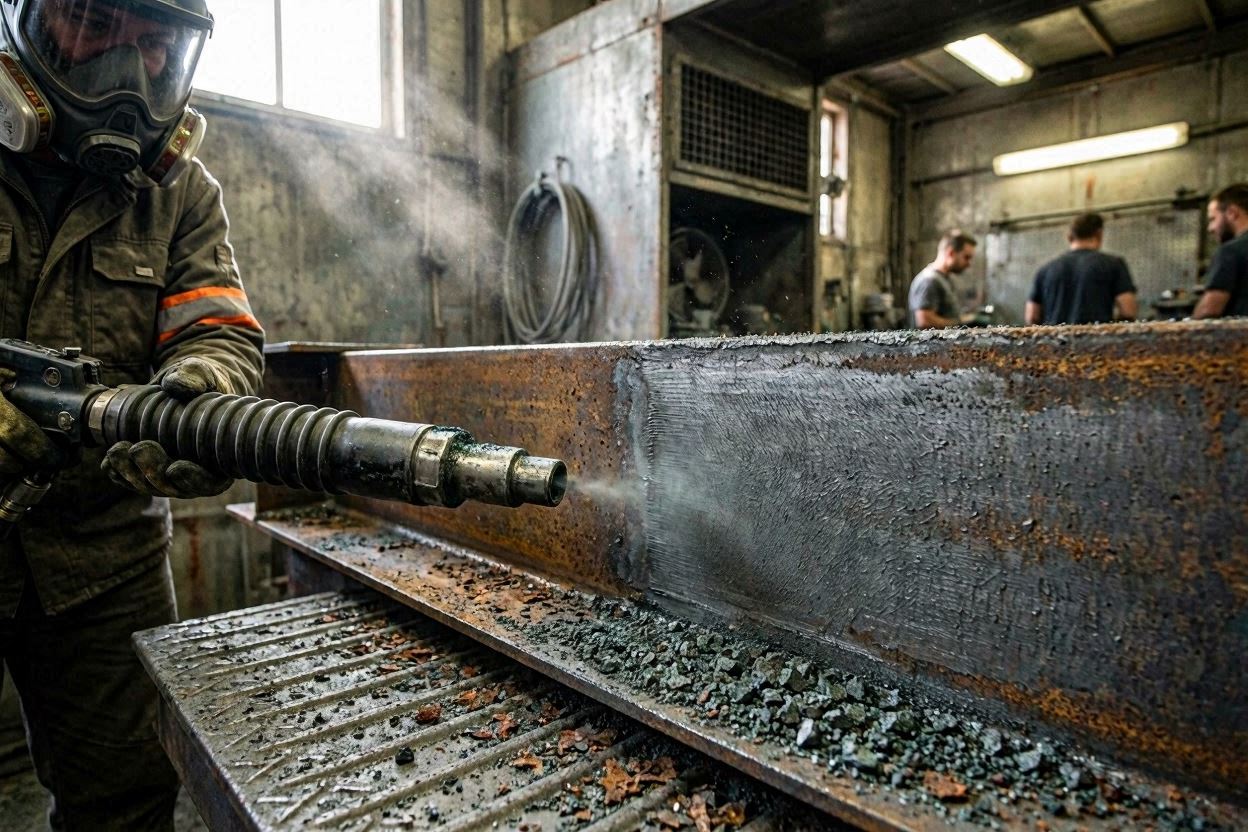
In a closed-loop blasting system — whether a blast cabinet, tumble blast machine, or tunnel blast line — spent media falls to the bottom of the blast enclosure after each pass and is continuously reclaimed, cleaned, classified, and returned to the blast nozzle or wheel for reuse. This continuous loop is what makes multiple recycle cycles possible.
The air wash separator is the most critical component in the reclaim system — and the most commonly misadjusted. Its classification air velocity must be set correctly for the specific grit size being used. Too low an air velocity and fine particles remain in the media charge, gradually lowering the effective D50 and degrading anchor profile output. Too high an air velocity and usable on-size particles are swept into the dust collector along with genuine fines, increasing media consumption rate unnecessarily.
3. What Actually Limits Media Service Life
Three distinct degradation mechanisms progressively reduce the usefulness of a blast media charge over its service life. Understanding each one helps you identify which mechanism is limiting your specific operation and take targeted corrective action.
Mechanism 1: Progressive Grain Fracture — The Primary Limiter
Every impact event subjects each grain to a high-strain-rate compressive and shear stress field. Grains fracture along crystal cleavage planes and pre-existing micro-cracks, releasing angular sub-fragments. These sub-fragments are themselves active abrasive particles — they cut effectively on the next pass — but each is smaller than the parent grain. Over multiple cycles, the overall particle size distribution of the media charge shifts progressively toward smaller sizes. As the D50 drops, the kinetic energy per particle (which scales with particle mass) decreases, and the achievable anchor profile depth per pass diminishes. When the achieved Rz falls below the specification minimum, the media charge has reached end-of-life for the current application — regardless of how much material remains in the hopper.
Mechanism 2: Dust and Fine Accumulation — The Multiplier
If the reclaim system’s air wash separator is not correctly set or is poorly maintained, fine particles and dust accumulate in the media charge rather than being removed. This has two effects: it dilutes the effective cutting fraction (large particles do the work; fines just take up space in the media stream), and it increases dust generation at the blast nozzle, raising the respirable particulate exposure for operators and increasing the load on the dust collector. The practical symptom is a media charge that looks full in the hopper but produces progressively shallower profiles — because the volume is maintained by accumulating fines rather than on-size cutting particles.
Mechanism 3: Contamination — The Application-Specific Limiter
Each blast pass picks up a small quantity of substrate material — rust particles, mill scale fragments, paint chips, and substrate metal fines — that enters the media reclaim system along with the spent abrasive. In most carbon steel applications, this contamination is inconsequential — the reclaim screen removes large fragments, and fine steel dust is separated in the air wash stage. However, in applications where media purity is critical — white fused aluminum oxide used on stainless steel, aerospace alloys, or medical devices — the accumulation of substrate contamination in the media charge can progressively compromise the purity requirement. For these applications, the media charge should be replaced at intervals defined by chemical testing of the media sample, not just by particle size degradation.
4. Typical Cycle Counts by Grade and Conditions
The cycle count ranges below are based on closed-loop blast cabinet operation with a functional air wash classifier, blasting mild steel at standard industrial conditions (70–85 PSI, F36 equivalent grit, venturi nozzle). Actual results in your operation may differ based on the variables described in Section 3.
| Condition Variable | Effect on Cycle Count | Practical Guidance |
|---|---|---|
| Blast pressure | Higher pressure → faster grain fracture → fewer cycles per kg | Use the minimum pressure that achieves the specification Rz; avoid over-blasting |
| Substrate hardness | Harder substrates fracture grains faster; softer substrates are gentler on media | On hardened steel (>45 HRC), expect 30–40% fewer cycles than on mild steel |
| Grit size | Coarser grits carry more energy per impact → fracture faster; finer grits last longer per particle but remove less material per pass | F16–F24 typically achieves the lower end of the cycle range; F60–F80 the upper end |
| Nozzle condition | Worn nozzle reduces velocity → less grain fracture per pass → slightly more cycles, but also lower production rate | Replace nozzle when bore diameter exceeds nominal by 25%; worn nozzles also produce inconsistent profiles |
| Air wash separator setting | Correctly set separator removes fines each cycle, maintaining D50; poorly set unit allows fine accumulation | Verify setting with periodic sieve analysis of clean media hopper output; adjust seasonally if air density changes |
| Cabinet sealing and dust collection | Poorly sealed cabinet allows fine particles to escape rather than be classified; effectively lowers recoverable fraction | Inspect and replace door seals, blast hose connections, and media valve seats on a scheduled maintenance basis |
5. Recyclability Compared: Al₂O₃ vs Garnet vs Coal Slag
The commercial case for aluminum oxide over competing media rests primarily on its recyclability advantage. The table below puts the comparison in concrete terms for a hypothetical blast cabinet processing 400 m² of mild steel per week to SSPC-SP 10.
| Metric | Brown Al₂O₃ (F36) | Almandine Garnet (30/60) | Coal Slag (16/40) |
|---|---|---|---|
| Nominal cycles | 6 (mid-range) | 2 | 1 (single-use) |
| Initial media load (kg/m²) | 2.5 | 2.5 | 2.5 |
| Net media consumption (kg/m²) | 2.5 ÷ 6 = 0.42 | 2.5 ÷ 2 = 1.25 | 2.5 ÷ 1 = 2.50 |
| Weekly media purchase (400 m²) | 168 kg | 500 kg | 1,000 kg |
| Weekly spent media disposal | ~168 kg | ~500 kg | ~1,000 kg |
| Relative total cost (media + disposal) | Lowest | Modéré | Highest |
| Profile consistency over charge life | High — gradual, predictable decline | Moderate — faster decline | N/A — replace each use |
For a full comparison of aluminum oxide against garnet across eight application scenarios, see: Aluminum Oxide vs Garnet Blast Media: Full Comparison.
6. How to Measure Media Health in Production
The most common mistake in media lifecycle management is replacing or topping up media on a time-based or visual schedule rather than a performance-based one. A hopper full of visually normal-looking media may be performing well below specification if its particle size distribution has degraded. The only reliable indicators of media health are measurement-based.
Primary Indicator: Anchor Profile Depth (Rz)
Measure the achieved anchor profile on a representative blasted surface at the start of each production shift and periodically during long runs, using ISO 8503 replica tape (Testex Press-O-Film or equivalent) or a calibrated electronic profilometer. Take five readings per measurement event, spaced at least 0.5 m apart. Record the mean Rz and compare it against the lower tolerance in your coating specification. When the mean Rz drops to within 5 µm of the specification minimum, schedule a top-up with fresh media before the next shift. Do not wait for the profile to actually fall below specification — at that point, any work produced in the current shift may need to be re-blasted.
Secondary Indicator: Sieve Analysis of the Media Charge
A sieve analysis of a representative media charge sample (taken from the clean media hopper after air wash classification) provides direct quantitative data on D10/D50/D90 values and can be compared against the FEPA F-grits tolerance for the nominal grade. When the D50 has dropped by more than 15–20% from the nominal fresh-media value, plan for a partial or full media change at the next scheduled maintenance window. Sieve analysis requires a calibrated sieve stack and a shake table — most quality laboratory suppliers can provide the equipment, and the test takes approximately 15–30 minutes per sample.
Production Log: The Long-Term Management Tool
A simple production log linking cumulative blasted area (m²) to measured Rz readings is the most practical tool for long-term media lifecycle management. Plot cumulative m² on the horizontal axis and mean Rz on the vertical. As cycles accumulate, you will see a characteristic gradual downward trend in achieved Rz. The slope of this trend line allows you to predict — to within one or two shifts — when the next top-up will be required, enabling planned purchasing and avoiding emergency procurement at premium prices.
| Shift | Cumulative m² | Mean Rz (µm) | 5-Reading Range | Status vs Spec (min 45 µm) | Action |
|---|---|---|---|---|---|
| Day 1 AM | 0 (fresh charge) | 58 | 54–63 | OK — well above spec | Aucun |
| Day 3 PM | 320 | 55 | 51–60 | OK | Aucun |
| Day 7 AM | 740 | 52 | 48–57 | OK | Aucun |
| Day 10 AM | 1,080 | 49 | 45–54 | Caution — approaching lower limit | Schedule top-up for next shift |
| Day 11 AM | 1,190 | 47 | 43–52 | Low end reading at 43 µm | Top up 30% fresh media before continuing |
| Day 11 PM | 1,270 (post top-up) | 54 | 50–58 | OK — restored | Resume production |
Sample KPI log — values are illustrative for F36 brown fused aluminum oxide on mild steel. Actual values depend on blast conditions and steel substrate type.
7. Reclaim & Classification System Design
The quality of the reclaim and classification system is the single greatest controllable variable affecting how many useful cycles your aluminum oxide charge delivers. A well-designed and correctly maintained classifier can extend effective media service life by 30–50% compared to an under-specified or poorly maintained equivalent.
Air Wash Separator — The Core Component
The air wash separator creates an upward air curtain through which spent media falls in a thin, evenly distributed curtain. Fine particles below the cut point are carried upward into the dust collector; on-size particles fall through to the clean media hopper. The cut point — the particle size at which 50% of particles go up and 50% fall through — is set by adjusting the air volume (via damper position or variable-speed fan). The cut point must be calibrated to the specific grit size being used and re-verified whenever you change to a different grit or if the system fan performance changes due to impeller wear or filter pressure drop.
Vibrating Screen Classifier
A vibrating screen with an appropriate mesh opening (typically 1.5–2× the D90 of the grit being used) removes oversize contaminants — weld spatter, scale fragments, substrate metal chips, and media agglomerates — from the recycled stream. These oversize particles cause uneven blasting patterns and can damage workpiece surfaces. Screen mesh should be inspected monthly and replaced when holes are worn oversize or when blinding (particle bridging across screen openings) is observed.
Dust Collection
The dust collector captures the fine fraction removed by the air wash separator. Most blast cabinet dust collectors use cartridge-type filter elements with pulse-jet cleaning. Filter pressure drop should be monitored continuously — excessive pressure drop across the filter reduces the available air volume for the air wash separator, shifting the cut point toward larger particles and allowing fines to accumulate in the media charge. Replace filter cartridges when pressure drop exceeds the manufacturer’s specification, regardless of elapsed operating time.
8. Total Cost of Ownership Calculation
The economic justification for investing in a closed-loop reclaim system — and for choosing aluminum oxide over single-use media — rests on a straightforward calculation. The following framework lets you calculate the specific cost advantage for your operation.
The TCO Formula
Net media cost per m² = (Unit purchase price per kg) ÷ (Number of recycle cycles) + (Disposal cost per kg of spent media) + (System maintenance cost amortized per m²)
Classifier Investment Payback Period
For operations considering an upgrade from open-blast single-use practice to closed-loop reclaim, the key financial question is how long the capital investment in blast cabinet + classifier takes to pay back in media cost savings. A simplified payback calculation:
- Annual media cost saving = (Single-use cost per m² − Reclaim cost per m²) × Annual m² processed
- Simple payback period (years) = Classifier capital cost ÷ Annual media cost saving
- At 300 m²/week (15,600 m²/year), the payback period for a standard blast cabinet + air wash classifier is typically 18–30 months at current media prices
- At 600 m²/week, payback compresses to 10–16 months
For bulk pricing and volume discount schedules from Jiangsu Henglihong Technology, see our wholesale resource page: Bulk Aluminum Oxide Blast Media – Wholesale Pricing & RFQ.
9. Seven Ways to Extend Media Service Life
Beyond the fundamental variables of grade and grit size, operational practices have a measurable impact on how many cycles you extract from each media charge. The following seven practices are consistently cited by blast equipment engineers as the highest-impact lifecycle management actions.
- Use the minimum blast pressure that achieves specification Rz. Every 10 PSI reduction in blast pressure reduces grain fracture rate per pass by approximately 15–20%, directly extending media service life. Determine the minimum pressure required for your specific grit-substrate-cleanliness combination by trial blast measurement, then standardize at that setting. Do not run at “full pressure” by default.
- Calibrate the air wash separator correctly for the grit size in use. A correctly set separator removes fines each cycle, maintaining the D50 of the active charge. A poorly set separator either leaves fines in (degrading performance) or removes useful media (increasing consumption). Calibrate whenever changing grit sizes and verify monthly with a sieve analysis sample.
- Replace nozzles before they wear beyond 25% of nominal bore diameter. A worn nozzle produces a diverged, reduced-velocity blast pattern that generates more fines per pass (more turbulent impact angles) and delivers less profile depth. Worn nozzles decrease cleaning rate and increase media consumption simultaneously — the worst combination.
- Maintain blast cabinet sealing. Poorly sealed doors, hose connections, and media valve seats allow fine particles to escape the reclaim loop, effectively reducing the media recovery fraction. Inspect door seals, blast hose grommets, and reclaim duct connections quarterly.
- Keep media moisture content below specification. Damp media clumps in the hopper and feed system, causing irregular flow and inconsistent blast patterns. Irregular blast patterns increase local over-blasting, which fractures grains faster. Store media in sealed packaging in a dry environment; specify moisture ≤ 0.3% (brown) or ≤ 0.15% (white) on your supplier CoA.
- Top up incrementally rather than replacing the full charge. Adding 20–30% fresh media when performance metrics indicate a decline — rather than waiting for complete charge failure and doing a full replacement — maintains consistent particle size distribution in the active charge and avoids the one-time cost spike of a complete replacement. Incremental top-up also prevents the sudden profile overshoot that occurs when a fully fresh charge is loaded after a degraded one.
- Log Rz measurements against cumulative m² treated. A running performance log is the only tool that tells you when to act before profile quality degrades below specification. Operations without a measurement log either over-spend on premature media replacement or under-maintain and produce non-conforming surfaces. The log costs ten minutes per shift and prevents both failure modes.
10. Frequently Asked Questions
In practice, outdoor open-blast applications rarely allow cost-effective media recovery. Spent media becomes mixed with substrate contamination, embedded in surrounding ground or structure, and dispersed by wind — making reclaim both technically challenging and commercially uneconomical unless the worksite is enclosed or bunded specifically for media recovery. In most genuine outdoor blasting scenarios, aluminum oxide is effectively used once — and in this case, its unit cost premium over single-use media like coal slag cannot be recovered through recycling. For outdoor applications without media recovery capability, garnet or coal slag is typically more cost-effective. Aluminum oxide’s value proposition is primarily realized in enclosed blast cabinet or blast room environments with a functioning reclaim system.
The three most reliable indicators are: first, the anchor profile achieved on a freshly blasted surface should remain stable across multiple shifts rather than declining — a steadily declining profile with no change in blast parameters indicates inadequate fines removal or media degradation. Second, collect a 100 g sample from the clean media hopper after the air wash separator and perform a simple sieve analysis using the FEPA F-grit sieve stack — if the D10 is significantly below the FEPA lower tolerance for your nominal grit, the separator is under-performing. Third, monitor dust collector pressure drop — if it rises steadily even after pulse-jet cleaning, the filters are blinding and reducing separator airflow, which allows fines to accumulate in the media charge. These three checks, performed weekly, will catch the vast majority of reclaim system performance issues before they cause a production problem.
A top-up involves adding a quantity of fresh media — typically 20–40% of the total hopper capacity — to restore the particle size distribution of a partially degraded charge. It is done incrementally, before the charge performance falls below specification, and is the preferred approach for routine lifecycle management. A full media change involves evacuating the entire hopper, cleaning the reclaim system, and recharging with 100% fresh media. It is appropriate when: the charge has been contaminated by substrate material that compromises application requirements (e.g., stainless steel work after a contamination incident); the charge has degraded to the point where a top-up would not restore adequate performance; or the operation is switching to a different grit size. Full media changes are more disruptive and costly than top-ups — the goal of good lifecycle management is to extend the period between full changes by performing timely incremental top-ups.
Yes — significantly. The grain fracture rate per impact event increases when the substrate is harder, because the abrasive grain cannot penetrate as deeply and a greater proportion of the impact energy is absorbed in grain fracture rather than substrate deformation. On mild steel (approximately 150–200 HBN), brown fused aluminum oxide F36 at 75 PSI might achieve 6–8 cycles. On hardened tool steel (50–60 HRC, approximately 500–700 HBN), the same media at the same conditions may achieve only 3–4 cycles. This reduced cycle count should be factored into your TCO calculation for hard substrate applications — though even at half the cycle count, aluminum oxide typically outperforms single-use alternatives on a cost-per-m² basis for enclosed blast operations.
Yes. The capital cost of a blast cabinet with air wash classifier and dust collection — ranging from approximately $8,000–$40,000 USD depending on cabinet size and system capacity — must be amortized over the production volume to yield a cost-per-m² contribution. At very low volumes (below approximately 50–80 m² per week), the amortized capital cost can exceed the media savings, making the simple approach of using a suction-feed cabinet with periodic media replacement more economical. The practical threshold at which closed-loop investment becomes clearly favorable is typically around 200–300 m² per week for a small workshop. Above 500 m² per week, the economic case for full reclaim is compelling under virtually any cost assumptions. Between 80–200 m² per week, the answer depends on local media prices, disposal regulations, and the specific cabinet investment cost — a project-specific calculation is recommended.
Yes — this is the recommended top-up approach. Adding 25–30% fresh media to a charge that has declined to 80–85% of its initial D50 typically restores the blended charge to approximately 90–92% of the fresh-media D50, which is usually sufficient to maintain specification Rz for several additional production shifts before the next top-up is needed. The blend should be added to the clean media hopper (after the air wash separator), not directly to the blast pot or cabinet hopper, so that the fresh media passes through the classifier before entering the active blast circuit. This approach is universally applicable regardless of grit size or grade — the only exception is contamination-critical applications (medical, aerospace) where mixing introduces uncertainty about the purity of the blended charge; in these cases, a full media change is preferred over a top-up.
Source High-Cycle Aluminum Oxide from Henglihong
Jiangsu Henglihong Technology manufactures brown fused and white fused aluminum oxide abrasives with tight FEPA grit tolerances and low moisture content — the two properties that most directly determine how many cycles you achieve in production. Every shipment includes a lot-specific Certificate of Analysis.
Related Resources
Continue with these guides from the Henglihong resource library:
- Aluminum Oxide Blast Media: The Complete Buyer’s Guide
- Aluminum Oxide Grit Size Chart & Selection Guide
- Brown vs White Aluminum Oxide: Which Should You Use?
- Aluminum Oxide vs Garnet Blast Media: Full Comparison
- How to Choose Aluminum Oxide Blast Media for Steel Surfaces
- Aluminum Oxide Blast Media for Aerospace & Medical
- Aluminum Oxide for Glass Etching & Frosting
- Bulk Aluminum Oxide Blast Media – Wholesale Pricing & RFQ
- Aluminum Oxide Anti-Slip Additive for Floor Coatings
Filtres