Black Silicon Carbide vs. Green Silicon Carbide: What’s the Difference?
A complete technical comparison of BSiC and GSiC — purity grades, crystal structure, physical properties, application matching, and procurement guidance for industrial buyers.
SECTION 01Overview: Two Grades of the Same Material
Silicon carbide (SiC) used as abrasive blasting media comes in two commercially distinct grades — Black Silicon Carbide (BSiC) und Green Silicon Carbide (GSiC). Both are produced from the same raw materials via the Acheson process, and both share the defining characteristics that make SiC the hardest commercially available blasting abrasive: extreme hardness (Mohs 9.0–9.5), sharp angular morphology, thermal stability, and chemical inertness. Yet they differ meaningfully in purity level, crystal quality, color origin, and suitability for specific industrial applications.
For many general-purpose industrial blasting applications, the choice between black and green SiC has no practical impact on blasting performance. For precision applications — semiconductor processing, aerospace-grade surface conditioning, optical component preparation — the difference is significant and choosing the wrong grade can introduce contamination, compromise surface finish, or create downstream quality failures.
This guide explains exactly where the differences lie, what they mean in practice, and how to determine which grade your application requires. For a broader understanding of silicon carbide blasting media overall, see the Complete Buyer’s Guide to Silicon Carbide Abrasive Blasting Media.
SECTION 02Production Differences: Why They Look Different
Both black and green silicon carbide are produced in the same Acheson electric resistance furnace, using the same basic reaction: silica sand (SiO₂) + petroleum coke (C) → SiC + CO at temperatures above 1,700°C. The difference in color and purity arises from where in the furnace the crystals form and how long they are exposed to peak synthesis temperatures.
The Acheson Furnace Temperature Gradient
In an Acheson furnace, temperature is highest immediately adjacent to the central graphite electrode core (reaching 2,400–2,600°C) and decreases progressively toward the outer edges of the charge mixture. This temperature gradient creates two distinct crystallization zones:
Inner Core Zone → Green SiC
Crystals forming closest to the graphite core experience the highest sustained temperatures. This drives off virtually all impurities (nitrogen, aluminum, boron), yielding crystals with SiC purity of 99.0–99.8%. The hexagonal alpha-SiC crystal structure that forms at these temperatures is exceptionally well-ordered, with fewer lattice defects. The resulting crystals appear green due to the high structural purity and absence of impurity inclusions that scatter light differently.
Outer Zone → Black SiC
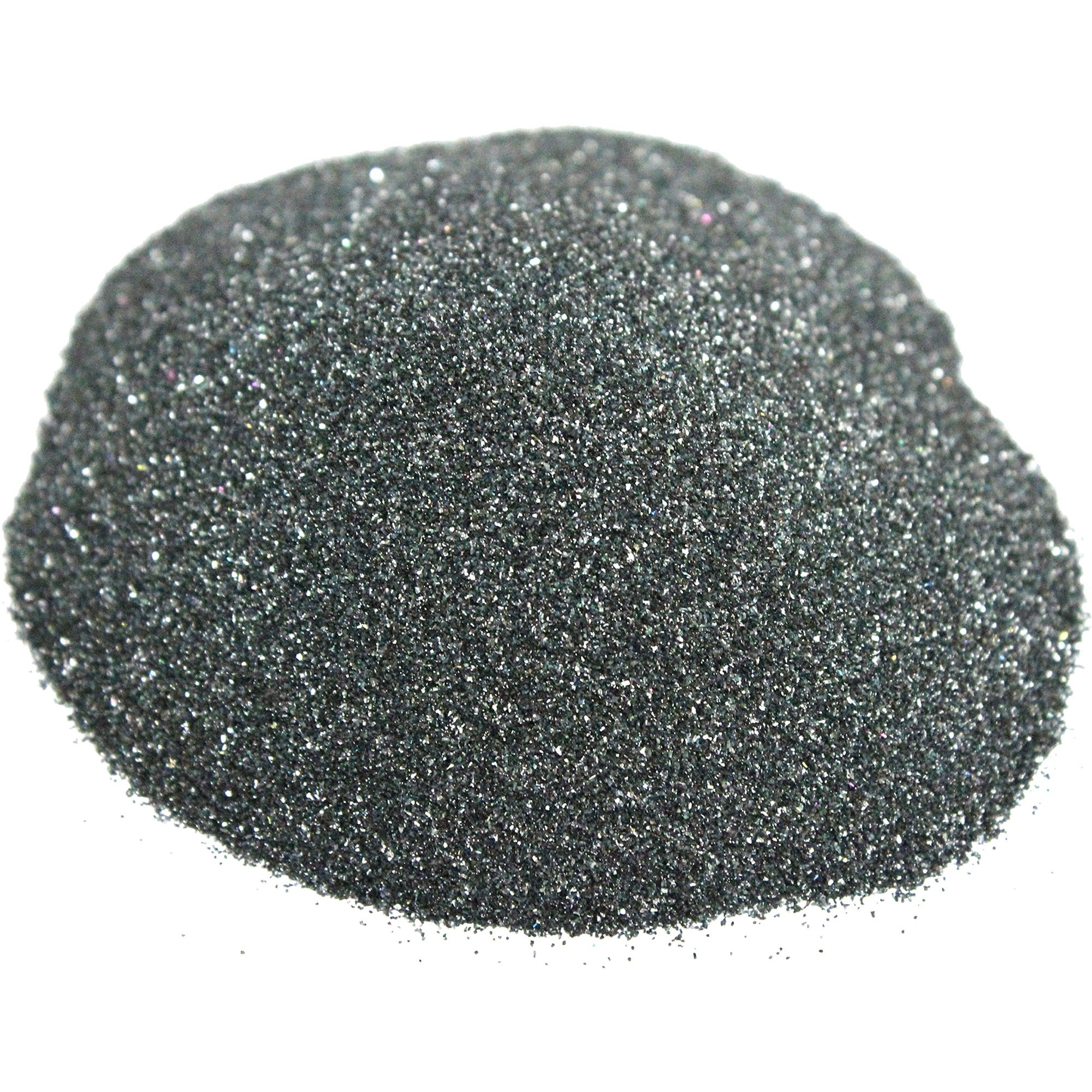
Crystals forming in the cooler outer regions of the furnace charge are exposed to lower temperatures and incorporate minor amounts of impurities — primarily iron (from raw material trace contamination), aluminum, and nitrogen — at levels typically ranging from 0.5% to 3%. These impurity inclusions absorb and scatter light, giving the crystals a characteristically dark gray to black appearance. SiC purity in this zone is 97.0–98.5%.
Key insight: Black and green SiC are not different materials — they are the same SiC compound produced at different positions within the same furnace. The color difference is a direct visual indicator of purity level, not a different product formulation.
SECTION 03Physical and Chemical Properties Compared
Despite their common origin, the purity difference between black and green SiC translates into measurable differences in several physical and chemical properties that matter in blasting applications.
Thermal Conductivity
Green SiC’s more perfect crystal lattice results in measurably higher thermal conductivity compared to black SiC. High-purity green SiC achieves thermal conductivity of 250–490 W/m·K (depending on crystal orientation), while black SiC typically measures 120–200 W/m·K. For blasting applications this difference is rarely significant — both grades dissipate heat generated at the impact site far faster than any organic or metallic abrasive. However, in lapping and polishing applications where heat buildup affects surface finish quality, the higher thermal conductivity of green SiC provides a measurable advantage.
Friability and Fracture Behavior
Both grades are brittle crystalline materials that fracture on high-energy impact, exposing fresh sharp edges. Green SiC, with its more perfect crystal structure, fractures along more predictable cleavage planes — producing angular fragments with sharper edges than those produced by black SiC fracture. This gives green SiC a slightly more aggressive cutting action per impact event. Black SiC tends to fracture more randomly due to impurity-induced lattice defects, producing slightly more variable fragment shapes — still angular and effective, but with marginally less cutting consistency at the micro level.
SECTION 04Full Comparison Table
| Property | Black Silicon Carbide (BSiC) | Green Silicon Carbide (GSiC) | Practical Impact |
|---|---|---|---|
| SiC Content | 97.0–98.5% | 99.0–99.8% | Purity-sensitive apps: GSiC required |
| Farbe | Dark gray / black | Iridescent green / gray-green | Visual ID only; no functional difference |
| Mohs-Härte | 9.0–9.2 | 9.3–9.5 | Minimal in most blast applications |
| Fe₂O₃ Content | ≤ 0.5% | ≤ 0.08% | Critical for non-ferrous substrates |
| Free SiO₂ | ≤ 0.3% | ≤ 0.15% | Relevant for health / clean-room use |
| Thermal Conductivity | 120–200 W/m·K | 250–490 W/m·K | Relevant in lapping / precision polishing |
| Crystal Structure Quality | Good (minor defects) | Excellent (near-perfect lattice) | Matters for semiconductor lapping |
| Relative Cost (per ton) | Baseline | +25–40% premium | Significant at volume |
| Commercial Availability | Wide — all suppliers | Fewer suppliers, shorter shelf window | Lead time may differ |
| Primary Use Cases | Steel, stone, concrete, glass, general industrial | Semiconductors, optics, aerospace, ceramics | Match to substrate sensitivity |
SECTION 05Application Matching Guide
The correct grade selection depends primarily on three factors: substrate hardness, contamination sensitivity, and required surface finish precision. Use the following guide to match your application to the appropriate SiC grade.
Applications Where Black SiC Is the Right Choice
⬛ Choose Black SiC For:
- Carbon and alloy steel surface preparation (Sa 2.5 / Sa 3)
- Structural steel, bridges, offshore platforms, storage tanks
- Concrete and masonry scarification
- Granite, marble, and stone etching / carving
- Decorative and architectural glass etching
- Marine hull and underwater structure preparation
- General industrial deburring and cleaning
- Anti-slip surface coating preparation
- Rock tumbling and lapidary work
- High-volume, cost-sensitive blasting operations
🟢 Choose Green SiC For:
- Silicon wafer and compound semiconductor processing
- SiC power device substrate conditioning (EV / power electronics)
- Precision optical component lapping and polishing
- Aerospace titanium / nickel superalloy surface prep
- Medical device and implant component finishing
- Hard ceramic and alumina substrate preparation
- Clean-room manufacturing environments
- Applications where iron contamination is unacceptable
- Ultra-precision lapping (Ra target < 0.2 µm)
- Research and metrology applications
Decision shortcut: If your substrate can tolerate trace iron contamination (≤ 0.5% Fe₂O₃) and your required surface finish is Ra > 0.5 µm, Black SiC will perform identically to Green SiC at 25–40% lower cost. If either condition is not met, specify Green SiC.
SECTION 06Cost Considerations
Green SiC commands a 25–40% price premium over black SiC of equivalent grit size, reflecting the higher energy consumption and lower yield of inner-zone crystals in the Acheson furnace. At small volumes (25–100 kg), this premium is modest in absolute dollar terms. At industrial procurement volumes (5–25 metric tons per shipment), the cost difference becomes significant and justifies careful application analysis before specifying the premium grade.
For the majority of surface preparation applications in construction, heavy industry, marine, and general manufacturing — which collectively represent over 70% of global SiC blasting media consumption — black SiC delivers equivalent functional performance to green SiC. Specifying green SiC in these contexts results in unnecessary cost without measurable process benefit.
For cost modeling across different procurement volumes and application scenarios, refer to: SiC Cost Analysis & Recyclability
SECTION 07How to Choose: Decision Checklist
Answer the following questions to determine the correct SiC grade for your application:
- Is the substrate a semiconductor wafer, optical component, or precision aerospace alloy? → Green SiC required
- Will the blasted surface be used in a clean-room or contamination-controlled environment? → Green SiC required
- Does the specification or quality standard prohibit iron contamination above 0.1%? → Green SiC required
- Is the required surface finish Ra < 0.2 µm? → Green SiC preferred
- Is the substrate carbon steel, stone, concrete, or standard glass? → Black SiC sufficient
- Is cost reduction the primary procurement objective? → Black SiC recommended
- Is the application high-volume industrial blasting with closed-loop media recovery? → Black SiC recommended
Jiangsu Henglihong Technology Co., Ltd. stocks both grades in the full FEPA/ANSI/JIS grit range. Contact our technical team with your application details for a grade recommendation and competitive quote: Request a Quote.
SECTION 08Häufig gestellte Fragen
SECTION 09Related Guides
Need Black or Green SiC in Bulk?
Jiangsu Henglihong Technology Co., Ltd. supplies both grades in the full grit range with full chemical certification. Factory-direct pricing, flexible packaging, FEPA/ANSI/JIS compliance.
Request Grade-Specific Quote →Filter