Plastic Abrasive Media: Urea vs Melamine Grit for Delicate Substrates
When the substrate cannot tolerate the impact energy, hardness, or material removal rate of conventional mineral or metallic abrasives — and yet a controlled surface preparation or coating removal is required — plastic abrasive media is the engineered solution. Manufactured from thermosetting plastics (primarily urea-formaldehyde and melamine-formaldehyde resins), plastic grit offers hardness low enough to leave aluminum, fiberglass, and composite substrates dimensionally unaffected, while still delivering sufficient cutting action to strip multiple layers of paint, epoxy coating, or primer in a single blast pass. This combination of controlled aggressiveness and substrate safety is what makes plastic abrasive media the standard specification in aerospace MRO, automotive refinishing, and marine coating maintenance.
This guide covers the two main plastic grit types, their performance differences, and the applications where each is specified. For the full context of soft and delicate-surface abrasive options within the broader product range, see the Abrasive Media Supplies Buyer’s Guide.
What Is Plastic Abrasive Media?
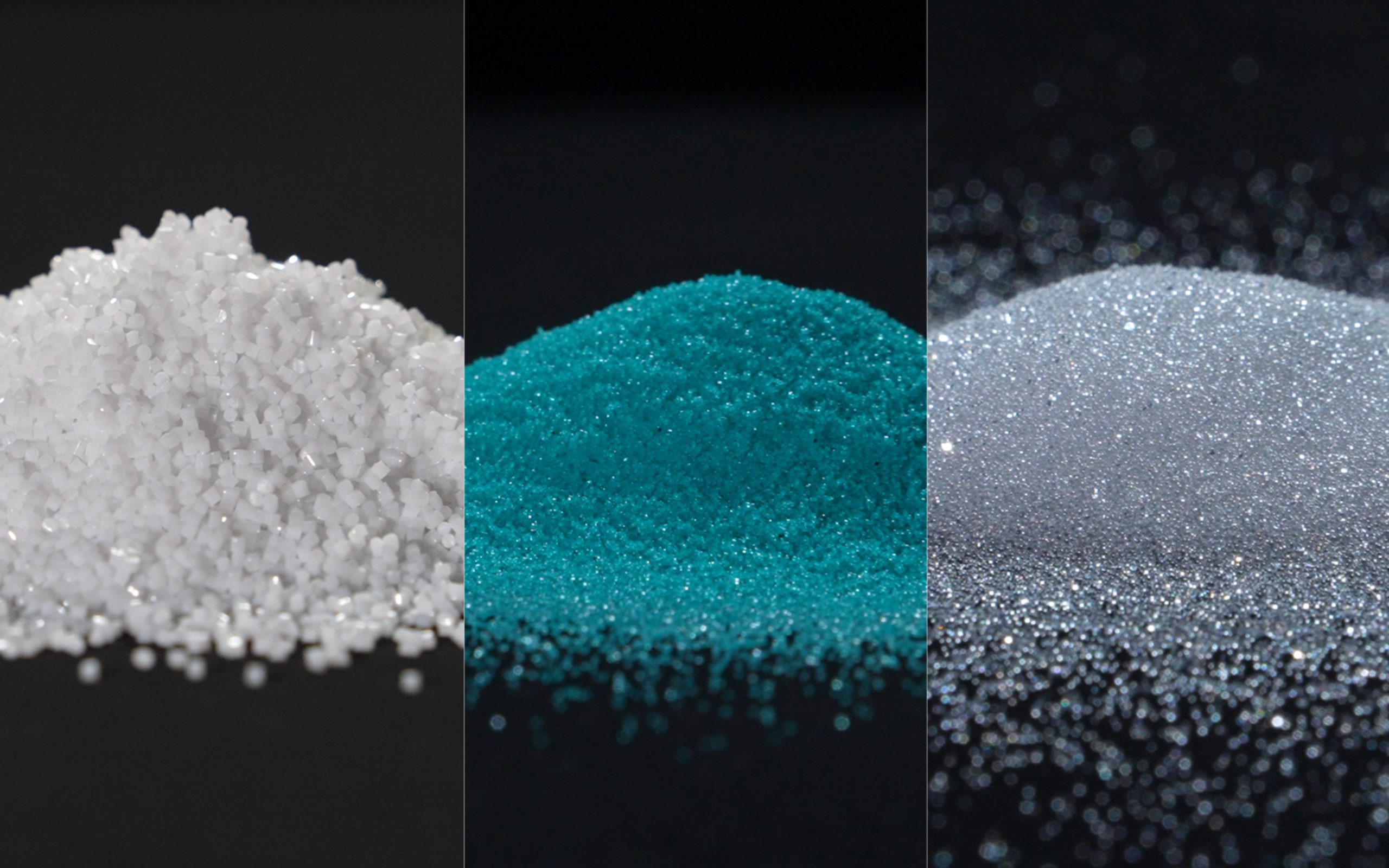
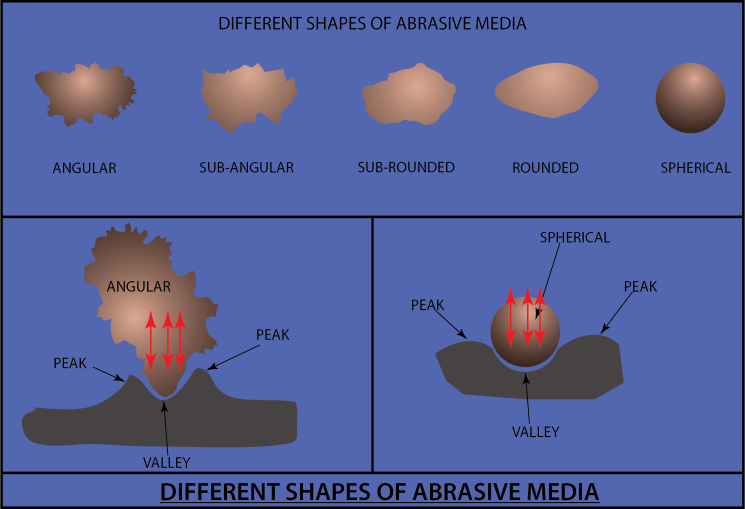
Plastic abrasive media — also called plastic grit — is manufactured by crushing or granulating thermoset polymer materials into angular particles that are then screened to a defined grit size distribution. Unlike thermoplastic materials (which would deform under impact rather than fracturing), thermosetting plastics form a rigid, cross-linked molecular structure on curing that gives them sufficient hardness and brittleness to function as abrasives — yet their hardness of just 3–4 on the Mohs scale is far below that of any metallic or mineral abrasive, which is the fundamental source of their utility for delicate substrate applications.
The military specification MIL-P-85891 defines two commercially dominant types of plastic abrasive grit for stripping aircraft coatings: Type II (urea-formaldehyde, typically white or light-colored) and Type V (melamine-formaldehyde, typically white to translucent). Both are manufactured in angular particle form and function by a controlled scoring and fracture mechanism on the coating surface — the grit particles are hard enough to cut into the coating layer, but not hard enough to deform or remove the substrate material beneath it, provided the correct grit size, blast pressure, and stand-off distance are used within the specification limits.
Urea (Type II) vs Melamine (Type V)
| Property | Urea Type II | Melamine Type V |
|---|---|---|
| Base Material | Urea-formaldehyde resin | Melamine-formaldehyde resin |
| Mohs-Härte | 3–3.5 | 3.5–4 |
| Spezifische Schwerkraft | ~1.5 g/cm³ | ~1.5 g/cm³ |
| Reuse Cycles | 20–35 | 30–45 |
| Friability | Higher (more brittle) | Lower (tougher) |
| Cutting Aggressiveness | Mäßig | Slightly higher |
| Substrate Risk | Lower | Slightly higher |
| Unit Cost | Lower | Higher |
| Best Application | Delicate aluminum skins, composites, thin-gauge panels | Thicker aluminum structures, steel with sensitive alloy coating |
| MIL-P-85891 Type | Type II | Type V |
Urea Type II is the softer of the two, with a higher degree of friability that limits the energy transferred to the substrate on impact — each particle is more likely to fracture on contact, absorbing and dissipating the kinetic energy rather than transmitting it to the substrate. This makes urea the preferred choice for the most delicate applications: thin-gauge aluminum fuselage skins, fiberglass radome structures, and honeycomb composite panels where any substrate distortion would require expensive re-work or component replacement.
Melamine Type V is slightly harder and tougher, giving it a marginally higher strip rate on thick or tenacious coating systems (multiple layers of epoxy primer and topcoat on a structural aluminum panel, for example) and a better reuse cycle count per kilogram of media. It is the standard choice for heavy coating removal on large aluminum structural components — wing spars, fuselage frames, engine nacelles — and for steel marine components where the substrate is robust enough to tolerate the slightly higher impact intensity.
Grit Sizes and Operating Pressures
| Grit Size | Mean Particle Size | Typical Blast Pressure | Anmeldung |
|---|---|---|---|
| 14 grit | ~1,400 µm | 40–60 psi | Heavy topcoat removal, thick epoxy systems |
| 20 grit | ~850 µm | 40–65 psi | Standard stripping, most aerospace MRO applications |
| 30 grit | ~600 µm | 35–60 psi | General coating removal, automotive refinishing |
| 40 grit | ~425 µm | 30–55 psi | Controlled strip of thin coatings, delicate substrates |
| 60 grit | ~250 µm | 25–45 psi | Very delicate substrates, thin-gauge aluminum |
| 80 grit | ~180 µm | 20–40 psi | Surface prep and light cleaning, fiberglass |
Blast pressure is a critical control parameter for plastic media. Unlike harder abrasives, where higher pressure generally improves cut rate without risk of substrate damage, plastic grit has a relatively narrow optimum pressure window. Too low, and the particles lack sufficient kinetic energy to cut the coating effectively; too high, and the increased impact energy can cause substrate deformation — particularly on thin aluminum skins (below 1.5 mm gauge). Most aerospace MRO process specifications define the allowable pressure range for each substrate thickness and specify that any variation requires re-qualification of the process.
Core Applications
Aerospace MRO: Aircraft Coating Stripping
Periodic aircraft repainting requires removal of the existing topcoat, primer, and often conversion coating from the aluminum or composite airframe structure. Chemical stripping agents are effective but environmentally regulated and require long dwell times and extensive protective measures. Plastic abrasive media blasting — typically melamine Type V in 20–30 grit range at 40–60 psi, applied through a suction blast nozzle in a booth equipped with appropriate dust collection — removes aircraft coatings at rates of several square meters per hour without any risk of aluminum skin thinning, provided the process is operated within the qualified parameters. This process is specified by most major airframe OEMs and is standard procedure in commercial aircraft MRO facilities worldwide.
Automotive Refinishing and Body Restoration
Automotive body shops and restoration specialists use plastic grit in 30–40 grit range for stripping paint from vehicle body panels without warping thin-gauge steel or aluminum sheet. The low impact energy of plastic media — compared to glass beads, sodium bicarbonate, or any mineral abrasive — allows it to be applied to complex curved body panel geometries without the differential stress concentration at panel edges and transitions that causes distortion with harder media. For automotive-specific media selection across the full range of applications, see: Abrasive Media for Automotive Restoration & Paint Stripping.
Marine Coating Maintenance
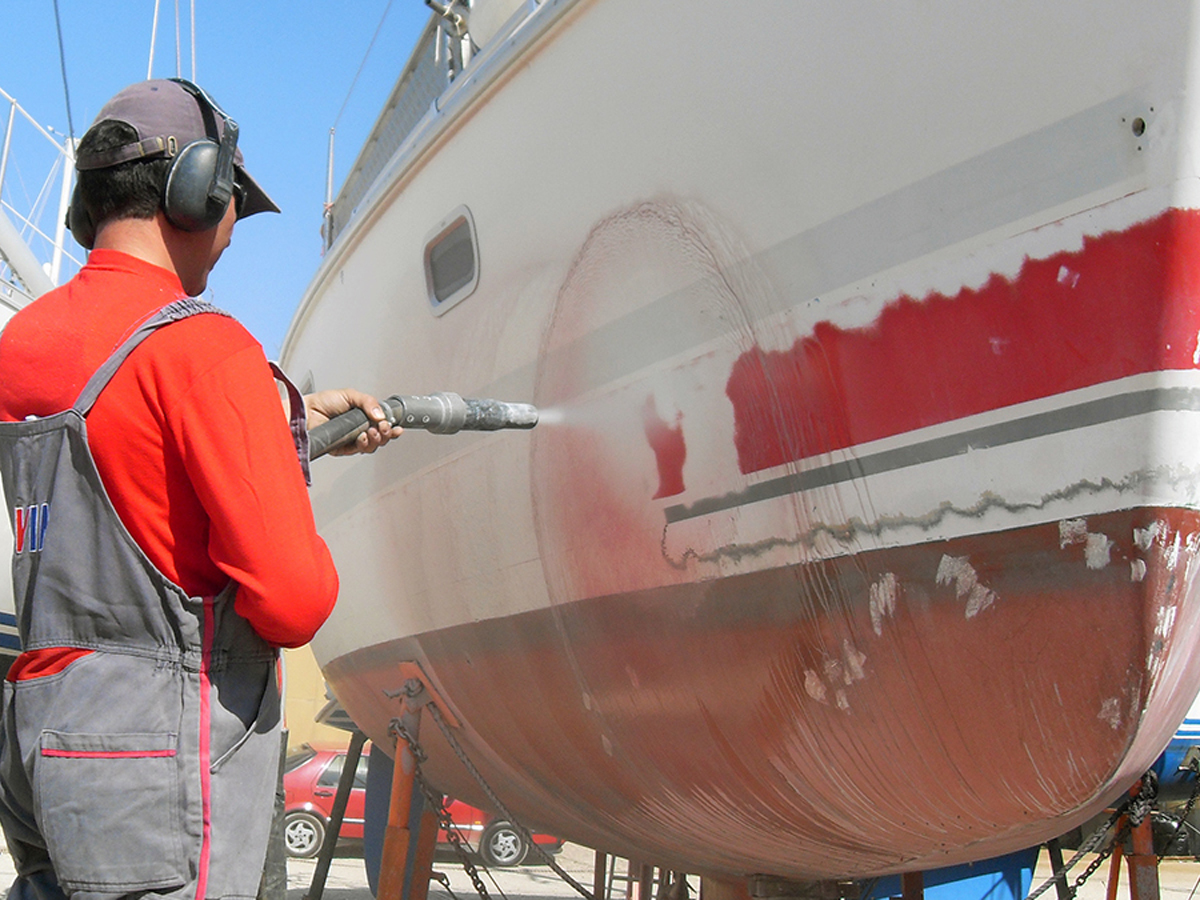
Ship and boat superstructure components — particularly aluminum topsides, wheelhouses, and deck equipment on naval and commercial vessels — require periodic re-coating that first necessitates removal of the existing coating system without compromising the thin-gauge aluminum structure. Melamine grit in 20–30 grit range is the preferred media for this application on aluminum marine structures, delivering controlled coating removal at the production rates needed for major vessel maintenance periods.
Composite and Fiberglass Structures
Carbon fiber reinforced polymer (CFRP) and glass fiber composite structures — increasingly used in aerospace, wind energy, automotive, and marine applications — are particularly sensitive to surface preparation. Any abrasive that is harder than the resin matrix of the composite (most mineral and metallic abrasives) risks exposing fiber ends at the surface, which can wick moisture and degrade bond strength. Urea Type II plastic grit is the safest option for composite surface preparation and intercoat adhesion blasting, providing controlled surface roughening of the resin matrix without cutting individual reinforcement fibers.
Plastic Media vs Walnut Shell and Other Organic Abrasives
| Factor | Plastic Grit (Urea / Melamine) | Walnut Shell Grit | Corn Cob Grit |
|---|---|---|---|
| Hardness (Mohs) | 3–4 | 3.5–4 | 2–3 |
| Cutting Aggressiveness | Moderate (controlled) | Mäßig | Very low |
| Reuse Cycles | 20–45 | 5–15 | 3–10 |
| Moisture Sensitivity | Niedrig | High (swells) | High (swells) |
| Biodegradability | No (synthetic polymer) | Yes | Yes |
| Food Contact Safe | Generally no | Yes (processed correctly) | Yes |
| Best For | Aerospace MRO, automotive, marine composite | Turbine blades, antique metalwork, soft alloys | Gentle cleaning, cosmetics equipment |
The primary advantage of plastic grit over walnut shell in most industrial applications is its higher reuse cycle count and lower moisture sensitivity. Walnut shell, being a natural organic material, absorbs moisture readily — leading to particle swelling, clumping, and loss of flowability in humid environments. Plastic grit, being a synthetic thermoset polymer, is essentially non-hygroscopic and maintains its particle geometry and flow characteristics across a wide humidity range, which is important for consistent process performance in blast booths that may not be climate-controlled.
Häufig gestellte Fragen
Plastic grit can clean and texture carbon steel surfaces, but its low Mohs hardness (3–4) limits its ability to remove mill scale, heavy rust, or tightly adherent coating from hard steel substrates. On mill-scale-free, lightly rusted, or previously blasted steel, plastic grit can achieve a clean surface condition. However, it cannot produce the Sa 2.5 or Sa 3 cleanliness with deep anchor profiles required for heavy protective coatings on structural steel — for that, angular metallic or mineral abrasives are required. Plastic grit is best used on steel only when the substrate is sensitive enough that harder abrasives cannot be used, or for the final light cleaning step before cosmetic finishing.
Spent plastic abrasive media is classified as solid waste (not hazardous waste in most jurisdictions) and can typically be disposed of in industrial solid waste landfill in most regions. However, the spent media contains the stripped coating material — which may include lead-based paint, chromate primer, or other regulated coating components depending on the age and history of the coated structure. In that case, the spent media-plus-coating waste may be classified as hazardous waste, and disposal must comply with applicable environmental regulations for the waste composition. Always characterize spent media for regulated coating components before determining the appropriate disposal route.
Plastic abrasive blasting uses standard pressure blast or suction blast equipment, but several equipment characteristics optimize performance with plastic media. Because plastic grit is significantly lighter than mineral or metallic abrasives (specific gravity ~1.5 vs 3.9–7.8 for other media), it requires lower blast pressures and larger nozzle orifices than heavier abrasives to maintain adequate velocity and coverage rate. Most plastic media blast systems operate at 25–65 psi with nozzle sizes #5–#7. Efficient dust collection is essential because plastic grit generates fine polymer dust that requires adequate filtration. A well-calibrated separator or classifier is also needed to remove fines and broken particles and maintain the working mix at the correct grit size distribution.
Source Plastic Abrasive Grit from Henglihong
Urea Type II and Melamine Type V per MIL-P-85891, in 14–80 grit range. Factory-direct pricing with export documentation for aerospace, automotive, and marine buyers.
Get a Free QuoteFilter