Aluminum Oxide Blast Media for Aerospace & Medical Applications
White fused aluminum oxide is the industry-standard abrasive for the world’s most demanding surface preparation specifications — from MRO stripping of aircraft coatings to osseointegration surface texturing on orthopedic implants. This guide covers the technical requirements, governing standards, and supply chain protocols that aerospace and medical procurement teams need.
- Why These Industries Demand Exceptional Abrasive Purity
- Aerospace Applications: MRO, Airframe & Turbine
- Medical & Dental Applications
- Governing Standards & Specifications
- Material Requirements: What the Specifications Actually Demand
- Substrate-by-Substrate Blast Parameters
- Supply Chain & Documentation Requirements
- Process Control for Critical Applications
- Frequently Asked Questions
1. Why These Industries Demand Exceptional Abrasive Purity
In most industrial blasting applications, the primary performance criteria for blast media are cutting speed, anchor profile consistency, and cost per square meter. In aerospace and medical device manufacturing, a fourth criterion dominates all others: the absolute prohibition of surface contamination from the abrasive itself.
Both sectors work with materials — high-strength aluminum alloys, titanium alloys, nickel superalloys, cobalt-chromium — whose performance depends on maintaining the integrity of native protective surface films and metallurgical microstructure. The failure mechanisms introduced by iron contamination are distinctly different in each sector but equally consequential in both:
This guide covers the technical and documentary requirements for white fused aluminum oxide in both sectors. For the broader product context including brown fused grade and general industrial applications, see: Aluminum Oxide Blast Media: The Complete Buyer’s Guide.
2. Aerospace Applications: MRO, Airframe & Turbine
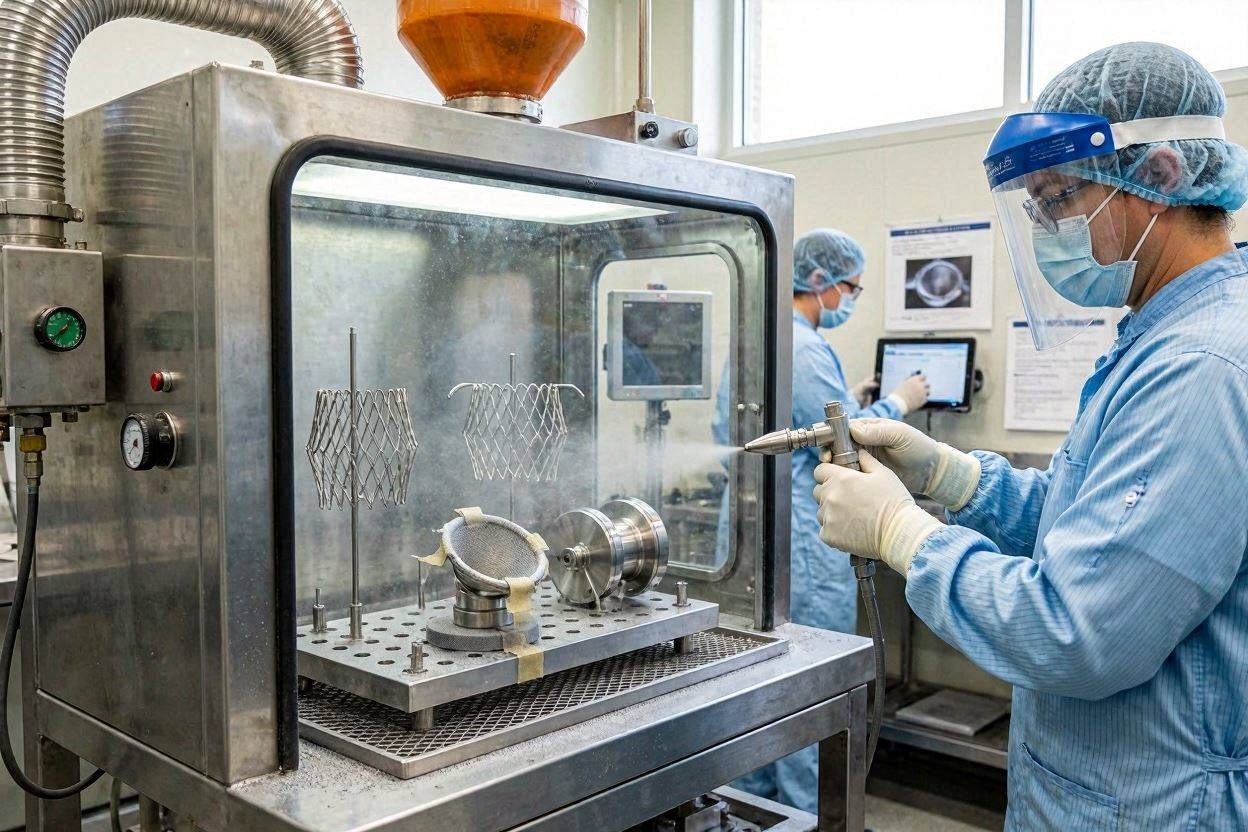
Aluminum oxide blast media serves three distinct functional roles in aerospace manufacturing and maintenance — each with its own performance requirements, substrate sensitivities, and governing specifications.
3. Medical & Dental Applications
Medical device surface preparation with aluminum oxide spans a range from macro-scale orthopedic implants to micro-scale dental ceramic components — united by the requirement for precise, reproducible surface topography, zero metallic contamination, and full process traceability documentation.
4. Governing Standards & Specifications
Aerospace and medical procurement specifications form a dense, interlocking framework of international standards, OEM process specifications, and regulatory requirements. The standards below are the most commonly encountered in procurement for white fused aluminum oxide blast media in these sectors.
5. Material Requirements: What the Specifications Actually Demand
Working through the aerospace and medical standards reveals a consistent set of material requirements that any qualified aluminum oxide blast media must meet. The table below consolidates these requirements for practical procurement use.
| Property | AMS 2431/9 Requirement | Medical / ISO 13485 Requirement | HLH White Fused Al₂O₃ Value |
|---|---|---|---|
| Al₂O₃ Purity | ≥ 99.5% | ≥ 99.5% (supplier specified) | ≥ 99.5% |
| Fe₂O₃ (Free Iron) | ≤ 0.10% | ≤ 0.05% (most implant specs) | < 0.05% |
| SiO₂ | ≤ 0.30% | ≤ 0.10% | < 0.10% |
| Na₂O | ≤ 0.50% | ≤ 0.35% | < 0.35% |
| Particle Size Distribution | FEPA 42-2 F-grits tolerance | Per drawing / supplier spec | FEPA certified, lot sieve analysis |
| 硬度 | Mohs ≥ 9.0 | Supplier specified | Mohs 9.0, 2,000–2,200 HV |
| 水分含量 | ≤ 0.50% | ≤ 0.15% | ≤ 0.15% |
| Certificate of Analysis | Required — lot-specific | Required — lot-specific, retained | Provided every shipment |
| Supplier Quality Certification | ISO 9001:2015 minimum | ISO 13485 preferred / ISO 9001 minimum | ISO 9001:2015 certified |
| Traceability to production lot | Required | Required — lot number on CoA and packaging | Full lot traceability |
6. Substrate-by-Substrate Blast Parameters
Each alloy type used in aerospace and medical applications has specific blast parameter requirements — driven by its hardness, its sensitivity to induced residual stress, and the surface finish or anchor profile requirements of the subsequent process (coating, bonding, or osseointegration).
| Substrate | Alloy Examples | Grade | Grit | Pressure | Standoff | Key Constraint |
|---|---|---|---|---|---|---|
| Aluminum alloys — airframe | 2024-T3, 7075-T6, 6061-T6 | 白色 | F80–F120 | 35–55 PSI | 15–25 cm | Max pressure critical — thin gauge distorts; avoid over-blasting |
| Titanium — aerospace | Ti-6Al-4V, Ti-3Al-2.5V | 白色 | F80–F150 | 40–65 PSI | 15–25 cm | AMS 2431/9; no iron contamination; check for alpha-case formation |
| Nickel superalloy — turbine | IN718, IN625, Waspaloy, René 80 | 白色 | F46–F80 | 50–75 PSI | 15–25 cm | TBC bond coat prep: Rz 50–75 µm required; purity critical at process temp |
| Titanium — medical implant | Ti-6Al-4V ELI (Grade 23), cp-Ti Grade 4 | 白色 | F120–F220 | 25–55 PSI | 10–20 cm | Target Sa 1–4 µm; lot CoA + traceability mandatory; ISO 13485 compliant supplier |
| Cobalt-chromium — orthopedics | CoCrMo (ASTM F75, F1537) | 白色 | F120–F180 | 40–60 PSI | 12–20 cm | Harder than Ti — may need slightly higher pressure; Fe₂O₃ < 0.05% critical |
| Zirconia — dental | Y-TZP (3 mol% yttria-stabilized) | 白色 | F120–F180 | 25–40 PSI | 10–15 cm | Avoid transformation of zirconia surface phase; validate with XRD if critical |
| Stainless steel — surgical instruments | 316L, 17-4 PH, 440C | 白色 | F120–F220 | 30–55 PSI | 12–20 cm | White grade mandatory; matte finish uniformity critical; ferroxyl test recommended |
| Nitinol (NiTi) — cardiovascular | Nickel-titanium shape memory alloy | 白色 | F150–F220 | 25–45 PSI | 10–18 cm | Extremely sensitive to surface damage — validate parameters on sample pieces first |
7. Supply Chain & Documentation Requirements
In aerospace and medical supply chains, the qualification and documentation requirements placed on blast media suppliers are substantially more demanding than in general industrial procurement. The following represents the minimum documentation package that Tier 1 aerospace and medical OEM suppliers typically require from their blast media vendors.
-
1Lot-specific Certificate of Analysis (CoA): Every shipment must be accompanied by a CoA tied to the specific production lot number, reporting Al₂O₃ purity, Fe₂O₃, SiO₂, Na₂O, moisture content, bulk density, and sieve analysis (D10/D50/D90 and sieve stack data). Generic or time-stamped CoAs not referencing a specific lot are non-conforming to aerospace and medical requirements.
-
2ISO 9001:2015 quality management certification: Current, valid, third-party-audited QMS certificate. Aerospace supply chains increasingly require suppliers to also hold AS9100 or be working toward it. Medical device supply chains may additionally require ISO 13485 compliance for consumables used in device manufacturing.
-
3FEPA particle size distribution certification: Sieve analysis data per FEPA 42-2 standards for F-grits, confirming the particle size distribution meets FEPA tolerance for the specified grit designation. Some aerospace programs additionally specify a tighter internal distribution tolerance than FEPA — confirm this before ordering.
-
4Material Safety Data Sheet (SDS / MSDS): Current REACH-compliant SDS confirming the media classification, hazard information, and disposal requirements. For medical device manufacturers, the SDS supports the biocompatibility risk assessment file required under ISO 10993.
-
5Conformance statement to AMS 2431/9 or equivalent: A written statement from the manufacturer confirming that the product meets the chemical and physical requirements of the applicable specification. This statement is distinct from the CoA — it is a formal specification compliance declaration, not just a test result report.
-
6Packaging lot number traceability: Each bag, pail, or bulk container must be labeled with a lot number that links back to the CoA. For aerospace programs, the lot number is recorded on the work order and retained in the component’s traveler documentation for the life of the aircraft.
-
7First Article / Qualification test report (when required): For new supplier qualification or new product introductions, some aerospace and medical OEMs require a full first-article inspection report with third-party chemical and physical test data. Jiangsu Henglihong Technology supports first-article testing requests and can provide samples for customer laboratory verification.
-
8Counterfeit prevention declaration: Aerospace supply chains increasingly require a statement confirming that materials are not counterfeit or misrepresented — i.e., that the media is genuinely the specified product from the manufacturer named on the packaging, not relabeled bulk commodity.
8. Process Control for Critical Applications
Specifying the correct media is necessary but not sufficient for aerospace and medical compliance. The blasting process itself must be controlled, validated, and documented to demonstrate that the specified surface condition is consistently achieved. The following process control framework reflects the requirements of NADCAP-audited blast shops and ISO 13485-regulated implant manufacturers.
9. Frequently Asked Questions
AMS 2431/9 defines material requirements — chemical composition, particle size distribution, and hardness — but does not maintain a qualified products list (QPL) of approved manufacturers in the way that some military specifications do. Compliance is demonstrated by the supplier providing a CoA showing that all specified properties are met, accompanied by a conformance statement to AMS 2431/9. However, individual OEM purchase orders and process specifications may add approved supplier list (ASL) requirements beyond the base AMS 2431/9 requirements. Always check the specific purchase order and referenced quality clauses for ASL requirements before qualifying a new blast media source in your supply chain.
This is an important biocompatibility question extensively studied in the implant literature. Aluminum oxide (Al₂O₃) is itself considered biocompatible — it is used as a bulk material for orthopedic bearing surfaces (alumina ceramic femoral heads) — so the primary concern is not the chemical toxicity of alumina particles but rather the particle burden on peri-implant tissue. Studies have found that blasting with appropriately specified white fused Al₂O₃ followed by proper cleaning (typically ultrasonic cleaning in deionized water, then acid passivation if appropriate to the substrate) leaves residual alumina particle counts well below levels associated with adverse tissue response. Many implant manufacturers additionally specify a final acid-etch step (e.g. HCl or H₂SO₄/HCl mixture) after blasting, which removes embedded abrasive particles from the surface entirely while preserving the surface micro-roughness created by blasting. The specific cleaning protocol should be validated as part of the process validation required by ISO 13485.
Both are blasting processes that use aluminum oxide (or other media) at controlled velocity — but they serve fundamentally different engineering purposes. Grit blasting is a surface preparation process: its goal is to clean the surface and create a defined surface topography (anchor profile or micro-roughness) for a subsequent process such as coating, bonding, or osseointegration. The primary output measured is surface cleanliness and surface roughness. Shot peening is a surface enhancement process: its goal is to plastically deform the near-surface layer to induce a compressive residual stress field that improves fatigue life and resistance to stress-corrosion cracking. The primary output measured is Almen arc height (a proxy for peening intensity) and coverage percentage. For peening, the media must be harder than the substrate and must be controlled to specific Almen intensity values — aluminum oxide is used for peening of titanium and nickel alloys where steel shot contamination is unacceptable.
Storage and handling practices for aerospace and medical blast media must be more controlled than for general industrial use. Store sealed in original manufacturer packaging — do not transfer to bulk drums or intermediate containers unless the transfer is performed in a clean room or controlled environment with documented procedures. Keep off the floor on pallets; protect from moisture and temperature cycling that causes condensation inside bags. Label storage location with lot number and expiry/inspection date. Handle bags with clean gloves — contamination from handling equipment (forklifts, floor surfaces) can introduce foreign material into the media charge. Dedicate storage areas for white fused media away from any brown fused media or other iron-bearing abrasives, and implement a FIFO (first-in-first-out) inventory rotation. For highest-criticality applications (NADCAP-audited processes), document the storage conditions and handling chain from receipt to point of use as part of the process record.
Blast cleaning of CFRP (carbon fiber reinforced polymer) structures requires careful process development because the hard abrasive must clean the surface without damaging the fiber-matrix interface. White fused aluminum oxide at fine grit (F150–F220) and low pressure (20–35 PSI) can be used for light surface preparation of CFRP before bonding or painting — but it is not appropriate for heavy cleaning or paint stripping, which risks fiber exposure and surface damage. Many aerospace OEMs prefer plastic media blast (PMB) or cryogenic blast for CFRP paint removal because these media are much softer than the carbon fiber reinforcement and remove only the paint without risking fiber damage. For CFRP surface preparation before bonding, peel ply removal followed by light grit blast or solvent wipe is the more commonly specified approach. Always verify with the OEM process specification before applying any abrasive blasting to CFRP components.
The qualification process typically involves three phases: documentary review, material testing, and process validation. For documentary review, Jiangsu Henglihong Technology can provide: current ISO 9001:2015 certificate, facility overview, quality manual excerpt, CoA template and sample, and written conformance statement to AMS 2431/9. For material testing, we can supply a qualification sample lot with full CoA, and support third-party testing by your nominated laboratory (SGS, Bureau Veritas, Intertek, or equivalent) at your cost. For process validation, we provide material to your blast shop for the required coupon blast trials, surface measurement, and documentation of blast parameters. Contact our export and quality team to initiate a qualification package — we have supported aerospace supplier qualification processes in North America, Europe, and Asia and can guide you through the documentation requirements efficiently. See also our bulk ordering page: Bulk Aluminum Oxide Blast Media – Wholesale Pricing & RFQ.
AMS 2431/9 Qualified White Fused Aluminum Oxide
Jiangsu Henglihong Technology supplies aerospace and medical-grade white fused aluminum oxide with lot-specific CoA, FEPA particle size certification, conformance statements to AMS 2431/9, and ISO 9001:2015 quality management on every shipment. Contact our technical team to initiate supplier qualification.
Related Resources
Continue with these guides from the Henglihong resource library:
- Aluminum Oxide Blast Media: The Complete Buyer’s Guide
- Brown vs White Aluminum Oxide: Which Should You Use?
- Aluminum Oxide Grit Size Chart & Selection Guide
- Aluminum Oxide vs Garnet Blast Media: Full Comparison
- How to Choose Aluminum Oxide Blast Media for Steel Surfaces
- Is Aluminum Oxide Blast Media Reusable? How Many Times?
- Aluminum Oxide for Glass Etching & Frosting
- Bulk Aluminum Oxide Blast Media – Wholesale Pricing & RFQ
- Aluminum Oxide Anti-Slip Additive for Floor Coatings
过滤器