Bulk Sandblasting Media: Packaging Options, MOQ & Freight Guide for Buyers
Understanding packaging formats, minimum order quantities, container loading parameters, and freight cost structures is essential for any buyer sourcing abrasive blast media internationally — whether from China, India, or any other major producing country. Errors in landed cost calculation are among the most common and costly mistakes in abrasive procurement: a supplier’s low FOB price can easily be offset by packaging inefficiency, unexpected freight surcharges, or customs clearance complications.
This guide provides a complete procurement framework for bulk abrasive orders. It is part of the comprehensive resource at Sandblasting Media Suppliers: The Industrial Buyer’s Complete Guide, published by Jiangsu Henglihong Technology Co., Ltd.
1. Standard Packaging Formats
Abrasive blast media is shipped in several packaging formats, each suited to different order volumes, handling equipment, and storage capabilities. Understanding the trade-offs between formats is the starting point for specifying your order correctly.
25 kg Paper or PE Bags (Palletized)
The most common packaging for smaller orders, samples, and buyers without forklift infrastructure. Typically 40–50 bags per pallet (1,000–1,250 kg/pallet), stretch-wrapped and strapped. Advantages: easy manual handling, stackable in standard racking, suitable for retail or distribution resale. Disadvantages: highest packaging cost per ton, highest labor cost for loading/unloading, significant packaging waste volume.
Specifications to confirm with your supplier: bag material (kraft paper vs. polyethylene inner liner vs. woven PP outer), load-bearing strength rating, pallet dimensions (standard 1,100×1,100 mm or 1,200×1,000 mm for EU), and whether pallets are heat-treated (ISPM 15-compliant for wood pallet export).
500 kg Flexible Intermediate Bulk Containers (FIBC / Big Bags)
FIBC bags (also called “jumbo bags” or “super sacks”) offer a substantial cost reduction over 25 kg bags for buyers with forklift access. At 500 kg per bag, a standard 20′ container holds approximately 40–44 bags (20–22 MT), reducing per-unit handling significantly. Standard FIBC configurations: single lift loop (1:1 safety factor for static lifting), four-loop (easier positioning), with or without liner (polyethylene liner recommended for moisture-sensitive media such as plastic blast media).
1,000 kg (1 MT) FIBC Big Bags
1 MT bags are the most common format for large blast room operators and bulk industrial buyers. Each bag holds exactly 1 metric ton, simplifying inventory tracking and consumption reporting. A 20′ container typically holds 18–22 × 1 MT bags depending on media density and bag dimensions. The efficiency gain over 25 kg bags is substantial: a single crane or forklift lift moves an entire metric ton vs. 40 individual bag lifts.
Bulk Loose (Pneumatic or Tipper Delivery)
The lowest cost-per-ton packaging option for very high-volume blast facilities with dedicated silo storage. Bulk loose delivery by pneumatic tanker or tipper truck eliminates all packaging cost and handling labor. Available primarily from regional distribution depots in North America and Europe where distributors hold large inventory. Not typically available for direct factory-to-buyer international shipping.
| Packaging Format | Unit Weight | Equipment Required | Relative Cost/MT | Best For |
|---|---|---|---|---|
| 25 kg bags, palletized | 25 kg/bag | None (manual) | Highest (+30–50%) | Small orders, distribution, retail |
| 500 kg FIBC | 500 kg/bag | Forklift or crane | Medium (+10–20%) | Mid-volume buyers, blast rooms |
| 1,000 kg FIBC | 1,000 kg/bag | Forklift ≥2.5 T capacity | Low (+5–10%) | High-volume blast rooms, industrial |
| Bulk loose | Tanker load | Silo / pneumatic system | Base price | Very high-volume facilities with silo |
2. Minimum Order Quantities Explained
Minimum order quantities (MOQs) from direct manufacturers vary by product type and supplier scale:
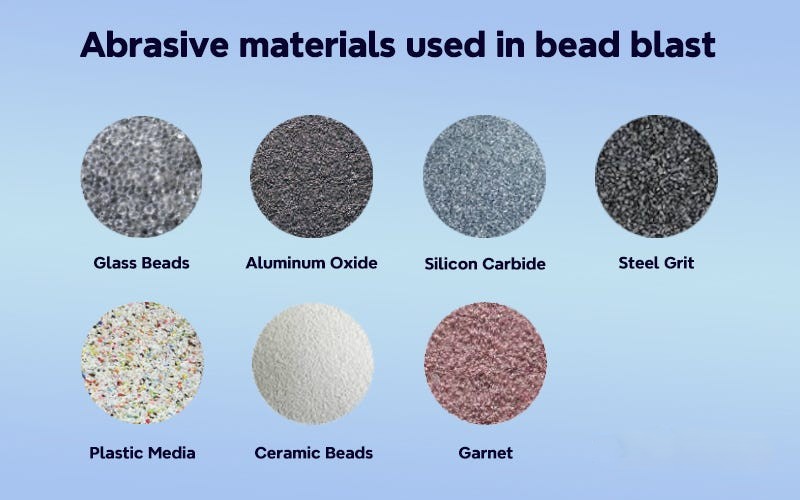
- Steel grit & steel shot: Typically 1 FCL (full container load) = 18–24 MT. Some suppliers offer LCL (less than container load) at 3–5 MT minimum, but freight cost per ton rises significantly.
- Aluminum oxide (BFA/WFA): 1 FCL = 15–20 MT for coarse grades; 10–15 MT for fine grades (lighter per container due to lower packing density). Sample quantities of 25–100 kg typically available via courier.
- Grenat : 1 FCL = 20–24 MT. Some Australian garnet suppliers have higher MOQs due to mining operation scale.
- Perles de verre : 1 FCL = 12–16 MT (lighter product). Fine grades often 5–10 MT MOQ due to slower production throughput.
- Plastic blast media: Often 1,000–2,000 kg minimum from manufacturers; 500 kg samples available from distributors.
3. Container Loading Reference
Steel abrasives are weight-dense materials. A standard 20′ container reaches its maximum payload weight (21,000–24,000 kg depending on country road axle limits and vessel loading rules) long before reaching its volume capacity. This means you optimize orders on a weight basis, not a volume basis.
| Container Type | Internal Volume | Max Payload | Steel Grit (1MT bags) | Garnet (1MT bags) | Al₂O₃ BFA (25kg bags) |
|---|---|---|---|---|---|
| 20′ GP Standard | 33.2 m³ | ~28,000 kg | 18–22 MT | 20–23 MT | 15–18 MT |
| 40′ GP Standard | 67.7 m³ | ~27,000 kg | 20–25 MT | 22–26 MT | 18–22 MT |
| 40′ HC High Cube | 76.4 m³ | ~26,500 kg | 20–25 MT | 22–26 MT | 20–24 MT |
4. Incoterms: FOB, CIF, DAP Explained
Incoterms (International Commercial Terms) define the point at which risk and cost transfer between buyer and seller in an international shipment. For abrasive blast media procurement, three Incoterms are most commonly used:
| Incoterm | Seller Pays To | Risk Transfers At | Buyer Pays | Best For |
|---|---|---|---|---|
| FOB (Free On Board) | Loading onto vessel at origin port | When goods cross ship’s rail at origin port | Ocean freight, destination port charges, import duty, inland delivery | Buyers who arrange their own freight — gives maximum cost control |
| CIF (Cost, Insurance, Freight) | Destination port (freight + insurance included) | When goods cross ship’s rail at origin port | Destination port charges, import duty, inland delivery | Buyers who want freight included in the quote for easy comparison |
| DAP (Delivered At Place) | Named destination (e.g., buyer’s warehouse) | At named destination when ready for unloading | Import duty and taxes only | Buyers who want door-to-door pricing; smaller orders |
For first-time importers, requesting CIF quotes from multiple suppliers allows straightforward price comparison. Experienced importers typically prefer FOB, as it gives them control over freight booking (they can use their own preferred forwarder) and often results in lower total cost when they have established freight relationships.
5. Freight Cost Benchmarks (May 2026)
Ocean freight rates are highly volatile and vary by origin, destination, vessel availability, and global trade conditions. The following ranges are indicative for standard 20′ FCL shipments of abrasive blast media as of May 2026:
| Route (Origin → Destination) | Transit Time | Ocean Freight (20′ FCL, est.) |
|---|---|---|
| China (Tianjin/Qingdao) → US East Coast | 28–35 days | $1,800–$3,500 |
| China (Shanghai) → US West Coast | 16–22 days | $1,500–$2,800 |
| China → Rotterdam (Europe) | 28–35 days | $1,200–$2,500 |
| China → Dubai (Middle East) | 18–25 days | $900–$1,800 |
| China → Sydney (Australia) | 18–25 days | $1,200–$2,200 |
| India → US East Coast | 25–32 days | $1,600–$3,000 |
*Rates are illustrative and subject to significant fluctuation based on global shipping market conditions, peak season surcharges, and bunker fuel adjustment factors. Always obtain current rates from your freight forwarder at time of quotation.
6. Calculating Your Landed Cost
Landed cost is the total cost of procuring abrasive media delivered to your facility. For international orders, it includes:
- Product cost (FOB price × quantity)
- Origin charges: Container stuffing, documentation, origin terminal handling (THC) — typically $150–$350 at Chinese ports
- Ocean freight (see table above)
- Marine insurance: Typically 0.3–0.6% of CIF value
- Destination port charges: Destination THC, port security fee, documentation fee — typically $200–$500 depending on port
- Import customs duty: Varies by product HS code and country. Steel abrasives (HS 7206.10): US duty typically 0–3.9%; EU duty 2–3%. Aluminum oxide: US 0%; EU 0–3%. Check current rates with your customs broker.
- Customs clearance / broker fee: Typically $150–$350 per entry
- Inland delivery: Drayage from port to your facility — varies by distance
7. Export Documentation Checklist
Confirm the following documents are provided by your supplier with every shipment:
- Commercial invoice — buyer/seller details, product description, quantity, unit price, total value, payment terms, Incoterm
- Packing list — package count, weight per package, total gross and net weight, marks and numbers
- Bill of lading (B/L) — ocean carrier’s document of title; original B/L required for customs clearance
- Certificate of Origin (COO) — country of manufacture; required for customs duty assessment and trade agreement benefits (e.g., GSP, FTA)
- Certificate of Analysis (COA) / Mill Test Certificate (MTC) — batch-specific quality test results (chemical composition, hardness, PSD, moisture)
- Safety Data Sheet (SDS) — required by importing country’s hazardous materials regulations; must be in the language of the destination country
- Phytosanitary certificate — required for wood pallets (ISPM 15 treatment certification) — all wood packaging in international trade must be heat-treated or fumigated
- MSDS / DG declaration — if any component of the shipment is classified as dangerous goods (most abrasives are not, but plastic media may require DG documentation)
8. Frequently Asked Questions
Get a Complete Landed Cost Quote
Contact Jiangsu Henglihong Technology Co., Ltd. with your required product, quantity, packaging format, and destination port. We will provide a full CIF or FOB quotation with all documentation details within 24 hours.
Request a Quote →Filtres