Zirconia Beads: Engineering Properties, Types, Sizes, and Industrial Applications
Zirconia beads are advanced ceramic grinding and dispersion media engineered for high-energy milling, ultra-fine grinding, and contamination-sensitive industrial processes. Owing to their exceptional density, hardness, fracture toughness, and chemical stability, zirconia beads have become the preferred media for applications ranging from pigments and coatings to lithium battery materials and semiconductor CMP slurry preparation.
This page serves as a comprehensive engineering-level reference for zirconia beads, covering material systems, crystal structures, size classifications, mechanical and physical properties, wear mechanisms, and selection criteria. It is designed as a technical pillar resource supporting engineers, process developers, and procurement specialists involved in precision milling and dispersion operations.
Table of Contents
- 1. What Are Zirconia Beads?
- 2. Crystal Structure and Material Systems
- 2.1 Cubic Zirconia Beads
- 2.2 Yttria Stabilized Zirconia Beads (YSZ)
- 2.3 Ceria Stabilized Zirconia Beads (Ce-TZP)
- 3. Zirconia Beads Sizes and Dimensional Control
- 4. Mechanical and Physical Properties
- 5. Wear Mechanisms and Contamination Control
- 6. Industrial Applications
- 7. Zirconia Beads vs Other Grinding Media
- 8. How to Select Zirconia Beads
- 9. Conclusion
1. What Are Zirconia Beads?
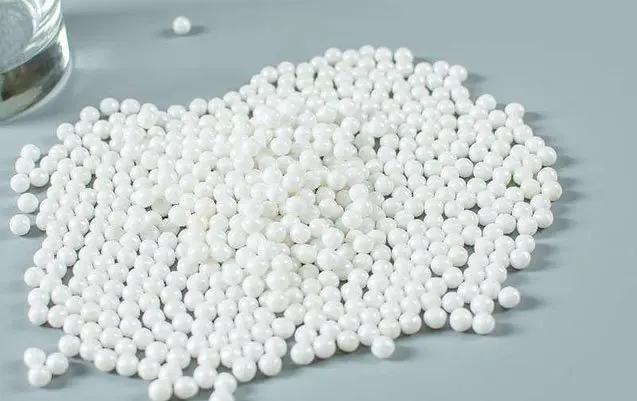
Zirconia beads are spherical ceramic particles manufactured primarily from zirconium dioxide (ZrO₂) and stabilized using specific dopants to control phase stability and mechanical performance. Unlike conventional glass or alumina beads, zirconia beads are designed to operate under extreme mechanical stress, high rotational speed, and prolonged milling cycles without significant degradation.
The key distinguishing characteristic of zirconia beads is their high density, typically close to 6.0 g/cm³. This high density enables more efficient kinetic energy transfer during milling, allowing faster particle size reduction, improved dispersion efficiency, and reduced processing time. In addition, zirconia beads exhibit superior fracture toughness, which minimizes catastrophic bead breakage even under high-impact conditions.
Due to these attributes, zirconia beads are widely adopted in bead mills, attritors, horizontal and vertical media mills, and nano-milling systems across chemical, electronic, pharmaceutical, and advanced materials industries.
2. Crystal Structure and Material Systems of Zirconia Beads
The performance of zirconia beads is fundamentally governed by their crystal structure and stabilizer chemistry. Pure zirconia undergoes phase transformations between monoclinic, tetragonal, and cubic phases as a function of temperature and stress. These transformations are accompanied by volume changes that can induce cracking and failure.
To prevent uncontrolled phase transformation and achieve reliable mechanical behavior, industrial zirconia beads are doped with stabilizing oxides such as yttria (Y₂O₃) or ceria (CeO₂). The type and concentration of stabilizer directly influence hardness, fracture toughness, wear rate, and chemical stability.
2.1 Cubic Zirconia Beads
Cubic zirconia beads are stabilized to maintain a fully cubic crystal structure at room temperature. This is typically achieved by incorporating higher concentrations of stabilizers such as yttria or ceria.
The cubic phase is isotropic, meaning its mechanical properties are uniform in all crystallographic directions. As a result, cubic zirconia beads demonstrate excellent thermal stability and resistance to stress-induced phase transformation.
However, because cubic zirconia lacks transformation toughening mechanisms, its fracture toughness is generally lower than that of tetragonal zirconia systems. Cubic zirconia beads are therefore best suited for applications where thermal stability and chemical resistance are more critical than impact resistance.
2.2 Yttria Stabilized Zirconia Beads (YSZ)
Yttria stabilized zirconia beads (YSZ) represent the most widely used zirconia grinding media. Typically stabilized with 3–5 mol% yttria, YSZ beads retain a metastable tetragonal phase at room temperature.
YSZ beads benefit from transformation toughening, a mechanism in which stress-induced transformation from the tetragonal to monoclinic phase absorbs energy and suppresses crack propagation. This mechanism provides YSZ beads with exceptionally high fracture toughness.
As a result, YSZ beads offer an optimal balance between wear resistance, impact strength, and cost, making them suitable for a broad range of general-purpose and high-energy milling applications.
2.3 Ceria Stabilized Zirconia Beads (Ce-TZP)
Ceria stabilized zirconia beads (Ce-TZP) are engineered for ultra-low wear and contamination-sensitive environments. Ceria-stabilized systems typically exhibit higher density and superior chemical inertness compared to YSZ.
Ce-TZP beads are characterized by extremely low wear rates, even under high shear and prolonged milling conditions. Their chemical stability in both acidic and alkaline environments makes them particularly suitable for nano-dispersion, inkjet ink milling, and semiconductor CMP slurry processing.
3. Zirconia Beads Sizes and Dimensional Control
Zirconia beads are available in a wide range of sizes, typically from less than 0.05 mm to several millimeters in diameter. Bead size selection directly influences collision frequency, energy density, milling efficiency, and achievable final particle size.
Common size categories include:
- 0.1 mm zirconia beads for nano-dispersion and CMP applications
- 0.3–0.5 mm beads for fine grinding and pigment dispersion
- 0.5–1.0 mm beads for general-purpose milling
- >1.0 mm beads for coarse grinding and mineral processing
In addition to nominal diameter, engineering-grade zirconia beads are specified by particle size distribution parameters such as D10, D50, and D90, as well as sphericity and surface roughness. Tight dimensional control ensures stable flow behavior and consistent milling performance.
4. Mechanical and Physical Properties of Zirconia Beads
| Property | YSZ Beads | Ce-TZP Beads | Cubic Zirconia Beads |
|---|---|---|---|
| Densité (g/cm³) | ~6.0 | ~6.1 | ~5.9 |
| Vickers Hardness (HV) | 1100–1300 | 1100–1250 | 1000–1200 |
| Fracture Toughness (MPa·m¹ᐟ²) | 7–10 | 8–11 | 5–7 |
| Wear Rate | Faible | Très faible | Faible |
These mechanical properties enable zirconia beads to sustain repeated high-energy impacts while maintaining dimensional integrity and low contamination output.
5. Wear Mechanisms and Contamination Control
Wear of grinding media is an inevitable phenomenon in milling processes and directly impacts product purity and operating cost. Zirconia bead wear primarily occurs through micro-abrasion, subsurface fatigue cracking, and grain boundary degradation.
Advanced zirconia beads are manufactured with fine-grain microstructures, high sintering density (>99.5%), and homogeneous stabilizer distribution to minimize wear and extend service life.
6. Industrial Applications of Zirconia Beads
Zirconia beads are extensively used in:
- High-energy grinding and fine milling
- Dispersion and deagglomeration of pigments and inks
- Nano-milling of advanced functional materials
- Semiconductor CMP slurry preparation
7. Zirconia Beads vs Other Grinding Media
| Type de média | Densité | Wear Rate | Contamination Risk |
|---|---|---|---|
| Perles en zircone | Very High | Très faible | Très faible |
| Billes d'alumine | Medium | Medium | Medium |
| Perles de verre | Faible | Haut | Haut |
8. How to Select Zirconia Beads
Selection of zirconia beads should be based on a systematic evaluation of process requirements:
- If contamination control is critical, choose Ce-TZP beads
- If impact resistance is required, choose YSZ beads
- If thermal stability is critical, choose cubic zirconia beads
Additional considerations include bead size, mill design, slurry viscosity, and operating speed.
9. Conclusion
Zirconia beads represent the highest-performance class of ceramic grinding media currently available. Through precise engineering of crystal structure, stabilizer chemistry, and dimensional control, zirconia beads enable efficient, low-contamination milling across a wide range of demanding industrial applications.
Filtres