Jiangsu Henglihong Technology Co, Ltd.
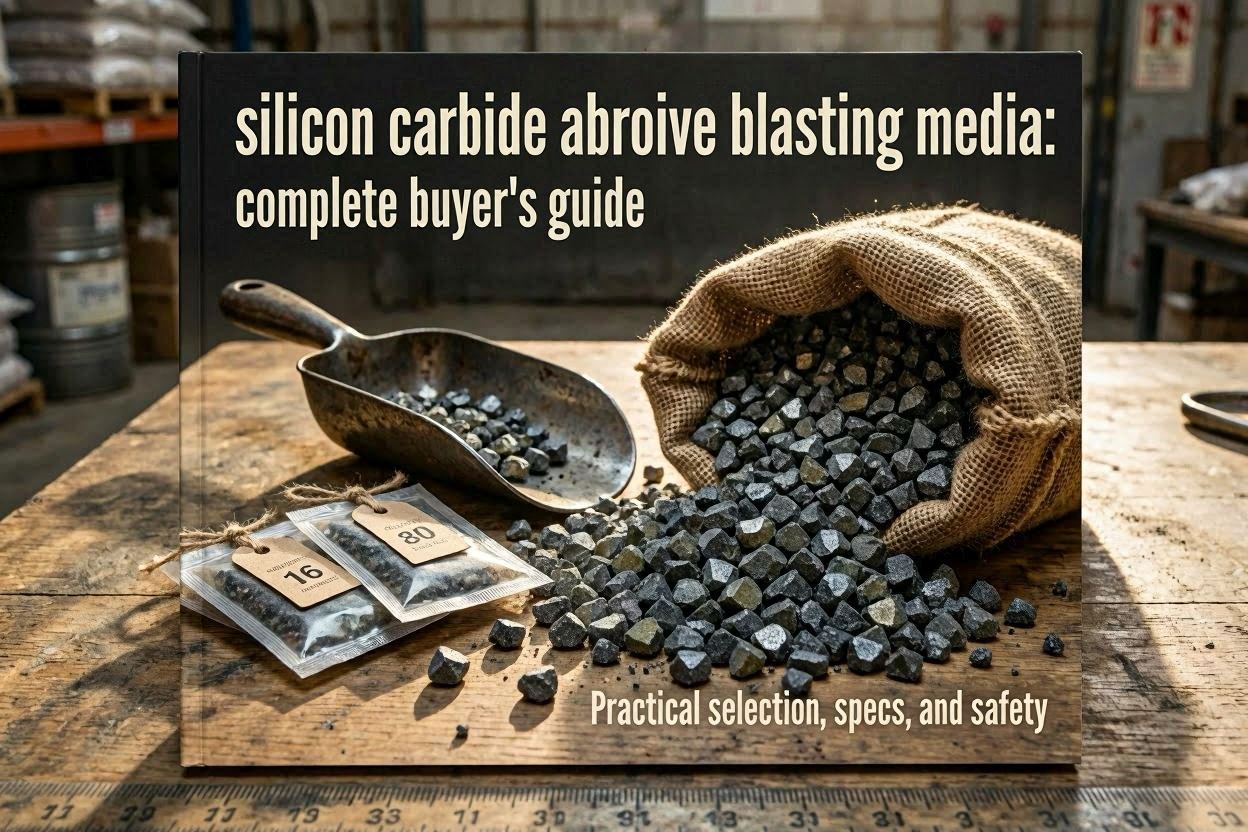
Silicon Carbide Sandblasting Media: Hardest Abrasive for Ceramics & Carbide
The definitive technical guide to silicon carbide (SiC) blasting abrasive — covering its manufacture, extreme hardness, black vs. green grades, grit sizes, applications in ceramics, carbide tooling and glass, cost justification, and when it outperforms aluminum oxide.
What Is Silicon Carbide Abrasive?
Silicon carbide (SiC) is a synthetic compound of silicon and carbon, produced in high-temperature electric arc furnaces at temperatures exceeding 2,200°C. It is the hardest commercially produced abrasive material in routine industrial use — with a Mohs hardness of 9.0–9.5, it is harder than aluminum oxide (Mohs 9.0) and approached only by diamond (Mohs 10) and cubic boron nitride (Mohs 9.5+) among practical abrasives.
Silicon carbide is characterized by extreme hardness, exceptional sharpness of particle edges (due to its brittle, sharp-fracture crystal structure), very high thermal conductivity, and chemical inertness to most acids and alkalis. These properties combine to make it the essential abrasive for applications where aluminum oxide — the next-harder common abrasive — cannot achieve the required material removal rate or surface quality on very hard, refractory, or chemically resistant substrates.
This page is part of Henglihong’s complete blasting media resource hub. For the full selection framework across all media types, see our complete guide to sandblasting material types and selection.
Silicon carbide is specified when aluminum oxide cannot perform the job — primarily on substrates with a Mohs hardness above 8 (ceramics, tungsten carbide, silicon, glass), or where the fastest possible material removal rate on any substrate is required regardless of cost. It is a premium, specialist abrasive that costs 3–5 times more per kilogram than aluminum oxide. Its selection is always justified by technical necessity, not by preference.
How Silicon Carbide Is Manufactured
Silicon carbide is produced commercially by the Acheson process, developed by Edward Acheson in 1891. Silica sand (SiO₂) and petroleum coke (carbon, C) are mixed and loaded into a large electric resistance furnace with graphite electrodes. An electric current passes through the charge, generating temperatures of 2,000–2,500°C at the core. At these extreme temperatures, the silica and carbon react:
SiO₂ + 3C → SiC + 2CO
The resulting silicon carbide mass is removed from the furnace, crushed, and processed to remove unreacted carbon and silica. The crushed material is then sized by air classification and sieving to FEPA standard grit sizes. The color of the final product (black or green) depends on the purity of the raw materials used and the processing temperature profile.
Black vs. Green Silicon Carbide: Which Grade Do You Need?
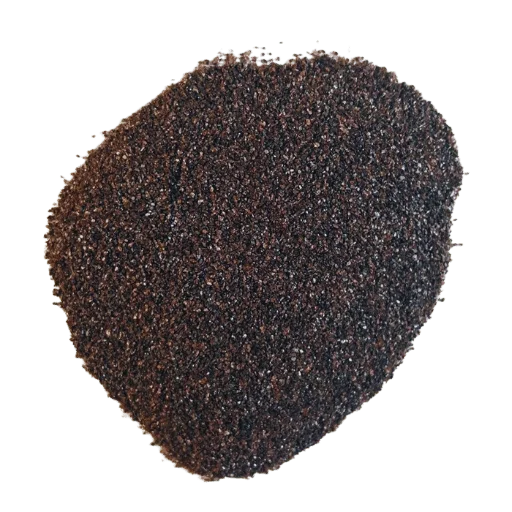
⬤ Black Silicon Carbide (98%+ SiC)
- Purity: 98–99% SiC
- Farbe: Black to dark gray
- Toughness: Slightly higher than green — marginally more fracture-resistant
- Cost: Lower — most widely available
- General-purpose industrial blasting on ceramics, stone, glass, composites
- Lapping and grinding of non-ferrous metals, refractories
- Wire sawing of silicon, quartz crystals
- Vitrified and resinoid grinding wheels for hard materials
⬤ Green Silicon Carbide (99%+ SiC)
- Purity: 99%+ SiC
- Farbe: Green (from higher purity, lower iron content)
- Toughness: Slightly lower — more friable, sharper fracture
- Cost: Higher — premium purity applications
- Precision lapping of tungsten carbide cutting tools
- Grinding of optical glass, sapphire, and technical ceramics
- Semiconductor wafer lapping and polishing
- Applications requiring maximum sharpness and purity
For sandblasting applications on ceramics, stone, refractory materials, and hard non-ferrous metals, black SiC is the standard and cost-effective choice. Reserve green SiC for precision finishing of tungsten carbide, sapphire, semiconductor materials, or high-purity optical glass where the marginally higher sharpness and purity of the green grade makes a measurable difference in outcome.
Physical & Performance Properties
Hardness: The Key Differentiator
At Mohs 9.0–9.5, silicon carbide is the only common abrasive that can effectively cut substrates with a Mohs hardness above 8 — the range occupied by technical ceramics (alumina, zirconia, silicon nitride), tungsten carbide (Mohs 8.5–9.0), silicon carbide itself (in structural applications), sapphire, quartz crystal, and ultra-hard tool steels. Aluminum oxide at Mohs 9.0 can barely cut these materials and wears rapidly — its cutting efficiency on substrates harder than Mohs 7–8 drops sharply, making cycle times impractically long and media consumption prohibitively high.
Sharper, More Brittle Fracture
Silicon carbide’s crystal structure is more brittle than aluminum oxide’s, which means that particles fracture into very sharp-edged sub-particles on impact rather than the more blocky fracture characteristic of alumina. This sharper fracture pattern gives SiC a faster initial cutting rate on any substrate, but also a higher fracture rate per blast cycle — meaning more media consumption per unit of surface area than aluminum oxide on the same substrate. On very hard substrates (where Al₂O₃ barely cuts at all), SiC’s higher consumption is fully justified by its vastly superior productivity.
Thermal Conductivity
Silicon carbide has extraordinarily high thermal conductivity for a ceramic material — approximately 120 W/m·K, compared to aluminum oxide at about 30 W/m·K. This makes SiC the preferred abrasive for grinding and lapping applications where heat generation must be minimized (semiconductor processing, precision optics) because it conducts heat away from the workpiece more effectively, reducing thermal distortion and surface damage.
Chemische Trägheit
Silicon carbide is chemically resistant to most acids (except hydrofluoric acid at elevated temperatures) and alkalis, and is unaffected by most organic chemicals. This makes it suitable for blasting surfaces that will subsequently be exposed to aggressive chemical environments, and for use on substrates (like silicon carbide ceramics themselves) that would react with other abrasive types.
Grit Sizes & Standards
Silicon carbide is available in the same FEPA F-series macro-grit designations as aluminum oxide, plus an extended range of micro-grit sizes (F230 through F1200) for precision lapping and polishing applications not commonly required for aluminum oxide blasting. The table below covers the most relevant grit range for blasting and surface preparation applications.
| FEPA Grit | US Mesh Approx. | Particle Size (µm) | Primary Application |
|---|---|---|---|
| F16–F24 | #16–#24 | 710–1,400 | Aggressive profiling of very hard ceramics, refractory materials |
| F36–F46 | #36–#46 | 355–710 | General blasting of hard ceramics, stone engraving, carbide surface prep |
| F60–F80 | #60–#80 | 180–355 | Moderate-finish blasting of ceramics, glass etching, composite surface prep |
| F100–F150 | #100–#150 | 106–180 | Fine glass etching, silicon wafer grinding, optical surface preparation |
| F220–F320 | #220–#320 | 45–106 | Precision lapping of carbide tools, fine ceramic finishing |
| F400–F1200 | #400–#1200 | 3–35 | Semiconductor lapping, optical polishing, ultra-fine ceramics finishing |
For the complete cross-media grit size reference including surface profile data, see our sandblasting grit size chart and surface profile guide.
Applications by Industry
Blasting and lapping of alumina (Al₂O₃), zirconia (ZrO₂), silicon nitride (Si₃N₄), and silicon carbide (SiC) ceramic components. These substrates have Mohs hardness 8.0–9.5 — SiC is the only effective abrasive.
Lapping and grinding of WC-Co (tungsten carbide-cobalt) cutting inserts, dies, and wear parts. Green SiC at F220–F400 is the standard precision lapping abrasive for carbide tooling surface finishing.
F60–F150 SiC for sandblasting decorative patterns, frosting, and deep etching into architectural glass, glassware, and optical glass — where its hardness and sharp fracture produce crisp, clean edge definition.
Ultra-fine green SiC (F400–F1200) for lapping silicon wafers, compound semiconductor substrates (GaAs, SiC wafers), and sapphire (Al₂O₃) substrates used in LED and power electronics manufacturing.
Blasting and profiling of refractory bricks, castables, and monolithic refractories used in high-temperature industrial furnaces. SiC abrasive can process materials that would rapidly wear out softer abrasives.
F36–F80 SiC for sandblasting hard stone (granite, quartzite, basalt) used in memorial stonework, architectural features, and decorative carving. Essential for granite where aluminum oxide’s efficiency is limited.
Fine SiC for grinding optical glass blanks, polishing concave and convex lens surfaces, and producing the dimensional accuracy required in precision optical instruments.
Blasting of carbon-fiber-reinforced polymer (CFRP), ceramic matrix composites (CMC), and boron carbide armor materials for surface preparation, adhesive bonding preparation, and quality inspection surface cleaning.
Cost Justification: When the Premium Is Worth It
Silicon carbide costs approximately 3–5 times more per kilogram than brown aluminum oxide. This premium is only justifiable — and in fact, often results in a lower total cost per unit produced — when one of the following conditions applies:
- Substrate hardness exceeds Mohs 8: On very hard substrates, aluminum oxide’s cutting efficiency falls so sharply that cycle times become impractically long and media consumption per unit of surface area exceeds what SiC would consume despite SiC’s higher unit price.
- Process specification requires maximum cutting rate: In high-volume production of hard ceramic components, SiC’s faster material removal rate reduces cycle time, improves throughput, and reduces total production cost even when media cost is higher.
- Dimensional precision is critical: In lapping and polishing of semiconductor substrates and precision optics, SiC’s consistent particle geometry and controlled fracture behavior produce tighter dimensional tolerances than aluminum oxide at equivalent grit sizes.
- No alternative abrasive can process the material: For tungsten carbide, technical ceramics, and sapphire, silicon carbide is essentially the only practical mineral abrasive option. The choice is not SiC vs. Al₂O₃ — it is SiC or nothing.
For applications on common industrial metals (carbon steel, stainless steel, aluminum) where the substrate is softer than the abrasive by a wide margin, aluminum oxide delivers superior economics and there is no technical advantage to using SiC. See our guide on aluminum oxide sandblasting media for these applications.
Silicon Carbide vs. Aluminum Oxide
| Factor | Silicon Carbide Advantage | Aluminum Oxide Advantage |
|---|---|---|
| Härte | Mohs 9.0–9.5 — harder, cuts harder materials | Mohs 9.0 — sufficient for all metals and most minerals |
| Particle sharpness | Sharper fracture — faster initial cutting rate | Tougher — fewer fractures, longer particle life |
| Cost per kg | 3–5× more expensive | Standard commercial pricing, widely available |
| Wiederverwertbarkeit | 5–10 cycles (more brittle) | 15–30 cycles (tougher) |
| Suitable substrates | All — including Mohs 8+ ceramics, carbide, silicon | All metals, glass, most minerals up to Mohs 8 |
| Anwendungen | Ceramics, carbide, semiconductor, glass, stone | Steel, structural metals, industrial surface prep |
| Cost-effective use case | Only when substrate hardness or specification demands it | Virtually all standard industrial blasting |
For the complete multi-media comparison including steel abrasives, glass beads, and garnet, see our sandblasting media comparison chart.
Häufig gestellte Fragen
Yes — silicon carbide can blast steel effectively, and in fact it cleans and profiles steel faster than aluminum oxide due to its slightly higher hardness. However, for standard industrial steel surface preparation (rust removal, mill scale removal, coating adhesion preparation), SiC is not cost-effective. Aluminum oxide delivers essentially the same surface profile quality at approximately one-third to one-fifth of the media cost and with better recyclability. SiC on steel is only justified in situations where production throughput is the overriding priority and the cost premium can be justified by the cycle time reduction — a relatively unusual scenario in standard fabrication environments.
No. Silicon carbide (SiC) is a compound of silicon and carbon, not crystalline silicon dioxide (SiO₂, quartz). The silicon atoms in SiC are covalently bonded to carbon atoms in a crystal structure that is chemically distinct from quartz. SiC dust does not carry the same silicosis risk as crystalline silica. However, SiC generates very fine abrasive dust with high particle counts at fine grit sizes, and all standard blasting respiratory protection requirements apply. The dust is not inert — fine SiC particles can cause respiratory irritation and should not be inhaled. Always operate in adequately ventilated environments or enclosed blast cabinets with proper dust collection. For complete safety guidance, see our sandblasting media safety guide.
Yes. Jiangsu Henglihong Technology Co., Ltd. manufactures and exports both black silicon carbide (98%+ SiC) and green silicon carbide (99%+ SiC) in FEPA F-grade macro grits (F12–F220) and selected micro-grit sizes for lapping and polishing applications. We supply B2B customers in the ceramics, semiconductor, refractory, stone-processing, and optical industries across Europe, North America, Southeast Asia, and the Middle East. Contact our sales team with your grit specification, quantity, and packaging requirements for a quotation and technical data sheet.
Request a Quote
Specify grade (black or green), FEPA grit size, quantity, and packaging. Competitive pricing with technical data sheet within 24 hours.
Get a Free Quote →Talk to a Technical Advisor
Unsure whether SiC or aluminum oxide is the right choice for your substrate and application? Our engineers will advise you on the optimal specification.
Contact Our Team →Filter