Pumps for Abrasive Media: The Complete Selection & Buying Guide
Every year, industrial facilities lose millions of dollars in unplanned downtime from a single, preventable mistake: using the wrong pump for abrasive media. Whether you are handling steel shot slurry in a surface finishing plant, transporting ore concentrate in a mine, or circulating garnet suspension in a waterjet system, the pump you choose determines your operational efficiency—and your total cost of ownership for the next three to five years.
This guide covers everything engineers, procurement managers, and operations teams need to know: a breakdown of major pump types, abrasion-resistant materials, a practical eight-parameter selection framework, and application-specific guidance across six key industries. Use the table of contents to jump directly to your area of interest.
1. What Qualifies as Abrasive Media?
Before selecting a pump, you must characterize the abrasive media you are handling with precision. The term covers a wide range of materials—each with distinct physical properties that directly govern pump selection and determine how long the pump will last before requiring maintenance.
In fluid handling, abrasive media refers to any solid particles suspended in a liquid carrier that are capable of causing mechanical wear on the surfaces they contact. Five variables define how aggressively a medium attacks pump components:
- Particle hardness (Mohs scale): The single most important predictor of pump wear. Soft materials such as limestone (Mohs 3) are relatively benign. Quartz sand (Mohs 7), garnet (Mohs 7–8), silicon carbide (Mohs 9), and alumina/corundum (Mohs 9) are highly aggressive. Steel shot and steel grit range from approximately Mohs 5.5 to 7, depending on hardness grade and heat treatment.
- Particle size and size distribution: Fine particles (sub-50 micron) cause polishing-type abrasion; coarser particles (200 micron and above) produce impact and gouging wear on internal pump surfaces. Consistent, tightly graded particle size distribution—characteristic of precision-manufactured abrasive media—creates more predictable, manageable wear patterns than irregular mixed-size feedstock.
- Form der Partikel: Angular, sharp-edged particles such as crushed steel grit or crushed garnet are significantly more abrasive than rounded particles such as glass beads or steel shot. Shape factor alone can double or triple wear rates versus equivalent rounded media at the same hardness and concentration.
- Solids concentration (% by weight or volume): Higher solid loading increases the frequency of particle-surface contact events, accelerating wear non-linearly. Most pumping systems operate between 15% and 45% solids by weight, though specialized slurry pumps can handle concentrations up to 60–70% in mining applications.
- Carrier fluid chemistry: Acidic or alkaline carriers compound mechanical wear with electrochemical corrosion, creating the destructive “erosion-corrosion” mechanism that often accelerates material loss far beyond either mechanism alone.
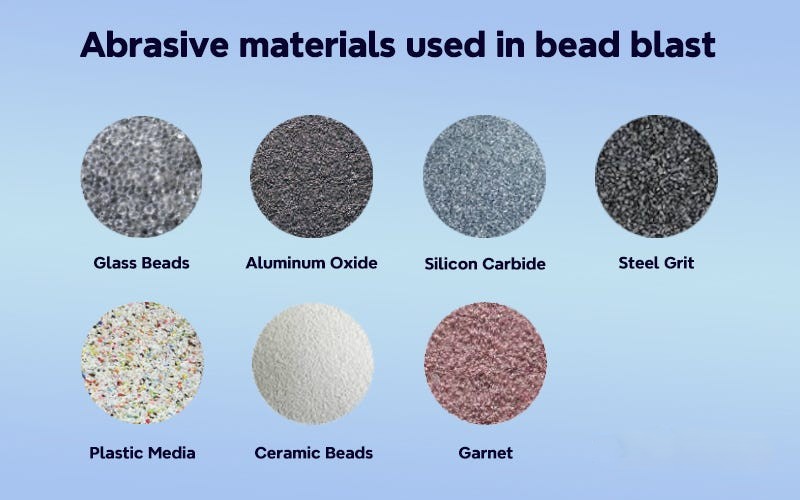
Common abrasive media encountered in industrial pumping include: steel shot and steel grit slurries, glass bead suspensions, garnet slurries, silica sand, alumina and corundum compounds, silicon carbide, bentonite and cement slurries, mineral ore and tailings, ceramic glaze compounds, lime milk, and abrasive blasting media recirculation mixtures.
Industry NoteThe physical properties of abrasive media—hardness, shape, and size distribution—are determined at the point of manufacture, long before the material reaches your pump. Sourcing consistently graded abrasive media from reputable manufacturers directly reduces pump wear variance and improves the accuracy of maintenance scheduling.
2. Why Standard Pumps Fail with Abrasive Media
Standard centrifugal pumps and general-purpose industrial pumps are engineered for clean, non-abrasive fluids. When exposed to abrasive media, they fail through three distinct mechanisms that every specifying engineer should understand clearly before selecting equipment.
Abrasion — Direct Contact Wear
Solid particles directly scratch and gouge pump surfaces, progressively removing material. Abrasion is most severe on surfaces in sliding contact with particles: impeller vanes, volute casings, and wear rings. Wear rate increases sharply with particle hardness and the relative velocity of particle-surface contact. A particle with a Mohs hardness greater than the pump material’s equivalent hardness will cut into it; a softer particle will cause comparatively minor polishing.
Erosion — Impact-Driven Material Loss
Particles traveling at high velocity strike internal surfaces at an angle and chip away material on impact. This is particularly severe at the impeller outlet, volute tongue, and any directional change in the flow path. Erosion rate scales approximately with the cube of particle velocity—doubling flow velocity increases erosion rate by a factor of eight. This relationship is why operating pumps at the lowest speed consistent with maintaining critical transport velocity is so important for service life.
Erosion-Corrosion — Synergistic Attack
When abrasive particles continuously remove protective oxide layers from metal surfaces, fresh reactive metal is exposed to the carrier fluid. This creates a destructive cycle in which mechanical wear and chemical corrosion accelerate each other, producing far greater material loss than either mechanism alone. Erosion-corrosion is particularly common in acid mine drainage, phosphate slurries, and industrial process fluids with mixed pH.
In a standard pump handling aggressive abrasive media, you can expect impeller wall thickness to reduce by 20–30% within the first few hundred operating hours, volute casings to develop deep grooving and pitting, mechanical seals to fail from abrasive ingestion, and internal clearances to open up as wear progresses—reducing hydraulic efficiency and increasing energy consumption simultaneously with the rising maintenance burden.
To understand precisely how different abrasive particles attack specific pump components—and what structural countermeasures work—see our dedicated technical resource: How Abrasive Particles Damage Pumps: Wear Mechanisms, Failure Modes & Prevention.
3. The Four Main Types of Pumps for Abrasive Media
There is no single “best” pump for all abrasive media applications. The right choice depends on your specific media characteristics, flow requirements, and operating constraints. Below is a comprehensive overview of the four primary pump types used in abrasive handling, followed by a side-by-side comparison table.
3.1 Centrifugal Slurry Pumps
Centrifugal slurry pumps are the workhorses of large-scale abrasive media handling. They use a high-speed rotating impeller to convert mechanical energy into fluid velocity and pressure, and are built specifically for solid-laden fluids with thick wear-resistant casings, large impeller clearances, and field-replaceable liners. These pumps excel in high-volume applications: mining tailings transfer, ore concentrate pipelines, dredging operations, and large process slurry recirculation loops.
Their primary limitation is efficiency degradation with increasing solids content and particle size, and significant internal wear when handling particles with hardness above Mohs 7 without appropriate liner material matching. Impeller tip speed must be carefully controlled—exceeding the recommended speed for a given media hardness dramatically shortens liner and impeller service life.
3.2 Peristaltic (Hose) Pumps
Peristaltic pumps work by mechanically squeezing a flexible hose with rotating rollers or shoes, creating a progressive cavity that moves fluid forward. The key advantage for abrasive applications is that the pumped medium only ever contacts the interior of the hose—never any metal pump component. This makes peristaltic pumps uniquely suited for highly abrasive, corrosive, or shear-sensitive media. They are self-priming, run dry without damage, and require minimal maintenance (hose replacement is the only regular wear task). Their primary limitations are lower maximum flow rates compared to centrifugal designs, and the ongoing cost of hose replacement in highly abrasive service.
3.3 Air-Operated Double Diaphragm (AODD) Pumps
AODD pumps use compressed air to alternately flex two diaphragms, creating a reciprocating positive-displacement pumping action. They are self-priming, can handle solids up to the full port diameter, require no electricity, and tolerate dry running without damage. Plastic AODD pumps—constructed in polyethylene, polypropylene, or PVDF—offer excellent abrasion resistance for fine-to-medium particle sizes and are widely used in ceramic glaze pumping, lime slurry transfer, and surface finishing compound circulation. The main limitation is pulsating flow output, which can cause pressure fluctuations in some process applications and may require dampeners.
3.4 Progressive Cavity Pumps
Progressive cavity pumps consist of a helical metal rotor rotating inside a flexible elastomeric stator. This geometry creates a continuous series of sealed cavities moving from inlet to outlet, generating smooth, pulsation-free flow at comparatively low fluid velocities. The low-velocity characteristic is their key advantage for abrasive media—lower velocity means significantly lower erosion rates. PC pumps are ideal for viscous abrasive media, applications requiring precise metering or dosing, and situations where pulsation-free flow is critical to process quality. The rotor and stator are wear components requiring periodic replacement; replacement frequency depends on media abrasivity, particle hardness, and operating speed.
Pump Type Comparison: Abrasive Media Applications
| Pump Type | Max Solids Content | Particle Tolerance | Abrasion Resistance | Typical Flow Range | Self-Priming | Dry-Run Safe | Flow Character |
|---|---|---|---|---|---|---|---|
| Centrifugal Slurry | Up to 70% w/w | Coarse (50 mm+) | ★★★★☆ (with liners) | Very High | ✗ | ✗ | Smooth, continuous |
| Peristaltic (Hose) | Up to 40% w/w | Limited by hose ID | ★★★★★ | Low–Medium | ✓ | ✓ | Pulsating |
| AODD | Up to 25% w/w | Limited by port size | ★★★★☆ | Low–Medium | ✓ | ✓ | High pulsation |
| Progressive Cavity | Up to 60% w/w | Fine to Medium | ★★★☆☆ | Wide range | ✓ | ✗ | Smooth, pulsation-free |
For a detailed head-to-head comparison with application-specific recommendations and total cost analysis, see: Peristaltic vs. AODD vs. Progressive Cavity Pumps for Abrasive Media: Which Is Right for You?
If your decision sits specifically between centrifugal and positive displacement technology, our engineering tradeoff guide covers the technical decision points in detail: Centrifugal vs. Positive Displacement Pumps for Abrasive Media.
A Note on Gear PumpsGear pumps are generally not suitable for abrasive media due to their tight internal clearances—abrasive particles rapidly wear the gear teeth and casing walls. If you are evaluating gear pumps for a fluid with some abrasive content, read our technical assessment first: Are Gear Pumps Suitable for Abrasive Liquids?
4. Materials That Make a Pump Abrasion-Resistant
The selection of pump construction materials is as critical as the choice of pump type. Even the most robustly designed pump will fail prematurely if the materials chosen are incompatible with the specific abrasive media being handled. Four major material families dominate abrasion-resistant pump construction, each exploiting a different protective mechanism.
The critical matching rule is straightforward: pump material hardness should exceed particle hardness for hard-metal pumps, or the pump must use a material that resists abrasion through an elastic deformation mechanism (rubber, polyurethane) rather than hardness alone. Using rubber liners with angular particles above Mohs 7 leads to rapid cut-through failure. Conversely, using expensive high-chrome alloys for fine, rounded, soft particles at low velocity is over-specification that adds cost without proportionate benefit.
For a complete material selection guide—including chemical compatibility matrices, temperature limits, service life data by application type, and worked selection examples—see our dedicated resource: Pump Materials for Abrasive Media: High-Chrome Alloy vs. Rubber vs. Ceramic vs. Polyurethane.
For structural guidance on impeller and liner design—including open vs. closed impeller tradeoffs, adjustable clearance systems, and liner thickness specification—see: Wear-Resistant Impeller & Liner Design for Abrasive Pumps: What Engineers Need to Know.
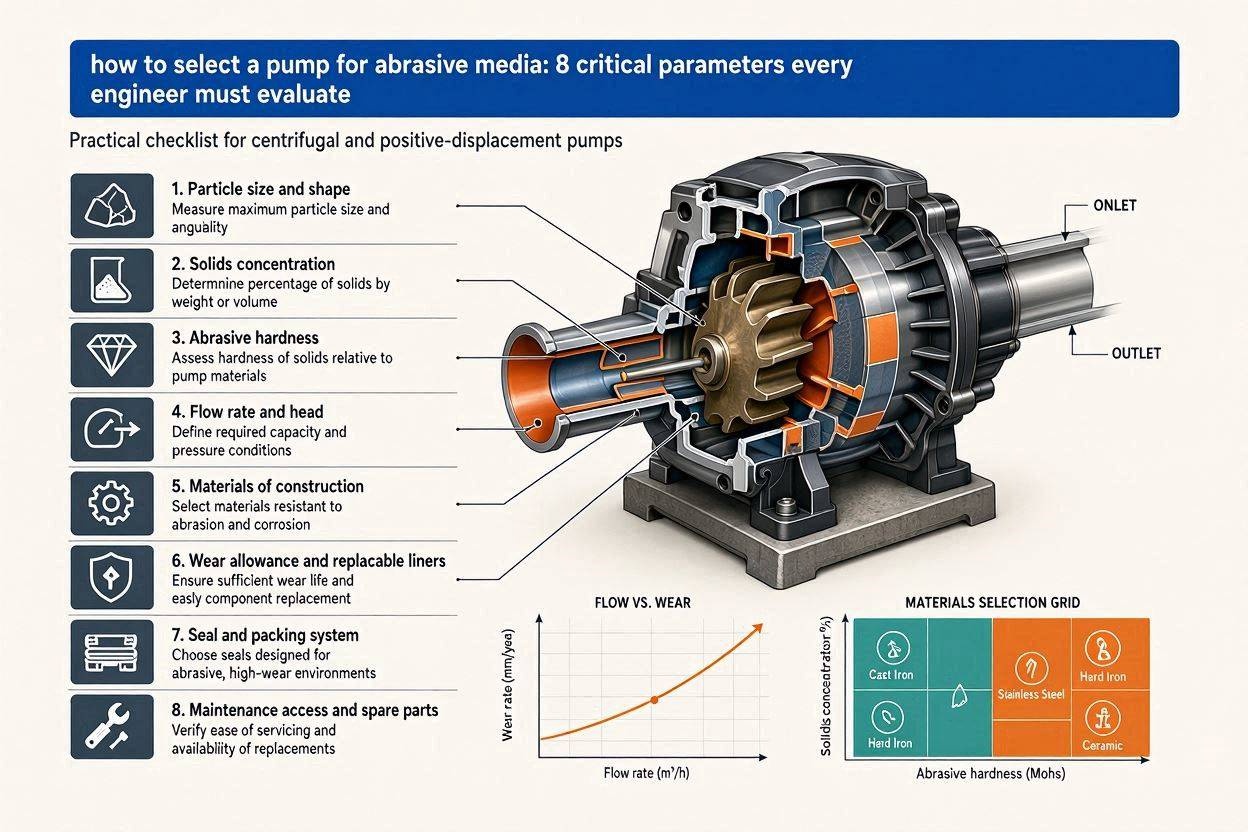
5. How to Select the Right Pump: 8 Critical Parameters
Selecting a pump for abrasive media requires systematic evaluation of eight interdependent parameters. Missing any single one of them can result in catastrophic premature failure, or an oversized and inefficient system that consumes excessive energy. Work through these parameters in order before engaging any supplier.
-
Particle Size (d50 and d95)
Specify both the median particle size (d50) and the 95th-percentile size (d95). The d95 governs the maximum clear passage requirement—all impeller clearances and internal passages must exceed the largest particles to prevent clogging. The d50 is the primary input for wear rate estimation and liner material selection.
-
Solids Concentration (% by weight)
Higher concentrations increase wear rates non-linearly and reduce pump hydraulic performance. Above 20% w/w, most centrifugal slurry pump curves must be derated—typically by 4–5% of head per 10% increase in solids concentration. Establish both your normal operating concentration and the maximum credible concentration under upset conditions.
-
Particle Hardness (Mohs Scale)
Cross-reference particle hardness against pump material hardness. For metal pumps, the pump material should be significantly harder than the abrasive particle. For particles above Mohs 7, rubber liners are generally contraindicated. For particles above Mohs 8, only high-chrome alloys or ceramics provide adequate service life.
-
Required Flow Rate (m³/h)
Account for maximum operating flow, minimum flow to maintain critical transport velocity (the speed below which particles settle in the pipeline), and allowance for future capacity expansion. Slurry pipeline critical velocity for most mineral slurries in 50–150 mm pipe falls between 1.5 and 3.5 m/s—your pump must maintain fluid velocity above this threshold under all operating conditions.
-
Total Dynamic Head (m)
Include static head (elevation difference), friction losses in the pipeline (which increase substantially with slurry concentration—typically 1.5–3× higher than equivalent water), and any required system backpressure. Underestimating friction losses for slurry is one of the most common pump sizing errors.
-
Fluid Viscosity (cP or mPa·s)
High-viscosity slurries require positive displacement pumps rather than centrifugal designs. Centrifugal pump performance degrades sharply above approximately 200–500 cP—at these viscosities, progressive cavity or peristaltic pumps typically deliver better efficiency and more stable flow characteristics.
-
Chemical Compatibility
Identify the pH range, temperature, and specific chemical composition of the carrier fluid and any dissolved species. Acidic slurries (pH below 5) rule out standard high-chrome alloys and require rubber, polyurethane, PVDF, or Hastelloy-lined pump designs. Highly alkaline slurries (pH above 10) require compatible elastomer or polymer selection verified against the specific chemical agent.
-
Operating Temperature (°C)
Temperature significantly narrows the usable elastomer range. Natural rubber is typically limited to 60–70°C; EPDM performs to approximately 120°C; PTFE and PVDF extend coverage further. High-temperature abrasive applications (hot process slurries, autoclaved mineral processing) must specifically confirm material compatibility before finalizing pump selection.
For a complete structured selection framework incorporating these eight parameters into a decision matrix—with worked examples across common industrial scenarios—see our dedicated guide: How to Select a Pump for Abrasive Media: 8 Critical Parameters Every Engineer Must Evaluate.
Once parameters are defined, quantifying expected wear rate allows you to schedule maintenance proactively and build an accurate spare parts budget. Our engineering resource covers a practical methodology for this: How to Estimate Pump Wear Rate for Abrasive Slurry Applications.
6. Industry Applications
The optimal pump configuration varies significantly across industries—not only because the abrasive media characteristics differ, but because operational priorities differ: continuous duty versus batch processing, hygienic requirements, available utilities, and tolerance for downtime all influence the best pump choice. Below is a summary of the six major application sectors.
-
🔧 Abrasive Blasting & Surface Preparation
Wet and slurry abrasive blasting systems use suspensions of abrasive particles—most commonly steel shot, steel grit, glass beads, garnet, or aluminum oxide—mixed with water and corrosion inhibitors. The slurry must be pumped from a mixing tank to the blast nozzle under controlled pressure and often recycled in a closed loop. AODD pumps and peristaltic pumps are the dominant choices, offering the self-priming capability, chemical compatibility, and solid-particle tolerance required. The consistency of particle shape and size distribution in the abrasive media directly influences how much pump wear occurs per cycle—rounded media such as steel shot causes substantially less pump wear than angular media at equivalent concentrations. For a complete breakdown of pump selection for wet and slurry blasting systems, including pressure calculations and media compatibility guidance, see our application guide: Pumps for Abrasive Blasting Systems: Selecting the Right Pump for Wet & Slurry Blast Applications.
-
⛏ Mining & Mineral Processing
Mining represents the highest-volume and most demanding application for abrasive slurry pumps. Particle sizes range from fine clay to coarse gravel; concentrations can reach 65–70% by weight; and 24/7 continuous operation is expected with minimal downtime tolerance. Centrifugal slurry pumps with high-chrome alloy impellers and replaceable rubber or chrome liners dominate this segment, with liner replacement intervals of 4–16 weeks depending on ore hardness and operating speed. For a comprehensive guide to mining slurry pump selection and maintenance strategy, see: Abrasive Slurry Pumps for Mining: Tailings, Ore Concentrate & Dewatering Applications.
-
🏺 Ceramic Manufacturing & Mass Finishing
Ceramic glaze compounds, slip casting slurries, and mass finishing compounds (abrasive ceramic media combined with burnishing compounds in water) present a unique challenge: fine particles at concentrations sufficient to cause meaningful pump wear, combined with strict requirements to prevent product contamination. AODD pumps in polypropylene or PVDF construction are most common; peristaltic pumps offer an alternative where precision metering is required. For application-specific guidance on selecting and maintaining pumps for these applications, see: Pumping Ceramic Glazes and Mass Finishing Compounds: The Right Pump for Fine Abrasive Slurries.
-
🧪 Chemical Processing — Corrosive & Abrasive Slurries
Chemical plants frequently handle slurries that are simultaneously abrasive and corrosive: acid mine drainage, phosphoric acid with silica particles, sodium hydroxide with mineral fillers, and similar fluids that attack pump surfaces through both mechanical and electrochemical pathways simultaneously. This dual-attack scenario demands careful combined material selection and often leads to PVDF, Hastelloy C-276, or ceramic-lined pump specifications. For a detailed treatment of this challenging application class, see: Pumps for Corrosive AND Abrasive Media: Solving the Toughest Chemical Slurry Applications.
-
💧 Wastewater & Sludge Treatment
Wastewater treatment facilities pump grit, sand, biological sludge, and flocculant-laden effluent through multiple treatment stages. While less abrasive than mining or blasting applications, the continuous-duty nature demands reliable, low-maintenance designs. Non-clog centrifugal pumps with hardened impellers handle grit channels and primary sludge; progressive cavity pumps are the preferred technology for sludge thickening, metering, and biogas digestate transfer. Abrasive wear on impeller and casing surfaces in grit handling applications can become significant in high-suspended-solids influent scenarios.
-
🏗 Construction & Civil Engineering
Tunneling, horizontal directional drilling (HDD), and foundation piling operations use bentonite and cement slurries for borehole stabilization and grouting. Bentonite—a thixotropic, mildly abrasive drilling mud—is typically handled with centrifugal or progressive cavity pumps; cement grout requires positive displacement pumps capable of generating higher pressures (often 10–50 bar). Particle settling in horizontal runs is a key operational concern and must be addressed through velocity management and regular flushing routines.
7. Maintenance, Operating Speed & Service Life
The most effective single intervention to extend pump service life in abrasive media applications is to minimize fluid velocity through the pump. As noted in the wear mechanisms section, erosion rate scales with approximately the second to third power of velocity. Operating at 80% of rated speed can extend liner and impeller life by 50–100%, with only a modest reduction in flow output. Where process requirements allow, installing a variable frequency drive (VFD) and running at the minimum speed consistent with maintaining critical transport velocity is the highest-return maintenance investment available for most installations. For operating speed optimization methodology and the specific RPM-wear rate relationships for different pump types, see: Optimal RPM & Flow Rate for Abrasive Media Pumps: Extending Service Life Through Speed Control.
Beyond speed management, a structured preventive maintenance regime is essential. Key practices include:
- Regular clearance monitoring: Measure impeller-to-liner clearance quarterly. Excessive clearance reduces efficiency and increases recirculation wear. Most manufacturers specify adjustment procedures to restore designed clearance before full liner replacement is required.
- Vibration and bearing temperature monitoring: Rising vibration amplitude or bearing temperature often precedes catastrophic bearing failure by several weeks, providing time for planned maintenance rather than emergency shutdown.
- Mechanical seal inspection: Mechanical seals are the most common failure point in abrasive pump applications. Inspect seal face condition at every planned shutdown and maintain a seal kit in local spare parts stock.
- Liner rotation and flipping: Where pump design allows, rotating or flipping rubber liners equalizes wear distribution and can extend liner service life by 30–40% before replacement is required.
- Pipeline velocity verification: Regularly verify that actual flow velocity in all pipeline segments exceeds critical transport velocity to prevent progressive particle settling and blockage.
For a complete preventive maintenance schedule including inspection checklists, wear part replacement intervals by pump type, and emergency shutdown protocols, see our full maintenance resource: Abrasive Media Pump Maintenance Guide: Inspection Schedule, Wear Parts & Failure Prevention.
8. Total Cost of Ownership: The Real Measure of Pump Performance
Procurement decisions for abrasive media pumps are frequently made on the basis of initial purchase price alone—a systematic error that almost always produces higher lifetime costs. The correct evaluation metric is Total Cost of Ownership (TCO) across a five-year operating horizon, which captures all cost categories:
- Initial capital cost — pump procurement and installation
- Energy cost — typically the largest single component over a five-year period, often exceeding initial capital cost by 2–4× in continuous-duty applications
- Planned maintenance cost — scheduled liner, impeller, and seal replacements
- Unplanned downtime cost — lost production value during unexpected failures; in high-throughput operations, a single day of downtime can cost more than the pump itself
- Spare parts inventory carrying cost — capital tied up in standby components
- End-of-life disposal and replacement cost
In high-duty abrasive applications, the initial pump purchase price typically represents only 10–20% of five-year total ownership cost. Energy and maintenance combined account for 60–75%. A pump that costs 40% more at purchase but runs 15% more efficiently and requires liner changes half as frequently will almost always deliver lower five-year TCO than the lowest-priced alternative—often substantially lower.
Additionally, the quality and consistency of the abrasive media itself has a direct and often underestimated impact on pump TCO. Inconsistently graded media with variable hardness and particle size distribution creates unpredictable wear patterns, shortens liner service life, and makes maintenance scheduling unreliable. Precision-manufactured abrasive media with tight particle size tolerances and controlled hardness grades delivers measurably more consistent wear rates—reducing maintenance variance and improving the accuracy of spare parts planning.
For a full TCO calculation methodology with worked examples comparing different pump types and material configurations in typical abrasive applications, see: Total Cost of Ownership for Abrasive Media Pumps: Why Cheap Pumps Cost More in the Long Run.
9. Frequently Asked Questions
10. Conclusion
Selecting the right pump for abrasive media is a multi-dimensional engineering challenge with significant commercial consequences. The cost of under-specification—in unplanned downtime, emergency part replacement, and energy waste—far exceeds any upfront savings at the procurement stage. The principles that consistently lead to correct decisions are: characterize your media precisely before engaging pump suppliers; match pump material to particle hardness and shape rather than defaulting to standard configurations; minimize operating velocity where process constraints allow; and evaluate pump performance on five-year total cost of ownership rather than purchase price alone.
The quality of the abrasive media itself is an equally important but frequently overlooked variable in the pump performance equation. Precision-graded media with tight size tolerances and controlled hardness grades produces consistent, predictable wear patterns—the foundation of reliable, cost-effective pump maintenance planning. Irregular, inconsistently manufactured abrasive media creates unpredictable pump wear, shorter service intervals, and higher total operating costs.
Source Precision-Graded Abrasive Media for Your System
The performance of your pumping system begins with the quality of the abrasive media flowing through it. Jiangsu Henglihong Technology Co., Ltd. manufactures premium abrasive blasting media—including steel shot, steel grit, stainless steel shot, glass beads, and aluminum cut wire shot—produced to strict SAE and ISO standards, with tightly controlled particle size distribution and certified hardness grades.
Our precision-graded media delivers consistent wear rates, predictable maintenance intervals, and measurably longer pump service life compared to commodity-grade alternatives. Contact us today to discuss your specific media requirements and receive a competitive quotation.
Request a Quotation →
Filter