Aluminum Oxide for Glass Etching & Frosting
The complete technical guide to using white fused aluminum oxide for architectural glass frosting, artistic etching, optical surface texturing, dental ceramics, and precision glass applications — covering grit selection, blast parameters, resist methods, and finish control.
- Why Aluminum Oxide Is the Standard for Glass Blasting
- Glass Etching & Frosting Applications
- Grade Selection: Why White Fused Is Required
- Grit Size vs Finish Quality: Understanding the Relationship
- Blast Parameters for Glass
- Resist and Stencil Methods
- Stage Blasting for Depth and Relief Effects
- Behavior on Different Glass Types
- Troubleshooting Common Glass Blasting Problems
- Häufig gestellte Fragen
1. Why Aluminum Oxide Is the Standard for Glass Blasting
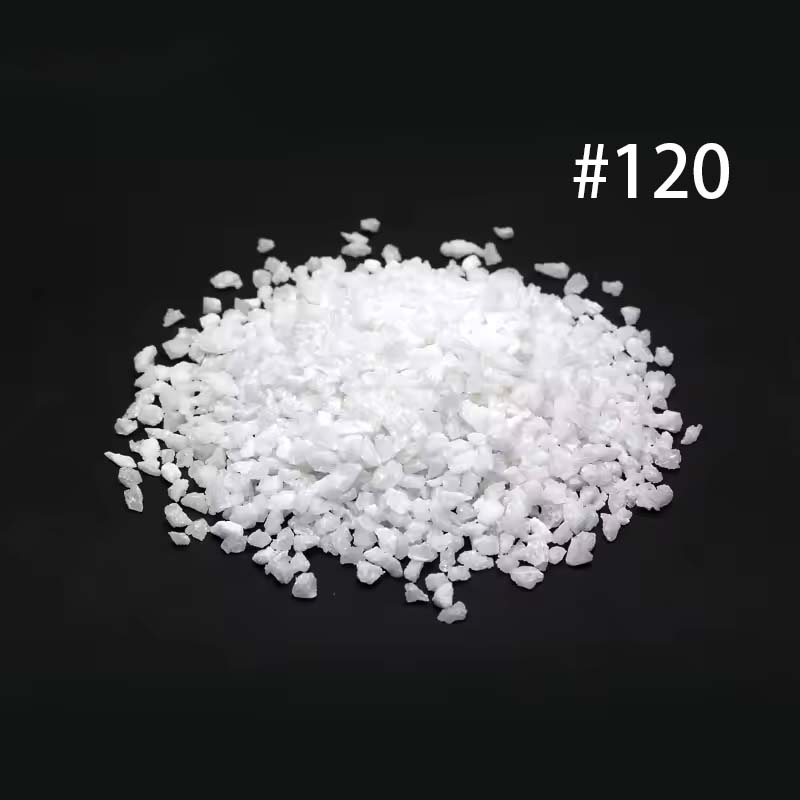
Glass etching and frosting by abrasive blasting requires a media that simultaneously satisfies four demanding criteria: it must cut glass reliably and consistently, leave no color contamination in the frosted surface, produce no respirable crystalline silica hazard, and be available in fine enough grit sizes to achieve the delicate surface textures that precision glass work demands. White fused aluminum oxide is the only abrasive that meets all four criteria simultaneously — which is why it has become the industry standard for glass blasting across applications ranging from architectural privacy screens to optical component surface preparation.
The comparison with its most common alternative — silicon carbide — illustrates the trade-offs well. Silicon carbide (Mohs 9.5) cuts glass slightly faster than aluminum oxide (Mohs 9.0), but generates significantly more dust, is harder to source in consistent fine-grit FEPA grades, and is substantially more expensive. For most glass blasting applications, white fused aluminum oxide delivers a better combination of cut quality, finish consistency, dust generation, and cost efficiency than any competing media.
This guide focuses on white fused aluminum oxide for glass applications — the grade manufactured and exported by Jiangsu Henglihong Technology Co, Ltd. For the full product background including both grades and all industrial applications, see: Aluminum Oxide Blast Media: The Complete Buyer’s Guide.
2. Glass Etching & Frosting Applications
The range of glass applications served by aluminum oxide spans from high-volume architectural glass processing lines to individual artist studios — united by the shared requirement for a consistent, controllable, color-neutral matte or textured surface finish.
Each application type has distinct requirements for surface roughness, pattern edge definition, depth uniformity, and clarity of the frosted finish — all of which are governed by the interaction of grit size, blast pressure, and standoff distance described in the sections that follow.
3. Grade Selection: Why White Fused Is Required
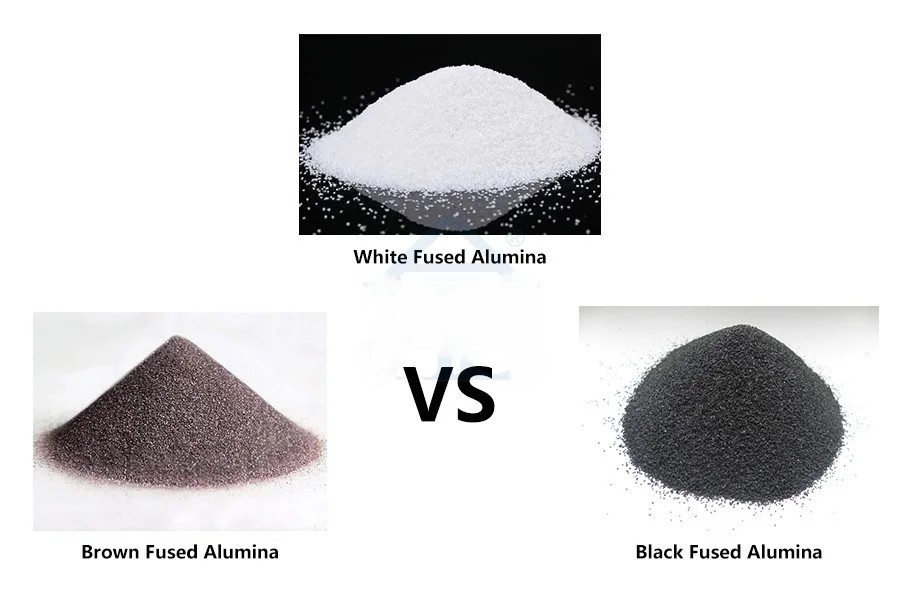
For any glass etching or frosting application, white fused aluminum oxide is the only acceptable grade. Brown fused aluminum oxide must never be used on glass for two reasons that are specific to this substrate:
Color Contamination
Brown fused aluminum oxide contains 1.5–3.8% titanium dioxide and 0.2–1.5% iron oxide — the compounds that give it its characteristic dark brown color. When brown-grade grains fracture on impact with a glass surface, microscopic colored particles become embedded in the freshly created micro-fissures of the frosted zone. The result is a frosted surface with a visible warm tan or brownish tint — particularly noticeable against backlit glass or on clear float glass panels where the intended finish is a neutral grey-white frost. This color contamination is irreversible and cannot be removed by cleaning. White fused aluminum oxide, with ≥ 99.5% Al₂O₃ and < 0.05% Fe₂O₃, is genuinely color-neutral — the frosted surface retains its clean grey-white appearance under all lighting conditions.
Silica Content and Surface Chemistry
Brown fused aluminum oxide contains 0.5–2.0% SiO₂ — a reactive silicate component that, when driven into the glass surface at blast velocity, can alter the local surface chemistry and create surface irregularities that compromise optical clarity in precision glass applications. White fused aluminum oxide contains less than 0.1% SiO₂, making its interaction with the glass surface chemically consistent and predictable.
For a full comparison of white and brown fused aluminum oxide properties and application decision logic, see: Brown vs White Aluminum Oxide: Which Should You Use?
4. Grit Size vs Finish Quality: Understanding the Relationship
Grit size is the primary control variable for glass surface finish quality. A smaller (finer) grit produces a smoother, more translucent frosted surface — maximum light transmission with a soft, even sheen. A larger (coarser) grit produces a rougher, more opaque frosted surface — lower light transmission with a deeper, more tactile texture. The relationship is direct and predictable, which is what makes aluminum oxide ideal for specification-grade glass work: once the grit-finish relationship is calibrated for a given glass type and blast unit, it is highly reproducible across production runs.
The Translucency–Privacy Trade-off
A commonly misunderstood relationship in architectural glass frosting is between surface roughness and privacy. A finer frost (F180–F320) appears more translucent — figures and shapes remain visible through it — but still provides excellent privacy at close range by diffusing directional light. A coarser frost (F60–F120) appears more opaque under most lighting conditions. For architectural privacy glass, F80–F120 represents the practical optimum: sufficient opacity for privacy at normal office or residential viewing distances, while maintaining enough light transmission to keep interior spaces bright.
| FEPA Grit | Particle Size (D50) | Surface Rz | Visual Effect | Light Transmission | Primary Application |
|---|---|---|---|---|---|
| F46–F60 | 300–425 µm | 25–45 µm | Heavy, opaque texture | 20–35% | Anti-slip floor glass, deep relief carving |
| F80 | ~212 µm | 18–28 µm | Bold matte frost | 35–50% | Industrial functional texturing, entrance glass |
| F100–F120 | 125–150 µm | 10–18 µm | Standard architectural frost | 50–65% | Office partitions, shower screens, balustrades — most popular range |
| F150–F180 | 80–100 µm | 6–12 µm | Fine, semi-translucent frost | 65–75% | Display glass, signage, decorative artistic work |
| F220 | ~68 µm | 4–8 µm | Very fine, luminous matte | 70–80% | LED diffuser glass, fine artistic etching, optical components |
| F320–F400 | 30–40 µm | 2–5 µm | Ultra-fine, near-polished satin | 80–90% | Optical filters, scientific glass, premium display covers |
5. Blast Parameters for Glass
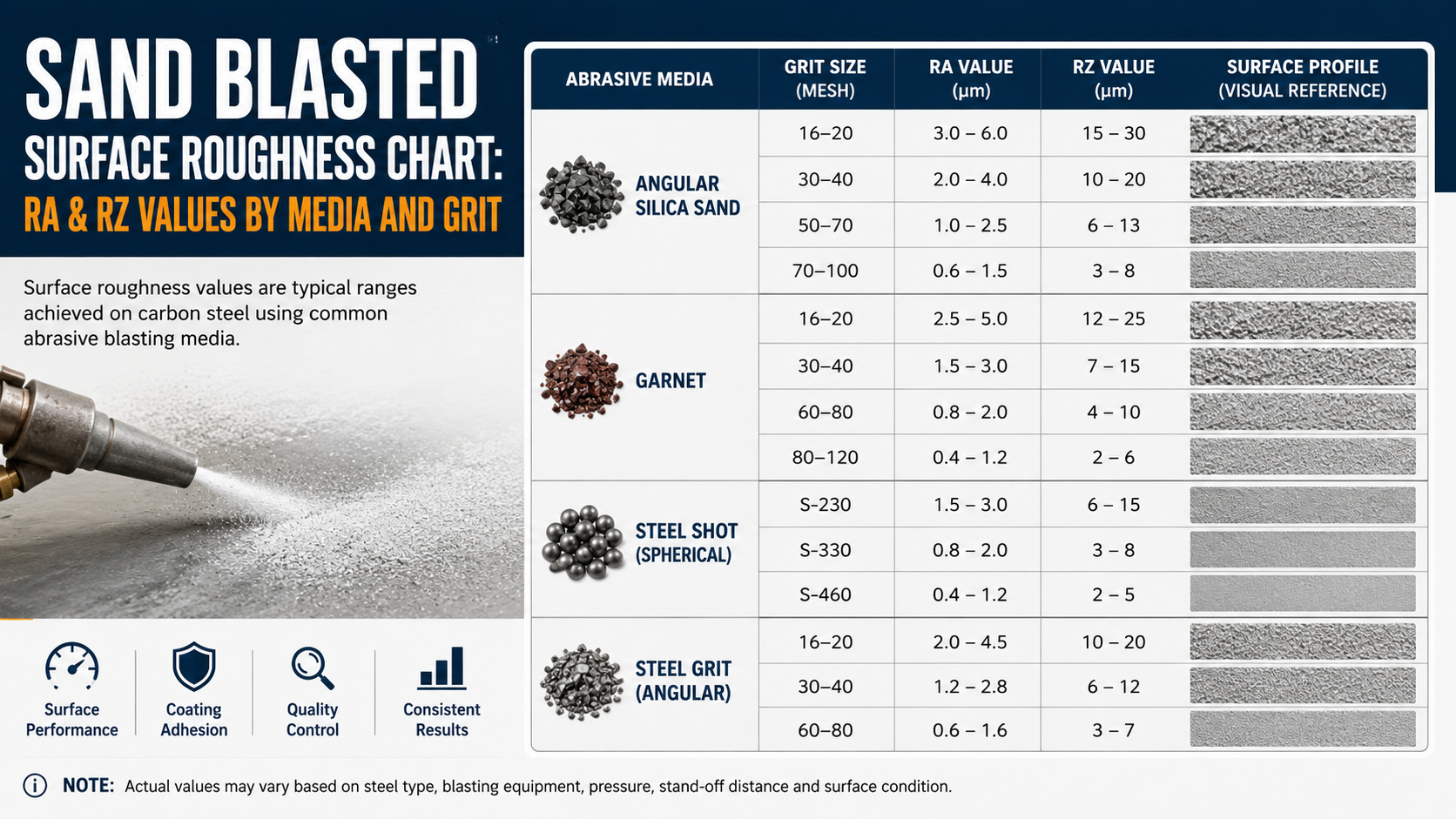
Glass requires significantly lower blast pressures and shorter dwell times per unit area than steel. This is not only because glass is much softer (Mohs 5.5–6.5 vs steel at 5–8), but because over-blasting glass causes progressive surface darkening — a phenomenon where cumulative micro-fracturing of the glass surface transitions from the desired controlled frost to an increasingly opaque, rough, and visually inconsistent result that cannot be reversed.
Recommended Blast Pressure by Application
| Anmeldung | Grit | Pressure (PSI) | Pressure (bar) | Standoff (cm) | Nozzle Angle |
|---|---|---|---|---|---|
| Architectural full-panel frosting | F100–F120 | 25–35 | 1.7–2.4 | 15–25 | 80–90° |
| Artistic stencil etching (shallow) | F120–F180 | 20–30 | 1.4–2.1 | 12–20 | 75–90° |
| Deep relief carving (multi-stage) | F60–F80 (stage 1), F120 (stage 2) | 35–50 | 2.4–3.5 | 10–18 | 70–85° |
| Optical / technical glass texturing | F220–F400 | 15–25 | 1.0–1.7 | 10–15 | 85–90° |
| Dental ceramic surface prep | F150–F220 | 25–50 | 1.7–3.5 | 8–15 | 80–90° |
| Anti-slip floor glass texturing | F60–F80 | 40–55 | 2.8–3.8 | 12–20 | 80–90° |
Nozzle Type and Movement for Glass
For glass applications, a suction-feed (siphon) blast cabinet is standard for small to medium panels. Direct-pressure systems deliver higher velocity and are appropriate only for heavier texturing work (anti-slip floor glass, deep relief carving) where a coarser finish is acceptable. For fine work (F180–F320), a suction system at 15–25 PSI provides better control over the subtlety of the finish than a direct-pressure system.
Nozzle movement should be consistent — either mechanically controlled (conveyor-fed glass processing lines) or, for hand-blasting, performed with a regular side-to-side sweeping motion at a consistent speed. Dwell time irregularity (pausing or slowing in one area) creates visible variation in frost density that is readily apparent in final inspection under raking light. Many experienced glass blast artists practice nozzle motion on scrap glass before committing to production work.
Cabinet Media Considerations for Glass
Glass blasting cabinets must be dedicated to glass work or thoroughly cleaned between glass and metal applications. Any residual iron-bearing media (from a previous steel blasting session) that enters the glass circuit will create brown contamination spots on frosted glass surfaces. For the same reason, always use a new or verified-clean media charge when starting a glass production run, and keep the glass media circuit completely separate from any metal-blasting media system.
6. Resist and Stencil Methods
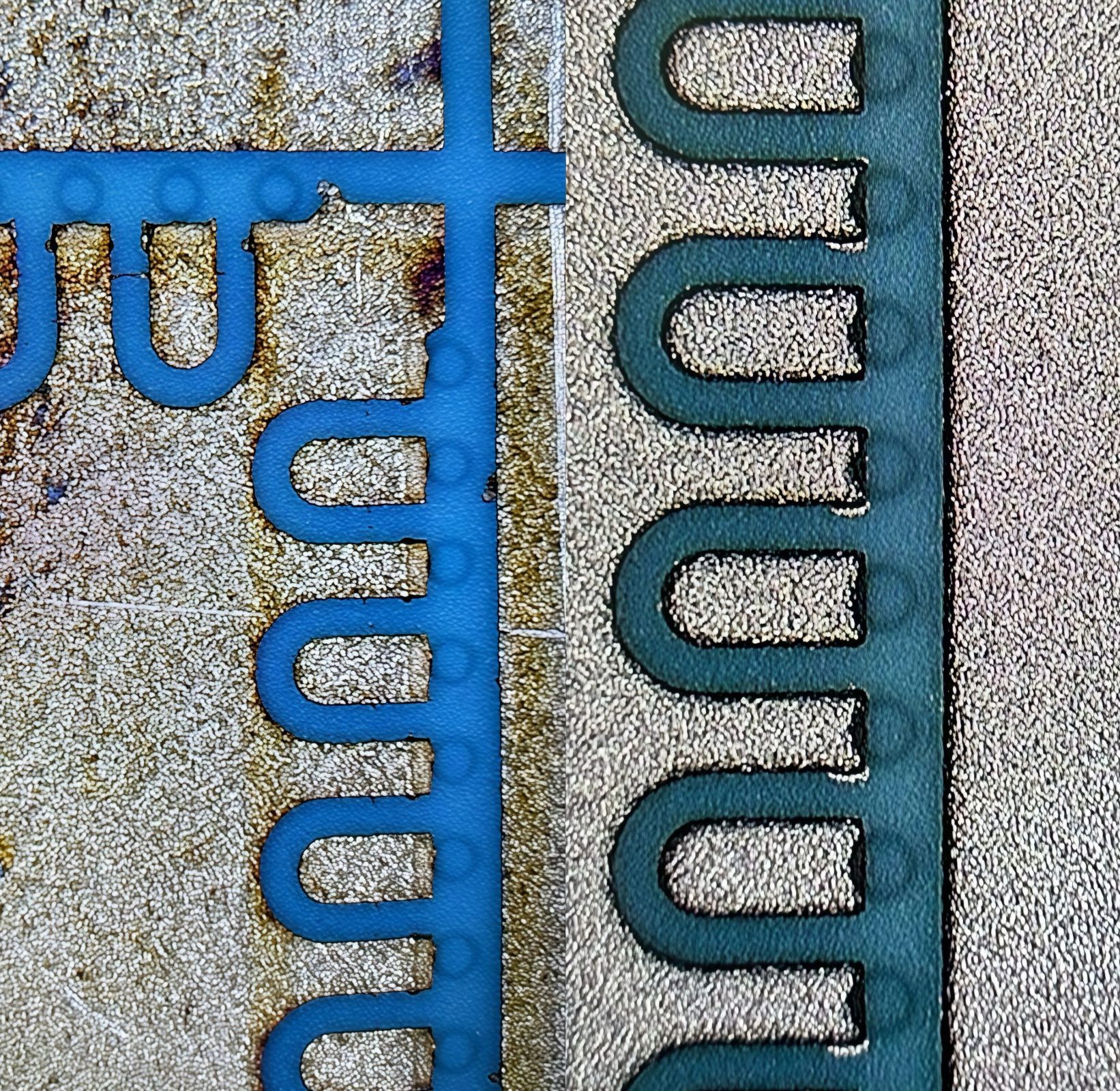
Patterned glass etching — as distinct from uniform full-surface frosting — requires a resist material that protects the non-etched areas of the glass surface from the blast stream while allowing the exposed design areas to be frosted or carved. The choice of resist method determines the achievable design complexity, edge definition, and depth capability of the finished work.
Edge Definition and Resist Thickness
The sharpness of the boundary between etched and unetched areas — called edge definition or line quality — is governed by resist thickness, grit size, blast pressure, and standoff distance. A thinner resist allows media to deflect under the resist edge at low angles, creating a slightly softened boundary — sometimes desirable for artistic work but unacceptable for precision signage or optical masking. A thicker resist provides a vertical wall at the design edge that produces a sharper, cleaner boundary. For maximum edge sharpness on architectural signage work, use a 250 µm or thicker vinyl resist, F120 grit at 25–30 PSI, and maintain a consistent 90° nozzle angle relative to the glass surface throughout the blast pass.
7. Stage Blasting for Depth and Relief Effects
Stage blasting — also called multi-level carving — is the technique that transforms flat glass etching into three-dimensional sculptural relief work. By selectively protecting completed design elements with additional resist layers while progressively blasting exposed areas deeper, an artist or fabricator can create glass surfaces with multiple distinct depth levels, producing a rich dimensional quality that simple one-level frosting cannot achieve.
8. Behavior on Different Glass Types
Not all glass blasts the same way. Differences in composition, thermal history, and surface treatment create significant variation in blasting behavior — affecting the pressure required, the achievable surface finish quality, and the risk of fracture or unexpected failure during blasting.
| Glass Type | Mohs-Härte | Blast Behavior | Special Considerations | Recommended Grit Range |
|---|---|---|---|---|
| Float glass (soda-lime) | 5.5–6.0 | Consistent, predictable. Most widely blasted glass type. Standard reference for all parameter tables. | Tin-rich surface (“tin side”) blasts slightly differently from air side — always blast the air side for consistent results. Use a UV lamp to identify tin side if uncertain. | F80–F320 |
| Tempered (toughened) glass | 5.5–6.0 | Blasts similarly to float glass but has a compressive stress layer at the surface. Uniform frosting achievable. Never attempt deep carving — removing the compressive stress layer at any point may cause spontaneous catastrophic fracture. | Frosting only — no depth carving. Maximum depth: <0.1 mm surface texture. Never cut or drill after blasting. | F100–F220 · low pressure |
| Laminated glass (PVB/SGP interlayer) | 5.5–6.0 | Blasts on the outer glass ply only. The interlayer is never exposed during normal blasting. Behaves like standard float glass on outer surface. | Avoid edge blasting — exposed interlayer at panel edges is vulnerable to moisture ingress if surface is etched too close to the edge. | F80–F220 |
| Borosilicate glass (lab / technical) | 6.0–6.5 | Slightly harder than float glass — requires marginally higher pressure or longer dwell time for equivalent frosting. Produces clean, sharp surface texture. Very low thermal expansion — stable during blasting. | Commonly used for laboratory glassware and scientific instrument windows. Excellent dimensional stability. | F120–F400 |
| Fused silica / quartz glass | 7.0 | Harder than standard glass — noticeably more resistant to blasting. Requires higher pressure or more passes. Produces high-quality, consistent surface texture for optical applications. | Higher media consumption per m² than float glass. May require F60–F80 for initial material removal, then F180–F320 for finish quality. | F60–F220 (two-stage) |
| Ceramic / porcelain | 6.5–7.5 | Harder and more brittle than glass. Requires moderate pressure to avoid micro-cracking. White fused Al₂O₃ is the standard media for dental porcelain and technical ceramic surface preparation. | Dental ceramics: use F150–F220 at 25–50 PSI. Industrial ceramic components: F120–F220 at 35–55 PSI. Always test on sample before production. | F120–F220 |
9. Troubleshooting Common Glass Blasting Problems
| Problem | Most Likely Cause | Corrective Action |
|---|---|---|
| Brownish or warm-tinted frost | Brown fused aluminum oxide used instead of white grade; cross-contamination from a previous metal-blasting session using brown media | Replace entire media charge with verified white fused Al₂O₃; deep-clean cabinet, hopper, and reclaim system before recharging; use dedicated glass-only equipment where possible |
| Uneven frost density — patchy or streaky appearance | Inconsistent nozzle speed or standoff; variable blast pressure from compressor regulation failure; media bridging in hopper causing surges; worn nozzle producing irregular pattern | Use mechanical nozzle movement or practice consistent manual technique; service compressor pressure regulator; install hopper vibrator for fine grits; replace nozzle; verify media moisture content |
| Glass fracture during blasting | Pressure too high for glass type; blasting over existing surface damage (chips, scratches); tempered glass being carved (not just frosted); thermal shock from localized heating | Reduce pressure; inspect glass for pre-existing damage before blasting; restrict tempered glass work to frosting only; ensure glass is at room temperature before blasting |
| Poor resist adhesion — undercutting at pattern edges | Glass surface not clean before resist application; resist film too thin for the blast parameters used; nozzle angle too oblique (spray hitting under resist edge) | Clean glass with isopropyl alcohol before resist application; use thicker resist (250+ µm); maintain nozzle at 80–90° to glass surface; reduce standoff distance |
| Visible “orange peel” texture instead of smooth frost | Grit too coarse for the intended finish; blast pressure too high; inconsistent media particle size from degraded media charge | Step to a finer grit; reduce pressure; replace or top up media charge; perform sieve analysis to verify D50 has not drifted below specification |
| Media clumping in cabinet hopper | Media moisture content too high; fine grit (F180+) stored in humid conditions; no hopper agitation for fine grades | Dry media at 110 °C for 2 hours; specify moisture ≤ 0.15% on CoA; install hopper vibrator or agitator paddle; use desiccant air dryer on blast air supply |
| Frosted surface appears cloudy or milky under backlight | Over-blasting (cumulative blast time too long); grit too coarse for the glass thickness and intended effect; multiple overlapping passes creating excessive depth | Reduce blast time per unit area; switch to finer grit; use a single systematic pass rather than multiple overlapping passes; calibrate dwell time on scrap glass before production |
10. Frequently Asked Questions
No — not for any application where finish color quality matters. Brown fused aluminum oxide will impart a visible warm tan tint to the frosted glass surface due to iron and titanium oxide particles embedded during blasting. This is irreversible. The only alternative to white fused aluminum oxide for color-neutral glass blasting is silicon carbide — but silicon carbide costs significantly more per kilogram, generates more dust, and is not available in the same fine FEPA grit range as white fused Al₂O₃. For glass applications, white fused aluminum oxide is effectively non-substitutable. Jiangsu Henglihong Technology supplies white fused aluminum oxide in the full fine-grit range from F60 through F1200 — contact us for lead times and pricing.
In professional glass processing terminology, the two terms describe different intentions rather than different techniques. “Frosting” refers to uniform, full-surface or large-area matte texturing that creates a consistent translucent appearance — typically for privacy or decorative purposes on architectural glass. “Etching” refers to selective surface texturing of defined design areas using a resist stencil — creating patterned images, text, or pictorial designs in the glass surface. Both use the same abrasive (white fused aluminum oxide), the same blast equipment, and many of the same operating parameters. The distinction is primarily in the intent and the use (or absence) of a resist material. In casual usage, “etching” is often used to describe any abrasive glass surface treatment — including what would technically be called frosting — and this interchangeable use is widely accepted in the trade.
Tempered glass can be surface-frosted with aluminum oxide — a light surface texturing that does not significantly penetrate below the compressive stress layer (approximately 1–2 mm deep on standard tempered glass). Use F100–F220 at low pressure (20–30 PSI) for uniform frosting and limit blast time to achieve only the desired surface texture. However, tempered glass must never be depth-carved, cut, drilled, or subjected to any process that penetrates the compressive stress layer. Removing the compressive stress layer releases the stored strain energy, causing the panel to shatter catastrophically into the characteristic small granular fragments of tempered glass. All cutting, drilling, and notching of tempered glass must be performed before tempering — never after. If you need a frosted-and-carved tempered glass panel, the carving must be done before tempering, followed by a light frost-only blast pass after tempering.
Consistency across large panels is the principal challenge in architectural glass frosting and requires attention to four variables simultaneously. First, use a consistent, overlapping nozzle movement pattern — either horizontal passes with 30–50% overlap, or a conveyor-fed automated system where the glass moves at constant speed under a fixed nozzle array. Second, maintain constant nozzle-to-glass standoff distance throughout the panel — use a standoff spacer guide on the nozzle if hand-blasting. Third, ensure the blast cabinet or blast room air volume is sufficient to prevent dust buildup that would impede visibility and create uneven blasting conditions as the session progresses. Fourth, verify that the compressor delivers consistent pressure throughout the session — pressure drop from a compressor tank running low causes progressively lighter frosting toward the end of a panel. Ideally, blast large architectural panels using automated conveyor equipment or a motorized carriage, which eliminates operator speed variability — the dominant cause of inconsistent frosting on manual hand-blast work.
Yes, in a closed-loop blast cabinet with a functional air wash separator. White fused aluminum oxide used for glass blasting typically achieves 5–10 recycle cycles before the particle size distribution degrades to the point where the achievable surface finish quality falls below the standard required for production work. The key performance indicator for glass media is not anchor profile depth (as it is for metal applications) but surface finish consistency — specifically the uniformity and sheen level of the frosted area. When the frosted finish becomes noticeably coarser or less consistent from the start to end of a panel, it is time to top up the media charge. For more detail on recycle economics and lifecycle management, see: Is Aluminum Oxide Blast Media Reusable? How Many Times?
After blasting, remove all resist material (if used) by peeling the vinyl or rubber, or washing off photoresist per the resist manufacturer’s instructions. Clean the glass surface with compressed air to remove residual media particles, followed by a wipe with a lint-free cloth and isopropyl alcohol to remove any fine alumina dust from the frosted surface. The frosted surface will be slightly hygroscopic — fine frost will appear cleaner and more uniform after the cleaning step than directly after blasting. For architectural glass that will be sealed with a protective coating (anti-fingerprint coating, sealing wax, or proprietary glass sealant), apply the sealer within 24 hours of blasting to prevent moisture absorption by the frosted surface. For premium glass art pieces, many studios apply a thin coat of mineral oil or beeswax to the frosted areas, which darkens the frost slightly and enriches its visual depth — though this finish requires periodic renewal.
Source Fine-Grit White Fused Aluminum Oxide
Jiangsu Henglihong Technology supplies white fused aluminum oxide for glass etching and frosting from F60 through F1200 — with tight FEPA grit tolerances, moisture ≤ 0.15%, and full Certificate of Analysis documentation on every batch.
Related Resources
Continue with these guides from the Henglihong resource library:
- Aluminum Oxide Blast Media: The Complete Buyer’s Guide
- Aluminum Oxide Grit Size Chart & Selection Guide
- Brown vs White Aluminum Oxide: Which Should You Use?
- Aluminum Oxide vs Garnet Blast Media: Full Comparison
- How to Choose Aluminum Oxide Blast Media for Steel Surfaces
- Is Aluminum Oxide Blast Media Reusable? How Many Times?
- Aluminum Oxide Blast Media for Aerospace & Medical
- Bulk Aluminum Oxide Blast Media – Wholesale Pricing & RFQ
- Aluminum Oxide Anti-Slip Additive for Floor Coatings
Filter