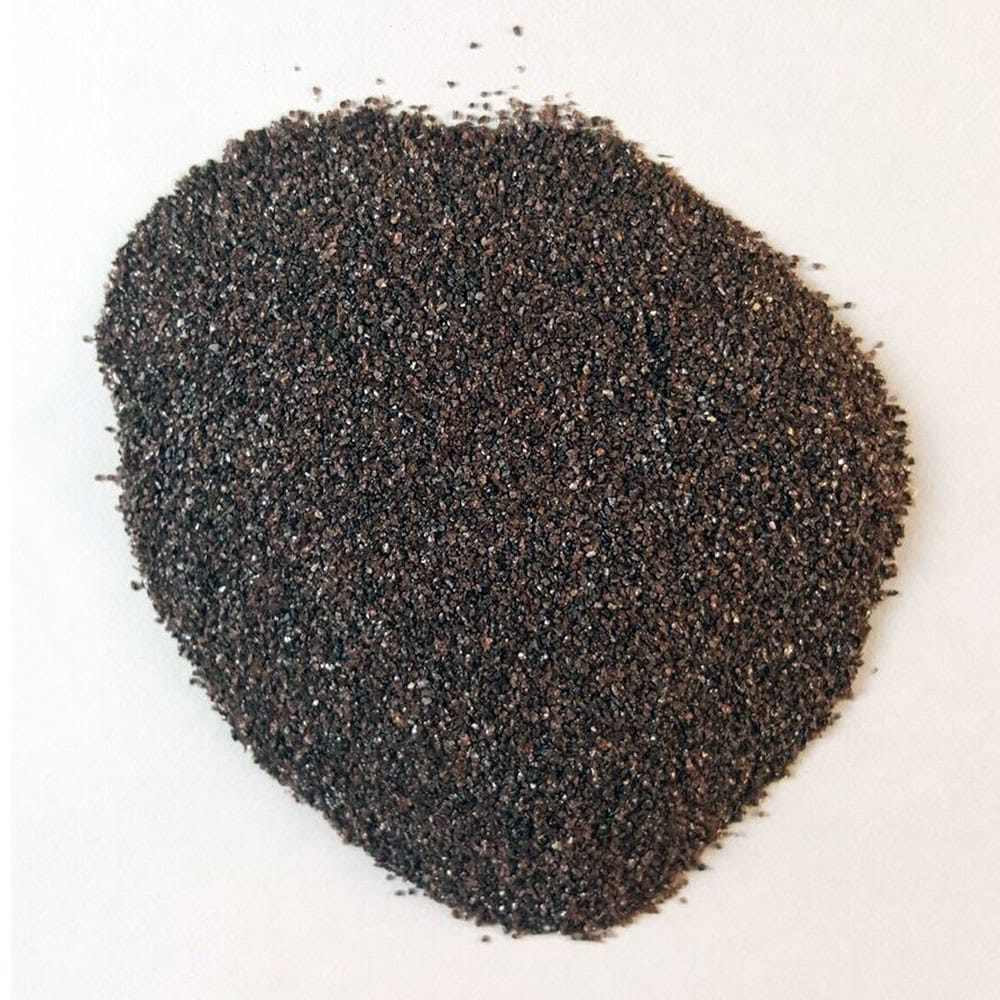
Garnet vs Aluminum Oxide Blasting Abrasive
Two of the most widely used sandblasting abrasives go head-to-head. When does garnet’s environmental advantage justify its lower recyclability? When does aluminum oxide’s cost efficiency outweigh garnet’s dust performance? Full analysis for B2B buyers.
The Core Trade-Off: Recyclability vs Environment
Garnet and aluminum oxide are both excellent, versatile blasting abrasives — angular, hard, silica-free, and capable of delivering Sa 2.5 cleanliness and coating-ready surface profiles on carbon steel. The choice between them comes down to two competing priorities: aluminum oxide’s far superior recyclability (20–30 cycles vs garnet’s 3–5) versus garnet’s dramatically lower dust generation and more favourable environmental and waste disposal profile.
In a blast room or cabinet where media is fully recovered and recycled, aluminum oxide wins the cost-per-cycle comparison by a wide margin. In field blasting, open-site operations, or environments with strict dust, health, or waste disposal regulations, garnet’s environmental advantages can outweigh aluminum oxide’s recyclability benefit — especially when disposal cost for spent media is factored into the total calculation.
Head-to-Head Comparison Table
| Factor | Garnet (GMA) | Aluminum Oxide (BFA) |
|---|---|---|
| 莫氏硬度 | 7.5–8 | 9 |
| Shape | Sub-angular | Angular, blocky |
| Profile Depth | 1.5–2.5 mil | 1.5–4.0 mil |
| Dust Generation | Very Low | Moderate |
| Free Silica | <1% | <1% |
| Heavy Metal Leachate | Very Low | Low–Medium |
| 可回收性 | 3–5 cycles | 20–30 cycles |
| Purchase Price/lb | $0.18–0.30 | $0.30–0.45 |
| Effective Cost/Cycle | $0.040–0.080/lb | $0.012–0.020/lb |
| Waste Disposal Class | Usually non-hazardous | Depends on substrate |
| Waterjet Use | Yes (GMA mesh 80) | No |
| Best Environment | Field, sensitive sites | Cabinet, blast room |
Dust Performance: Garnet’s Key Advantage
Garnet generates significantly less respirable dust than aluminum oxide at equivalent blast pressures — a difference attributable to garnet’s fracture characteristics. Garnet particles tend to fracture less aggressively on impact, breaking into fewer, larger sub-fragments rather than shattering into fine dust. Aluminum oxide’s harder, more brittle fracture produces more fine particles per unit of media consumed.
In practical terms, garnet’s lower dust output means: longer intervals between dust separator bag changes; lower airborne particle concentrations in the blast zone; reduced respiratory exposure for operators and nearby workers; and greater practical compliance with OSHA’s 50 μg/m³ PEL for respirable dust without engineering controls beyond standard blasting PPE. In enclosed environments — blast cabinets, blast rooms, drydock interiors — this difference is measurable and meaningful.
For full regulatory guidance on dust exposure limits and OSHA compliance for blasting operations, see the OSHA Safety Regulations guide.
Cost & Recyclability Analysis
Aluminum oxide’s recyclability advantage is decisive in enclosed recycling systems. With 22 average usable cycles versus garnet’s 4, the effective cost per cycle at typical market prices strongly favours aluminum oxide — even though garnet’s purchase price per bag is lower. The math: garnet at $0.24/lb ÷ 4 cycles = $0.060/lb effective cost; aluminum oxide at $0.38/lb ÷ 22 cycles = $0.017/lb effective cost. Aluminum oxide is 3.5× cheaper per unit of blasting work in a recycling system.
The calculation changes in field operations where recycling is not possible. In that scenario, both media are single-use from a practical standpoint, and the purchase price comparison becomes relevant again — though garnet’s lower disposal cost (non-hazardous in most jurisdictions vs. potentially regulated for aluminum oxide depending on substrate and prior coatings) may narrow or eliminate the price gap. For the full multi-media cost model, see Recyclable Media Comparison.
Environmental Compliance: Where Garnet Wins
Garnet’s spent media typically passes TCLP (Toxicity Characteristic Leaching Procedure) testing as non-hazardous waste, significantly simplifying disposal logistics and cost compared to some aluminum oxide applications where spent media contains heavy-metal residues from blasted coatings. Garnet is also preferred by environmental engineers for blasting operations near waterways, storm drains, or sensitive habitats, where any media spill or runoff must meet ecological standards.
For operations in EU member states, Australia, and jurisdictions with strict occupational health regulations on dust, garnet’s lower dust profile also simplifies regulatory compliance monitoring. For complete guidance on spent media classification and disposal, see the Environmental Compliance guide.
Surface Profile Results
For most standard protective coating systems (1.5–2.5 mil profile requirement), garnet and aluminum oxide produce comparable surface profiles. Garnet’s sub-angular shape produces a slightly smoother, more rounded profile compared to aluminum oxide’s blocky angular cuts — a difference that is measurable with replica tape but generally within coating specification tolerances. For coating systems requiring profiles above 2.5 mil, aluminum oxide’s higher hardness and more aggressive cutting geometry gives it a clear advantage over garnet, which tops out at approximately 2.5–3.0 mil in most operating conditions.
Decision Guide: Garnet or Aluminum Oxide?
Choose Garnet When
- Working on open sites near occupied buildings, waterways, or sensitive environments
- Operating in jurisdictions with strict dust PEL monitoring requirements
- Media recycling is not possible (field blasting) and disposal cost matters
- Dual use with waterjet cutting is required (GMA mesh 80)
- Blasting food equipment, water tanks, or substrates requiring chemical inertness
Choose Aluminum Oxide When
- Operating in an enclosed blast room or cabinet with media recovery
- Profile depth above 2.5 mil is required
- Cost-per-cycle is the primary procurement metric
- Blasting glass, ceramics, or very hard non-ferrous substrates
- Fine grit sizes (120–320) are needed for precision finishing
For full technical guides on each media, see the Garnet guide 和 Aluminum Oxide guide.
FAQ
Both produce adequate anchor profiles for standard epoxy coating systems (1.5–2.5 mil DFT range). For very high-build epoxy systems requiring profiles above 2.5 mil, aluminum oxide’s higher hardness gives it a slight edge. For thin-film epoxy systems on previously blasted steel in maintenance painting, garnet’s cleaner, more consistent sub-angular profile can produce excellent adhesion results. In practice, the surface cleanliness standard (Sa 2.5) matters more than the choice between these two media for most epoxy coating applications.
Garnet is significantly preferred for blasting near waterways, harbours, and coastal environments. Its lower heavy-metal leachate profile means spent garnet that enters the water is less ecotoxic than aluminum oxide or metallic abrasives. Garnet’s lower dust generation also reduces airborne contamination of adjacent water bodies. Many environmental permits for marine blasting and bridge work over water specifically require garnet or other low-leachate abrasives by name.
Garnet or Aluminum Oxide? Get Expert Guidance from Jiangsu Henglihong Technology
We supply both media globally and can help you select the right abrasive for your specific application, site conditions, and regulatory environment. Request a free consultation and quotation.
过滤器