Aluminum Oxide Blast Media: Uses, Grit Sizes & Complete Buyer’s Guide
The industrial blasting world’s most versatile abrasive — covering brown vs white fused alumina, grit size selection by application, surface profile data, recyclability economics, and everything you need to specify and source aluminum oxide blast media correctly.
1. What Is Aluminum Oxide Blast Media?
Aluminum oxide blast media — also known as aluminium oxide abrasive, corundum grit, or by its technical name 熔融氧化铝 — is a synthetic mineral abrasive manufactured by fusing bauxite ore in an electric arc furnace at temperatures exceeding 2,000 °C. The result is a crystalline material of exceptional hardness, toughness, and chemical purity that, when crushed and sized to precise grit grades, becomes the most widely used blasting abrasive in global industrial manufacturing.
As of March 2026, aluminum oxide accounts for a dominant share of the industrial mineral abrasive blasting market, used across surface preparation, deburring, descaling, and finishing operations in virtually every manufacturing sector. Its combination of very high hardness (Mohs 9.0), sharp angular particle morphology, chemical inertness和 outstanding recyclability makes it the reference standard against which other blasting media are compared.
Unlike silica sand — which is banned or severely restricted in most countries due to silicosis risk — aluminum oxide contains no free crystalline silica and is fully compliant with OSHA, EU Directive 2017/2398, and equivalent occupational health regulations worldwide. This makes it the default specification for any operation that has transitioned away from silica sand and needs a high-performance, regulation-compliant replacement.
2. Brown vs White Fused Alumina — Which Do You Need?
Aluminum oxide for blasting is commercially available in two primary grades: brown fused alumina (BFA) 和 white fused alumina (WFA). Both are manufactured from the same fundamental process, but differ in raw material purity and final chemical composition — differences that matter significantly for certain substrate types.
The practical decision rule is straightforward: use brown fused alumina for carbon steel, cast iron, structural steel, and general industrial surface preparation where iron contamination is not a concern. Use white fused alumina wherever iron contamination is unacceptable — stainless steel, titanium alloys, nickel superalloys, and any component that will undergo electroplating, anodizing, or thermal spray coating where trace iron at the surface would cause adhesion failure or corrosion initiation.
3. Grit Size Guide & Surface Profile Data
Grit size is the primary variable controlling surface profile depth (anchor profile). Every industrial coating system specifies a minimum and maximum surface profile — typically expressed in µm Ra or Rz per ISO 8503 — and selecting the correct aluminum oxide grit to consistently hit that window is a critical engineering decision, not a rough estimate.
The FEPA F-grade system (F12 through F220+) is the standard sizing reference for blasting-grade aluminum oxide in international trade. Equivalent US mesh sizes are also shown in the table below for reference.
| FEPA Grade | US Mesh Equiv. | Particle Size (µm) | Profile Depth (Rz) | Typical Use Case |
|---|---|---|---|---|
| F12 | ~12 Mesh | 1,700–2,360 | Extremely heavy scale, thick epoxy removal, maximum profile | |
| F16 | ~16 Mesh | 1,180–1,700 | Very heavy structural steel prep, high-build zinc-rich coatings | |
| F24 Popular | ~24 Mesh | 710–1,000 | Heavy structural steel, Sa 2.5 / SSPC-SP10, industrial coating prep | |
| F36 Popular | ~36 Mesh | 500-710 | General steel surface prep, pipeline coating, marine applications | |
| F46 | ~46 Mesh | 355-500 | Standard industrial prep, epoxy primer systems | |
| F54–F60 Popular | ~54–60 Mesh | 250-355 | Versatile mid-range; polyurethane, epoxy, zinc coatings | |
| F80 | ~80 Mesh | 180-250 | Stainless steel, aluminum, pre-electroplating, thin-film coatings | |
| F100–F120 | ~100–120 Mesh | 106–180 | Fine surface conditioning, pre-anodizing, pre-thermal spray | |
| F150–F180 | ~150–180 Mesh | 63-106 | Precision finishing, medical components, pre-PVD/CVD coating | |
| F220+ | ~220+ Mesh | <63 | Ultra-fine finishing, optical components, semiconductor substrates |
Profile depth ranges are indicative for brown fused alumina at 5–7 bar (73–102 psi) blast pressure, 150–200 mm standoff distance, perpendicular blast angle. Actual profiles vary with equipment condition, nozzle wear, and substrate hardness.
4. Applications by Industry and Substrate
Aluminum oxide’s combination of high hardness, angular shape, and chemical inertness makes it suitable for a wider range of substrates and industries than any other single mineral abrasive. The following application grid covers the most commercially significant uses as of March 2026.
Structural Steel & Infrastructure
Rust, mill scale, and old coating removal from bridges, storage tanks, offshore platforms, and steel fabrications prior to heavy-duty coating application. F24–F46 BFA is the standard specification. See our industrial surface prep guide for full detail.
Aerospace & Defense
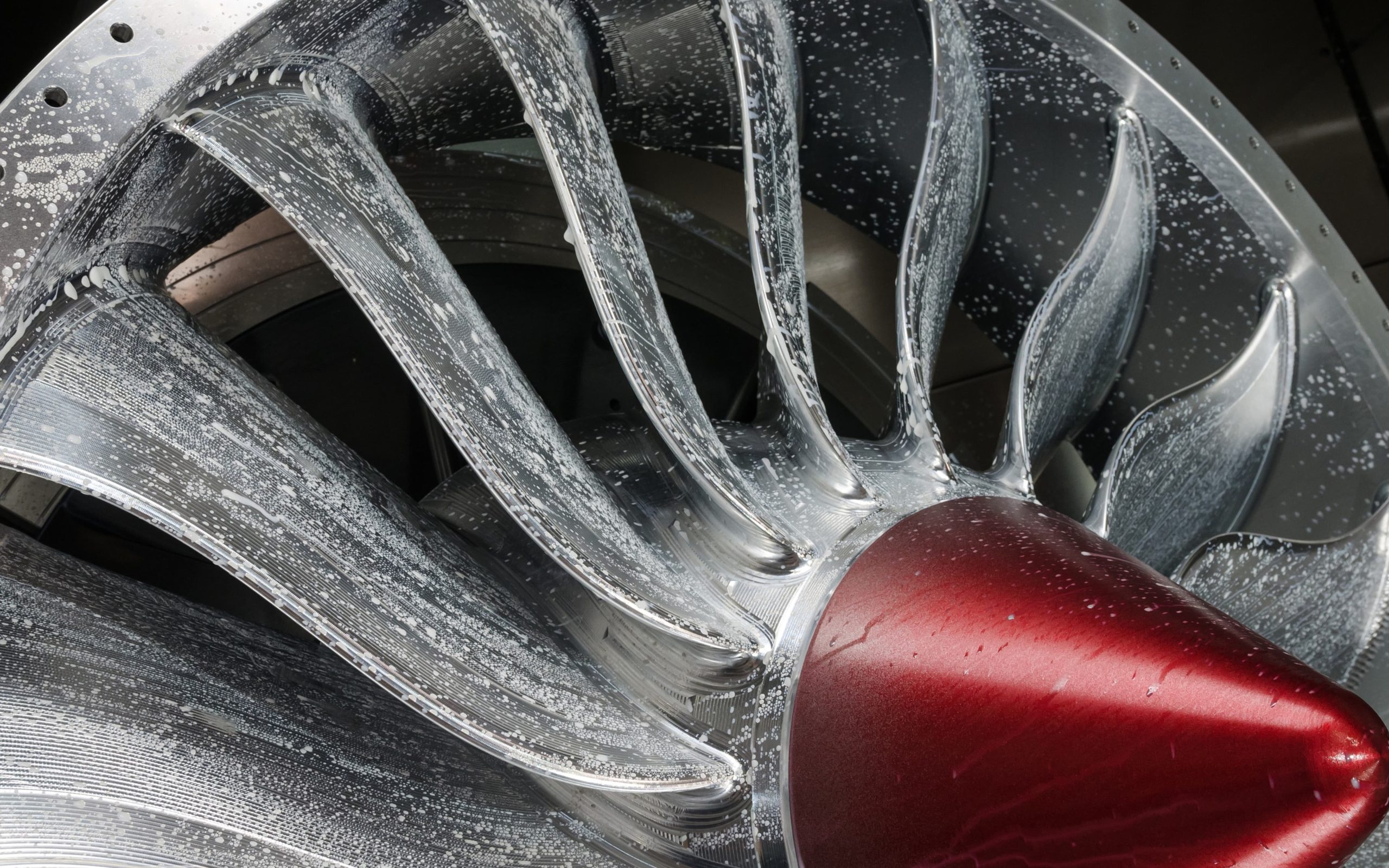
Surface preparation of titanium airframe components, nickel superalloy turbine parts, and aluminum structural elements. WFA (white grade, low iron) is mandatory to prevent iron contamination. Fine grits (F80–F120) for thin-gauge parts.
Automotive Restoration
Frame, subframe, and chassis preparation prior to epoxy primer. F36–F60 BFA for heavy steel components. Medium grits for alloy wheels. For thin body panels, finer grit or alternative media is recommended — see the automotive restoration guide.
Precision Machined Parts
Deburring of castings, forgings, and CNC-machined components. Pre-treatment before electroplating, anodizing, or powder coating. Fine-to-medium grit aluminum oxide produces consistent, measurable surface profiles that plating and coating adhesion depends on.
Oil & Gas Pipeline
Internal and external pipe surface preparation for FBE (fusion-bonded epoxy) and three-layer polyethylene coating systems. F36–F54 is the common specification. Aluminum oxide’s consistent profile generation is critical for coating adhesion in high-pressure service.
Medical & Semiconductor
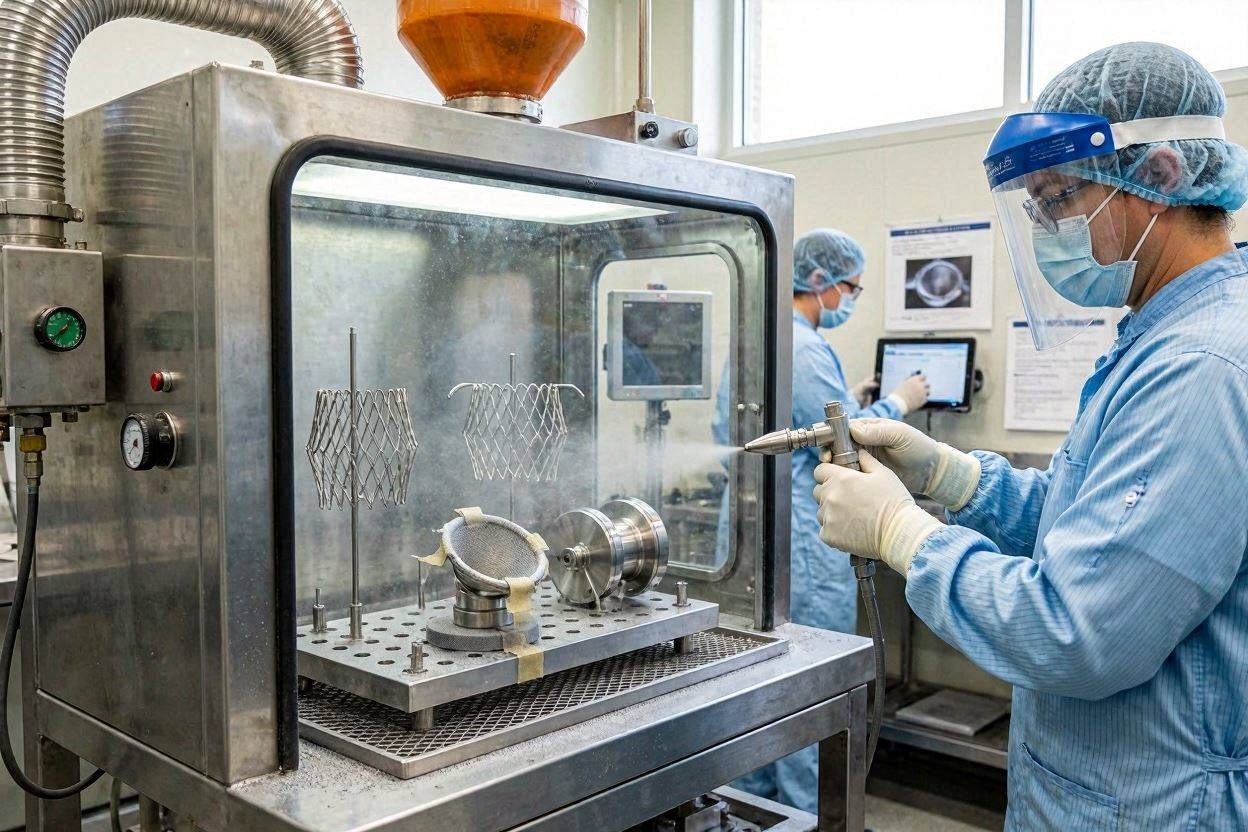
Ultra-fine WFA (F150–F220) for surface preparation of orthopedic implants, dental components, and semiconductor substrates. Extremely tight size distribution and certified low iron content are mandatory. Standard BFA is not appropriate for these applications.
5. Recyclability and Cost Economics
Aluminum oxide’s recyclability is one of its most commercially significant properties and the primary reason it outperforms single-use abrasives like copper slag and coal slag on a cost-per-m² basis in any recirculating blast system.
In a recirculating blast cabinet or enclosed blast room with a properly tuned separator/classifier, aluminum oxide particles fracture gradually over successive cycles, always exposing fresh sharp edges. The classifier continuously removes sub-size dust and fines, maintaining consistent particle size in the working mix. Media charge is “topped up” periodically with fresh abrasive rather than replaced entirely.
The economic advantage compounds over a production year. A high-volume cabinet blasting operation running two shifts per day will process several thousand m² annually. At typical consumption rates, the difference between specifying aluminum oxide versus a single-use alternative can represent tens of thousands of dollars in annual media and disposal cost savings. For a full cost model with price benchmarks and ROI calculation examples, see the Blasting Media Cost Guide & ROI Analysis.
6. When to Use Aluminum Oxide — and When Not To
✓ Use aluminum oxide for:
- Carbon steel, structural steel, and cast iron surface preparation
- Stainless steel and non-ferrous metals (use WFA grade)
- Titanium and nickel superalloy components (WFA, certified low iron)
- Ceramic, carbide, and technical substrate preparation
- Pre-electroplating, pre-anodizing, pre-thermal spray treatment
- Recirculating cabinet blast systems where high recyclability is needed
- Any application requiring a documented, consistent anchor profile
- Operations where silica-free compliance is required
✗ Do not use aluminum oxide for:
- Carbon fiber reinforced polymer (CFRP) or fiberglass composites — use plastic blast media
- Thin-gauge aluminum body panels where warping is a risk — use plastic media or glass bead at low pressure
- Applications requiring a smooth peened finish rather than an etched anchor profile — use glass bead or steel shot
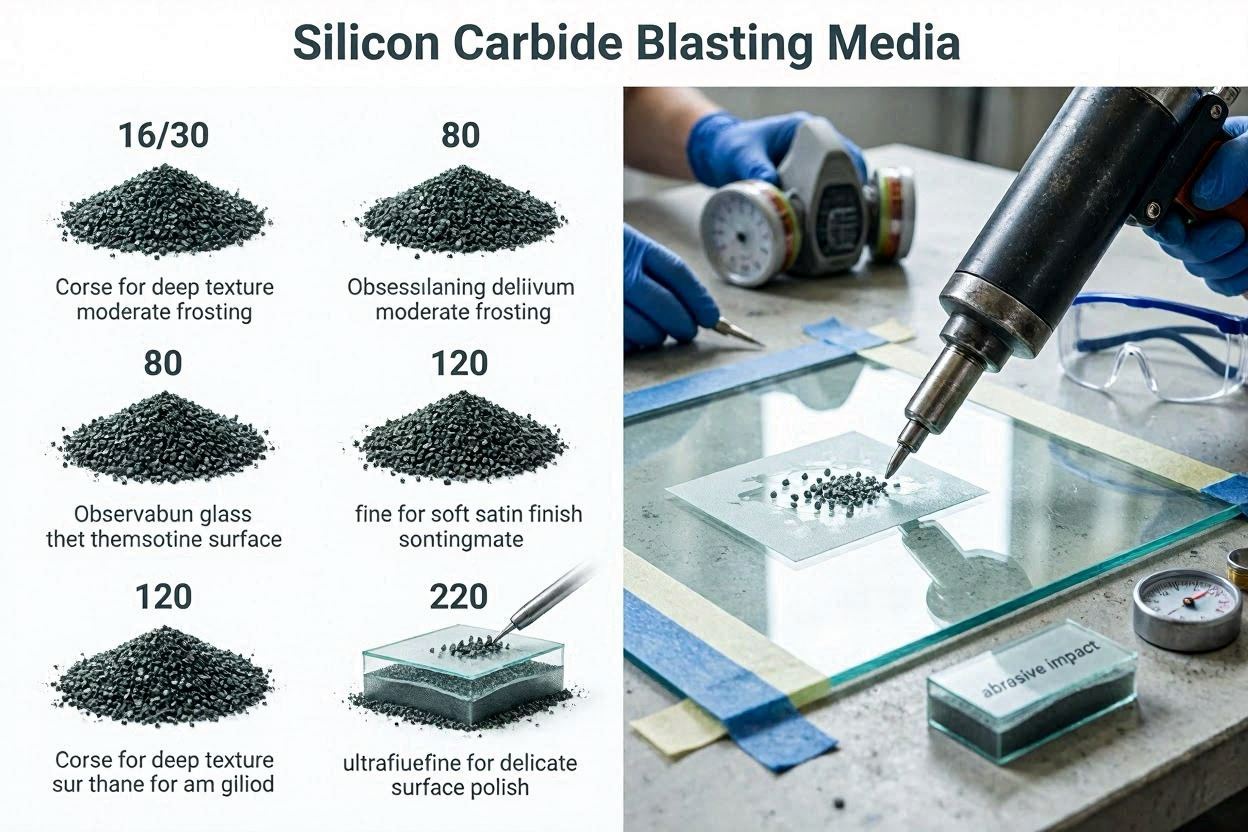
- Extremely hard substrates like glass that require even faster cutting — 碳化硅 will outperform
- Open outdoor blasting where low dust is the primary requirement — 石榴石 produces significantly less airborne dust
- Wheel blast (centrifugal) equipment — designed for metallic abrasives only, mineral media causes rapid blade wear
7. Sourcing and Quality Standards
Aluminum oxide blast media is a commodity in global trade, but quality varies significantly between suppliers. Inconsistent grit sizing, elevated iron content, excessive fines, or undisclosed silica contamination all translate directly into variable surface profiles, equipment wear, or compliance problems on the production floor. Apply the following standards when evaluating suppliers.
Key Standards to Reference
- FEPA Standard 42-1984 — particle size distribution for F-grade abrasives (the global reference for grit sizing)
- ISO 11127-1 through 11127-7 — non-metallic blasting abrasive specifications and test methods
- ANSI B74.12 — North American equivalent for abrasive grain sizing
- GB/T 2478 — Chinese national standard for fused aluminum oxide abrasives (relevant for China-sourced product)
What to Request from Your Supplier
- Material Test Report (MTR) for each shipment: confirming Al₂O₃ content, Fe₂O₃ content, TiO₂ content, and free silica percentage
- Sieve analysis certificate: confirming particle size distribution conforms to the specified FEPA or ANSI grade with actual percentage retained on each sieve
- SDS/MSDS: Safety Data Sheet for the specific product grade, confirming absence of regulated hazardous components at threshold concentrations
- Moisture content: important for sea freight shipments — clumped or moisture-contaminated aluminum oxide causes feed problems in blast pots and cabinets
For a head-to-head comparison of aluminum oxide against garnet, glass bead, steel grit, and other major abrasives across all key parameters, see the Blasting Media Comparison Chart. For guidance on matching aluminum oxide to your specific substrate and coating system, refer to the complete blasting media selection guide.
8. Frequently Asked Questions
Related Resources
Explore the rest of our blasting media resource library for further guidance on selection, comparison, and application-specific recommendations:
- Blasting Media: Complete Industry Guide — full overview of all media types and applications
- Types of Blasting Media: Complete Guide — how aluminum oxide compares to all other abrasive types
- How to Choose the Right Blasting Media — step-by-step selection framework and substrate matrix
- Blasting Media Comparison Chart — side-by-side data for all major abrasives
- Blasting Media Cost Guide & ROI Analysis — cost-per-m² modeling and price benchmarks
- Garnet Blasting Media — eco-friendly alternative with lower dust generation
- Glass Bead Blasting Media — for smooth, peened finishes on stainless and aluminum
- Silicon Carbide Blast Media — for glass, ceramics, and the hardest substrates
- Steel Grit vs Steel Shot — metallic abrasive options for high-volume production
- Blasting Media Safety Guide — OSHA/EU compliance, PPE requirements, silica risk management
- Eco-Friendly Blasting Media — low-dust and silica-free options for regulated environments
- Industrial Surface Prep: Best Blasting Media for Metal
- Blasting Media for Automotive Restoration
- Plastic Blast Media for Aerospace & Automotive
Source Aluminum Oxide Blast Media from a Trusted Manufacturer
Jiangsu Henglihong Technology supplies brown and white fused aluminum oxide in FEPA F-grades, with full MTR documentation, sieve analysis certification, and reliable sea freight logistics to North America, Europe, and beyond.
Request a Quote or Technical Sample过滤器