Abrasive Media Hardness Comparison: Mohs Scale & What It Means for Blasting
Hardness is the most fundamental property governing whether an abrasive media will cut a given substrate effectively — and whether it will do so without excessive media wear, equipment damage, or substrate distortion. An abrasive that is harder than its target cuts efficiently; one that approaches the same hardness as its target abrades inefficiently and breaks down rapidly; one that is softer than its target does not cut at all and simply deforms on impact. The Mohs hardness scale provides the reference framework for comparing abrasive media and substrate materials on a common basis.
This guide explains the Mohs scale, how each principal abrasive media type ranks on it, how hardness interacts with toughness to determine real-world blasting performance, and how to use hardness data to make informed media selection decisions. For the complete media buying guide with full product specifications, see the Abrasive Media Supplies Buyer’s Guide.
The Mohs Hardness Scale Explained
The Mohs hardness scale was devised by German mineralogist Friedrich Mohs in 1812 as a practical field test for identifying minerals. It ranks ten reference minerals from 1 (talc, the softest) to 10 (diamond, the hardest) based on their ability to scratch each other. A material that can scratch a reference mineral is harder than it; a material that is scratched by a reference mineral is softer. The scale is ordinal — it indicates relative ranking — but not linear. The hardness difference between 9 and 10 (corundum to diamond) is far greater in absolute terms than the difference between 1 and 2 (talc to gypsum).
The ten reference minerals on the Mohs scale:
- Talc — fingernail can scratch it
- Gypsum — fingernail barely scratches it
- Calcite — copper coin can scratch it
- Fluorite — steel knife barely scratches it
- Apatite — steel knife scratches it
- Orthoclase feldspar — steel file scratches it with difficulty
- Quartz — scratches ordinary glass
- Topaz — scratches quartz
- Corundum (sapphire/ruby) — scratches topaz
- Diamond — scratches everything; scratched by nothing
For abrasive media applications, the Mohs scale provides a quick comparative framework. The critical rule: abrasive must be at least 1.5–2 Mohs harder than the substrate to cut it productively. Below this differential, the abrasive abrades itself as much as the substrate, consuming media at high rates with low cutting efficiency.
Abrasive Media Hardness Rankings
The following bar chart and table rank all nine principal abrasive media types from softest to hardest on the Mohs scale:
| Media | 莫氏硬度 | Hardness Category | Key Implication for Blasting |
|---|---|---|---|
| 碳酸氢钠 | 2.5 | Very Soft | Gentle cleaning only; no profiling on any metal substrate |
| Plastic Grit (Urea / Melamine) | 3–4 | Soft | Strips coatings from aluminum and composites; no substrate material removal |
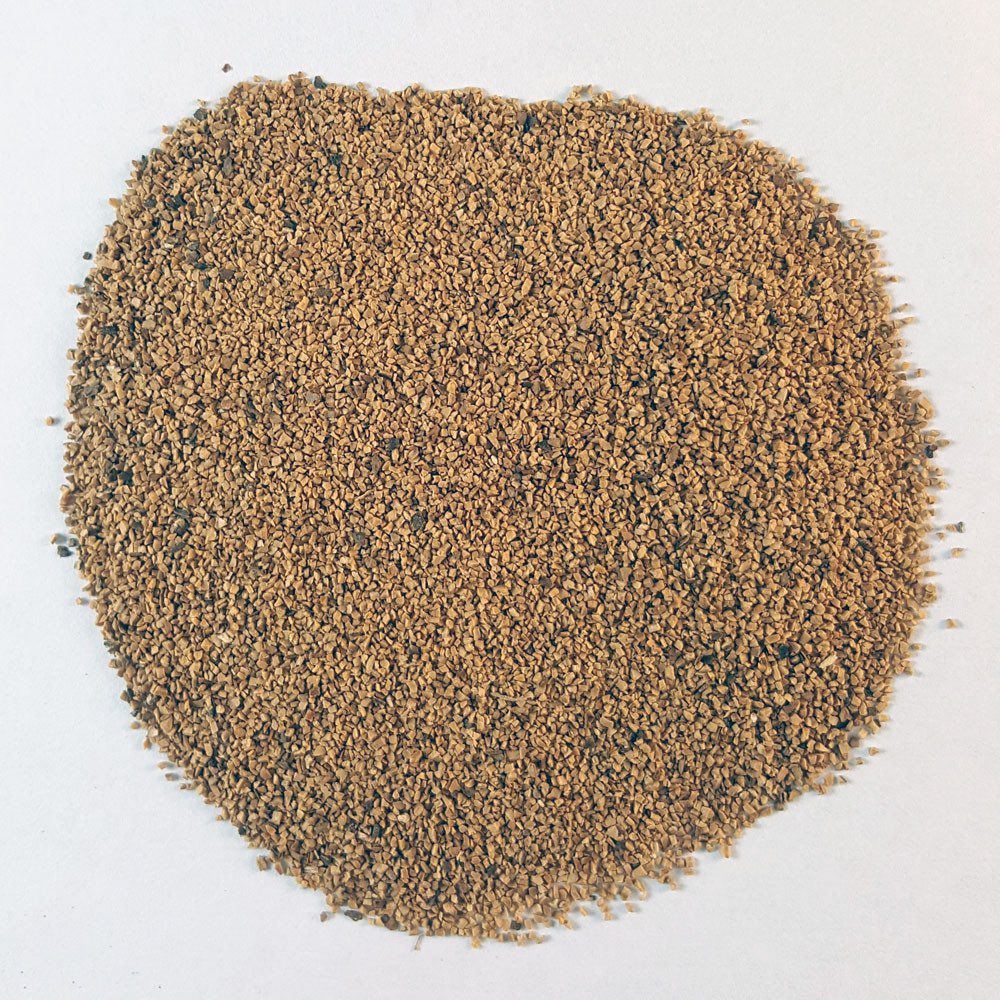
| Walnut Shell | 3.5–4 | Soft | Cleans delicate surfaces; no profiling on metal |
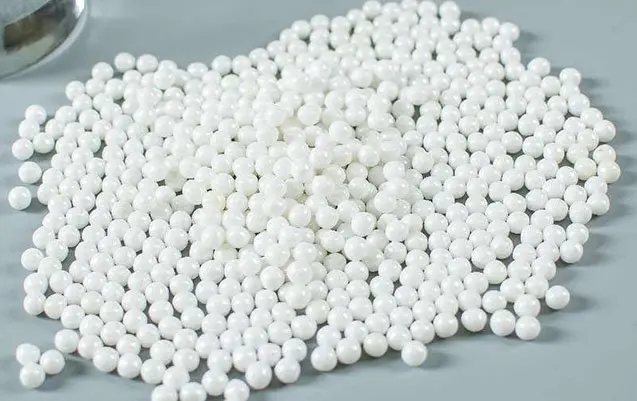
| 玻璃珠 | 5.5 | Medium-Soft | Peens and burnishes; cannot profile carbon or alloy steel |
| 钢丸 | 5–6 (HRC 40–51) | Medium | Peens and descales steel; produces low-depth smooth profile |
| Copper Slag | 6-7 | Medium-Hard | Profiles carbon steel; marginally effective on hard alloys |
| 钢砂 | 7–8 (HRC 54–65) | Hard | Aggressive profiling of all steel grades; Sa 3 capable |
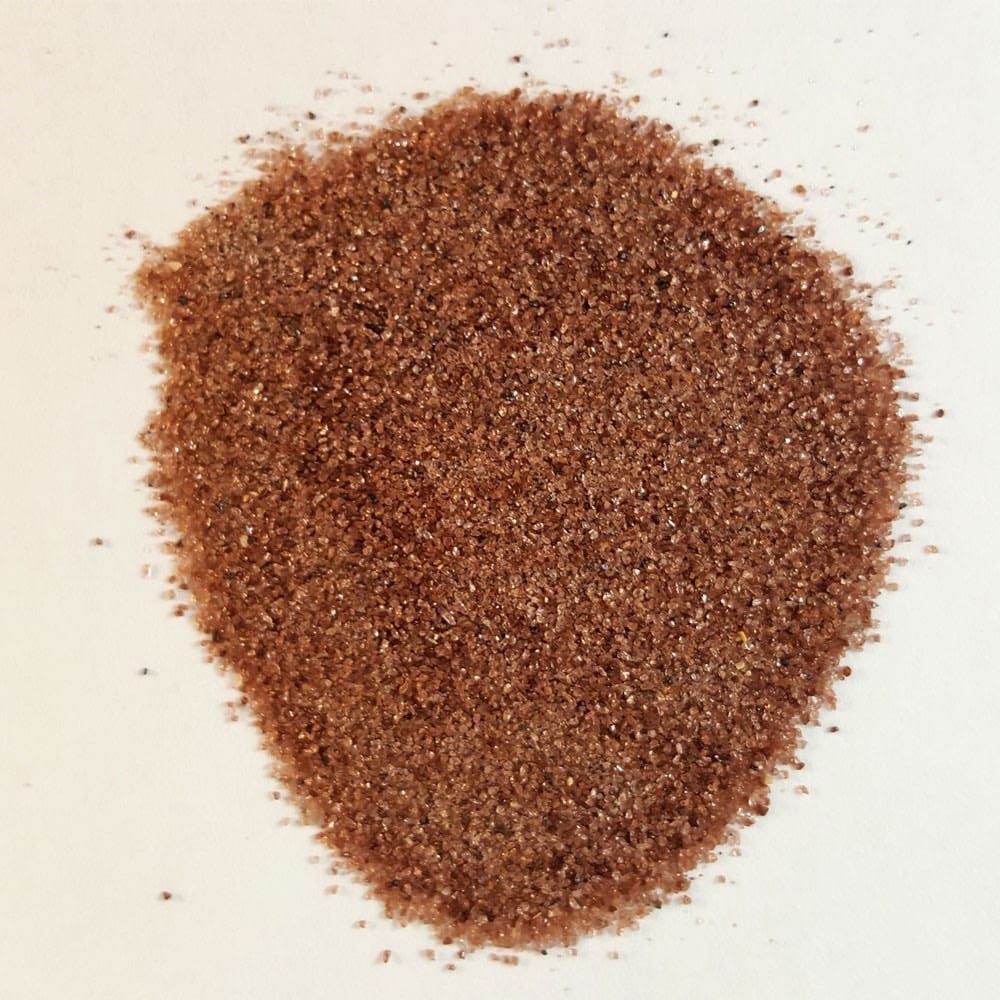
| Garnet (Almandine) | 7.5–8.5 | Hard | Profiles most metals and stone; preferred for pipeline and marine |
| 氧化铝 | 9.0 | Very Hard | Profiles steel, aluminum, stainless, titanium, and ceramics |
| 碳化硅 | 9.5 | Extremely Hard | Cuts glass, stone, hard ceramics; most productive on hardest substrates |
Common Substrate Hardness Reference
| Substrate Material | Approx. Mohs Hardness | Minimum Media Hardness Required |
|---|---|---|
| Soft polymers / rubber | 1–2 | 2.5+ (any abrasive) |
| Calcite / soft stone | 3 | 4.5+ |
| Aluminum alloys (soft) | 2.5–3.5 | No minimum for cleaning; 5+ for profiling |
| Zinc / soft brass | 2.5–4 | 4.5+ for profiling |
| Mild carbon steel | 4.5–5.5 | 7.0+ for profiling to Sa 2.5 |
| Stainless steel (austenitic) | 5.5–6.5 | 7.0+ for profiling |
| Cast iron | 5–6 | 7.0+ for aggressive profiling |
| Standard float glass | 5.5 | 7.5+ for etching; 9.0+ for productive cutting |
| Titanium alloys | 6–6.5 | 8.0+ for profiling |
| Granite / hard stone | 6-7 | 9.0+ for productive surface work |
| Hardened tool steel | 7–8 | 9.0+ (Al₂O₃ minimum) |
| Tungsten carbide | 9–9.5 | 9.5 SiC only; diamond for lapping |
Hardness vs Toughness: Why Both Matter
Hardness and toughness are related but distinct properties, and understanding the difference prevents a common over-simplification in abrasive media selection: assuming that harder is always better.
硬度 (Mohs scale) measures resistance to scratching and surface penetration — relevant to cutting ability.
Toughness measures resistance to fracture under impact — relevant to reuse cycle count and breakdown rate.
Silicon carbide (9.5 Mohs) is harder than aluminum oxide (9.0 Mohs) but more brittle — it fractures more readily under the repeated impact loads of blasting, giving it fewer reuse cycles per kilogram than Al₂O₃ despite its superior hardness. The self-sharpening behavior this produces (new cutting edges exposed at each fracture) partially compensates by maintaining cutting efficiency per impact — but the net result is that SiC is not automatically more economical than Al₂O₃ on substrates where both can cut effectively.
Similarly, steel shot (Mohs 5–6) appears dramatically softer than garnet (Mohs 7.5–8.5) — yet steel shot delivers up to 3,000 reuse cycles against garnet’s 5–10, because the toughness of the metallic steel structure prevents the particle fracture that progressively reduces mineral abrasives to unusable fines. For more on how to factor both properties into media selection: How to Choose Abrasive Blast Media: 5-Step Selection Framework.
Hardness Differential and Cutting Efficiency
The practical cutting efficiency of an abrasive increases with the hardness differential between media and substrate, up to a point of diminishing returns. Key observations:
- A differential of 1.5–2.0 Mohs is the practical minimum for productive blasting. Below this, the media abrades against the substrate without effective penetration, consuming media at high rate with low surface preparation output.
- Between differentials of 2.0–4.0 Mohs, cutting efficiency is broadly proportional to differential — harder media cuts faster, holding other parameters constant.
- Above differentials of 4.0+ Mohs, the substrate hardness becomes the limiting factor rather than the media hardness — using silicon carbide (9.5 Mohs) on mild steel (4.5 Mohs) cuts no faster than aluminum oxide (9.0 Mohs) on the same substrate, because the steel’s hardness limits how deep each particle penetrates regardless of which abrasive is used. The premium of SiC over Al₂O₃ is only justified when the substrate hardness approaches or exceeds Al₂O₃’s effective cutting threshold.
Practical Implication: Do not over-specify abrasive hardness. Using SiC (9.5 Mohs, premium cost) on standard carbon steel (4.5–5.5 Mohs) delivers no performance advantage over garnet (7.5–8.5 Mohs) or Al₂O₃ (9.0 Mohs), but costs significantly more per kilogram. Reserve SiC for substrates where its exceptional hardness margin over the target material actually translates to a measurable performance improvement: glass, hard stone, ceramics, and corundum-based materials.
Frequently Asked Questions
Counter-intuitively, garnet’s higher Mohs hardness does not translate to faster cutting on mild steel. The difference lies in specific gravity and therefore kinetic energy: steel grit has a specific gravity of approximately 7.8 g/cm³ vs garnet’s 3.9–4.1 g/cm³. At the same blast velocity, a steel grit particle carries approximately twice the kinetic energy of an equivalent-sized garnet particle. This higher impact energy drives the angular cutting edges deeper into the steel surface per impact, achieving a faster cut rate and deeper profile than garnet of equivalent or slightly higher Mohs hardness. Hardness determines whether cutting can occur at all; kinetic energy (mass × velocity²) determines how deeply each particle penetrates per impact event.
Mohs hardness is a useful reference point for media selection but is not precise enough to serve as a standalone procurement specification. The Mohs scale is ordinal and approximate — two minerals both rated at Mohs 7 can have meaningfully different absolute hardnesses and different blasting behaviors. For procurement documents, specify the applicable product standard (ASTM B-7 for garnet, SAE J827 for steel shot, FEPA F-series for aluminum oxide and SiC), the grade and grit size designation within that standard, and the performance parameters (particle size distribution D50 ± tolerance, chemical composition minimums) confirmed by COA. Mohs hardness is useful in buyer education and media selection discussion; it is not a substitute for dimensional and chemical specifications in a purchase order.
Select the Right Hardness Media for Your Application
Henglihong supplies abrasive media from Mohs 3 (plastic grit) through Mohs 9.5 (silicon carbide). Technical team available to confirm correct hardness specification for your substrate and coating system.
Get a Free Technical Recommendation过滤器