Blasting Sand Grit Size Guide: Coarse vs Medium vs Fine — What You Need for Each Job
Grit size is one of the most consequential decisions in abrasive blasting. Choose the wrong size and you either damage the substrate, fail to achieve the required surface profile, or waste media doing work that a coarser or finer grit would accomplish faster. This guide explains the mesh system, what each grade produces, and how to match grit size to your specific job.
Understanding the Mesh System
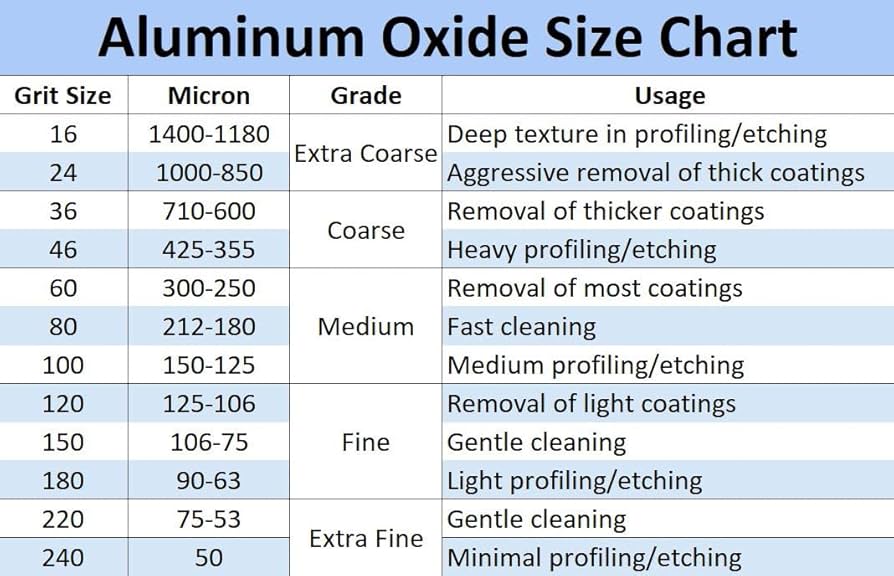
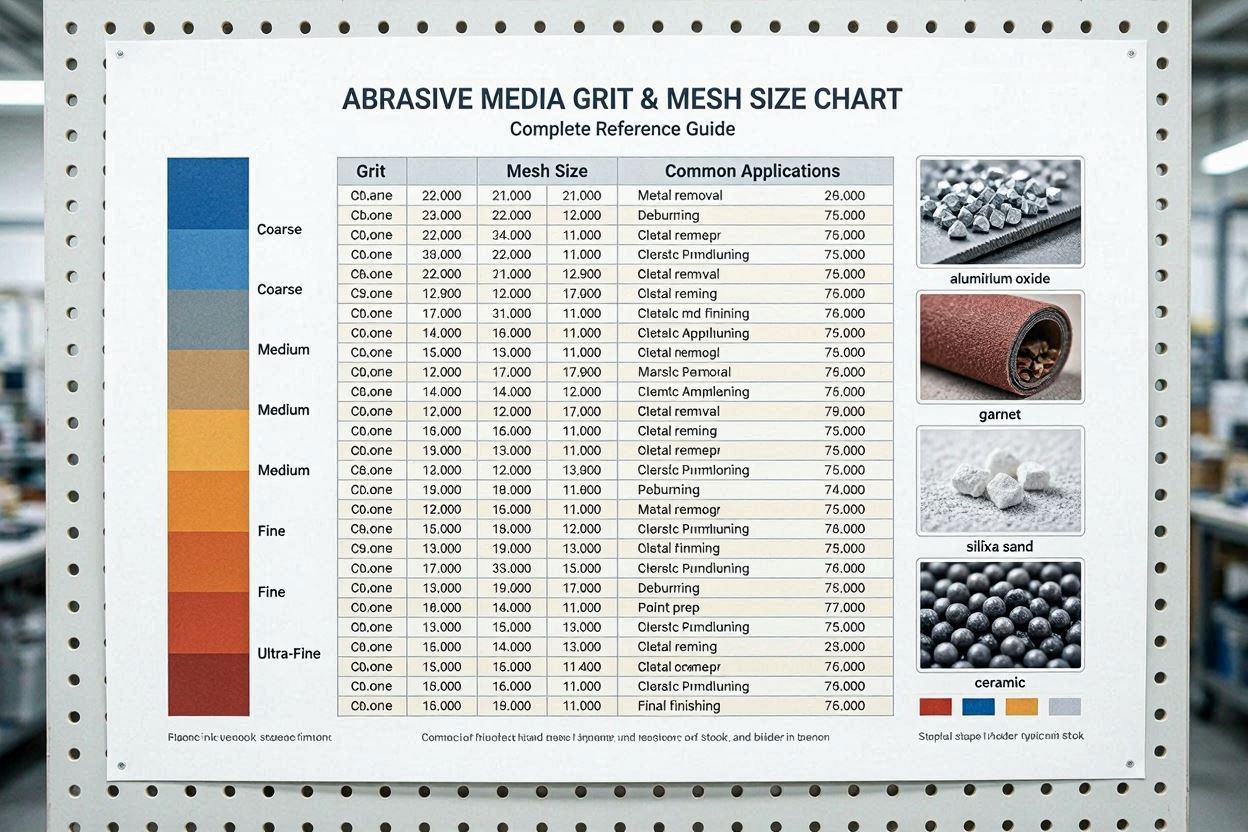
Abrasive media grit size is expressed as a mesh number — the number of openings per linear inch in the sieve screen used to separate particles during production. A higher mesh number means smaller particles; a lower mesh number means larger particles. This is counterintuitive for newcomers: coarse grit has a low mesh number.
Most commercial blasting media is sold as a size range — for example, “30/60 mesh” means particles that pass through a 30-mesh screen but are retained on a 60-mesh screen. This range specification is important: the distribution of particle sizes within a grade affects both blasting uniformity and the surface profile produced.
| Grade Name | Mesh Range | Particle Size (mm) | Surface Profile (mil) |
|---|---|---|---|
| Very Coarse | 6–16 mesh | 1.18–3.35 mm | 3–5 mil |
| Coarse | 16–30 mesh | 0.60–1.18 mm | 2–3.5 mil |
| Medium | 30–60 mesh | 0.25–0.60 mm | 1–2.5 mil |
| Fine | 60–120 mesh | 0.125–0.25 mm | 0.5–1.5 mil |
| Extra Fine | 120–220 mesh | 0.065–0.125 mm | 0–0.5 mil |
Note that surface profile depth also depends on blast pressure, nozzle distance, and the hardness of both the media and the substrate. The figures above assume standard operating conditions (90–110 PSI nozzle pressure, 6–8 inch standoff distance, garnet or equivalent mineral abrasive).
Surface Profile: What It Is and Why It Matters
Surface profile — sometimes called “anchor pattern” or “surface roughness” — is the microscopic peaks and valleys left on a blasted surface. It is measured in mils (thousandths of an inch) and is the primary factor determining how well a coating will mechanically bond to the substrate.
The relationship between surface profile and coating adhesion is direct: coatings grip the peaks of the anchor pattern as they cure. Too shallow a profile and there is insufficient mechanical bond area — coatings peel prematurely. Too deep a profile and the peaks can protrude through thin primer coats, creating corrosion initiation points.
Every industrial coating system is specified with a target surface profile range. Epoxy primers typically specify 1.5–3 mil. Zinc-rich primers often require 2–4 mil. Thin decorative coatings may specify no more than 1 mil. Always consult the coating manufacturer’s product data sheet before selecting grit size, and select the grit that achieves the specified profile with your equipment and media type.
Coarse Grit (6–20 Mesh)
Coarse — 6 to 20 Mesh | Profile: 2.5–5 mil
Maximum material removal. Used for the heaviest mill scale, deep pitting corrosion, and structural steel that requires a 3+ mil anchor profile for thermal spray or zinc-rich primers. Coarse garnet (12/20 mesh) and coarse steel grit achieve this range reliably. Not suitable for thin metals, painted panels, or any surface where dimensional change is a concern.
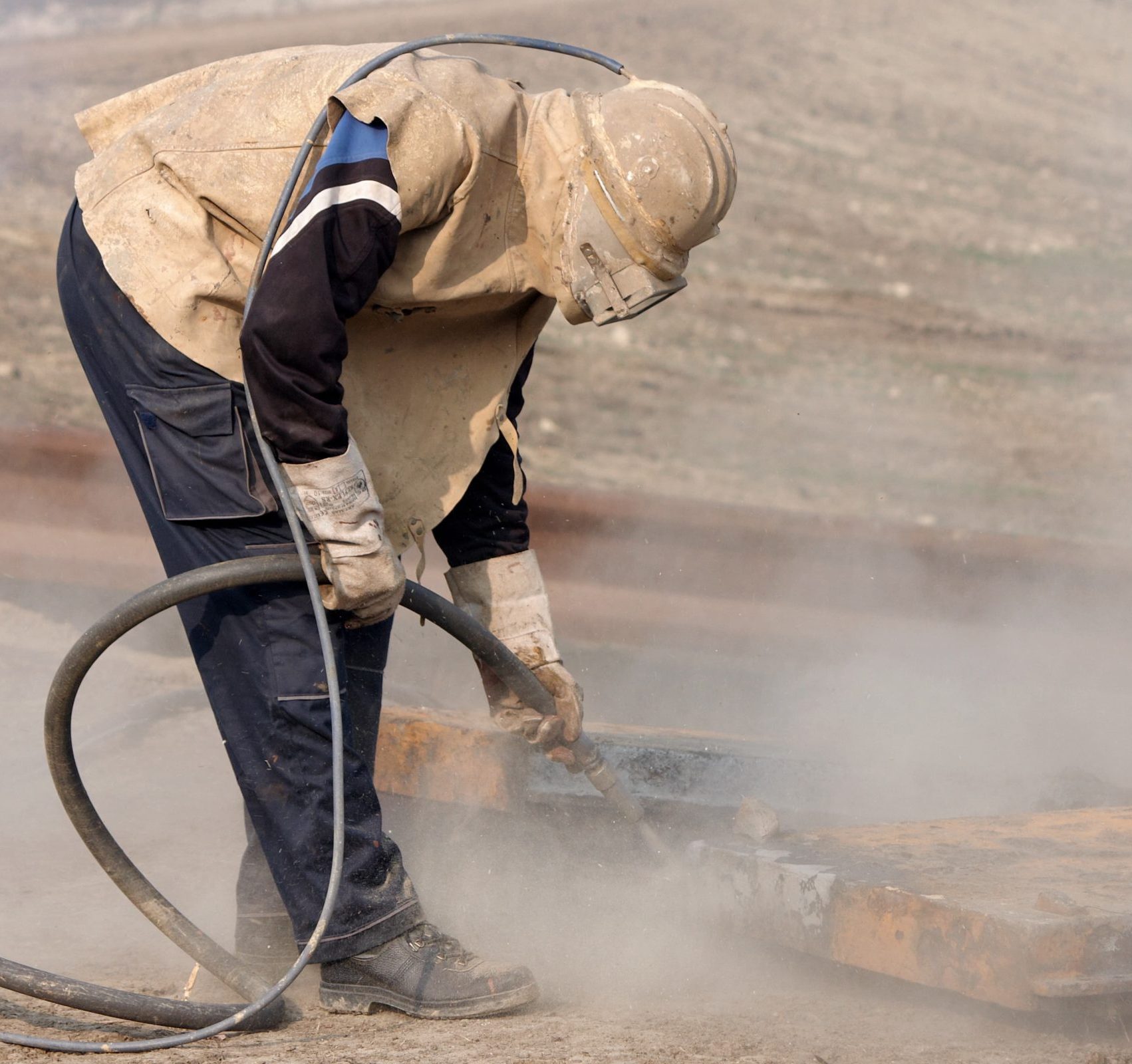
Coarse grit is the workload of shipyards, bridge painters, and structural steel fabricators. At 90–110 PSI with garnet or steel grit, it achieves near-white metal (SSPC-SP 10) or white metal (SSPC-SP 5) cleanliness with a 2.5–4 mil anchor pattern in a single pass on moderately corroded steel. On heavily scaled or pitted plate, multiple passes may be required even with coarse media.
The most common mistake with coarse grit is using it on automotive bodywork or thin sheet metal. Even one pass of coarse garnet on a car door panel will leave deep pits and may cause warping from localized thermal stress during blasting. For automotive applications, always use medium or fine grit. See: Blasting Sand for Automotive Restoration.
Medium Grit (30–60 Mesh)
Medium — 30 to 60 Mesh | Profile: 1–2.5 mil
The most versatile grit range — suitable for the majority of steel surface preparation, rust removal, and paint stripping applications. Achieves the 1.5–2 mil profile required by most industrial primer systems. Balances cutting speed with surface smoothness. The recommended starting point for any operator who is uncertain about grit size.
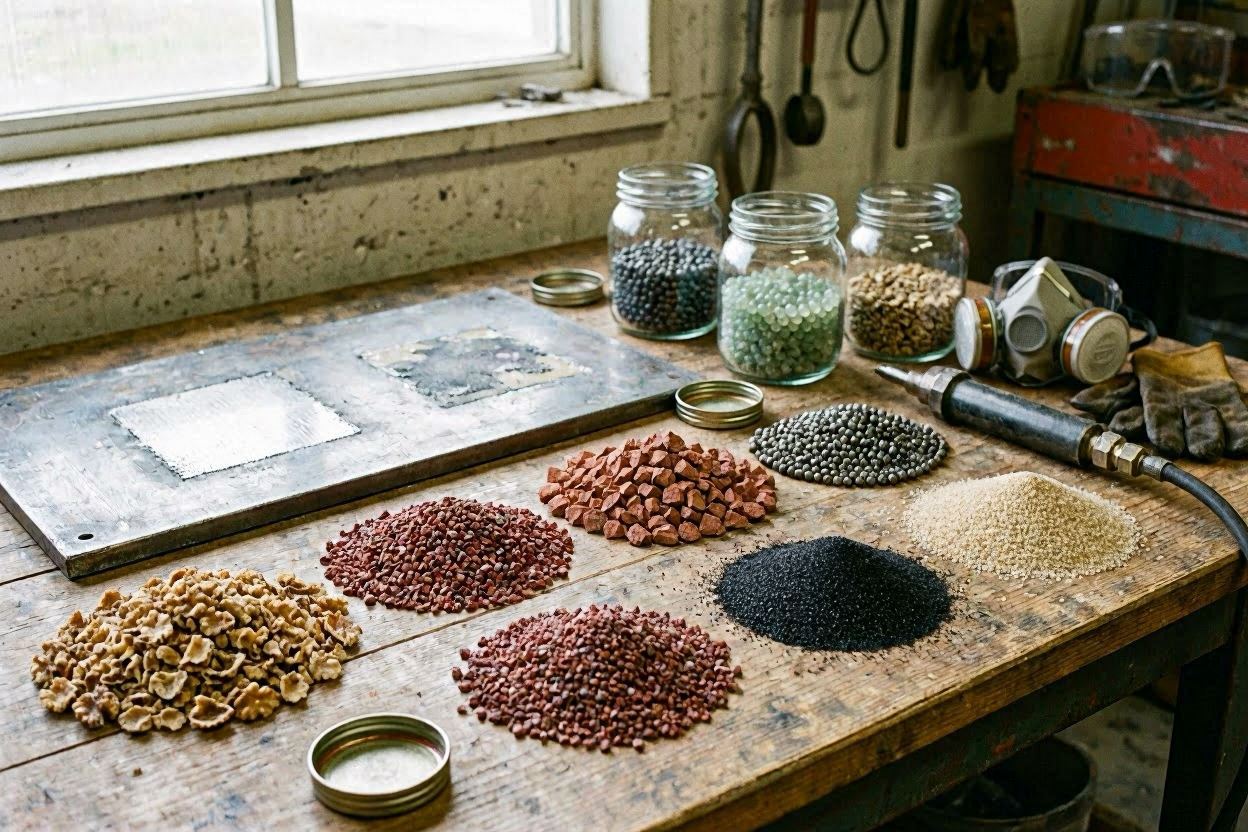
Medium grit (30–60 mesh) in garnet, coal slag, or aluminum oxide covers the bulk of professional blasting work. It removes adherent rust and mill scale from structural steel efficiently, produces a consistent anchor profile for epoxy and polyurethane systems, and is aggressive enough to strip multiple layers of paint from properly supported surfaces without the substrate damage risk of coarse grades.
For rust removal projects specifically, medium garnet (30/60 mesh) at 90 PSI achieves SSPC-SP 6 or SP 10 cleanliness on most carbon steel in a single controlled pass. For a detailed breakdown of media selection for rust removal, see: Best Blasting Sand for Rust Removal.
Fine Grit (80–120 Grit)
Fine — 80 to 120 Grit | Profile: 0.5–1.5 mil
Light cleaning, deburring, and finishing work. Appropriate for aluminium, stainless steel, thin sheet metal, and any substrate where a coarse anchor pattern would be damaging or undesirable. Removes light surface oxidation, machining marks, and thin paint films without aggressive profiling. The standard range for glass beads in finishing and peening applications.
Fine grit is the professional choice for automotive restoration work on body panels, where the goal is to remove surface rust and old paint without warping the metal or creating peaks that bleed through thin primer coats. Fine garnet (60/80 or 80/100 mesh) at reduced pressure (60–80 PSI) achieves this reliably on 18–22 gauge steel panels.
Glass beads in the 80–120 size range produce a fine, bright, peened finish on stainless steel and aluminium — not a profiled anchor pattern, but a smooth, attractive matte surface that requires no further treatment in decorative applications. For finishing work in a blast cabinet, 80–120 glass beads are the standard specification.
Extra Fine Grit (150–220 Grit)
Extra Fine — 150 to 220 Grit | Profile: Near-zero
Polishing, surface cleaning without profiling, glass frosting, and precision part deburring. Produces virtually no anchor pattern — not suitable before painting or coating. Used in precision cabinet blasters for detailed work on small components, optical surfaces, and decorative glass. Also appropriate for removing thin surface contamination from precision machined parts without dimensional change.
Extra fine media is a specialist tool. For any surface that will receive a coating, extra fine grit is counterproductive — it cleans but does not prepare. Its value lies in applications where the blasted surface is the finished surface, or where the part must meet tight dimensional tolerances that coarser media would violate.
Grit Selection by Application
| Application | Recommended Media | Recommended Grit | Target Profile |
|---|---|---|---|
| Structural steel (heavy coating) | Garnet or steel grit | 12/20 or 20/40 mesh (coarse) | 2.5–4 mil |
| Steel pipe / marine coating prep | 石榴石 | 30/60 mesh (medium) | 1.5–3 mil |
| Rust removal — general steel | Garnet or coal slag | 30/60 mesh (medium) | 1.5–2.5 mil |
| Automotive body panels | Glass beads or fine garnet | 60/80–80/100 mesh (fine) | 0.5–1 mil |
| Aluminium cleaning / finishing | 玻璃珠 | 80–120 mesh (fine) | 0.5–1 mil |
| Cabinet blasting — general | 氧化铝 | 80–120 grit (fine) | 0.5–1.5 mil |
| Concrete surface prep | Silica sand or coal slag | 20–40 mesh (medium/coarse) | 2–3 mil |
| Glass etching / frosting | 氧化铝 | 150–220 grit (extra fine) | Near-zero |
| Shot peening (aerospace / auto) | Glass beads or steel shot | Per SAE J443 intensity spec | Intensity-controlled |
How Blast Pressure Affects Profile Depth
Grit size sets the potential surface profile — blast pressure controls how much of that potential is realized. For a given grit size, increasing blast pressure increases both cutting speed and profile depth. Decreasing pressure reduces profile depth and gives finer control over the surface finish — useful when working with fine media on thin metals.
As a practical guide: at 90 PSI, medium garnet (30/60 mesh) produces approximately 1.5–2 mil profile on clean carbon steel. Raising pressure to 120 PSI with the same media increases the profile to approximately 2–2.5 mil. Dropping to 60 PSI produces approximately 1–1.5 mil. This pressure range gives operators meaningful control over the final profile without changing media.
For automotive work where warping is a risk, reduce both grit size and pressure simultaneously. Fine garnet (80/100 mesh) at 60–70 PSI is a common specification for blasting door skins and bonnets without distortion. For more detail, see: Blasting Sand for Automotive Restoration.
Common Grit Size Mistakes
Using coarse grit on thin metal. The most damaging error. Coarse garnet or coal slag on sheet metal causes warping, deep pitting, and dimensional change that cannot be corrected. Always use fine grit (80+ mesh) on panels under 3/16 inch thickness.
Using fine grit for heavy rust removal. Fine media on heavily corroded or scaled steel is extremely slow and often unable to achieve the required surface cleanliness. Operators frequently apply more pressure to compensate, which can cause rebound damage or equipment wear. Use medium or coarse grit for rust removal — then switch to fine for finish work if needed.
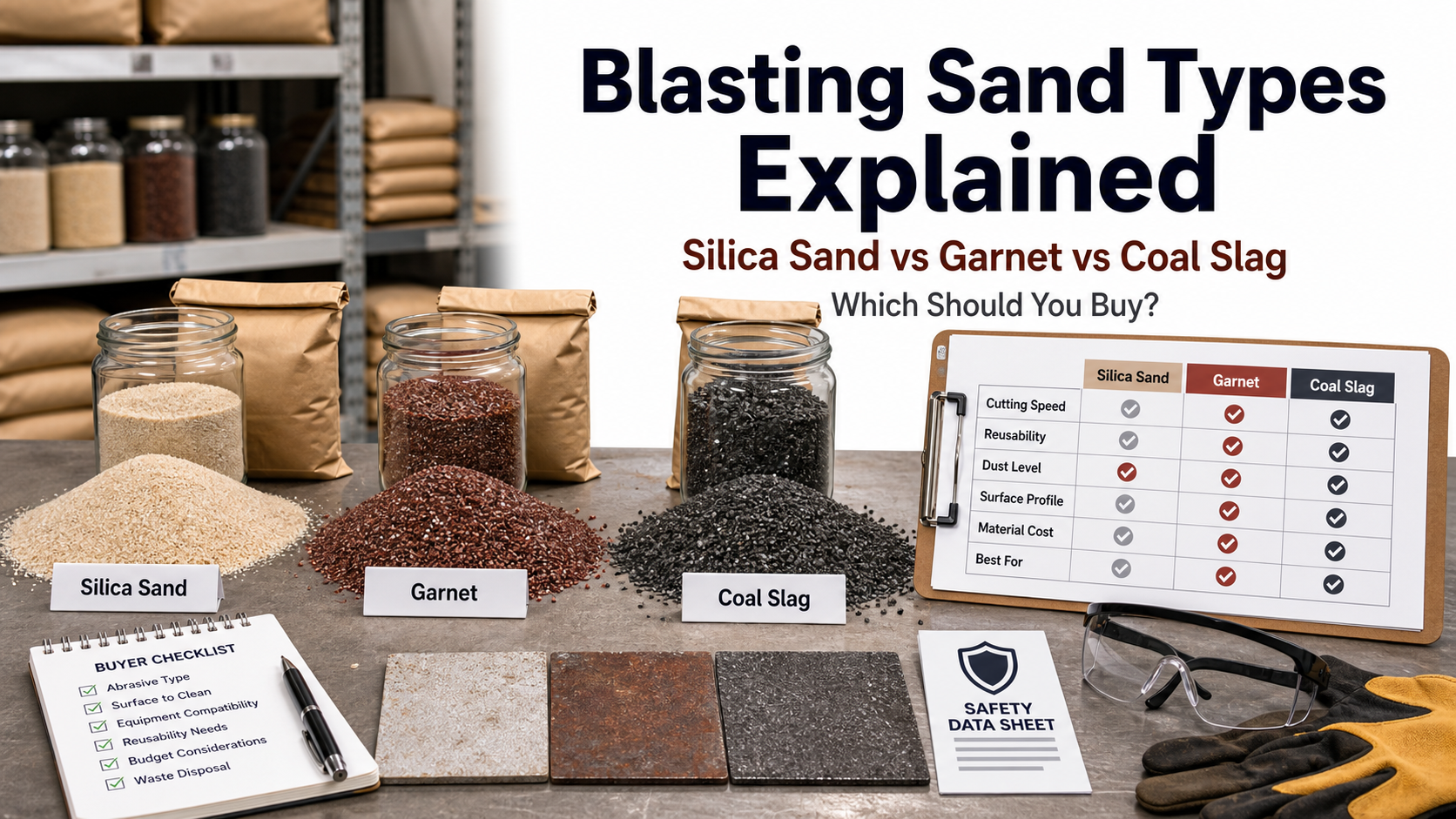
Selecting grit size by product name rather than mesh number. “Medium” from one supplier may be 30/60 mesh; from another it may be 20/40. Always verify the actual mesh range on the product specification sheet before purchasing. Our media types guide covers what to look for: Blasting Sand Types Explained.
Ignoring the coating specification. If your coating system specifies a 2–3 mil anchor profile and you use fine grit producing 1 mil, the coating will underperform regardless of how well the rest of the preparation is done. The coating data sheet is your primary technical reference for grit selection.
Frequently Asked Questions
Bottom Line
Grit size selection starts with the end requirement — the surface profile specified by your coating system or determined by your finish objective. Work backward from that target to the mesh range that achieves it with your media type and equipment. When in doubt, start with medium grit (30–60 mesh) on steel — it covers the majority of professional blasting applications and gives you a reliable baseline to adjust from.
For the full landscape of media type options and purchasing channels, see the complete buyer’s guide: Where to Buy Blasting Sand: The Complete Buyer’s Guide.
过滤器