Reusable vs Single-Use Blast Media: Cost-Per-Cycle Analysis
The most common budgeting error in abrasive blasting procurement is comparing media options purely on their list price per metric ton. A ton of coal slag at $120 looks far more attractive than a ton of steel grit at $550 — until you account for the fact that steel grit recycles 500–1,500 times while coal slag is discarded after a single pass. Across the full lifecycle of a blast room or a large-scale project, the economics can flip dramatically.
This guide provides a rigorous, numbers-based framework for calculating the true cost per square meter of surface prepared — the only metric that allows valid comparison between reusable and single-use abrasive media. It is part of the complete Sandblasting Media Suppliers: Industrial Buyer’s Complete Guide by Jiangsu Henglihong Technology Co., Ltd.
1. Why Unit Price Misleads Buyers
Unit price comparisons fail because they ignore three critical cost drivers that vary widely between media types:
- Consumption rate: How many kilograms of media are consumed per square meter of surface prepared? A recyclable media may consume only 0.5–3 kg/m² over its working life; a single-use media consumes 100–300 kg/m².
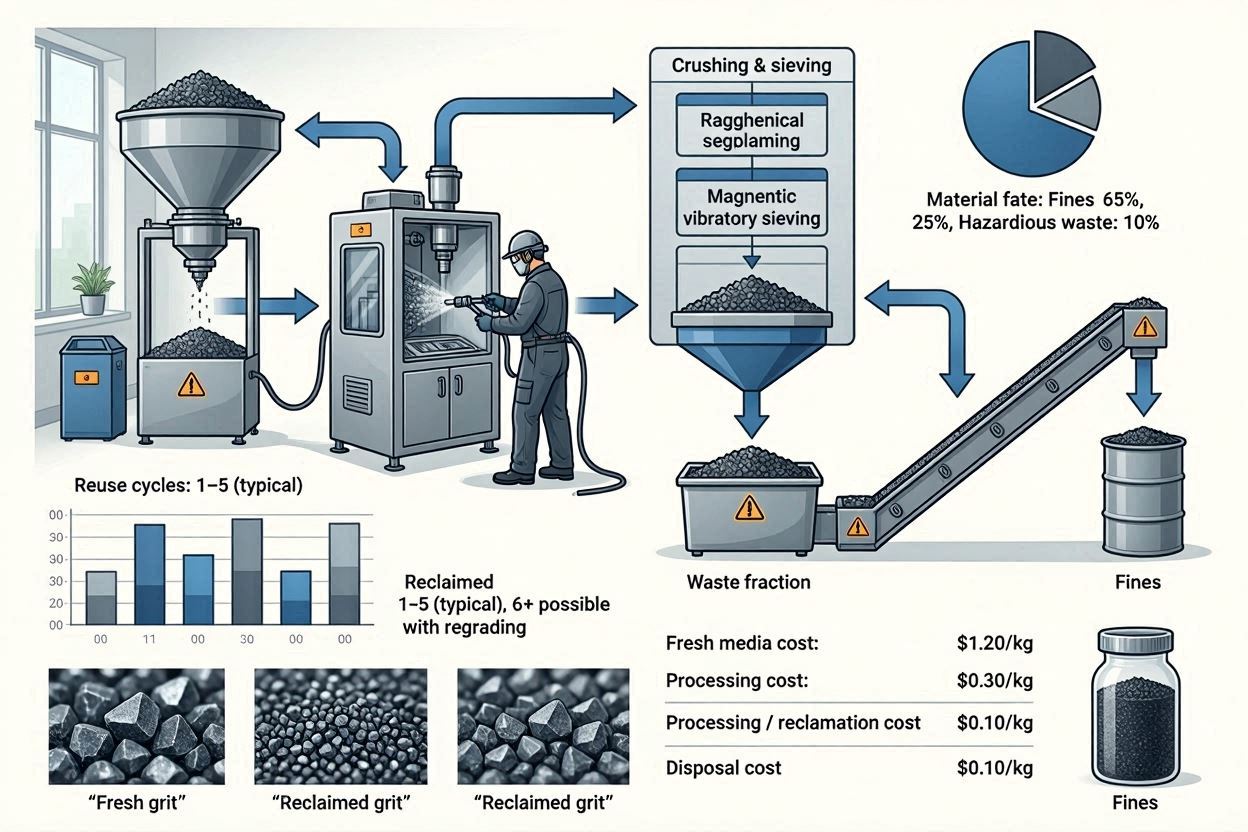
- Recyclability: How many times can the working mix be reused before it must be replaced? Steel grit: 500–2,000 cycles. Coal slag: 1 cycle.
- Disposal cost: What does it cost to dispose of spent abrasive? Non-hazardous metal grit costs $40–$80/MT to dispose. Coal slag from certain sources, or spent abrasive from lead-paint projects, can cost $150–$400/MT as hazardous waste.
2. The True Cost Model
True cost per m² is calculated as follows:
True Cost Formula
Media cost per m² = (Unit price per MT × Consumption rate per m²) ÷ Recycle cycles
Disposal cost per m² = (Disposal cost per MT × Consumption rate per m²) ÷ Recycle cycles
True cost per m² = Media cost per m² + Disposal cost per m² + (PPE / dust control overhead per m²)
For blast room operations, “consumption rate” refers to the total media consumed as fines and losses per unit area over the working life of the media charge. For once-through field operations, it is simply the total media used per unit area blasted.
3. Reusable Media: Recyclability & Consumption Data
| 媒体类型 | Grade | Unit Price (FOB, USD/MT) | Recycle Cycles | Loss Rate / Cycle (%) | Effective kg / m² consumed |
|---|---|---|---|---|---|
| Steel grit | G25, Medium HRC | $480–$580 | 500–1,500 | 0.05–0.2% | 0.3–1.5 kg/m² |
| Steel grit | G25, High HRC | $520–$640 | 300–800 | 0.1–0.3% | 0.5–2.0 kg/m² |
| Steel shot | S230, Standard | $440–$540 | 1,000–3,000 | 0.03–0.1% | 0.15–0.8 kg/m² |
| Aluminum oxide (BFA) | #36 | $580–$750 | 50–150 | 0.5–2.0% | 4–12 kg/m² |
| Aluminum oxide (WFA) | #60 | $900–$1,250 | 30–100 | 0.8–3.0% | 6–18 kg/m² |
| 石榴石 | 30/60 mesh | $180–$280 | 3–6 | 15–30% | 25–60 kg/m² |
| 玻璃珠 | Grade 6–7 | $400–$650 | 20–60 | 1.5–5% | 8–20 kg/m² |
4. Single-Use Media: Performance Data
| 媒体类型 | Grade | Unit Price (USD/MT) | Consumption Rate (kg/m²) | Disposal Cost (USD/MT) |
|---|---|---|---|---|
| Coal slag | Medium | $80–$150 | 150–300 kg/m² | $80–$300 (variable hazard) |
| Copper slag | Medium | $100–$180 | 120–250 kg/m² | $60–$150 |
| Crushed glass | 20/40 | $120–$250 | 100–200 kg/m² | $50–$120 |
5. Worked Example: 10,000 m² Structural Steel Blast Project
Scenario: Sa 2.5 preparation of 10,000 m² of structural steel in an enclosed blast room, targeting 50–80 µm anchor profile for standard epoxy primer. Comparing steel grit G25 (medium HRC) against coal slag (medium grade).
Steel Grit G25 (Medium HRC) — Blast Room with Recovery
- Initial media charge: 5,000 kg (5 MT) at $530/MT = $2,650
- Media consumed over project (0.8 kg/m² × 10,000 m²): 8,000 kg = 8 MT at $530/MT = $4,240 (makeup media)
- Disposal of spent fines (8 MT at $60/MT): $480
- Dust collection filter changes (low frequency): $400
- Total media cost: $7,770 → $0.78/m²
Coal Slag — Open-Air or Once-Through Blast
- Media required (200 kg/m² × 10,000 m²): 2,000 MT at $115/MT = $230,000
- Disposal of spent abrasive (2,000 MT at $150/MT, non-hazardous assumption): $300,000
- Enhanced dust suppression / filter costs: $8,000
- Total media cost: $538,000 → $53.80/m²
Result: 69× Cost Difference
Steel grit in an enclosed blast room costs $0.78/m² vs. $53.80/m² for coal slag in an open-air, once-through setup — a 69× difference. Even if the coal slag scenario uses a contained blast room, the economics still heavily favor recyclable steel grit for any project above a few hundred square meters.
Note: Open-air coal slag blasting also has higher labor costs (workers spend more time managing abrasive supply logistics) and generates far more waste volume, adding indirect cost. The comparison above uses conservative disposal cost estimates; in states with stricter hazardous waste classification for coal slag, disposal costs can be 2–3× higher.
6. Break-Even Analysis: When Does Switching Media Pay Off?
The question many blast room operators ask is: at what production volume does investing in a recyclable media (and potentially a media recovery system) pay off versus continuing with single-use slag?
| Annual Blast Volume (m²) | Annual Cost — Coal Slag | Annual Cost — Steel Grit (Blast Room) | Steel Grit Saves |
|---|---|---|---|
| 500 m² | ~$26,900 | ~$390 | $26,510 |
| 2,000 m² | ~$107,600 | ~$1,560 | $106,040 |
| 10,000 m² | ~$538,000 | ~$7,770 | $530,230 |
| 50,000 m² | ~$2,690,000 | ~$38,850 | $2,651,150 |
For any operation blasting more than 500 m²/year in an enclosed facility, the switch from single-use to recyclable media is economically compelling. The capital cost of a blast room with a media recovery and classifier system (typically $50,000–$300,000 depending on capacity) pays back within months at moderate production volumes.
7. Hidden Cost Factors That Affect the Analysis
Separator / Classifier Efficiency
The recyclability of steel grit depends heavily on how effectively the blast room’s separator removes fines, broken particles, and dust from the working mix between cycles. A poorly maintained separator allows degraded media to contaminate the working mix, reducing blast efficiency and increasing consumption rate — sometimes by 3–5×. Regular classifier calibration and screen maintenance is essential to realizing the theoretical recyclability of steel grit.
Blast Pressure and Nozzle Condition
Excessive blast pressure (beyond the media manufacturer’s recommendation) accelerates media breakdown and increases fines generation per cycle. Worn nozzles also distort the blast pattern, wasting media. Both factors reduce effective recyclability significantly.
Substrate Contamination Level
Heavily contaminated substrates (thick rust, old lead paint, heavy mill scale) consume more media per m² than clean or lightly contaminated steel. Always use the contamination level in your consumption rate estimates, not ideal-case figures.
Storage and Moisture
Steel grit stored in humid conditions will surface-rust, which does not affect blasting performance but can introduce superficial rust staining on freshly blasted surfaces before coating. Store media in covered, dry conditions. For steel shot used in precision peening applications, moisture-free storage is mandatory.
8. Frequently Asked Questions
Get a Media Cost Analysis for Your Operation
Share your blast volume, substrate type, and current media with the team at Jiangsu Henglihong Technology Co., Ltd. We will provide a detailed cost comparison and recommendation.
Request a Cost Analysis →过滤器