Glass Beads & Crushed Glass Blasting Media: Supplier Guide & Mesh Chart
Glass-based abrasives occupy a distinct niche in the blasting media market: they deliver surface treatment without aggressive material removal, and they do so with no heavy metals, no significant free silica, and — in the case of crushed glass — using 100% post-consumer recycled material. For industrial buyers evaluating glass bead and crushed glass blasting media suppliers, the key decision is choosing between these two very different products that share only their base material.
This page is part of the complete Sandblasting Media Suppliers Buyer’s Guide by Jiangsu Henglihong Technology Co., Ltd., covering all major abrasive media families.
1. Glass Beads vs. Crushed Glass: The Core Distinction
玻璃珠
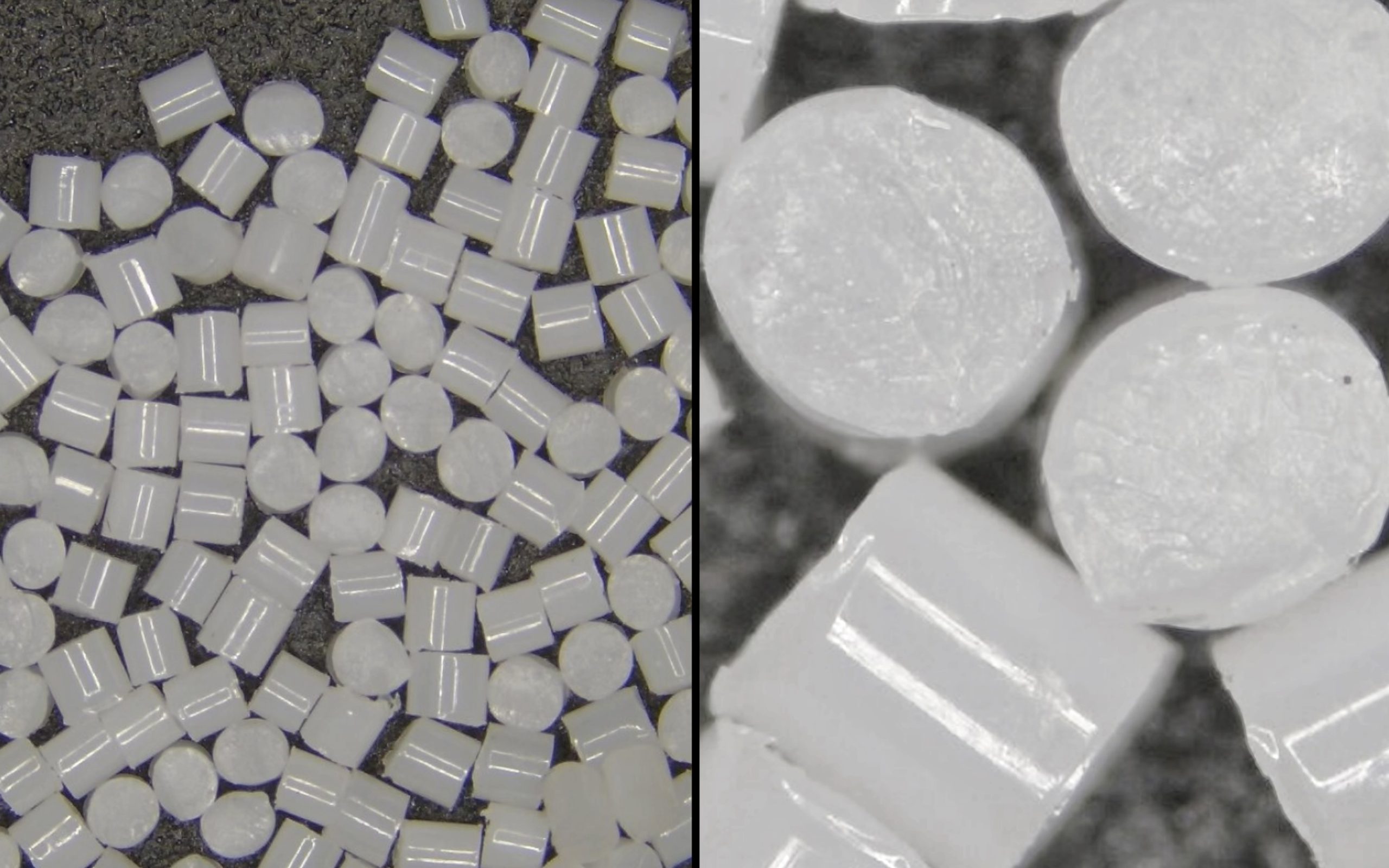
- Shape: perfectly spherical
- Action: peening (compressive, non-cutting)
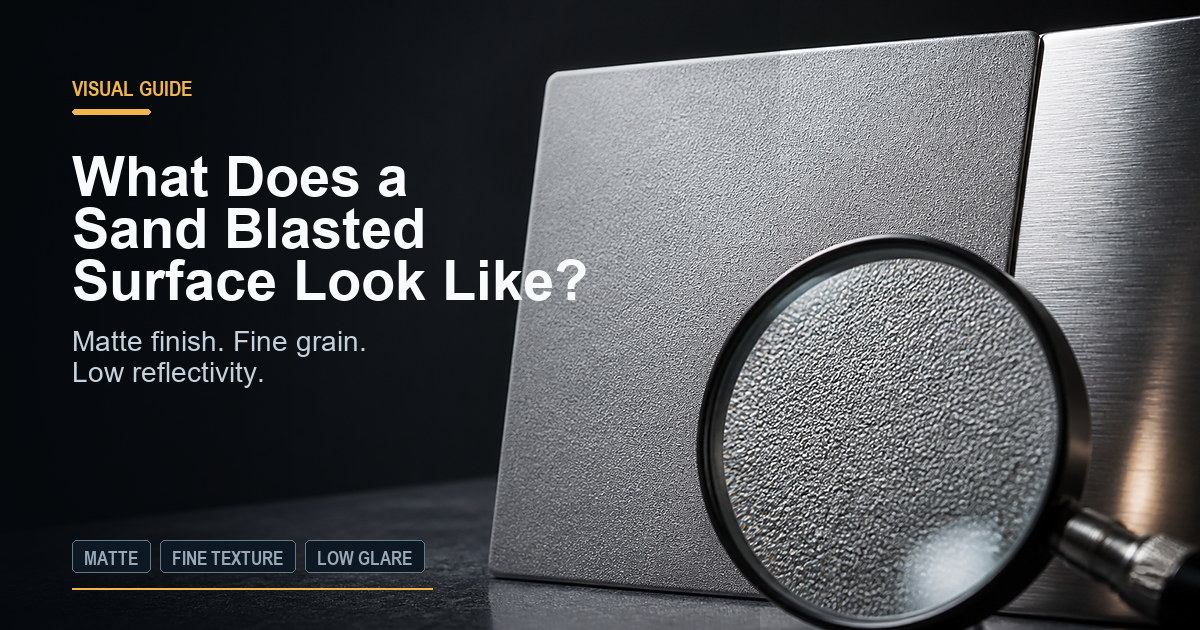
- Surface result: smooth, bright satin finish
- Profile depth: very shallow (2–15 µm)
- Made from: virgin or recycled soda-lime glass, manufactured to precise diameter
- Recyclability: moderate (20–60 cycles in cabinet)
- Mohs hardness: 5.5–6.0
- Best for: decorative finishing, cleaning without dimension change, peening non-ferrous metals
Crushed Glass
- Shape: angular, irregular fragments
- Action: cutting (aggressive, profile-creating)
- Surface result: angular anchor profile
- Profile depth: 30–80 µm (mesh-dependent)
- Made from: 100% post-consumer recycled glass bottles
- Recyclability: low (1–3 cycles)
- Mohs hardness: 5.5–6.0
- Best for: rust removal, coating prep on steel and concrete, eco-conscious projects
2. Glass Beads: Properties & Specifications
Industrial glass beads for blast finishing are manufactured by melting soda-lime glass, forming spherical droplets through flame-rounding or prilling, and then screening to precise diameter ranges. Quality specifications are governed by MIL-G-9954A (military specification) and various ASTM standards. The spherical geometry is what defines the glass bead’s performance: when propelled at a surface, beads transfer kinetic energy as compressive stress rather than cutting force, plastically deforming the surface layer and producing a burnished, reflective finish.
Glass Bead Grades (MIL-G-9954A Equivalent)
| Grade | Diameter Range (µm) | Mesh Equivalent | Typical Application |
|---|---|---|---|
| Grade 2 | 1700–2360 | #8–#12 | Heavy peening, large parts |
| Grade 3 | 1180-1700 | #12–#16 | Foundry descaling, heavy cleaning |
| Grade 4 | 850-1180 | #16–#20 | General descaling, moderate peening |
| Grade 5 | 600-850 | #20–#30 | Automotive parts, tool finishing |
| Grade 6 | 425-600 | #30–#40 | Precision finishing, stainless steel |
| Grade 7 | 300-425 | #40–#50 | Fine decorative finishing |
| Grade 8 | 212-300 | #50–#70 | Ultra-fine satin finish |
| Grade 9 | 150-212 | #70–#100 | Optics, precision instruments |
| Grade 10 | 106-150 | #100–#140 | Extreme fine finishing |
| Grade 13 | 53–106 | #140–#270 | Micro-finishing, thin-film applications |
Key quality parameters to request from glass bead suppliers: sphericity (≥80% round per MIL-G-9954A), free silica content (<1%), absence of lead or heavy metals, moisture content (<0.5%), and breakage rate in service (typically 5–15% per cycle in a properly maintained cabinet).
3. Crushed Glass: Properties & Specifications
Crushed glass abrasive is manufactured by collecting post-consumer glass (primarily beverage bottles), removing labels and contaminants, crushing, and screening to specific mesh ranges. The resulting product is angular, hard (Mohs 5.5–6), chemically inert, lead-free, and entirely free of heavy metals — a profile that makes it attractive both for performance and environmental reasons.
Despite its moderate hardness (lower than garnet or aluminum oxide), crushed glass is significantly harder than coal slag and produces cleaner, more consistent anchor profiles. Its angular morphology allows it to achieve Sa 2.5 on lightly to moderately corroded steel in outdoor blasting applications.
Crushed Glass Key Specifications
- Free silica content: <1% (the silica in glass is bound in an amorphous glass matrix, not crystalline — this is a critical distinction from crystalline silica sand)
- Lead content: Non-detect (post-consumer container glass is lead-free)
- Mohs hardness: 5.5–6.0
- Specific gravity: 2.4–2.5 g/cm³
- Chloride content: Very low (<10 ppm), critical for blasting before immersion service coatings
- Moisture: <0.5%
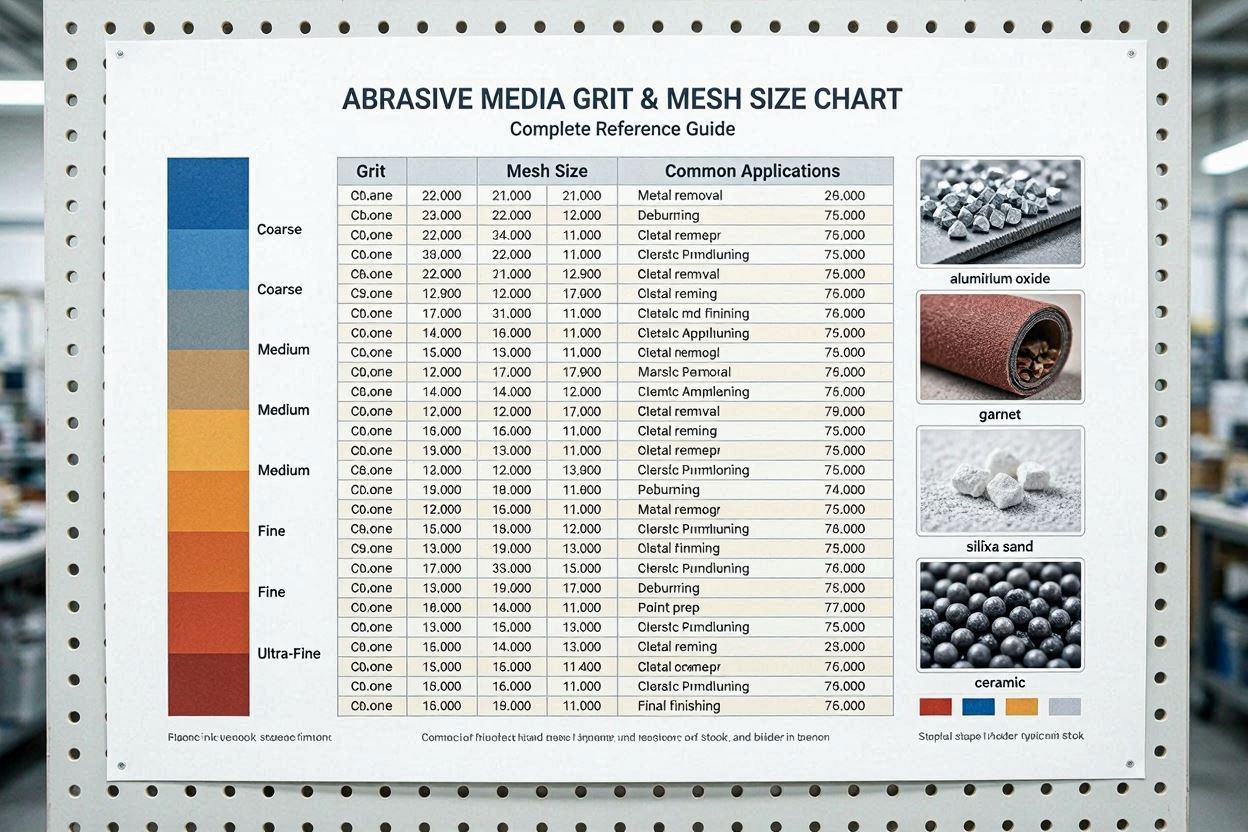
4. Crushed Glass Mesh Size Reference Chart
| Mesh Size | Particle Range (µm) | Typical Profile Depth | Application |
|---|---|---|---|
| 6/10 | 3360–2000 | 80–120 µm | Very aggressive profiling, thick coating removal |
| 10/20 | 2000–850 | 60–90 µm | Heavy rust removal, structural steel |
| 20/40 | 850–425 | 40–65 µm | Standard Sa 2.5 prep |
| 30/50 | 600–300 | 30–50 µm | General surface prep, concrete |
| 40/70 | 425–212 | 20–35 µm | Light cleaning, fine profiling |
| 70/140 | 212–106 | 8–20 µm | Fine finishing, thin-film prep |
5. Applications by Industry
Glass Bead Applications
- Stainless steel finishing: Producing a uniform satin or matte finish on architectural stainless, food processing equipment, and medical device components without iron contamination.
- Automotive restoration: Cleaning and brightening engine components, carburetors, aluminum wheels, and chrome trim without dimensional impact or surface damage.
- Shot peening of precision parts: Springs, gears, and turbine components where a smooth peened surface (rather than angular profile) is required.
- Trophy and decorative finishing: Producing consistent satin finishes on trophies, nameplates, and architectural metal hardware.
Crushed Glass Applications
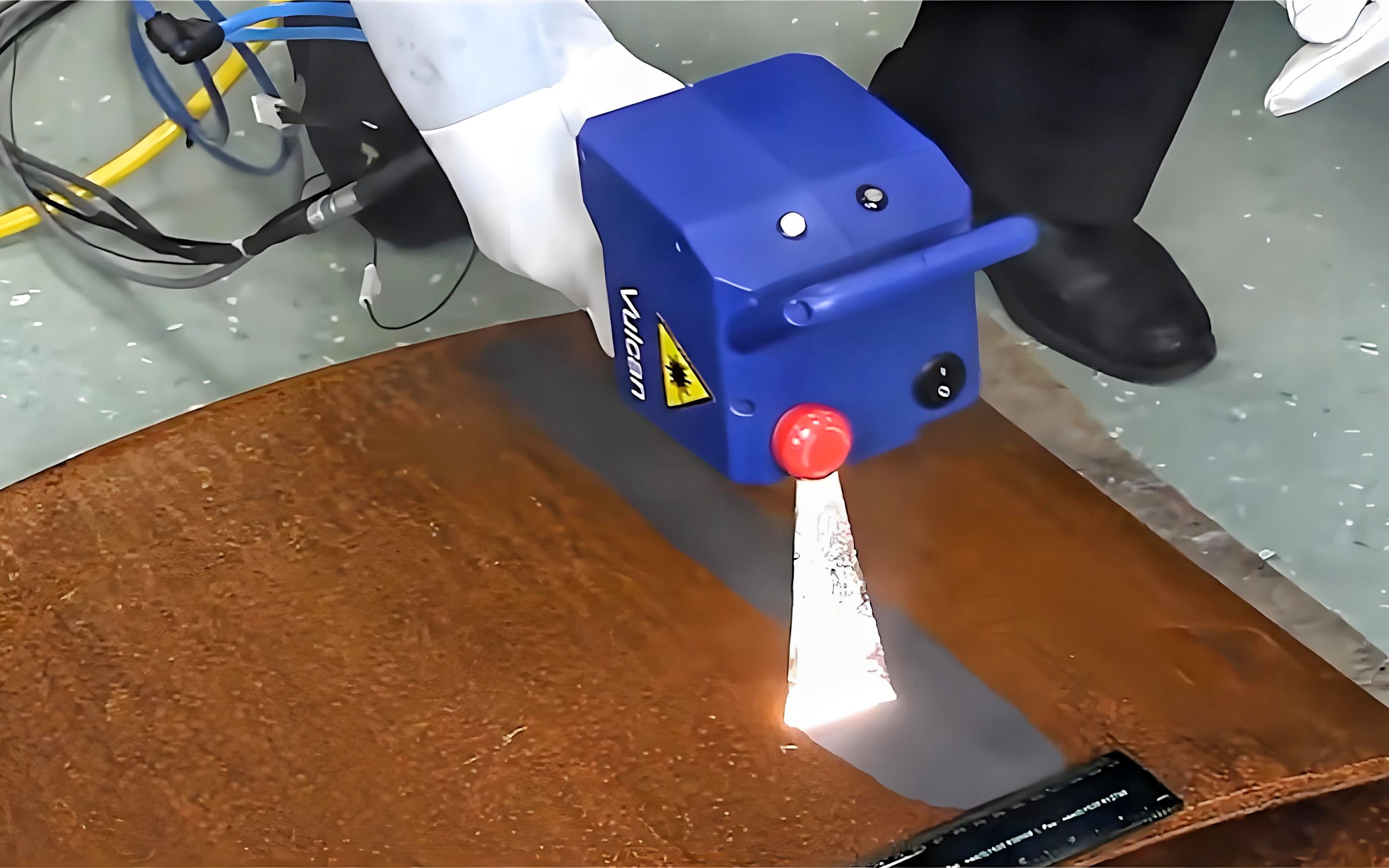
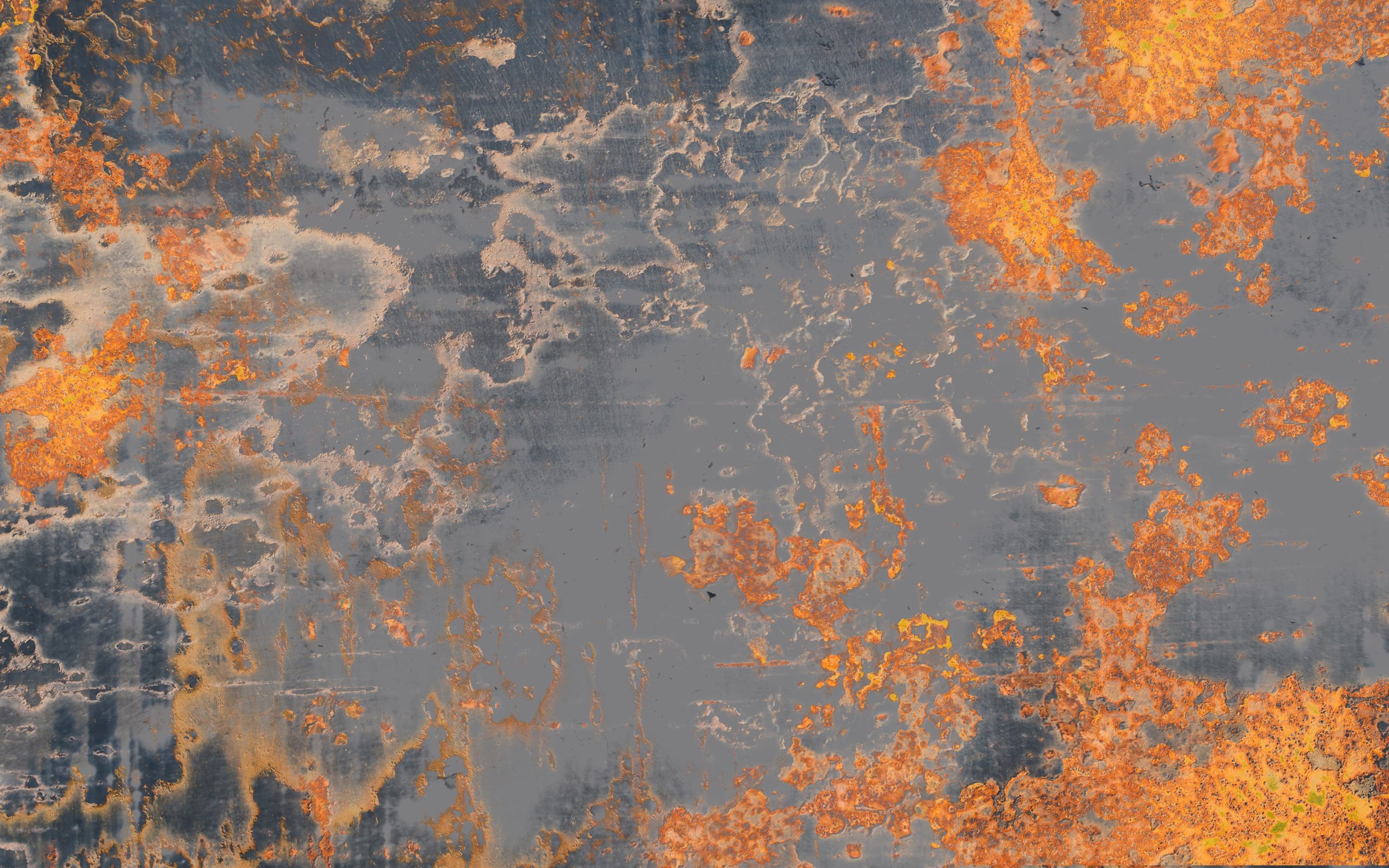
- Structural steel rust removal: Achieves Sa 2 to Sa 2.5 on light-to-moderate rust for field blasting applications.
- Concrete surface preparation: Profiling concrete floors and walls before epoxy or polyurethane coating application. For detailed guidance, see: Concrete & Masonry Blasting Media Guide.
- Environmentally sensitive projects: The 100% recycled material content and clean chemistry make crushed glass the preferred choice on projects with strict environmental compliance requirements.
- Lead paint removal: The clean, low-heavy-metal profile of crushed glass avoids adding contaminants to lead-laden spent abrasive, simplifying hazardous waste classification.
6. Environmental Credentials
Crushed glass carries stronger environmental credentials than virtually any other industrial abrasive:
- 100% recycled feedstock — diverts post-consumer glass from landfill
- No heavy metals — simplifies spent abrasive disposal
- Low dust relative to silica sand
- Lead-free, chromium-free — unlike some slags which may contain trace heavy metals
- LEED credit eligible — recycled content can contribute to LEED v4 Material & Resources credits on construction projects
7. Sourcing & Pricing (May 2026)
| 产品 | Grade / Mesh | Price Range (USD/MT) | Notes |
|---|---|---|---|
| 玻璃珠 | Grade 5–7 (general finishing) | $400–$650 | MIL-G-9954A equivalent |
| 玻璃珠 | Grade 9–13 (fine / precision) | $600–$950 | Tight diameter tolerance |
| Crushed glass | 20/40 (standard blast) | $80–$160 | Recycled; varies by regional supply |
| Crushed glass | 30/50 (fine blast) | $90–$180 | Recycled; lower availability |
For full guidance on evaluating overseas glass bead and crushed glass suppliers, including documentation to request, see: How to Evaluate a Sandblasting Media Supplier: 8 Quality Checkpoints.
8. Frequently Asked Questions
Inquire About Glass Bead & Crushed Glass Supply
Contact the team at Jiangsu Henglihong Technology Co., Ltd. with your required grade, quantity, and application details for a prompt quotation.
Contact Us →过滤器