How to Choose the Right Blasting Media: A Step-by-Step Selection Guide
A structured, four-step decision framework used by industrial surface preparation professionals to match blasting media to substrate, surface profile requirement, regulatory environment, and total cost target — every time.
1. Why Media Selection Matters More Than You Think
In most blasting operations, media selection is treated as a procurement decision rather than an engineering one — someone calls a supplier, asks for “aluminum oxide 80 grit” or “whatever we used last time,” and places the order. This approach works until it doesn’t: until a batch of stainless steel parts is contaminated with iron particles from the wrong abrasive, until thin aluminum panels warp under coarse grit at full pressure, until a coating fails adhesion testing because the anchor profile was 15 µm shallower than the primer specification required, or until the quarterly media budget is blown because single-use slag was specified for a recirculating cabinet system.
The correct blasting media specification is the foundation of every downstream quality outcome. Cleanliness grade, surface profile, coating adhesion, substrate integrity, worker safety compliance, and total operating cost per m² all depend directly on media selection. Working through the four-step framework below — in sequence — eliminates the most common and costly selection errors before they reach the production floor.
2. Step 1 — Identify Your Substrate Material and Sensitivity
The physical and chemical properties of the substrate set hard constraints on which media can be used. The primary rule is simple: never specify media that is significantly harder than the substrate when dimensional tolerance, surface geometry, or metallurgical integrity is critical. In practice this means working from the substrate outward to the media, not the other way around.
Determine substrate hardness and thickness
Thin-gauge sheet metal, composite panels, and precision-machined components have much narrower tolerance for abrasive aggression than heavy structural sections. A 3 mm aluminum hood panel and a 25 mm structural steel plate both call for “surface preparation” — but they require completely different media, grit sizes, and blast pressures.
Check for contamination sensitivity
Stainless steel, titanium, and nickel alloys cannot tolerate iron contamination from metallic or iron-bearing abrasives — embedded iron particles initiate corrosion that defeats the entire purpose of the surface treatment. These substrates require clean, iron-free mineral abrasives (white fused aluminum oxide or garnet) or glass bead. Verify that your supplier can certify free-iron content per your specification.
Check for composite or fiber-reinforced structures
Carbon fiber reinforced polymer (CFRP), fiberglass, and Kevlar composites must be blasted exclusively with plastic blast media. Any mineral or metallic abrasive — regardless of grit size — will sever reinforcing fibers, cause delamination, and create sub-surface damage invisible to visual inspection. This is non-negotiable in aerospace, marine, and automotive composite repair specifications. See our plastic blast media guide for full detail.
Substrate-to-Media Matching Matrix
Use the table below as your starting filter. Identify your substrate in the left column, then narrow from the primary media recommendations before applying Steps 2–4 to make the final selection. For a more detailed overview of each media type’s properties, see the complete types of blasting media guide.
| Substrate | Key Constraint | Primary Media | Alternative | Avoid |
|---|---|---|---|---|
| Carbon / structural steel | Heavy scale, rust, high-build coatings | Aluminum Oxide 36–80G Steel Grit GL25–40 | Garnet 30–80M | Glass Bead Plastique |
| Acier inoxydable | No iron contamination | White Al₂O₃ 80–120G Glass Bead #8–13 | Garnet 60–80M | Steel Grit/Shot Copper Slag |
| Aluminum (structural) | Moderate aggression, no iron | Al₂O₃ 100–150G Glass Bead #10–13 | Garnet 80M | Grain d'acier Coarse Slag |
| Aluminum (thin sheet / body panel) | Warp prevention; very low aggression | Plastic Media 16–40M Glass Bead #12–13 | Fine Al₂O₃ 180–220G | Any coarse angular media |
| CFRP / Fiberglass composite | No fiber damage; no substrate removal | Plastic Media (Urea/Acrylic) | Walnut Shell (light clean only) | All mineral & metallic abrasives |
| Titanium / Ni superalloy | No iron or metallic contamination | Virgin White Al₂O₃ 80–120G | Garnet (low-iron certified) | Grain d'acier Brown Al₂O₃ (high Fe₂O₃) |
| Glass / ceramics | Etching / surface texturing | Silicon Carbide 60–220G | Al₂O₃ (slower cut) Glass Bead (frosting) | Steel or metallic abrasives |
| Cast iron / foundry castings | Scale, sand, and burr removal | Steel Shot S230–S330 Steel Grit G25 | Al₂O₃ 36–54G | Glass Bead (insufficient) |
| Stone / masonry | Cleaning or texturing without damage | Garnet 30–80M Al₂O₃ 60–120G | Walnut Shell (monuments, delicate) | SiC on soft stone (over-aggression) |
3. Step 2 — Define the Required Surface Profile
Every industrial coating system — primer, topcoat, thermal spray, adhesive, or plating — specifies a minimum and maximum surface profile (anchor depth), typically expressed in µm Ra, Rz, or Ry, and measured with a Testex Press-O-Film tape or a contact profilometer per ISO 8503 or ASTM D4417. Getting outside the specified range in either direction causes problems: too shallow and the coating cannot achieve adequate mechanical adhesion; too deep and peaks protrude through the coating film, creating corrosion initiation sites.
Two media properties control profile depth: particle size (grit) et particle shape (angular vs. spherical).
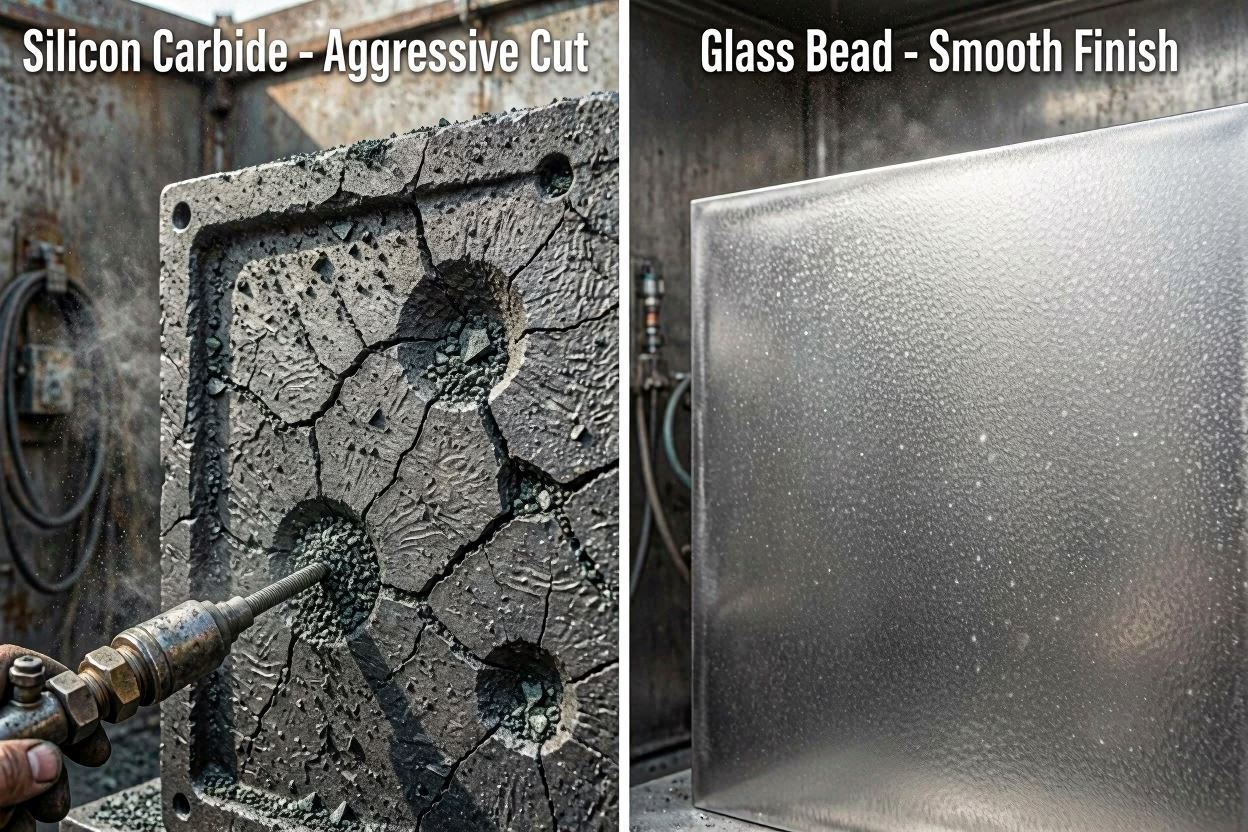
- Angular media (aluminum oxide, steel grit, garnet, silicon carbide, copper slag) — cut into the surface, producing sharp peaks and deep valleys. Higher Rz values, better mechanical key for heavy-build coatings.
- Spherical media (glass bead, steel shot) — peen the surface, producing rounded dimples. Lower Rz values, smoother finish. Preferred for peening applications, decorative finishes, and thin-film coatings.
- Coarser grit = deeper profile. Finer grit = shallower profile. This relationship is approximately linear within a media type at constant blast pressure and standoff distance.
4. Step 3 — Apply Environmental and Safety Constraints
Regulatory and environmental requirements are non-negotiable constraints that override purely technical or economic preferences. Three areas require attention in every blasting media specification.
Silica-Free Mandate
Crystalline silica sand is effectively banned from professional blasting operations in the EU, UK, USA (OSHA 29 CFR 1926.1153), Canada, Australia, and most industrialized countries due to the silicosis risk from respirable crystalline silica (RCS) dust. If your current specification still references silica sand, replace it immediately with aluminum oxide, garnet, glass bead, or steel abrasives. Our blasting media safety guide covers the full regulatory framework and PPE requirements.
Spent Media Classification
When media is used on surfaces coated with lead paint, chromate primers, or other hazardous coatings, the spent abrasive becomes a hazardous waste requiring licensed collection and disposal. Choosing a highly recyclable media (aluminum oxide, steel grit) minimizes the volume of spent material requiring disposal over a production run — a significant cost and compliance benefit. For environmentally sensitive sites or projects near waterways, garnet and aluminum oxide are the preferred specifications. See our eco-friendly blasting media guide for full detail.
Substrate Contamination Risk
Some media types introduce chemical contamination that creates downstream problems. Steel abrasives leave iron particles embedded in the surface of stainless steel and non-ferrous metals, triggering corrosion. Copper slag can introduce copper ions onto surfaces that will be electroplated or used in food contact applications. Always verify that your chosen media is chemically compatible with downstream processes — plating, anodizing, welding, bonding, or food contact use.
5. Step 4 — Calculate Total Cost Per m²
This is the step most buyers skip — and it is consistently where the largest cost savings are found. Media with a higher unit price per kilogram is frequently cheaper per m² of surface treated when recyclability is factored in. The formula is straightforward:
Cost per m² = (Price per kg ÷ Recycle cycles) × Consumption rate (kg/m²) + Disposal cost per kg × Waste generated per m²
Example A: Copper Slag (single-use)
Unit price: $0.12/kg
Recycle cycles: 1
Consumption: ~0.8 kg/m²
Disposal: $0.08/kg
Total cost/m²: ~$0.16 + $0.06 = $0.22
Example B: Aluminum Oxide (recirculating cabinet)
Unit price: $0.75/kg
Recycle cycles: 150
Consumption per cycle: ~0.005 kg/m²
Disposal: minimal
Total cost/m²: ~$0.004 — over 50× cheaper per m²
The numbers above are illustrative — actual consumption rates vary by media type, blast pressure, substrate condition, and nozzle size. But the principle is consistent: in any recirculating blast system, recyclable media will almost always outperform single-use alternatives on a cost-per-m² basis, often dramatically so. Request a full cost-per-m² analysis from your supplier before making any specification change. For detailed price benchmarks across all media types as of March 2026, see the Blasting Media Cost Guide & ROI Analysis.
6. Grit Size Selection Reference
Once media type is determined, grit size is the primary tuning parameter for surface profile depth. The table below covers the most common grit/mesh ranges for aluminum oxide and garnet — the two most widely used mineral abrasives for industrial surface preparation — with indicative profile ranges and typical applications. Always verify against your specific coating system’s PDS.
| Grit / Mesh | Approx. Particle Size | Profile Depth (Al₂O₃) | Typical Application |
|---|---|---|---|
| F16 / 16 Mesh | 1,180–1,400 µm | 100–130 µm | Very heavy mill scale, severe corrosion, thick epoxy removal |
| F24 / 24 Mesh | 710–1,000 µm | 80–110 µm | Heavy structural steel prep, high-build coating systems |
| F36 / 36 Mesh | 500–710 µm | 65–90 µm | General steel surface prep, pipeline coating, Sa 2.5 / SSPC-SP10 |
| F54 / 54 Mesh | 355–500 µm | 50–70 µm | Standard industrial prep, epoxy and zinc primer systems |
| F80 / 80 Mesh | 212–300 µm | 35–55 µm | Stainless steel, moderate coating prep, pre-electroplating |
| F120 / 120 Mesh | 106–150 µm | 20–35 µm | Fine surface conditioning, pre-anodizing, thin-film coatings |
| F180–F220 | 53–90 µm | 10–20 µm | Precision finishing, decorative metalwork, pre-PVD/CVD coating |
Profile ranges are indicative for brown fused aluminum oxide at 5–7 bar blast pressure, 150–200 mm standoff. Actual profiles will vary by equipment, nozzle wear, blast angle, and substrate condition.
7. Equipment Compatibility
Media selection cannot be made in isolation from the blasting equipment being used. Different equipment types have different media compatibility profiles — specifying incompatible media causes equipment damage, poor blast consistency, or significant dust generation that creates health exposure liabilities.
| Equipment Type | Al₂O₃ | Steel Grit/Shot | Grenat | Glass Bead | Supports en plastique | Notes |
|---|---|---|---|---|---|---|
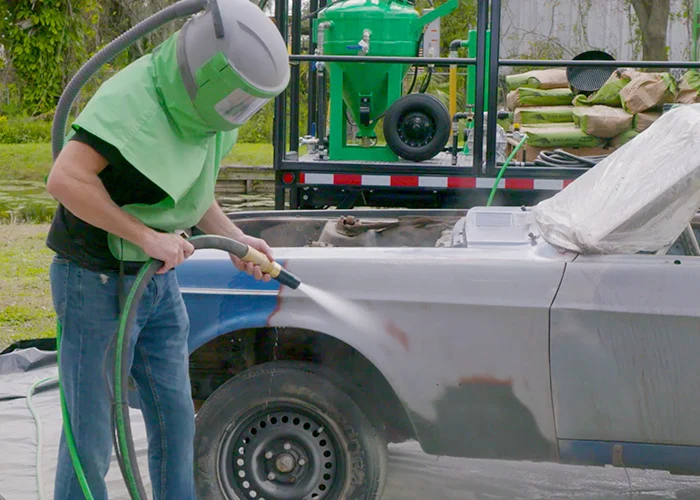
| Pressure blast pot (open air) | ✓ | ✓ | ✓ | △ | △ | Glass bead and plastic require moisture-free air and careful pressure control to avoid excessive fracture |
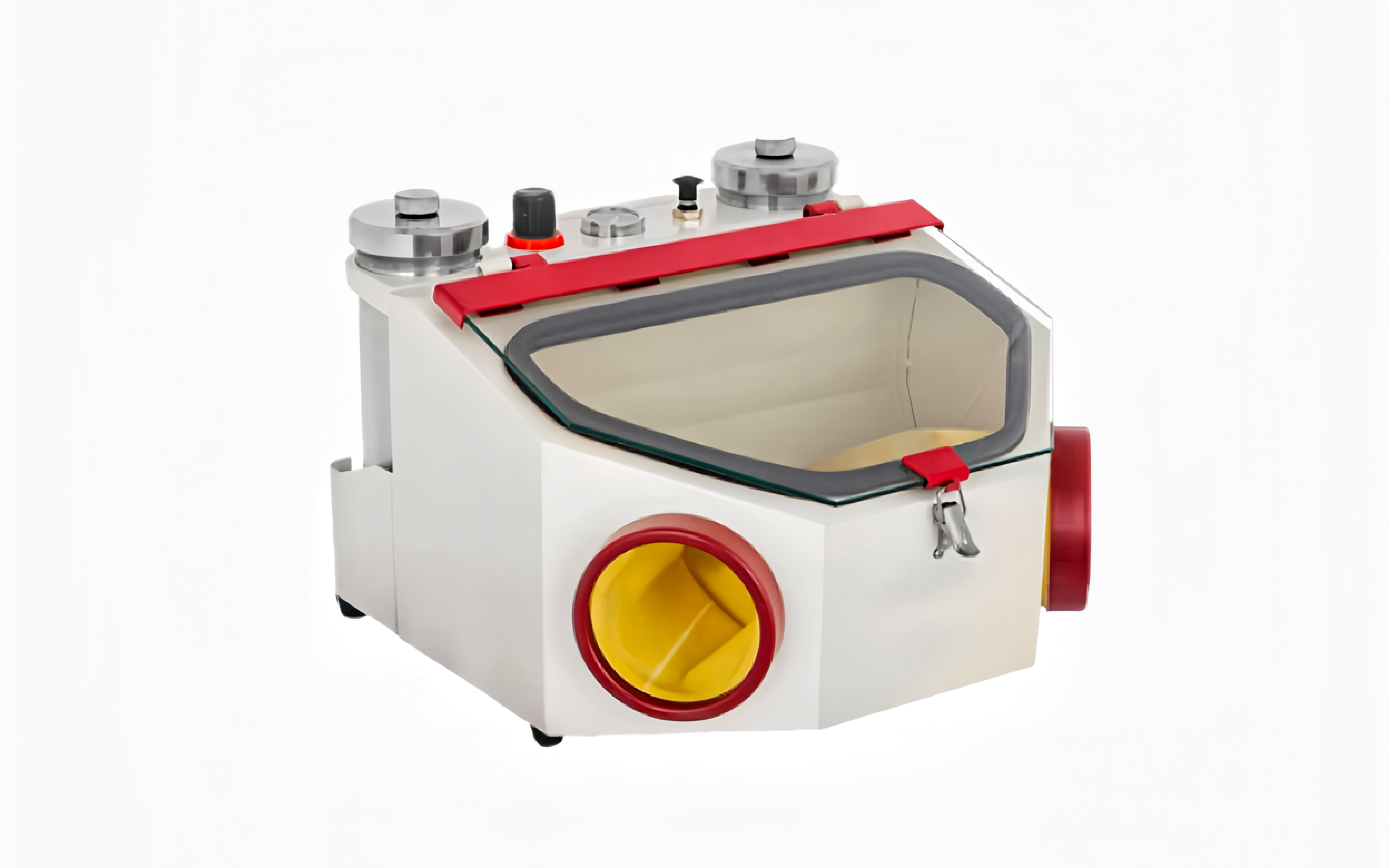
| Recirculating blast cabinet | ✓ | ✓ | △ | ✓ | ✓ | Garnet’s lower recycle life makes it less economical in cabinets; classifier must be tuned to media density |
| Centrifugal wheel blast room | ✗ | ✓ | ✗ | ✗ | ✗ | Wheel blast equipment is designed exclusively for metallic abrasives; mineral media causes rapid wheel wear |
| Wet / dustless blasting system | ✓ | ✗ | ✓ | ✓ | △ | Steel abrasives rust rapidly in wet systems; plastic media may absorb water and lose cutting efficiency |
| Suction (siphon) blast gun | ✓ | △ | ✓ | ✓ | ✓ | Heavy metallic abrasives have limited suction lift; use pressure pot for steel grit above G25 |
✓ Fully compatible · △ Compatible with caveats · ✗ Not compatible
8. Pre-Order Decision Checklist
Before finalizing any blasting media purchase order, work through the following checklist. Each item represents a common failure point that generates rework, compliance liability, or budget overrun when overlooked.
Blasting Media Selection Checklist
-
□Substrate identified — material, thickness, and any contamination sensitivity documented
-
□Surface profile requirement confirmed — minimum and maximum profile depth (µm) obtained from coating manufacturer’s PDS
-
□Cleanliness grade specified — ISO 8501 Sa grade or SSPC-SP grade defined for the application
-
□Silica-free confirmed — selected media verified as containing <1% free crystalline silica by certified analysis
-
□Iron contamination risk assessed — stainless, titanium, or non-ferrous substrates require iron-free media certification
-
□Equipment compatibility verified — media type and density confirmed compatible with blast pot, cabinet, or wheel blast system
-
□Cost per m² calculated — full lifecycle cost including recycle cycles and disposal compared across shortlisted media options
-
□Supplier quality documentation requested — material test report (MTR), SDS/MSDS, and sieve analysis certificate on file for each shipment
-
□Spent media disposal plan in place — waste classification and licensed disposal route confirmed before blasting commences
-
□PPE and engineering controls confirmed — supplied-air respirator, blast suit, hearing protection, and ventilation in place per OSHA / EU requirements
9. Frequently Asked Questions
Further Reading
This guide forms part of the complete blasting media resource library from Jiangsu Henglihong Technology. Explore these related articles to go deeper on specific areas:
- Blasting Media: Complete Industry Guide — the pillar page covering all topics in one place
- Types of Blasting Media: Complete Guide — full technical data on every major media type
- Blasting Media Comparison Chart — side-by-side visual reference across all key parameters
- Blasting Media Cost Guide & ROI Analysis — price benchmarks and cost-per-m² calculations
- Blasting Media Safety Guide — OSHA/EU compliance, silica risk management, PPE selection
- Aluminum Oxide Blast Media: Uses & Grit Guide
- Garnet Blasting Media — Eco-Friendly & High Performance
- Glass Bead Blasting Media: Finish & Applications
- Steel Grit vs Steel Shot: Which Should You Use?
- Plastic Blast Media for Aerospace & Automotive
- Silicon Carbide Blast Media: Hardest Abrasive Explained
- Blasting Media for Automotive Restoration
- Industrial Surface Prep: Best Blasting Media for Metal
- Eco-Friendly Blasting Media: Low-Dust & Silica-Free Options
Ready to Specify the Right Abrasive?
Our technical team at Jiangsu Henglihong Technology can recommend the correct grade, grit size, and packaging for your substrate and application — with competitive pricing, full MTR documentation, and reliable export logistics to North America, Europe, and beyond.
Request a Technical ConsultationFiltres