Common Sand Blasted Surface Defects: Shadowing, Embedment, Flash Rust
Six defects account for nearly all sand blasted surface rejections: shadowing, embedment, flash rust, over-blasting, profile too low, and profile too high. This guide presents each defect with visual signature, root cause, and field-ready remediation steps.
Why Defect Recognition Matters
Coating warranties depend on substrate condition. A defect missed at the blasting stage becomes a coating failure within months — and the cost of recoating dwarfs the cost of catching the defect at acceptance. Every QC inspector, sourcing manager, and coating contractor should be able to identify the common defects at a glance.
This guide covers the six defects responsible for nearly all sandblasting rejections. For the broader specification context, see the pillar guide on sand blasted surface.
Defect 1: Shadowing
Visual signature
Dark patches against an otherwise uniform pale gray field. May appear as scattered spots, larger irregular zones, or systematic patterns aligned with weld lines, mill scale layers, or operator overlap boundaries. Most visible under raking (low-angle) light.
Root cause
Insufficient blast cleanliness. The dark patches are residual mill scale, rust, paint, or other contaminants that were not fully removed. Common contributing factors: blast pressure too low, traverse speed too high, worn media, or operator skipping difficult areas.
Remediation
Re-blast the affected areas with appropriate parameters. If shadowing covers more than 20% of the workpiece, re-blast the entire surface. If shadowing is a recurring problem, adjust the process: increase pressure, slow operator traverse, refresh media, retrain operator.
Defect 2: Embedment
Visual signature
Discrete dark or metallic particles visible in profile valleys, particularly under magnification. On stainless steel, embedded ferrous media causes a “rust freckle” pattern that develops within weeks of humidity exposure.
Root cause
Wrong media for the substrate (e.g., steel grit on stainless), worn or fractured media producing fine fragments, or excessive blast pressure forcing media into the substrate. Embedment is more severe with 90° impact angle than with the standard 75° angle.
Remediation
Light re-blasting with appropriate media to remove embedded particles. For stainless steel, follow with passivation per ASTM A967 — see our stainless guide. If embedment is widespread, the workpiece may require chemical pickling to remove all ferrous traces.
Defect 3: Flash Rust
Visual signature
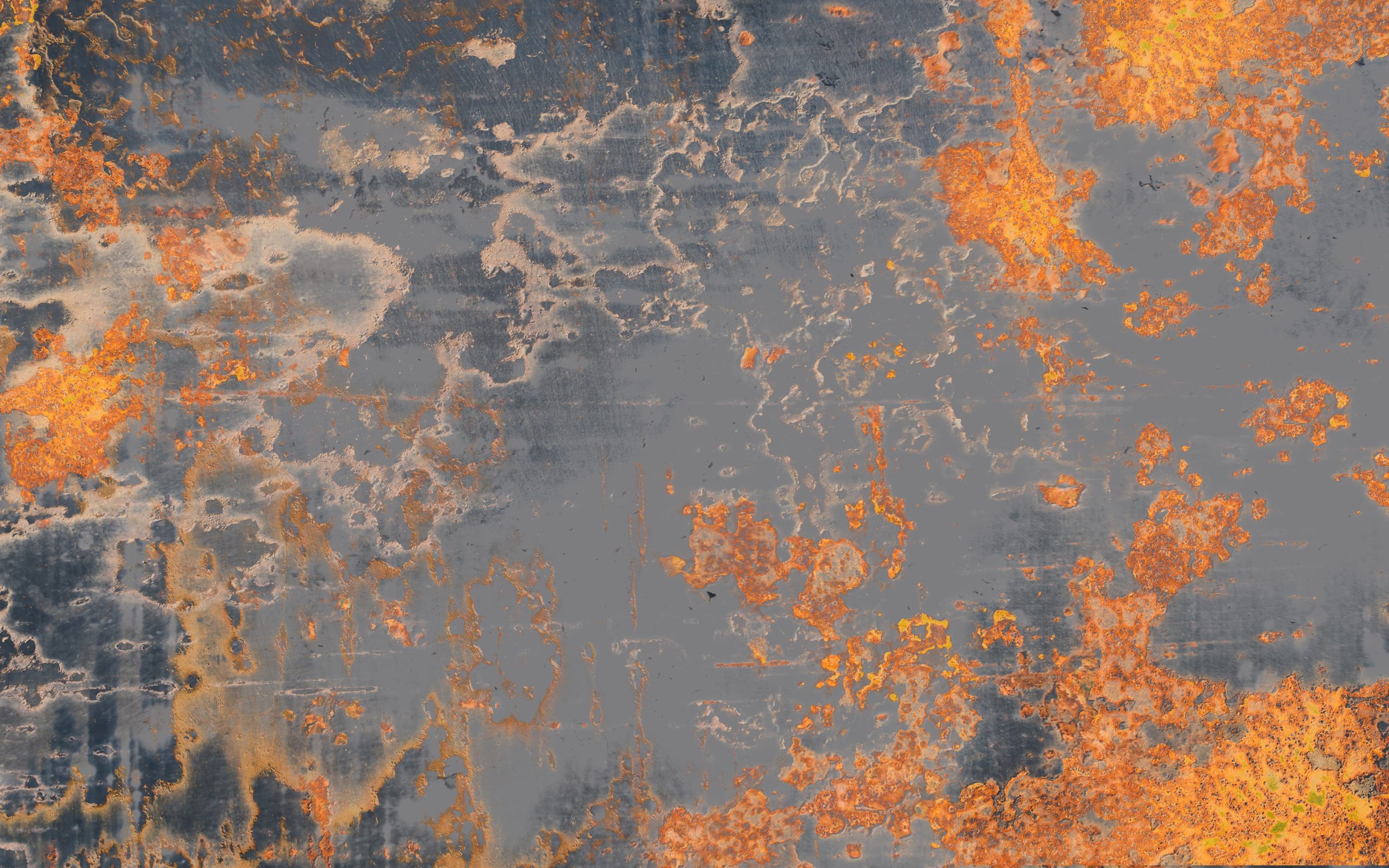
Light orange-to-brown bloom developing on bare blasted steel within minutes to hours after blasting. Most visible against the pale gray of fresh blast. Categorized by ISO 8501-3 into grades L (light), M (medium), and H (heavy) flash rust.
Root cause
Atmospheric moisture condensing on freshly blasted bare steel. Occurs faster in high humidity, on cool steel, and in the presence of soluble salts. Coastal yards, recently rained-on workpieces, and overnight holds are the typical scenarios.
Remediation
Re-blast. Even very light flash rust (Grade L) compromises coating adhesion under most specifications. The only prevention is faster priming — typically within 4 hours of blasting in humid environments. See our reference on the marine workflow with 4-hour primer window.
Defect 4: Over-blasting
Visual signature
Polished, slightly shiny craters in the otherwise matte surface. The profile peaks are rounded rather than sharp. Under raking light, the surface lacks the uniform matte appearance of a properly blasted surface and instead shows scattered specular highlights.
Root cause
Excessive dwell time, blast pressure too high, or exhausted media producing only impact without cutting. Common in manual blasting when the operator pauses or repeatedly passes over the same area.
Remediation
For light over-blasting, accept and proceed (the coating typically still adheres). For severe over-blasting where the profile is rounded, the surface must be re-blasted with fresh media at appropriate parameters to restore the sharp profile.
Defect 5: Profile Too Low
Visual signature
Surface appears properly clean but smoother than expected. May only be detectable by profile measurement; replica tape reading falls below specified minimum. Pull-off adhesion tests may fail after coating.
Root cause
Worn (rounded) media, blast pressure too low, media too fine for the substrate, or insufficient impact angle. Often appears progressively as media in a closed-loop system breaks down.
Remediation
Refresh or replace media; verify pressure at the nozzle (not the compressor); increase pressure or switch to coarser media. Re-blast affected surfaces to specification.
Defect 6: Profile Too High
Visual signature
Surface appears visibly textured beyond specification. Replica tape reading exceeds specified maximum. Coating consumption is higher than estimated; peak projection through thin coatings may be visible.
Root cause
Media too coarse, blast pressure too high, excessive dwell, or wrong media type for the application. May result from substitution of cheaper coarser media without spec change approval.
Remediation
For deep profiles, light re-blasting with finer media reduces profile depth. Alternative: increase coating DFT to maintain the 3:1 ratio (with cost implications and possible specification deviation). See our anchor pattern guide for ratio rules.
Questions fréquemment posées
What causes flash rust on sandblasted steel?
Atmospheric moisture condensing on freshly blasted bare steel. Develops within 30 minutes to 4 hours in humid coastal conditions. Faster in high humidity, on cool steel, and where soluble salts are present. The only prevention is faster priming.
How do I prevent media embedment?
Use media compatible with the substrate (no steel on stainless or aluminum), maintain media at proper condition (not worn), keep blast pressure within recommended range, and use 75° impact angle rather than 90°.
What is shadowing in sandblasting?
Shadowing refers to dark patches on an otherwise uniform blast surface, indicating residual coating, mill scale, rust, or other contamination that was not fully removed. Root cause is typically insufficient cleanliness grade — pressure too low, operator too fast, or worn media.
How do I tell if my profile is too low or too high?
Measure with replica tape per ASTM D4417 Method C or a stylus profilometer per ISO 4287, and compare to specification. Too low: smoother than expected, possible coating adhesion failure. Too high: visibly textured beyond spec, peak projection risk.
Can light flash rust be coated over?
Most modern coating specifications prohibit coating over any visible flash rust. Some manufacturers explicitly allow Grade L (light) flash rust but require re-preparation for M or H grades. Check the coating manufacturer’s TDS before deviating from re-blasting.
Request an Abrasive Blasting Media Sample
Jiangsu Henglihong Technology Co., Ltd. supplies certified aluminum oxide, garnet, glass bead, steel grit, and steel shot to global industrial buyers. Request a sample with full batch documentation for technical evaluation.
Request a Sample →Filtres