Black Beauty Grit Size Chart: How to Choose the Right Mesh for Your Job
A complete mesh-to-Mil-profile reference covering all commercial Black Beauty grades — with SSPC-SP mapping, nozzle sizing, coating compatibility, and application-scenario decision guidance.
1. Why Grit Size Is the Most Critical Blasting Variable
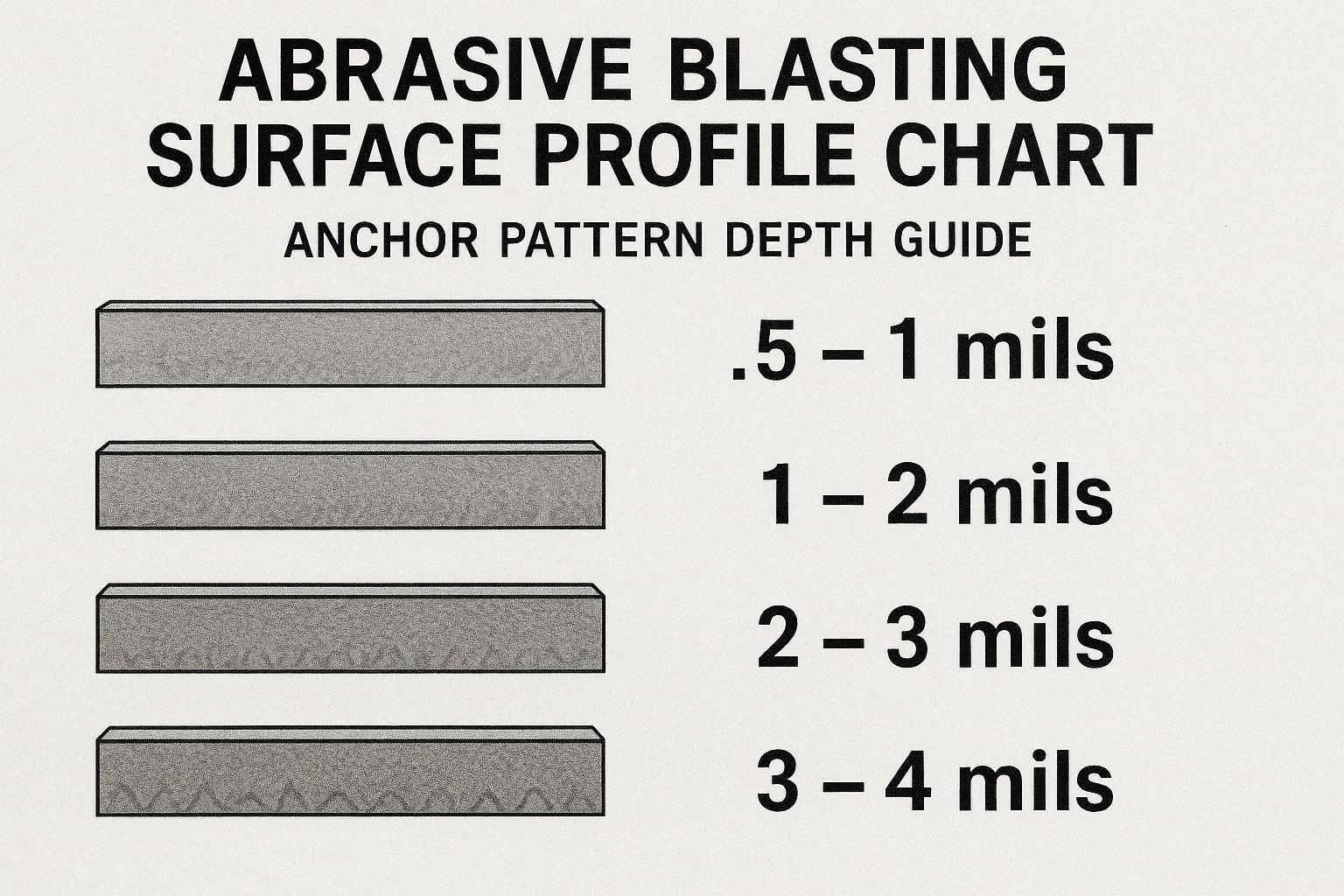
Of all the variables in an abrasive blasting specification — nozzle pressure, stand-off distance, blast angle, media type — grit size has the single largest influence on the final anchor profile depth. Get it right and the downstream coating system performs as designed. Get it wrong and you face either a bond failure from an insufficient anchor profile or wasted primer material consumed by an unnecessarily deep anchor pattern.
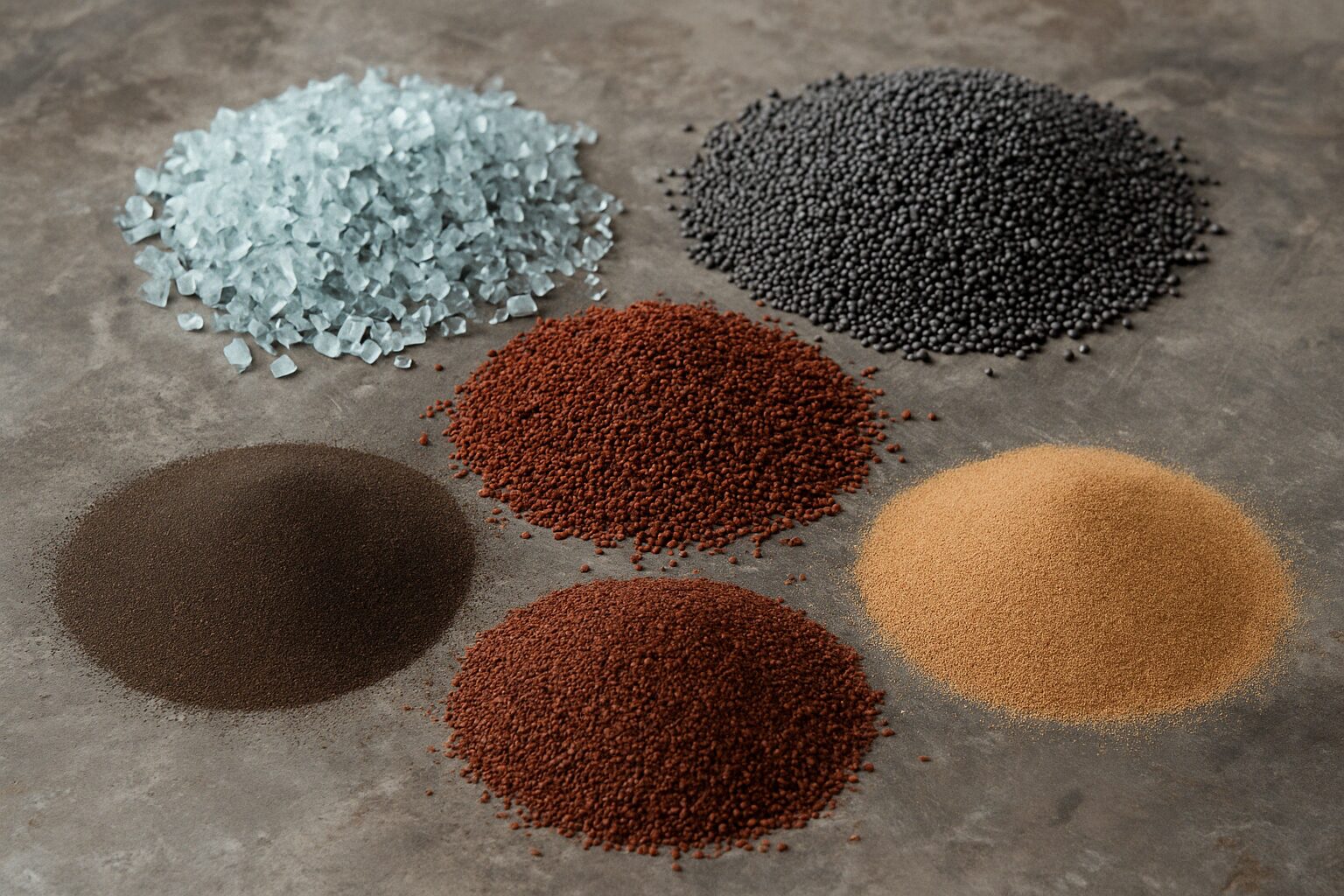
For Black Beauty coal slag, four commercially available mesh grades cover the full range of industrial surface preparation requirements, from light brush-off cleaning to aggressive mill scale removal on heavily corroded ship plating. Each grade is defined by the upper and lower sieve sizes through which the particles pass and are retained — expressed as a fraction (e.g., 12/40 means particles pass through a 12-mesh sieve but are retained on a 40-mesh sieve).
This guide is the companion specification resource to our full buyer’s overview: Black Beauty Abrasive Blasting Media: The Complete Buyer’s Guide.
2. How Mesh Numbers Work
Mesh number refers to the number of openings per linear inch in a wire screen used for particle size classification. A higher mesh number means smaller openings and therefore smaller particles. A lower mesh number means larger openings and coarser particles.
In a grade designation like “12/40,” the first number (12) is the coarser screen through which particles pass freely — setting the maximum particle size. The second number (40) is the finer screen on which particles are retained — setting the minimum particle size. All particles in a 12/40 grade are therefore between the 12-mesh and 40-mesh sieve openings.
Standard sieve opening dimensions for reference:
| Mesh Number | Opening (inches) | Opening (mm) |
|---|---|---|
| 8 | 0.0937 | 2.38 |
| 12 | 0.0661 | 1.68 |
| 16 | 0.0469 | 1.19 |
| 20 | 0.0331 | 0.841 |
| 30 | 0.0234 | 0.595 |
| 40 | 0.0165 | 0.420 |
| 60 | 0.0098 | 0.250 |
3. Master Grit Size Chart
| Grade | Mesh Size | Particle Size Range | Anchor Profile (Mil) | Min. Nozzle Orifice | Blast Pressure (psi) | SSPC-SP Levels | MIL Spec |
|---|---|---|---|---|---|---|---|
| Extra Fine | 30/60 | 0.25–0.60 mm | 1.0 – 2.6 Mil | 1/8 in. (3.2 mm) | 60–90 | SP 6, SP 7 | MIL-A-22262B(SH) ✓ |
| Fine | 20/40 | 0.42–0.84 mm | 2.0 – 3.8 Mil | 3/16 in. (4.8 mm) | 80–100 | SP 6, SP 10 | MIL-A-22262B(SH) ✓ |
| Medium | 12/40 | 0.42–1.68 mm | 3.0 – 4.8 Mil | 1/4 in. (6.4 mm) | 90–110 | SP 10, SP 5* | — |
| Coarse | 8/16 | 1.19–2.38 mm | 4.0 – 6.0+ Mil | 5/16 in. (8.0 mm) | 100–120 | SP 10, SP 5* | — |
*SP 5 (White Metal) may require multiple passes. Always verify with post-blast visual comparator (SSPC-VIS 1) and Testex tape profile measurement.
4. Grade-by-Grade Breakdown
Taille des particules : 0.25 to 0.60 mm. The finest commercially available Black Beauty grade, Extra Fine is designed for light cleaning applications where a minimal anchor profile is required.
- Primary use: Brush-off blast cleaning (SSPC-SP 7), commercial blast (SSPC-SP 6), high-pressure water blasting systems
- Best for: Sandblast cabinets, light shop maintenance, automotive parts, valve and fitting restoration, surfaces receiving thin-film coatings (<3 Mil DFT)
- Military approval: Qualified under MIL-A-22262B(SH) — suitable for U.S. Navy and Coast Guard maintenance work
- Nozzle note: Minimum 1/8-inch nozzle orifice. Smaller orifices risk bridging and rapid nozzle wear
- Coating match: Thin-film epoxy primers (1.5–3 Mil DFT), wash primers, alkyd maintenance coatings
Taille des particules : 0.42 to 0.84 mm. The Fine grade spans the range between brush-off and near-white blast, making it the standard specification for new construction steel and light-rust maintenance blasting.
- Primary use: SSPC-SP 6 commercial blast and SSPC-SP 10 near-white blast (lower end)
- Best for: New fabricated steel before shop primer, light to moderate rust removal, pipeline exterior, tank interior (reduced-profile specification)
- Military approval: Qualified under MIL-A-22262B(SH)
- Nozzle note: Minimum 3/16-inch nozzle. Venturi-type nozzles recommended for production blasting rates
- Coating match: Inorganic zinc silicate primers (requiring 2.0–3.0 Mil profile), high-build epoxies, FBE pipe coatings at 2.5–3.5 Mil specification
Taille des particules : 0.42 to 1.68 mm. Medium-grade Black Beauty is the most widely specified and highest-volume coal slag grade globally. It covers the broadest range of general industrial blasting applications and is the reference grade in most structural steel maintenance specifications.
- Primary use: SSPC-SP 10 near-white blast — the minimum requirement for high-performance industrial protective coatings under most owner specifications
- Best for: Bridge maintenance, structural steel fabrication shops, industrial equipment overhaul, general contractor field blasting, tank exteriors
- Nozzle note: Minimum 1/4-inch nozzle orifice required. Below this, nozzle wear accelerates dramatically and throughput drops
- Coating match: Zinc-rich primers (organic or inorganic, 3.0–4.0 Mil), high-build epoxy intermediate coats, coal tar epoxy, polyurethane topcoats over epoxy primer systems
- Consumption reference: Approximately 0.5–0.7 lb of media per square foot at standard blasting parameters for moderate rust conditions
Taille des particules : 1.19 to 2.38 mm. Coarse-grade Black Beauty is specified for the most demanding heavy-industrial applications where thick corrosion product and aged coatings must be removed efficiently, and where the coating system requires a deep anchor profile for adhesion.
- Primary use: SSPC-SP 10 near-white and SSPC-SP 5 white metal (multiple passes) on heavily corroded substrates
- Best for: Ship hull preparation in dry dock, offshore platform maintenance, heavily corroded pipeline, ballast tank interior blasting, structural steel with heavy mill scale
- Nozzle note: Minimum 5/16-inch wide-throat Venturi nozzle. High air volume is essential — minimum 375 CFM compressor output recommended per nozzle at 100 psi
- Coating match: Heavy-duty epoxy systems (5–8 Mil DFT), antifouling coatings over epoxy tie-coat, thick-film polyurethane systems, spray-applied polyurea linings
5. SSPC-SP Cleanliness Level Matching
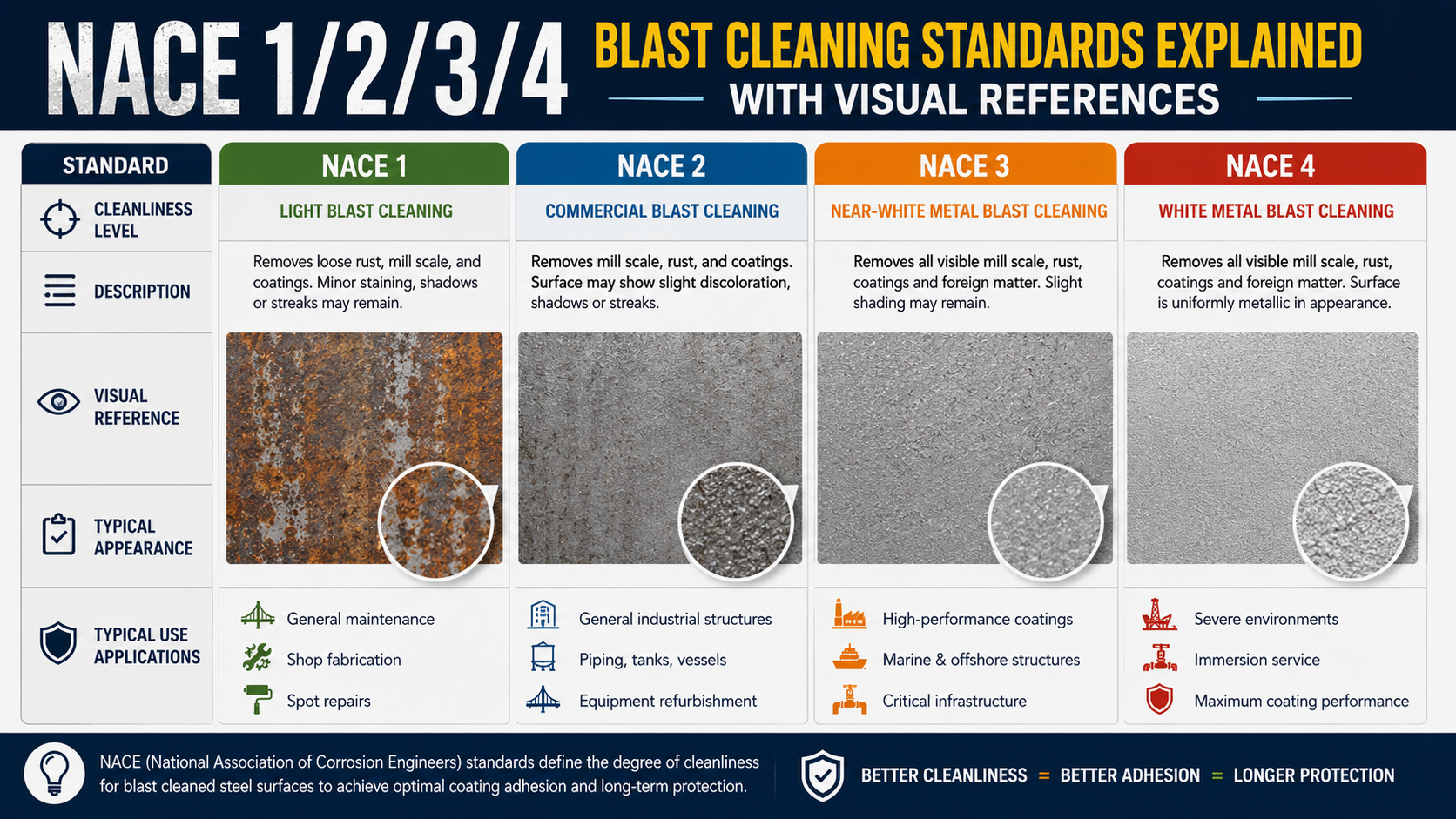
The Society for Protective Coatings (SSPC) defines standardized surface cleanliness grades that correlate to the degree of rust, mill scale, and coating removal. Selecting the correct Black Beauty grade to reach a specified SSPC-SP level is a fundamental blasting specification task.
| SSPC-SP Level | Description | Recommended Black Beauty Grade | Notes |
|---|---|---|---|
| SP 7 | Brush-Off Blast — removes loose mill scale, rust, and coatings; tight adherent scale/rust may remain | Extra Fine (30/60) | Low-anchor-profile specification; used where coating system tolerates SP 7 |
| SP 6 | Commercial Blast — at least 2/3 of each unit area free of all visible residue | Extra Fine (30/60) or Fine (20/40) | Standard for maintenance recoating where SP 10 is not specified |
| SP 10 | Near-White Metal Blast — at least 95% of each unit area free of all visible residue | Fine (20/40) or Medium (12/40) | Required by most high-performance industrial coating specifications; the most common project standard |
| SP 5 | White Metal Blast — free from all visible rust, mill scale, paint, and foreign matter | Medium (12/40) or Coarse (8/16) — multiple passes | Highest standard; required for tank lining, nuclear, and critical immersion service |
6. Matching Grit to Coating System
The anchor profile created by your chosen Black Beauty grade must align with the coating manufacturer’s minimum and maximum profile requirements. This is non-negotiable: exceeding the maximum profile wastes primer and can leave profile peaks exposed above the first coat; falling below the minimum compromises adhesion and leads to early delamination.
| Coating Type | Typical Min. Profile (Mil) | Typical Max. Profile (Mil) | Recommended Grade |
|---|---|---|---|
| Wash primer / thin-film alkyd | 0.5 | 1.5 | Extra Fine (30/60) |
| Inorganic zinc silicate primer | 2.0 | 3.5 | Fine (20/40) |
| Organic zinc-rich primer | 2.5 | 4.0 | Fine (20/40) or Medium (12/40) |
| High-build epoxy (standard) | 2.0 | 4.0 | Fine (20/40) or Medium (12/40) |
| Coal tar epoxy | 3.0 | 5.0 | Medium (12/40) |
| FBE (Fusion Bonded Epoxy) | 2.5 | 4.5 | Fine (20/40) or Medium (12/40) |
| Antifouling / hull coating | 3.5 | 5.5 | Medium (12/40) or Coarse (8/16) |
| Spray polyurea lining | 3.0 | 6.0 | Medium (12/40) or Coarse (8/16) |
7. Grit Selection Decision Guide
Use this step-by-step logic to confirm your grit selection on any project:
- Identify the SSPC-SP cleanliness level specified in the coating manufacturer’s data sheet or project specification.
- Identify the minimum and maximum anchor profile depth (Mil) required by the coating system.
- Select the Black Beauty grade whose Mil profile range falls within the coating specification window (see Master Chart above).
- Confirm your compressor CFM output and available nozzle sizes are compatible with the selected grade’s minimum nozzle orifice requirement.
- Consider substrate condition: heavily pitted or deeply corroded steel may require one grade coarser than the nominal specification to achieve required cleanliness in a single pass.
- Verify selection with a test blast on a representative panel — measure cleanliness with SSPC-VIS 1 comparator and profile with Testex tape before committing to full production blasting.
8. Common Grit Selection Mistakes
- Using Medium grade in a blast cabinet. Cabinet suction systems cannot move 12/40 mesh particles efficiently through small-bore hoses. Always use Extra Fine or Fine in cabinet applications.
- Exceeding coating profile maximum. A Coarse grade creating a 5.5 Mil peak pattern under a 3 Mil DFT primer leaves profile peaks exposed and causes premature coating failure.
- Under-specifying for heavily corroded steel. Fine grade at nominal pressure on C-grade rust (heavy pitting, SSPC-VIS 1 C-grade) may require 3–4 passes to approach SP 10. Specifying Medium instead achieves the same result in fewer passes with less media consumption.
- Ignoring nozzle orifice minimums. Running Medium-grade Black Beauty through a 3/16-inch nozzle (Fine minimum) accelerates nozzle wear by a factor of 3–5× and reduces coverage rate significantly.
- Not re-verifying profile after media degradation. In blast rooms with partial reclaim, recycled Black Beauty fines produce a shallower anchor profile than fresh media. Profile should be measured periodically during production runs.
For technical data sheet parameters including particle size distribution tolerances and specific gravity by grade, see: Black Beauty Blasting Media Specifications: Technical Data Sheet Breakdown.
Return to the overview: Complete Buyer’s Guide · Related: How to Choose Blasting Media for Steel Surface Prep · Cabinet Blasting Tips
Filtres