Jiangsu Henglihong Technology Co., Ltd.
What Is Sandblasting Material? Complete Guide to Types, Grit & Selection
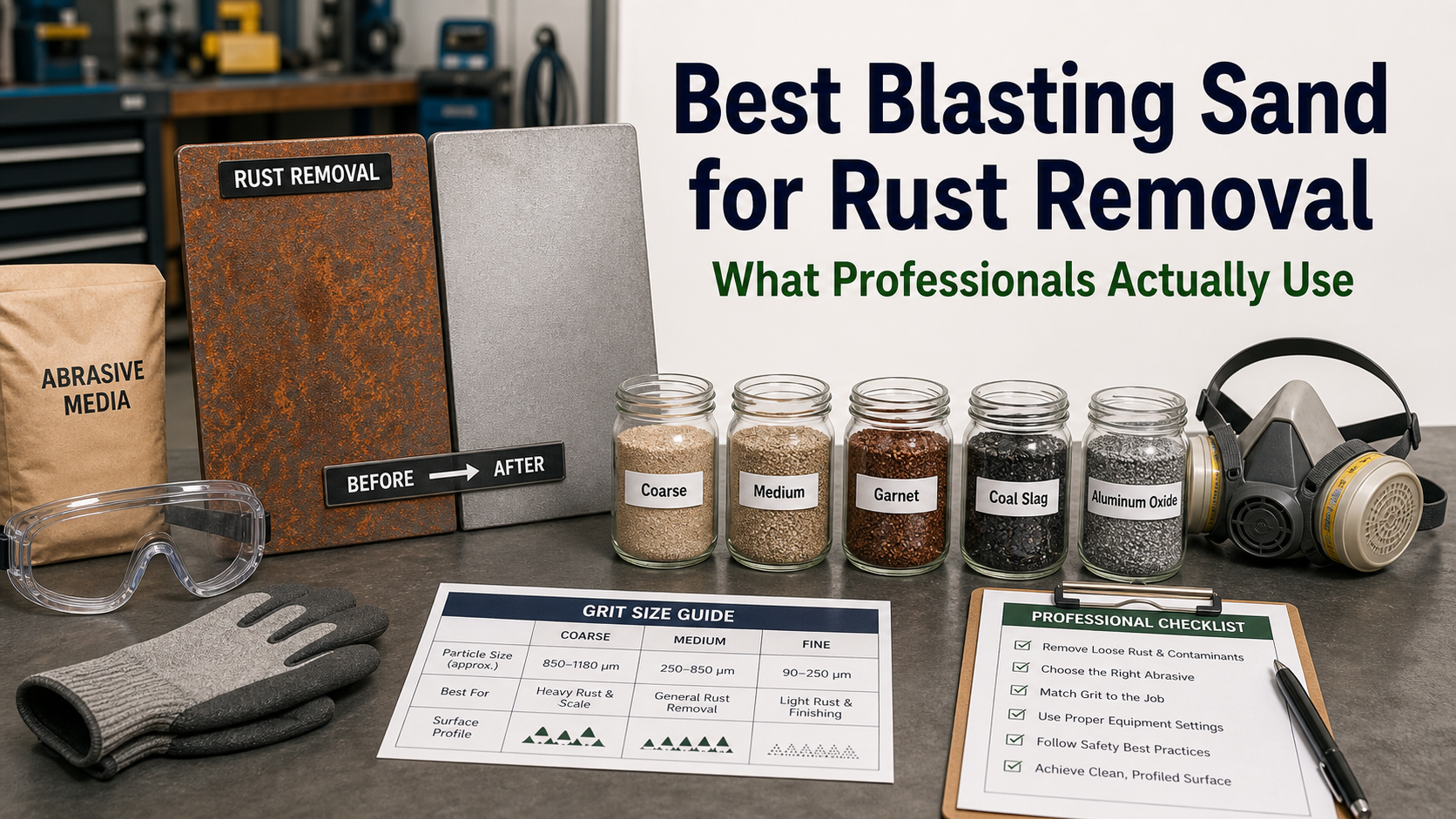
A comprehensive reference covering every major abrasive blasting medium — from aluminum oxide and glass beads to steel grit and walnut shell — with selection criteria, grit size guidance, safety essentials, and real-world application examples.
What Is Sandblasting Material?
Sandblasting material — also referred to as blasting media, abrasive media, or blast abrasive — is any granular substance that is propelled at high velocity against a workpiece surface to clean, profile, deburr, peen, or finish it. The process of accelerating these particles through compressed air (or occasionally mechanical force) is known as abrasive blasting, bead blasting, media blasting, or simply sandblasting, a name that dates back to the earliest use of natural silica sand as the propellant material.
Today, the term “sand” in sandblasting is largely historical. Natural silica sand has fallen out of widespread industrial use because of serious occupational health hazards associated with respirable crystalline silica (RCS) dust. In its place, a broad family of engineered and naturally sourced abrasives has evolved to serve virtually every surface-finishing application imaginable — from removing mill scale from structural steel to gently stripping paint from a fiberglass boat hull without damaging the underlying laminate.
Sandblasting material is any abrasive particle — mineral, metallic, or organic — that is accelerated by pressurized air or mechanical means to impact a target surface, removing contaminants, creating a surface profile, or achieving a specific finish. The choice of media directly determines the speed, cleanliness, surface roughness, and cost of any blasting operation.
How Abrasive Blasting Works
Understanding the physics behind blasting helps you make smarter media choices — the same abrasive can behave very differently at different pressures, nozzle diameters, and standoff distances.
In a typical pressure-blast system, compressed air drives abrasive particles through a blast hose and out of a carbide-tipped nozzle at velocities that can exceed 250 mph. When a particle strikes the surface, it transfers kinetic energy in a fraction of a millisecond. What happens next depends on four interacting variables:
Kinetic energy transfer
Particle mass multiplied by velocity squared determines how much energy is available to displace rust, scale, or old coatings. Heavier, denser particles (like steel shot) carry more momentum at the same velocity than lighter particles (like walnut shell).
Particle hardness vs. substrate hardness
If the media is harder than the contaminant but softer than the substrate, it selectively removes the contamination without damaging the base material. This principle guides every media selection decision in industrial surface preparation.
Particle shape effect
Angular particles (aluminum oxide, steel grit, garnet) cut into the surface like tiny chisels, creating a rough anchor profile ideal for paint adhesion. Round particles (glass beads, steel shot) peen and polish, leaving a smoother, compressive finish.
Grit size (mesh size) effect
Larger particles create deeper anchor profiles and faster cleaning rates but leave coarser finishes. Finer grits produce smoother surfaces and are preferred for precision finishing, thin-walled substrates, or applications requiring tight dimensional tolerances.
Key Properties of Blasting Media
Every sandblasting material can be evaluated along four primary axes. Mastering these four concepts will allow you to evaluate any media — even one you’ve never used — with confidence.
1. Hardness (Mohs Scale)
Hardness determines how aggressively a medium cuts into a surface and how long individual particles remain sharp before fracturing into fines. The Mohs hardness scale runs from 1 (talc) to 10 (diamond). For metallic abrasives, the Rockwell C (HRC) scale is more commonly used — HRC 40–66 is roughly comparable to Mohs 7–8. A useful rule of thumb: the media should be harder than the contaminant you want to remove, but ideally not harder than the substrate you want to protect.
2. Particle Shape: Angular vs. Round
Angular particles — produced by crushing minerals or casting metallic grits — have jagged, irregular edges that cut aggressively into the surface and create a pronounced anchor profile. This roughness is essential when a new coating must mechanically bond to the substrate. Round particles, such as glass beads or steel shot, strike the surface and roll rather than cut, producing a peened or burnished finish without an anchor profile. They are ideal when you need to clean a surface or relieve stress in metal components without adding surface roughness.
3. Grit & Mesh Size
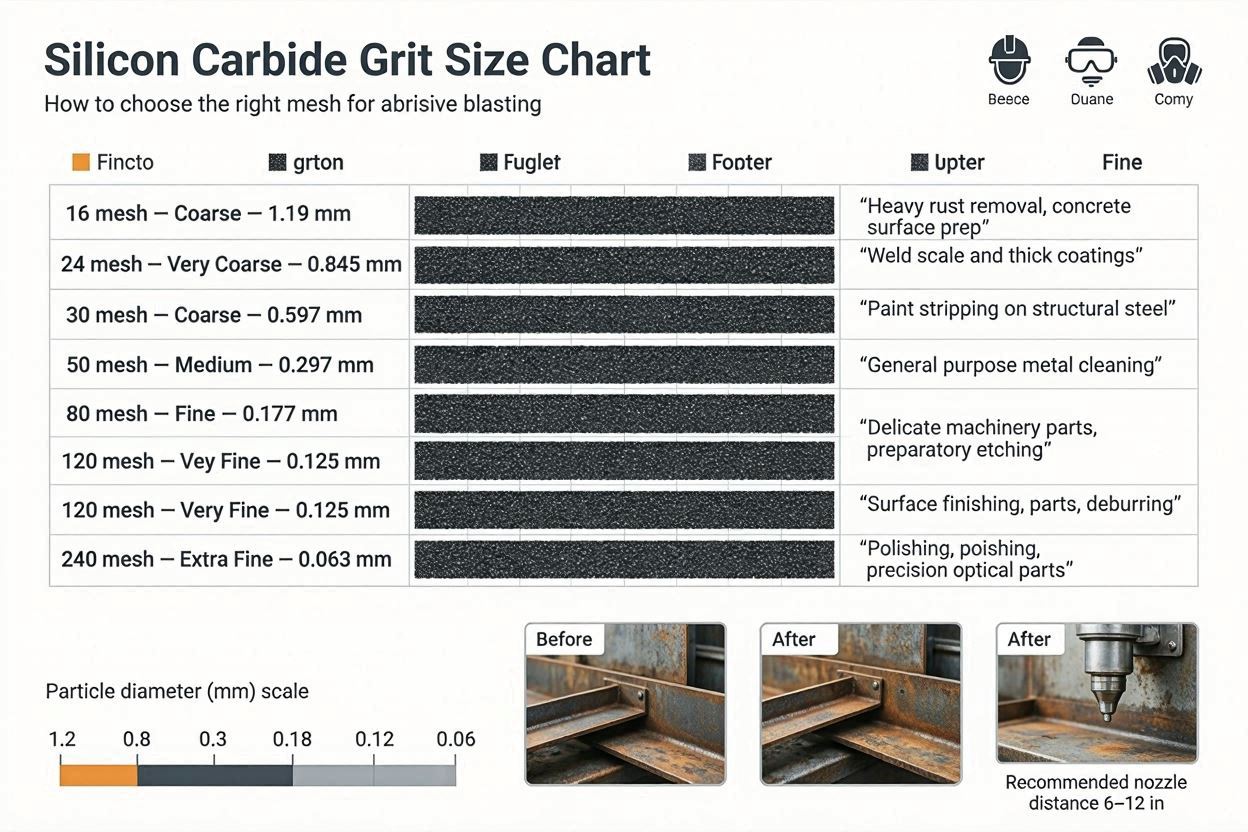
Grit size (often expressed as mesh size) describes the physical diameter of individual abrasive particles. The mesh number refers to the number of openings per linear inch in a sieve screen: a higher mesh number means a smaller opening, and therefore a finer particle. Coarse grit (low mesh number, e.g., #16–#40) removes material quickly and creates aggressive surface profiles. Fine grit (high mesh number, e.g., #120–#220) creates smoother finishes and is preferred for detail work, finishing, or blasting thin or delicate substrates. For a detailed breakdown of mesh numbers, anchor profiles, and application pairings, see our dedicated sandblasting grit size chart and mesh size guide.
4. Density, Recyclability & True Cost Per Cycle
A common mistake in media procurement is evaluating abrasives purely by price per pound or kilogram. A far more meaningful metric is the cost per effective blast cycle — the cost to process one unit of surface area from start to acceptable finish. A media that costs three times more per kilogram but lasts fifteen times longer before it fractures into unusable fines is actually five times cheaper in operation. Density influences particle momentum and recyclability: denser particles (steel, aluminum oxide) tend to fracture less per pass, enabling many reuse cycles in reclaim systems. Low-density organic media (walnut shell, corn cob) are single-use or very limited reuse.
Types of Sandblasting Material
Below is a practical overview of the seven most important categories of blasting media used in industrial and commercial surface preparation today. Each entry links to a dedicated deep-dive page for buyers who need full technical specifications, grit availability, and application case studies.
Óxido de aluminio
The workhorse of industrial abrasive blasting. Aluminum oxide (Al₂O₃) combines extreme hardness with a sharply angular grain shape that cuts through rust, mill scale, old coatings, and heat treatment scale with exceptional efficiency. Available in brown (standard) and white (high-purity) grades, it is one of the most recyclable mineral abrasives available — well-maintained reclaim systems can achieve 15–30 reuse cycles, making it highly cost-effective for high-volume operations. It is the go-to choice for preparing steel structures, heavy equipment, and industrial machinery for protective coatings.
Full guide: Aluminum Oxide Sandblasting Media →Cuentas de vidrio
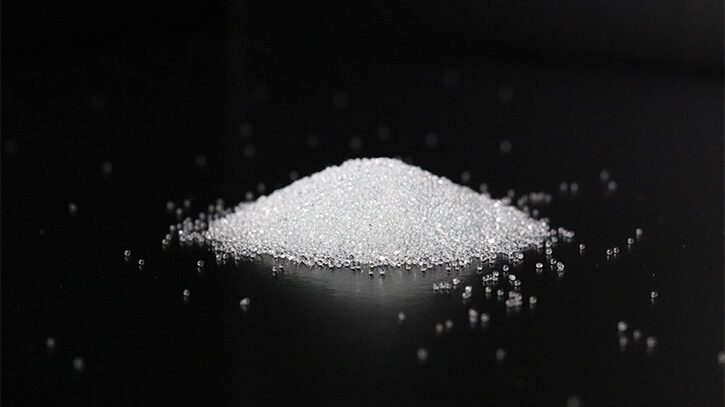
Manufactured from high-quality soda-lime glass and precision-graded into consistent spherical particles, glass beads deliver a gentle, peening action that cleans and brightens surfaces without creating the aggressive anchor profile left by angular abrasives. This makes them uniquely suited to applications where dimensional tolerances must be preserved — aerospace components, medical devices, food-grade stainless steel equipment, and decorative hardware. Glass beads also generate significantly less dust than most mineral alternatives, improving operator visibility and reducing respiratory exposure. They are reusable for multiple cycles before particle breakdown becomes excessive.
Full guide: Glass Beads Sandblasting Media →Steel Grit & Steel Shot
Steel abrasives are the highest-volume media type in heavy industrial applications globally. Steel shot — spherical particles produced by atomizing molten steel — is the peening specialist, used extensively for shot blasting structural steel, rail components, castings, and forgings, and for stress-relief and surface hardening of springs and turbine blades. Steel grit — angular particles produced by crushing hardened steel shot — delivers aggressive cutting action for fast removal of thick coatings, tight mill scale, and heavy rust on very hard substrates. Both types offer extraordinary recyclability: in closed-loop blast cabinets and blast rooms equipped with reclaim systems, steel abrasives can sustain 200–300 effective reuse cycles, delivering the lowest cost per square meter of any media type in high-throughput environments.
Full guide: Steel Grit vs Steel Shot →Granate
A naturally occurring silicate mineral mined primarily in Australia, India, and the United States, garnet offers a compelling balance of cleaning efficiency, low dust generation, and environmental acceptability. Its crystalline structure fractures along clean planes, constantly exposing fresh sharp edges throughout the blasting cycle — a property that sustains its cutting efficiency better than many alternatives. Garnet generates very low airborne dust compared to coal slag, copper slag, and most silica-based abrasives, making it a preferred choice for enclosed-space blasting and environmentally sensitive job sites. It is also the abrasive of choice in waterjet cutting applications due to its hardness, low iron contamination, and clean fracture behavior.
Full guide: Garnet Sandblasting Media →Crushed Glass
Manufactured from 100% post-consumer recycled glass, crushed glass media provides a genuinely eco-conscious alternative to virgin mineral abrasives and hazardous slag-based products. Its angular, multi-faceted particle geometry provides effective cutting action for removing paint, light rust, and mill scale from steel, concrete, and masonry surfaces. Crucially, crushed glass is entirely free of free silica (the RCS hazard associated with natural sand), heavy metals, and sulfur compounds — making it one of the safest mineral abrasives for operator health and one of the cleanest for environmental disposal. It is gaining rapid adoption in the marine, bridge maintenance, and general construction sectors where environmental compliance is a primary procurement driver.
Full guide: Crushed Glass Sandblasting Media →Walnut Shell & Corn Cob
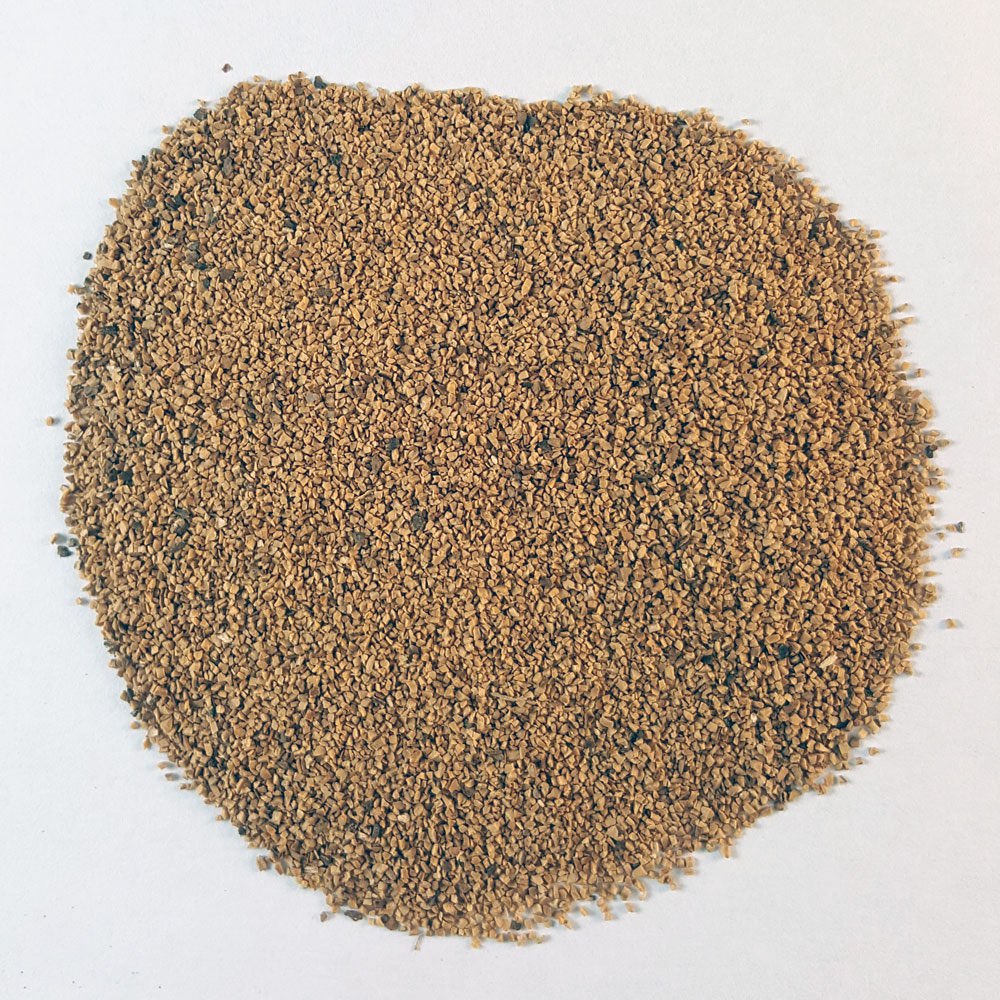
When the substrate is too fragile, too valuable, or too dimensionally sensitive to tolerate harder abrasives, organic media — principally ground walnut shells and ground corn cob — become the only sensible choice. Both are natural, biodegradable, and non-toxic. Walnut shell (Mohs 3.5–4.0) is the harder of the two and is commonly used for removing carbon deposits from aircraft turbine components, stripping paint from fiberglass panels, cleaning wood surfaces, and deburring plastic injection-molded parts. Corn cob (Mohs 2.5–3.0) is even gentler and has the additional advantage of being highly absorbent, making it particularly effective for cleaning oil-contaminated metal components and polishing jewelry or electronic parts. Neither media will leave an anchor profile on any typical substrate.
Full guide: Walnut Shell & Corn Cob Blasting Media →Carburo de silicio
Silicon carbide (SiC) is the hardest blasting abrasive in routine commercial use — harder even than aluminum oxide, and approaching diamond on the Mohs scale. It is a synthetic abrasive produced in electric arc furnaces from silica sand and petroleum coke. Its combination of extreme hardness and extremely sharp particle geometry gives it an unmatched material-removal rate on very hard substrates that would wear out softer abrasives rapidly: technical ceramics, tungsten carbide tooling, refractory materials, stone engraving, glass etching, and semiconductor wafer lapping. Silicon carbide is significantly more expensive per kilogram than aluminum oxide, and its selection is typically justified only when no other abrasive can achieve the required result within an acceptable cycle time.
Full guide: Silicon Carbide Sandblasting Media →Side-by-Side Comparison of All Major Media Types
The table below condenses the most decision-relevant properties of each major sandblasting material into a single reference. For a fully interactive version with cost-per-cycle calculations and substrate compatibility matrices, see our sandblasting media comparison chart.
| Tipo de medio | Hardness (Mohs) | Shape | Reuse Cycles | Dust Level | Relative Cost/Cycle | Best For |
|---|---|---|---|---|---|---|
| Óxido de aluminio | 9.0 | Angular | 15–30 | Medium | Bajo | Steel surface prep, coating adhesion |
| Cuentas de vidrio | 5.5–6.0 | Round | 10–20 | Bajo | Medium | Peening, polishing, stainless steel |
| Disparo de acero | HRC 40–50 | Round | 200–300 | Muy bajo | Lowest | High-volume structural steel blasting |
| Granalla de acero | HRC 55–66 | Angular | 100–200 | Muy bajo | Muy bajo | Heavy rust/scale removal, aggressive profiling |
| Granate | 7.5–8.0 | Angular | 3–5 | Bajo | Medium | Low-dust environments, waterjet cutting |
| Crushed Glass | 5.5–6.0 | Angular | 1–3 | Medium | Low-Med | Eco-compliant jobs, concrete, masonry |
| Walnut Shell | 3.5–4.0 | Irregular | 1–3 | Medium | Medium | Fiberglass, wood, soft metals |
| Carburo de silicio | 9.0–9.5 | Angular | 5–10 | Alta | Alta | Ceramics, carbide tooling, glass engraving |
Reuse cycle figures assume a properly maintained reclaim system with regular media classification and fines removal. Open-blast (one-pass) operations will not reclaim any media; cost-per-cycle comparisons must be adjusted accordingly. Cost/cycle rankings are relative — absolute figures vary by region, volume, and supplier.
How to Choose the Right Sandblasting Material
Selecting the wrong media is one of the most common — and costly — mistakes in surface finishing. Follow this structured decision process to arrive at the correct choice for every project.
The complete, illustrated selection flowchart — including substrate-specific recommendations and equipment compatibility checks — is available in our standalone guide: How to Choose Sandblasting Material: Step-by-Step Selection Guide. The key decision factors are summarized below.
Define your substrate and its hardness
Is the workpiece carbon steel, stainless steel, aluminum, cast iron, concrete, fiberglass, wood, or plastic? Harder substrates can tolerate harder, more aggressive media. Softer or thin-walled substrates need media that removes contaminants without deforming or etching the base material.
Identify the contaminant and required cleanliness standard
Light rust and old paint require moderate hardness and angular shape. Tight mill scale and multi-layer coatings on structural steel require hard, aggressive angular media. Specify the cleanliness standard you need (e.g., ISO 8501-1 Sa 2.5, SSPC-SP 10 Near-White) — this will help narrow the field considerably.
Define the required surface finish and anchor profile
If you need a rough anchor profile for a heavy-duty epoxy or zinc-rich primer, angular hard media is mandatory. If you need a smooth, bright, unprofiledsurface — for aesthetic finishing, tight-tolerance aerospace parts, or pre-plating — round media is the correct choice. Consult the coating manufacturer’s specification for required profile depth (Ra or Rz).
Assess your operating environment and equipment
Open-air blasting on a bridge or ship hull requires media that meets local environmental regulations — crushed glass or garnet may be preferred over coal slag in many jurisdictions. Blast cabinet operations with reclaim systems can justify the higher upfront cost of recyclable media like steel abrasives or aluminum oxide. Consult your equipment manual for minimum recommended particle size to avoid nozzle clogging.
Calculate true cost per square meter, not cost per bag
Factor in purchase price, recyclability, media consumption rate, disposal costs, and labor productivity (faster media = fewer blast hours). A media that costs 30% more per kilogram but cleans 50% faster and lasts 10 times longer will dramatically reduce your total project cost.
1. Using harder media than necessary: Excess hardness can warp thin sheet metal, embed abrasive particles in soft substrates, and create profiles too rough for the specified coating system. 2. Ignoring moisture: Many mineral abrasives absorb or retain moisture, which clogs blast nozzles and introduces flash rust to freshly cleaned surfaces within minutes. 3. Mixing media types: Mixing different abrasives in a reclaim system contaminates the blend and makes quality control impossible. Always purge the system completely before switching media.
Grit Size Quick Reference
Grit size is the single most confusing aspect of sandblasting media procurement for buyers new to abrasive specification. Here is a concise reference to orient you before diving into the full technical documentation. For a complete mesh-size-to-application cross-reference table with anchor profile data, see the dedicated sandblasting grit size chart.
| Grit Range | Approximate Particle Size | Surface Profile (Ra) | Aplicaciones típicas |
|---|---|---|---|
| Very Coarse #8–#24 |
0.71–2.36 mm | 75–150+ µm | Aggressive profiling, thick scale removal on heavy structural steel |
| Coarse #24–#60 |
0.25–0.71 mm | 40–75 µm | General rust and paint removal, surface profiling for industrial coatings |
| Medium #60–#120 |
0.125–0.25 mm | 15–40 µm | Balanced cleaning and finishing, automotive bodywork, moderate profiling |
| Fine #120–#220 |
0.063–0.125 mm | 5–15 µm | Light deburring, surface etching, preparation of thin or soft substrates |
| Very Fine #220+ |
< 0.063 mm | < 5 µm | Precision polishing, lapping, glass decoration, semiconductor components |
Common Applications by Industry
Abrasive blasting is one of the most widely practiced surface-finishing processes in global manufacturing. Below are the major application domains and the media types typically specified for each.
Steel shot/grit and aluminum oxide for rust removal and Sa 2.5 surface prep before coatings. High-volume, closed-loop operations.
Aluminum oxide or garnet for hull plate profiling. Crushed glass on environmentally restricted drydock sites.
Glass beads for shot peening turbine blades and landing gear. Walnut shell for carbon removal from jet engines without dimensional loss.
Glass beads for paint stripping aluminum panels without warping. Walnut shell or soda blast for body panels. See our guide on automotive sandblasting media.
Aluminum oxide for deburring machined parts and weld cleaning. Steel grit for aggressive descaling of hot-rolled plate. Full coverage in our guide on best sandblasting material for metal.
Steel grit or garnet for pipe internal and external cleaning prior to FBE, PE, or epoxy coating. High cleanliness standards (Sa 3 or Sa 2.5) mandatory.
Crushed glass or steel shot for concrete surface preparation before overlay, waterproofing, or epoxy floor coating application.
Silicon carbide fine powder for ceramic substrate finishing. Glass beads (fine grade) for deburring micro-components. Ultra-gentle corn cob for PCB cleaning.
Safety & Health Considerations
No guide to sandblasting material is complete without an honest discussion of occupational health and environmental risks — both of which are directly influenced by the choice of abrasive.
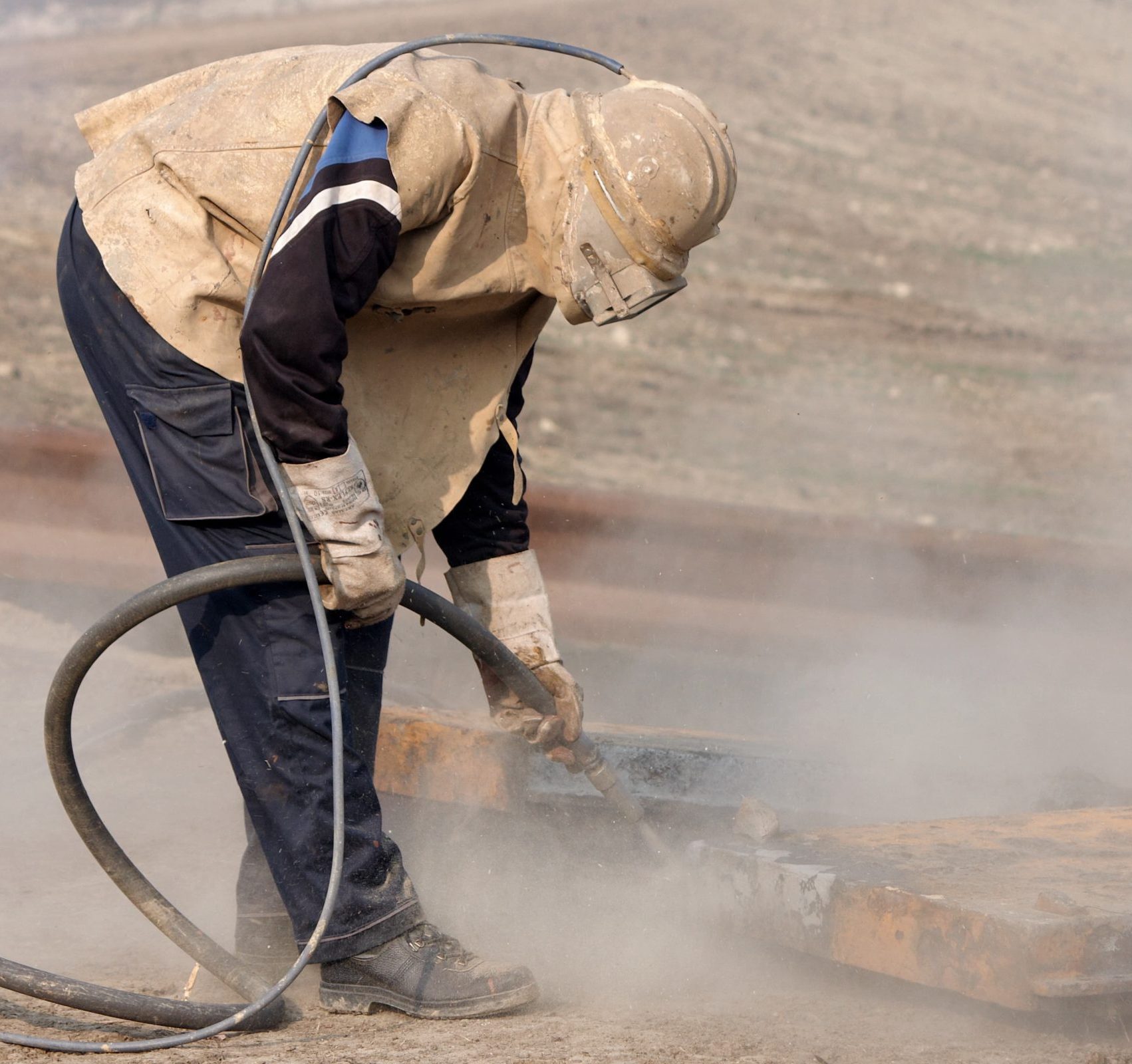
The central historical hazard in abrasive blasting is silicosis — an incurable, often fatal lung disease caused by prolonged inhalation of respirable crystalline silica (RCS) dust generated when natural silica sand fractures during blasting. This hazard led the U.S. Occupational Safety and Health Administration (OSHA), the European Chemicals Agency (ECHA), and equivalent bodies worldwide to impose strict permissible exposure limits (PELs) for RCS, and in many jurisdictions to effectively ban or severely restrict the use of silica sand for abrasive blasting in enclosed spaces.
Modern engineered abrasives — including aluminum oxide, glass beads, steel abrasives, and crushed glass — contain negligible free silica and represent a fundamentally safer class of materials. However, every blasting operation generates dust, and appropriate engineering controls, administrative procedures, and personal protective equipment (PPE) remain mandatory regardless of the media type used.
Essential safety controls for any blasting operation:
- Respiratory protection: Supplied-air respirators (airline respirators or SARs) are the standard for enclosed blasting. Half-face respirators with P100 filters may be appropriate for low-dust outdoor operations but must be selected based on a site-specific exposure assessment.
- Engineering controls: Local exhaust ventilation (LEV), blast enclosures, and water suppression systems to capture dust at the source before it becomes airborne.
- Equipo de protección individual: Blast helmet or hood, heavy-duty blast suit, leather gloves, and steel-toed boots are minimum requirements for operators.
- Media classification and disposal: Spent media must be classified for heavy metal content before disposal. Lead, chromium, and cadmium from old painted surfaces can leach into blast media during cleaning, creating hazardous waste subject to RCRA or equivalent regulations.
For a complete regulatory reference covering OSHA PELs, NESHAP requirements, EU REACH restrictions, and a worked comparison of the dust generation profiles of all major media types, see our detailed page on sandblasting media safety, silica health risks, and OSHA-compliant alternatives.
- ▸Aluminum Oxide Sandblasting Media: Properties, Grit Sizes & Best Uses
- ▸Glass Beads Sandblasting Media: Smooth Finish & Peening Applications
- ▸Steel Grit vs Steel Shot: Which Blasting Media Is Right for Heavy Work?
- ▸Garnet Sandblasting Media: Low Dust, High Efficiency for Metal & Wood
- ▸Crushed Glass Sandblasting Media: Eco-Friendly Alternative to Silica Sand
- ▸Walnut Shell & Corn Cob Blasting Media: Gentle Abrasives for Delicate Surfaces
- ▸Silicon Carbide Sandblasting Media: Hardest Abrasive for Ceramics & Carbide
- ▸Sandblasting Grit Size Chart: Mesh Size, Surface Profile & Application Guide
- ▸Sandblasting Media Comparison Chart: Hardness, Cost & Recyclability
- ▸How to Choose Sandblasting Material: Step-by-Step Selection Guide
- ▸Sandblasting Media Safety: Silica Health Risks, OSHA Rules & Safe Alternatives
- ▸Best Sandblasting Material for Metal: Surface Prep Before Painting & Coating
- ▸Sandblasting Material for Automotive Restoration: Remove Paint Without Warping
Preguntas frecuentes
For high-volume industrial steel surface preparation, steel shot and steel grit dominate the market due to their exceptional recyclability (200–300 cycles) and the lowest cost per square meter among all media types. In operations without closed-loop reclaim systems, aluminum oxide is the most practical and widely available alternative — it is harder than most contaminants encountered in structural steelwork, highly angular for excellent anchor profile creation, and available from a broad range of suppliers worldwide in all relevant grit sizes.
The use of natural silica sand for abrasive blasting is heavily restricted or outright prohibited in most industrialized nations. In the United States, OSHA’s Respirable Crystalline Silica standard (29 CFR 1910.1053 / 1926.1153) imposes a permissible exposure limit of 50 µg/m³ as an 8-hour TWA and requires engineering controls, medical surveillance, and hazard communication programs. In the EU, the use of silica sand for dry blasting in enclosed spaces has been effectively banned under REACH restrictions. Many individual countries and industrial facilities have adopted a complete prohibition. If you are currently using silica sand, we strongly recommend transitioning to one of the safer alternatives described in this guide — crushed glass, garnet, aluminum oxide, and steel abrasives all offer equivalent or superior performance without the silicosis risk.
The decision comes down to the surface finish and anchor profile you need. If you need a smooth, bright, dimensionally accurate surface — such as for polishing stainless steel kitchen equipment, finishing aerospace components before plating, or shot peening to improve fatigue resistance — glass beads are the correct choice. If you need to remove rust, scale, or thick coatings and create a rough anchor profile for a subsequent coating, aluminum oxide is the correct choice. A common mistake is using glass beads for rust removal — they will eventually clean the surface, but extremely slowly and without generating a useful surface profile. Conversely, using aluminum oxide on a part intended to be polished will leave it too rough for the application.
For automotive paint removal, the media choice depends critically on the substrate material and panel thickness. For steel body panels: fine-grade aluminum oxide (80–120 grit) or crushed glass provides efficient paint removal with acceptable profile depth for automotive primers. For aluminum body panels: glass beads or soda blast are the recommended choices — they remove paint without the warping risk that harder, heavier media can cause on thin aluminum sheet. For fiberglass body panels: walnut shell or plastic grit are the only safe options — harder media will damage the glass fiber structure beneath the gelcoat. For detailed application guidance, see our guide on sandblasting material for automotive restoration.
Reusability varies enormously by media type and system design. Steel shot and steel grit deliver the best recyclability — 200 to 300 effective cycles in well-maintained closed-loop blast rooms with efficient reclaim, classification, and dust removal systems. Aluminum oxide achieves 15–30 cycles. Glass beads typically deliver 10–20 cycles before breakdown into fines makes them ineffective. Garnet: 3–5 cycles. Crushed glass: 1–3 cycles. Organic media (walnut shell, corn cob): generally 1–3 cycles, often single-use. The reuse figure is always dependent on the hardness of the substrate being blasted, the blast pressure applied, and the quality of the reclaim and classification system. Blasting harder substrates at higher pressures will accelerate media breakdown and reduce reuse cycles.
Jiangsu Henglihong Technology Co., Ltd. specializes in the manufacture and export of aluminum oxide (brown and white), silicon carbide, glass beads, and steel shot/grit — the four highest-volume industrial blasting media categories. We supply B2B customers across the automotive, aerospace, marine, oil & gas, and general metal fabrication sectors worldwide. Our technical team can advise on grit selection, quality standards, and packaging formats for bulk and container shipments. Please use the contact options below to reach our sales or technical team.
Request a Quote
Tell us your substrate, target cleanliness standard, and annual volume. We’ll recommend the optimal media grade and provide a competitive FOB or CIF price within 24 hours.
Get a Free Quote →Talk to a Technical Advisor
Not sure which sandblasting material is right for your process? Our surface preparation engineers will review your application spec and provide a no-obligation recommendation.
Contact Our Team →Filtros