How Abrasive Particles Damage Pumps: Wear Mechanisms, Failure Modes & Prevention
Understanding why y where abrasive particles damage pump components is the engineering foundation of effective pump selection, materials specification, and maintenance scheduling. Without this understanding, pump selection is guesswork—you choose materials that feel “robust” and hope for the best. With it, you can predict wear rates, identify the highest-risk zones in your specific pump geometry, choose the right material for each failure mode, and design a maintenance program that catches problems before they become failures.
This guide explains the three core wear mechanisms that abrasive particles use to destroy pump components, identifies which pump zones are most vulnerable to each mechanism, and lists the engineering countermeasures that extend service life in each case. For guidance on selecting the right pump type and materials based on this understanding, see: Pumps for Abrasive Media: The Complete Selection & Buying Guide.
1. The Three Core Wear Mechanisms
Abrasive particles damage pump components through three distinct physical and chemical mechanisms. These mechanisms can operate independently or simultaneously, and their relative contributions depend on the specific combination of particle characteristics, pump geometry, operating speed, and carrier fluid chemistry in your application.
- Particle slides across pump surface
- Hard particle cuts into softer material
- Micro-cutting and ploughing of surface
- Dominant where relative motion is tangential
- Rate: proportional to hardness ratio × concentration × sliding distance
- Particle strikes surface at high velocity
- Material chipped or displaced on impact
- Angle-dependent: ductile metals worst at 15–30°; ceramics worst at 90°
- Dominant in high-velocity zones (impeller outlet, volute tongue)
- Rate: proportional to velocity² to velocity³
- Abrasion removes protective oxide layer
- Fresh reactive metal exposed to carrier fluid
- Chemical attack of exposed surface
- Weakened surface area erodes faster
- Rate: 2–5× higher than either mechanism alone
2. Mechanism 1: Abrasion — Direct Contact Sliding Wear
Abrasion occurs when a hard particle slides across a pump surface in relative motion, producing micro-cutting or ploughing of the surface material. It is the dominant wear mechanism in regions where the flow velocity is moderate and the particle-to-surface contact is sustained over a meaningful contact distance—primarily along impeller vane surfaces and inside volute casing walls.
The rate of abrasive wear is governed by a relationship of the form: Wear ∝ (Hparticle / Hmaterial) × Concentration × Contact pressure × Sliding distance. The hardness ratio is the most critical term: when particle Mohs hardness exceeds pump material hardness, wear rate increases sharply. When particle hardness is significantly below pump material hardness, the particle scratches the surface only lightly (polishing wear rather than gouging).
This is why the material matching rule is fundamental to pump selection: pump material must be substantially harder than the abrasive particle for hard-metal pumps, or the pump must exploit a different wear-resistance mechanism (elastic deformation, for rubber and polyurethane). For particles above Mohs 7, rubber liners suffer cut-through rather than elastic deflection, and high-chrome alloys become the required material. See the full material guide: Pump Materials for Abrasive Media: Chrome vs. Rubber vs. Ceramic vs. Polyurethane.
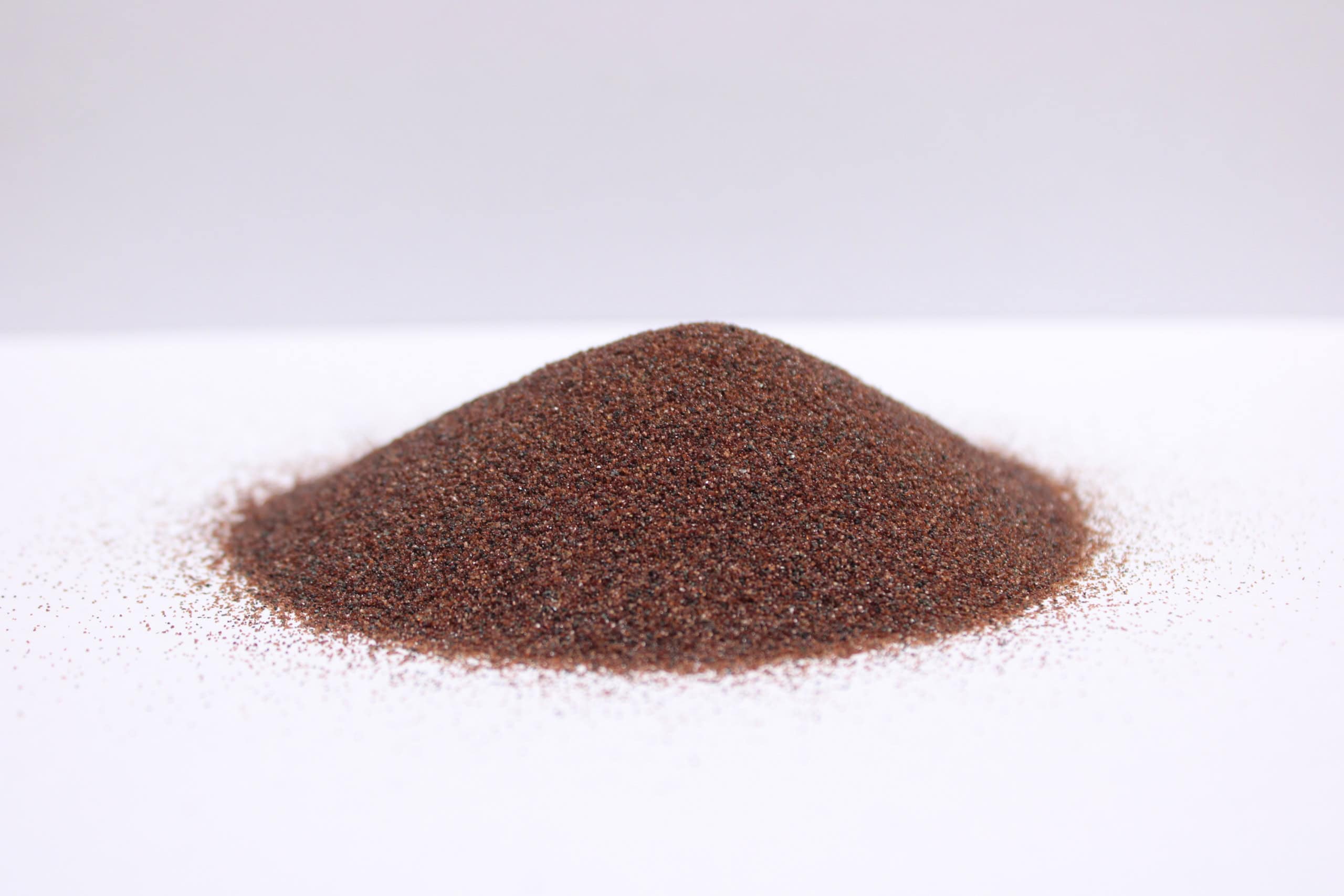
Particle shape significantly amplifies abrasion rate. Angular, sharp-edged particles (crushed steel grit, garnet, silica sand) produce cutting wear—a single particle can carve a groove many times its own diameter as it slides across a surface. Rounded particles (steel shot, glass beads) produce ploughing wear, which displaces rather than removes material and is typically 2–4× less severe for the same hardness and concentration.
3. Mechanism 2: Erosion — Impact-Driven Material Loss
Erosion occurs when particles traveling at high velocity impact pump surfaces and remove material on impact through chipping, cracking, or plastic deformation. It is the dominant wear mechanism in the highest-velocity zones of centrifugal pumps—the impeller outlet, the volute tongue, and any flow direction change—where particles arrive at speeds proportional to impeller tip velocity.
The velocity dependence of erosion is its most important characteristic for pump engineers: erosion rate scales approximately with the second to third power of particle velocity (E ∝ vn, where n = 2.0–3.0 depending on material and impact conditions). This means doubling the impeller tip speed increases erosion rate by four to eight times. Conversely, reducing operating speed from 100% to 80% of design reduces erosion rate by approximately 50%—a powerful lever for extending pump service life. See: Optimal RPM & Flow Rate for Abrasive Media Pumps.
The angle of particle impact also determines erosion mode and rate. For ductile materials such as metals:
- Low-angle impact (15–30°): Cutting-mode erosion — particle ploughs a groove along the surface. Maximum erosion rate for metals occurs in this range.
- High-angle impact (70–90°): Deformation-mode erosion — particle compresses and deforms the surface plastically. Less severe for ductile metals, but the dominant mode in zones where flow impinges perpendicularly on walls.
For brittle materials such as ceramics and white cast iron:
- Maximum erosion occurs at high impact angles (70–90°) through crack propagation and material fracture. Ceramics are therefore inappropriate for zones experiencing high-velocity, high-angle particle impact, despite their very high hardness.
4. Mechanism 3: Erosion-Corrosion — Synergistic Attack
Erosion-corrosion occurs when abrasive wear and chemical corrosion operate simultaneously on the same surface, producing combined material loss that is 2–5× greater than the sum of each mechanism acting independently. The synergy arises because the protective oxide film (the passivating layer that gives metals their corrosion resistance) is continuously removed by abrasive contact, preventing it from re-forming and leaving bare reactive metal permanently exposed to the corrosive carrier fluid.
Erosion-corrosion is most severe in applications combining:
- Acidic carrier fluids (pH below 5) — acid mine drainage, phosphate slurry, pickle liquor
- Abrasive particles — ore minerals, mineral acids with silica, reactive slurries
- High flow velocity — which both increases mechanical wear and maintains fresh electrolyte at the surface
Materials that rely on a passive oxide film for their corrosion resistance—stainless steels, nickel alloys—are particularly susceptible to erosion-corrosion when that film is disrupted. High-chrome white iron, which resists corrosion through chromium carbide precipitation rather than a passive film, is more tolerant of combined attack in moderately acidic conditions (pH 4–6). Below pH 3, or in oxidizing acid environments, even high-chrome alloys are inadequate and PVDF, PTFE, or ceramic materials are required. See: Pumps for Corrosive AND Abrasive Media.
5. Critical Wear Zones Inside a Centrifugal Slurry Pump
In centrifugal slurry pumps, wear is not uniformly distributed. Six zones experience disproportionately high wear rates due to geometric features that concentrate particle velocity, impact angle, or particle-surface contact time:
| Zone | Primary Mechanism | Key Driving Factor | Typical First-Failure Indicator |
|---|---|---|---|
| Impeller outlet (vane tip) | Erosion | Maximum fluid velocity in pump | Thinning or rounding of vane trailing edge |
| Impeller suction face | Abrasion | Continuous particle sliding along vane | Gradual reduction in vane thickness |
| Volute tongue | Erosion | High-velocity flow impinges directly | Deep pitting or groove at tongue location |
| Volute casing wall | Abrasion + Erosion | Asymmetric velocity profile in scroll | Wear groove pattern in lower volute section |
| Wear ring clearance | Abrasion + Erosion | Narrow gap amplifies particle velocity | Rising vibration; efficiency drop |
| Mechanical seal faces | Abrasion | Particle ingestion between seal faces | Seal leakage; increased product contamination |
For centrifugal slurry pumps, the impeller and volute liner are the primary wear components. Most manufacturers design these as replaceable items—the pump frame and bearing assembly are designed for long service life, while the wear components are replaced on a regular schedule. Monitoring the thickness of these wear components at each maintenance inspection is the most reliable way to predict remaining service life. See our full maintenance guide: Abrasive Media Pump Maintenance Guide.
6. Six Key Factors That Control Wear Rate
- Particle velocity (dominant factor): Wear rate scales with velocity raised to a power of 2–3. Reducing impeller tip speed by 20% can reduce wear rate by 36–49%. This is why operating at the minimum speed consistent with maintaining critical transport velocity is the highest-return action available to reduce pump wear. A variable frequency drive is the recommended implementation tool.
- Particle hardness relative to pump material: When particle Mohs hardness exceeds pump material hardness, wear rate increases steeply. The practical threshold: for high-chrome alloys (equivalent Mohs ~8–9), wear rate begins rising sharply when particle hardness exceeds approximately 0.8 × material hardness. For rubber, this threshold is approximately Mohs 6.5.
- Particle size and size distribution: Larger particles carry more kinetic energy per particle and create larger impact craters. Coarser media (d50 above 500 micron) tends to dominate wear behavior even at lower concentration because the energy per particle-surface impact event is much higher than for fine media. The d95 is particularly important: oversize particles in an otherwise fine-media stream cause disproportionate peak impact events at valve seats and impeller clearance zones.
- Forma de las partículas: Angular particles produce cutting-mode abrasion and are 2–4× more aggressive than spherical particles of equivalent hardness, size, and concentration. This is why switching from steel shot to steel grit in a recirculating blasting system dramatically increases pump wear even though the media material and concentration remain the same.
- Solids concentration: Wear rate increases with concentration but not proportionally—at very high concentrations, particles interfere with each other’s trajectories, reducing the effective energy delivered per particle-surface impact. For practical purposes, wear rate roughly doubles as concentration increases from 10% to 30% w/w for most mineral slurries.
- Carrier fluid chemistry (for erosion-corrosion): The chemical environment determines whether mechanical wear is compounded by corrosion. Even a mildly acidic carrier (pH 5–6) can double wear rates compared to neutral pH through the erosion-corrosion mechanism in steel and cast iron pumps. This effect increases dramatically as pH falls below 4. Material selection for corrosive conditions requires combined assessment of both chemical compatibility and mechanical wear resistance.
7. Engineering Countermeasures to Reduce Pump Wear
Understanding the wear mechanisms enables targeted engineering responses. The following countermeasures are listed in approximate order of impact per implementation cost:
- Reduce operating speed (highest return): Install a VFD and operate at the minimum speed that maintains critical transport velocity and process throughput. For every 10% reduction in speed, wear rate typically falls 20–30% due to the velocity exponent relationship.
- Match pump material to particle hardness: Switch from rubber to high-chrome alloy at particle hardness above Mohs 6.5–7. Consider ceramic inserts at Mohs 8+ for the highest-wear zones (impeller tip, volute tongue). See: Wear-Resistant Impeller & Liner Design for Abrasive Pumps.
- Maintain designed impeller clearance: As the gap between impeller and liner increases with wear, fluid recirculates through the gap at high velocity, causing accelerated secondary wear. Adjusting impeller position to restore designed clearance before replacement extends total liner service life by 20–35%.
- Control particle size distribution at the source: Using abrasive media with certified tight particle size distribution eliminates oversize particles that cause disproportionate peak wear events. Sourcing from manufacturers who provide sieve analysis certificates on every batch reduces wear rate variance and supports accurate maintenance scheduling.
- Install double mechanical seals with flush water: Seals fail most frequently from abrasive ingestion. A pressurized clean-water flush to the seal chamber (pressure slightly above slurry pressure) excludes abrasive particles from the seal faces, extending seal life by 3–5× compared to unprotected single seals in most abrasive applications.
- Size suction pipe diameter generously: Oversized suction piping reduces fluid velocity at the pump inlet, decreasing the kinetic energy of particles entering the impeller. This reduces erosion at the impeller inlet eye—a frequently overlooked secondary wear zone—without affecting process throughput.
Preguntas frecuentes
Control Wear at the Source — Start with Your Abrasive Media
The particle hardness, size distribution, and shape of your abrasive media are the primary inputs to every wear rate equation in this article. Jiangsu Henglihong Technology Co., Ltd. manufactures certified abrasive media with documented hardness grades and tight particle size tolerances — giving you reliable, consistent inputs for wear rate prediction and pump maintenance planning.
Request Media Certifications →Filtros