Ceramic Beads vs. Glass Beads for SLS 3D Printing Depowdering: Performance and Cost
Glass beads were the original blasting media for SLS depowdering — widely available, low entry cost, and adequate for early-generation SLS operations with modest throughput. As SLS has scaled from prototyping to volume production and surface quality standards have tightened, the limitations of glass beads have become increasingly disqualifying. This article provides the complete performance and cost comparison: why ceramic beads outperform glass across every metric that matters in professional SLS production, and the few scenarios where glass beads remain defensible.
1. A Brief History of Glass Beads in SLS Depowdering
When commercial SLS production scaled up in the 2000s, glass beads were the natural choice for post-processing media. Industrial glass bead blasting was a well-established process in metalworking and aerospace, glass beads were widely available from multiple suppliers in standardised size grades, and their cost was low. For the prototype-focused, relatively low-volume SLS operations of that era, glass beads were adequate: they cleaned parts, produced a reasonable surface finish, and did not require the cost justification that a higher-performance media demanded.
As SLS matured into a production technology through the 2010s and into the 2020s — with service bureaus running dozens of builds per week and OEM operations producing thousands of identical functional parts — the limitations of glass beads became progressively more disqualifying. Higher throughput meant faster media degradation; tighter surface quality standards meant Ra drift from degrading glass was no longer within acceptance bands; expanding dyeing requirements meant glass fragment contamination was creating costly reject events. By July 2026, the majority of professional SLS operations globally have switched from glass to ceramic bead depowdering media.
2. Physical Properties Comparison
| Property | Ceramic ZS | Ceramic ZrO₂ | Cuentas de vidrio |
|---|---|---|---|
| Densidad (g/cm³) | 3.8–4.0 | 5.4–5.6 | 2.5–2.6 |
| Hardness (Mohs) | 7.0–7.5 | 8.0–8.5 | 5.5–6.0 |
| Sphericity | >95% | >96% | 90–95% |
| Recycling cycles (SLS) | 1,500–2,500 | 2,500–4,000 | 400–800 |
| Failure mode | Spherical attrition | Spherical attrition | Shattering |
| Ra drift over service life | ±1–2 µm | ±0.5–1.5 µm | +3–6 µm upward |
| Surface contamination risk | Minimal (chemically inert) | Minimal (chemically inert) | High (sharp glass fragments) |
| Unit cost (relative) | Moderate (2–3× glass) | High (4–5× glass) | Low (baseline) |
| Cost per 1,000 parts | Lower than glass | Similar to glass or lower | Higher than ceramic ZS |
3. Cleaning Effectiveness on PA12 SLS Parts
Both ceramic and glass beads can remove the semi-sintered skin from PA12 SLS parts — but ceramic beads do so more efficiently and with greater consistency, for two reasons.
First, ceramic ZS beads have higher density (3.8–4.0 g/cm³ vs. 2.5–2.6 g/cm³ for glass). At the same blast velocity, a ceramic bead delivers approximately 55–60% more kinetic energy per impact than an equivalent-size glass bead. This means ceramic beads can dislodge the semi-sintered skin at lower pressure and shorter cycle time than glass beads at equivalent settings — or clean more thoroughly at the same pressure.
Second, ceramic beads are harder (Mohs 7.0–7.5 vs. 5.5–6.0 for glass). The combination of higher hardness and higher density means the ceramic bead penetrates the semi-sintered skin bond more effectively per impact event, producing complete skin removal in fewer total impacts than glass.
In practice: a standard PA12 depowdering cycle with ceramic ZS at 62 PSI for 7 minutes typically delivers complete skin removal and Ra 6–11 µm. An equivalent glass bead cycle at 62 PSI for the same 7 minutes produces Ra 7–14 µm with higher variability — the cleaning result is adequate early in the media charge life but degrades measurably as glass beads shatter and the charge composition changes.
4. Surface Finish Consistency Over Media Lifetime
Ra consistency over the media charge lifetime is where the difference between ceramic and glass beads is most commercially significant — and most often undiscounted in purchase decisions that focus only on unit price.
| Metric | Ceramic ZS (1,500–2,500 cycles) | Glass Beads (400–800 cycles) |
|---|---|---|
| Ra at cycle 50 (fresh) | Ra 7–11 µm (qualification value) | Ra 8–13 µm (qualification value) |
| Ra at cycle 300 | Ra 7–12 µm (±1 µm drift) | Ra 10–17 µm (+3–4 µm drift) |
| Ra at cycle 600 | Ra 8–12 µm (±1.5 µm drift) | Ra 13–20 µm (+5–7 µm, approaching replacement) |
| Ra at cycle 1,000 | Ra 8–13 µm (approaching top-up) | Media already replaced once |
| Monitoring frequency needed | Weekly or monthly | Daily or per-shift |
| Out-of-spec Ra events per 1,000 cycles | 1–3 events | 8–15 events |
The glass bead Ra drift is not gradual and predictable — it accelerates as the proportion of angular fragments in the charge increases. Operations using glass beads find that Ra is acceptable for the first 200–300 cycles, then begins to drift and become more variable, requiring either frequent media replacement (which increases cost) or tighter monitoring with more frequent Ra measurement (which increases labour cost).
5. Failure Mode: Shattering vs. Spherical Attrition
The fundamental difference between ceramic and glass bead degradation is the failure mode — and this difference drives every downstream quality and cost implication.
Glass beads fail by shattering. On impact, glass beads fracture along internal stress planes (Hertzian cone cracks), breaking into irregular angular fragments. The fragmentation typically occurs suddenly and completely — a glass bead that survives 200 impacts may shatter on the 201st. The angular fragments have sharp edges, irregular shapes, and behave differently from the spherical beads they replaced, producing scratching rather than peening action on the nylon surface.
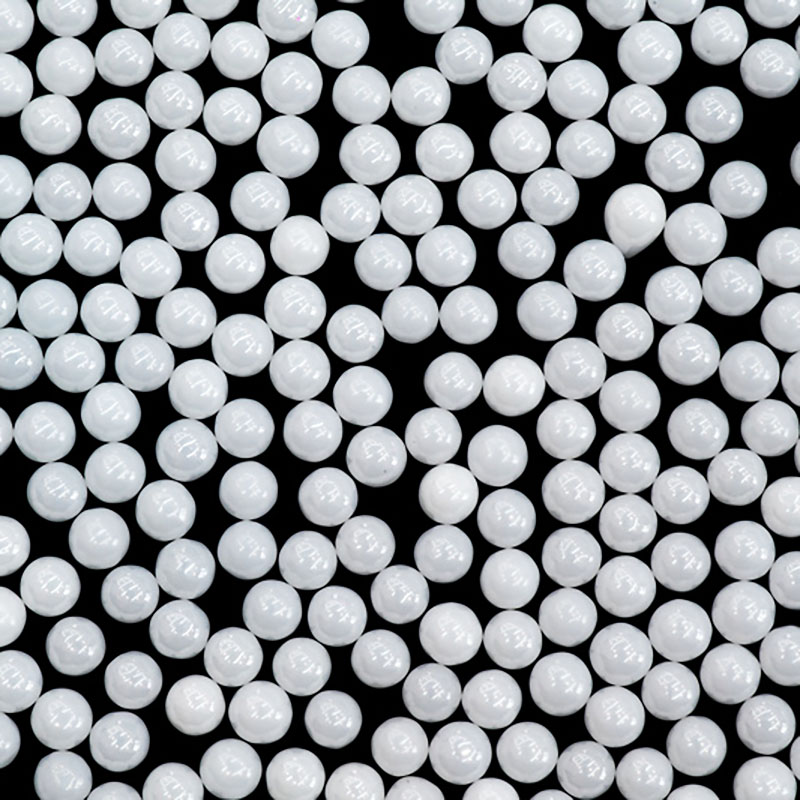
Ceramic beads fail by spherical attrition. Each impact chips micro-scale fragments from the ceramic bead surface, progressively reducing diameter while maintaining approximate spherical morphology. The bead does not suddenly fail — it gradually becomes smaller. At any point during its service life, the vast majority of the ceramic charge remains spherical and functionally useful, just at a slightly smaller average diameter. Cleaning performance declines gradually and predictably, not catastrophically.
The attrition-vs-shattering distinction is the root cause of ceramic’s Ra consistency advantage and the reason ceramic produces far less surface contamination than glass.
6. Glass Fragment Contamination and Its Consequences
Glass fragments embedded in SLS nylon surfaces are a production quality problem that is often under-counted because the contamination is subtle, variable, and manifests differently in different downstream processes.
In dyeing operations
Sharp glass fragments embedded in the nylon surface block dye penetration at the point of embedment, creating white or lighter-coloured pinholes in the dyed surface. These pinholes are typically 0.05–0.3 mm diameter and individually subtle, but in aggregate on a large area they produce a mottled appearance under raking light that fails appearance inspection. Parts rejected for this reason cannot be re-dyed to remedy the contamination — the glass is embedded and the pinholes persist.
In painting and coating operations
Glass fragments under paint or powder coat create stress risers that cause local delamination of the coating over time. Parts with glass contamination may pass initial visual inspection but fail adhesion cross-cut testing, or show coating delamination around the contamination sites after environmental cycling.
In dimensional measurement
Glass fragments sitting proud of the nylon surface produce false high readings on dimensional measurements and surface roughness profilometry. This can cause parts to fail dimensional inspection when they are actually within specification, triggering unnecessary rework.
7. Cost-Per-Part Analysis
The conventional purchasing argument for glass beads — lower unit price per kilogram — inverts completely when expressed as media cost per part processed.
| Scenario | Ceramic ZS | Ceramic ZrO₂ | Cuentas de vidrio |
|---|---|---|---|
| Charge mass | 10 kg | 10 kg | 10 kg |
| Cost per kg | ~USD 10 | ~USD 18 | ~USD 4 |
| Total charge cost | USD 100 | USD 180 | USD 40 |
| Service life (cycles) | 2,000 | 3,000 | 600 |
| Parts per cycle | 30 | 30 | 30 |
| Total parts processed | 60,000 | 90,000 | 18,000 |
| Media cost per part | USD 0.0017 | USD 0.0020 | USD 0.0022 |
| vs. glass baseline | −23% | −9% | Baseline |
The table above covers pure media cost. When rework cost from glass-contamination rejects is included — parts rejected for dye pinholes, coating delamination, or Ra exceedances from glass fragment-induced surface degradation — the total cost advantage of ceramic over glass is typically 30–60% at operations processing 100+ builds per week.
8. When Glass Beads Are Still Acceptable
Glass beads remain defensible in these specific circumstances
- Very low throughput operations — fewer than 50 blast cycles per month — where the 400–800 cycle glass bead service life is sufficient for many months of operation
- Prototype or one-off SLS parts where dyeing is not performed and surface finish Ra is not tightly specified
- Simple open geometry parts with no fine internal channels, where glass bead fragment contamination risk is lower (no channel accumulation zones)
- Budget-constrained startups or academic labs where SLS blasting is occasional and media cost minimisation outweighs process consistency
9. Switching from Glass to Ceramic: What to Expect
- Purge the glass bead charge completely before introducing ceramic. Mixing glass and ceramic beads creates a polydisperse charge with unpredictable Ra output and accelerated glass fragment accumulation from continued glass shattering. Remove all glass media, clean the blast cabinet interior, and verify no glass residue remains in the cabinet floor and hose before loading ceramic.
- Reduce inlet pressure by 5–10 PSI from your glass bead setting. Ceramic ZS delivers approximately 55–60% more kinetic energy per impact than glass at the same velocity. Starting at the same pressure as your glass protocol will over-blast your PA12 parts initially.
- Re-qualify by first-article inspection at the reduced pressure. Check Ra on a reference coupon and inspect for powder removal completeness. If powder remains in recesses, extend cycle time rather than increasing pressure on first qualification runs.
- Expect 5–15% shorter cycle time for equivalent cleaning coverage at the adjusted pressure. Ceramic’s higher kinetic energy per impact means fewer total impacts are needed to achieve complete skin removal.
- Surface contamination issues should resolve immediately. Any glass-fragment dye pinholes or coating adhesion problems present in your previous glass bead production will not occur with ceramic beads from the first cycle.
Preguntas frecuentes
Three factors drive the switch. First, recycling life: ceramic ZS runs 1,500–2,500 cycles vs. 400–800 for glass — 3–5× longer from the same charge investment. Second, Ra consistency: ceramic degrades gradually through spherical attrition, maintaining consistent surface finish through its service life; glass shatters into angular fragments that progressively degrade Ra output by 3–6 µm and create increasing variability within 300–500 cycles. Third, glass contamination: shattered glass fragments embed in nylon surfaces and create dye pinholes, coating delamination, and dimensional measurement errors — reject costs that often exceed the media cost savings glass beads provide on a unit-price basis.
Glass beads last 400–800 blast cycles before Ra output deteriorates to the point where replacement is necessary. Zirconia-silicate (ZS) ceramic beads last 1,500–2,500 cycles; pure zirconia (ZrO₂) ceramic beads last 2,500–4,000 cycles. Despite ceramic’s higher unit cost per kilogram (2–5× glass depending on grade), the 3–5× service life advantage makes ceramic ZS media cost per part approximately 20–25% lower than glass beads at any production throughput above low-volume prototype work.
Glass beads degrade by catastrophic fracture — each impact can shatter the bead into angular fragments. Over 200–400 cycles, the charge transitions from uniform spherical glass to a mixed population of spheres and angular debris. The angular fragments produce scratching rather than peening on the nylon surface, causing Ra to drift upward 3–6 µm from the qualification baseline by mid-service-life. Ceramic beads degrade gradually through spherical attrition (becoming smaller but remaining spherical), maintaining Ra within ±1–2 µm of the baseline through 80% of their service life. This difference means ceramic requires much less frequent Ra monitoring and produces far fewer out-of-specification surface finish events per production run.
Yes — reduce blast pressure by approximately 5–10 PSI from your glass bead setting when switching to ceramic ZS at the same nominal bead size. Ceramic ZS beads (density 3.8–4.0 g/cm³) deliver approximately 55–60% more kinetic energy per impact than glass (2.5–2.6 g/cm³) at the same nozzle velocity. Running ceramic at glass bead pressure settings will over-blast PA12 parts — producing higher Ra, increased material removal, and potential bead embedment on fine features. After the pressure reduction, verify by first-article Ra measurement and adjust cycle time if needed for complete powder removal.
Related Articles in This Series
Return to the Ceramic Beads for SLS Powder Removal — Complete Guide for the full overview.
The other alternative to ceramic — when plastic media is and isn’t appropriate for SLS.
Ra consistency data over media lifetime — the key advantage of ceramic over glass.
How to monitor ceramic bead media condition and manage charge top-up and replacement.
Why glass contamination causes dye pinholes — and how ceramic beads eliminate this problem.
How to adjust pressure when switching from glass to ceramic bead blasting.
Full ceramic bead protocol for the most common SLS material — applying the ceramic advantage.
Switch to Ceramic Beads for Your SLS Depowdering Operation
Jiangsu Henglihong Technology Co., Ltd. supplies ZS and ZrO₂ ceramic blasting beads in ISO-classified sizes from 0.05 mm to 0.60 mm. Ready to switch from glass to ceramic? Tell us your current glass bead size and SLS material — we will recommend the equivalent ceramic grade, starting pressure adjustment, and supply samples for qualification.
Request Ceramic Bead SamplesFiltros