Jiangsu Henglihong Technology Co., Ltd.
Aluminum Oxide Sandblasting Media: Properties, Grit Sizes & Best Uses
The definitive technical guide to aluminum oxide (Al₂O₃) abrasive — covering brown vs. white grades, Mohs hardness, mesh sizes, surface profile data, recyclability, and the applications where it outperforms every competing media type.
What Is Aluminum Oxide Abrasive?
Aluminum oxide — chemical formula Al₂O₃, also known as alumina, corundum, or alox — is a synthetic mineral abrasive produced by fusing bauxite ore in high-temperature electric arc furnaces (the Bayer and Hall–Héroult processes). The result is an extremely hard, chemically stable crystalline material that fractures under impact to continuously expose fresh, razor-sharp cutting edges throughout the blasting cycle. This self-sharpening characteristic is one of the primary reasons aluminum oxide has become the most widely used mineral blasting abrasive in industrial surface preparation worldwide.
Unlike natural abrasives such as garnet or quartz, the composition, crystal structure, and particle geometry of aluminum oxide can be precisely controlled during manufacturing. This means that consistent hardness, predictable grit sizes, and reliable surface profile outcomes are achievable across production batches — a critical advantage in industrial coating specifications where surface profile tolerances are tight.
For a broader comparison of all available sandblasting media options, see our comprehensive guide to sandblasting material types and selection.
Aluminum oxide is the first-choice industrial abrasive for steel surface preparation, aggressive rust and mill scale removal, weld cleaning, and surface profiling before protective coatings. It combines Mohs 9 hardness with angular geometry, outstanding recyclability, and broad grit-size availability — making it highly cost-effective for both open-blast and reclaim-system operations.
Physical & Chemical Properties
Understanding the underlying material science of aluminum oxide explains why it behaves so reliably in demanding blasting applications.
Hardness and Crystal Structure
At Mohs 9.0, aluminum oxide is harder than virtually every substrate and contaminant it will encounter in industrial blasting — including carbon steel (approximately Mohs 4–5), rust (Mohs 3–4), mill scale (Mohs 6–7), paint and organic coatings (Mohs 1–3), and even stainless steel (Mohs 5.5–6.5). This hardness margin ensures that each particle can cut decisively into contaminants and substrate alike without the particle itself dulling or deforming. The alpha-alumina crystal structure (corundum) is thermodynamically stable and does not react with most metals, acids at room temperature, or alkaline cleaning agents — making spent media relatively safe to handle and dispose of.
Particle Shape: Blocky Angular
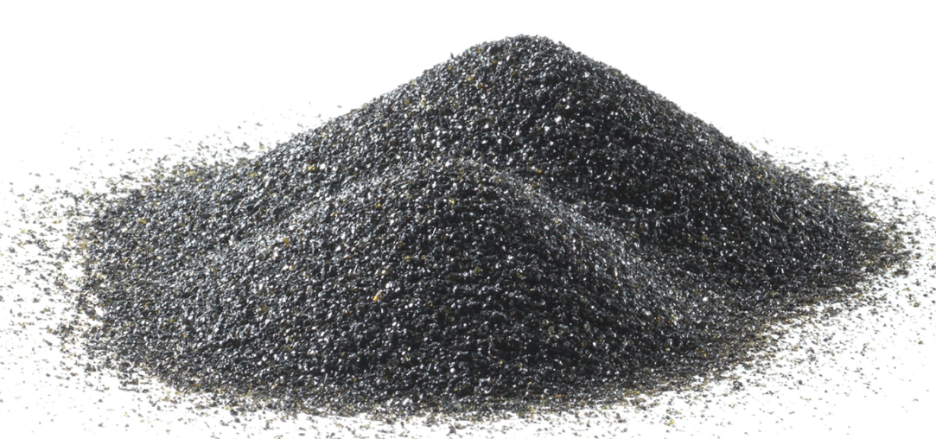
Aluminum oxide particles produced by crushing fused alumina blocks have an irregular, blocky angular shape with multiple sharp facets and edges. When a particle impacts the substrate, these sharp edges function as micro-chisels, cutting into the surface and displacing contaminants or base material. This cutting action creates the pronounced, jagged anchor profile that coating engineers specify to maximize the mechanical adhesion of primers, epoxies, zinc-rich coatings, and polyurethane topcoats. The anchor profile depth (Ra and Rz values) produced by aluminum oxide at various grit sizes and pressures is well-documented in SSPC and ISO surface preparation standards, which is why it is the reference abrasive for many coating specification documents.
Comparative Hardness — Key Blasting Media
Mohs Scale Comparison (1 = softest, 10 = hardest)
Chemical Stability and Contamination
One significant advantage of aluminum oxide over ferrous abrasives (steel shot and grit) is that it introduces no iron contamination to the blasted surface. This makes it the preferred abrasive for blasting stainless steel, non-ferrous metals (aluminum, titanium, copper alloys), and any substrate where iron contamination would compromise the subsequent process — such as surfaces destined for stainless steel welding, electroplating, anodizing, or use in food-contact or pharmaceutical environments.
Brown vs. White Aluminum Oxide: Which Grade Do You Need?
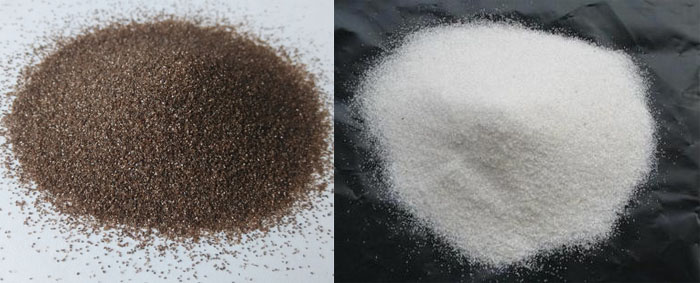
Aluminum oxide for blasting is available in two primary grades, distinguished by their purity level, toughness, and thermal properties. Selecting the correct grade for your application prevents unnecessary cost while ensuring the surface finish outcome you need.
⬤ Brown Aluminum Oxide (BFA)
Al₂O₃ content: 94–97%
Color: Brown to dark brown
Toughness: Higher — more fracture-resistant
Cost: Lower — most widely available
- General industrial surface preparation
- Heavy rust and mill scale removal
- Structural steel, bridges, pipelines
- Blast cabinets and rooms with reclaim
- Abrasive grinding wheels and bonded abrasives
⬤ White Aluminum Oxide (WFA)
Al₂O₃ content: 99%+
Color: Blanco
Toughness: Lower — more friable, sharper fracture
Cost: Higher — specialist applications
- Precision deburring of hardened tool steels
- Stainless steel and non-ferrous metal blasting
- Optical glass and lens grinding
- Medical implant surface finishing
- Applications requiring zero iron contamination
For the vast majority of structural steel surface preparation and industrial coating projects, brown aluminum oxide is the correct and most cost-effective choice. Reserve white aluminum oxide for applications involving stainless steel, titanium, non-ferrous metals, or high-precision finishing where iron contamination is a genuine disqualifying risk.
Grit Size Chart & Surface Profile Data
Aluminum oxide is commercially available across a very wide grit range, from coarse F12 (approximately 1.7 mm particle diameter) through ultra-fine F220 (approximately 0.063 mm). The table below maps FEPA grit designations to particle size ranges, approximate anchor profile depths on carbon steel, and typical application categories. For a complete cross-media grit size reference, see our sandblasting grit size chart and surface profile guide.
| FEPA Grit | US Mesh Approx. | Particle Size (mm) | Anchor Profile Ra (µm) | Anchor Profile Rz (µm) | Typical Use |
|---|---|---|---|---|---|
| F12 | #12 | 1.70–2.00 | 60–80 | 120–150 | Very aggressive profiling, thick scale |
| F16 | #16 | 1.18–1.70 | 50–70 | 100–130 | Heavy structural steel, ship hull prep |
| F24 | #24 | 0.71–1.18 | 40–55 | 80–110 | Industrial coating prep, bridge structures |
| F36 | #36 | 0.50–0.71 | 30–45 | 60–90 | General rust and mill scale removal |
| F46 | #46 | 0.355–0.50 | 25–38 | 50–75 | Versatile industrial prep, pipe coating |
| F60 | #60 | 0.25–0.355 | 18–28 | 35–55 | |
| F80 | #80 | 0.18–0.25 | 12–20 | 25–40 | Automotive surface prep, light coatings |
| F120 | #120 | 0.106–0.18 | 8–14 | 15–28 | Precision deburring, thin-coat prep |
| F180 | #180 | 0.075–0.106 | 4–8 | 8–15 | Fine finishing, light etching |
| F220 | #220 | 0.053–0.075 | 2–5 | 4–10 | Ultra-fine finishing, glass etching |
Anchor profile depth depends not only on grit size but also on blast pressure (PSI), nozzle-to-surface standoff distance, nozzle diameter, and blast angle. The Ra/Rz values above are representative of typical production conditions (80–100 PSI, 6–10 inch standoff, perpendicular blast angle) on carbon steel. Always conduct trial blasts and measure actual profile with a surface profilometer before specifying for coating work.
Best Uses & Applications by Industry
Aluminum oxide’s combination of extreme hardness, angular geometry, and broad grit availability makes it the most versatile heavy-duty industrial abrasive. Below are the primary application domains where it consistently outperforms alternatives.
Removing tight mill scale, weld spatter, and heavy rust from I-beams, plates, and box sections prior to zinc-rich primer or epoxy coating. Sa 2.5 and Sa 3 cleanliness readily achievable.
Internal and external pipe surface prep before FBE (fusion-bonded epoxy), polyethylene, or coal tar enamel coating. Aluminum oxide produces the anchor profile required by ISO 8501 and NACE SP0188 standards.
Hull plate preparation for anticorrosive primer systems. Where garnet or crushed glass may be preferred on environmentally sensitive drydock sites, aluminum oxide delivers superior throughput in enclosed or ventilated blast rooms.
Deburring castings, forgings, and machined components. Removing heat-treatment scale and oxidation from gear blanks, shafts, and structural weldments before quality inspection or finishing.
White aluminum oxide for precision deburring of titanium and aluminum aerospace parts where iron contamination from steel media would be disqualifying. Consistent grit sizing ensures dimensional repeatability.
Removing weld oxidation (heat tint), spatter, and flux residue from stainless steel and carbon steel weldments before non-destructive testing (NDT) or final coating application.
Creating controlled micro-roughness on metal substrates for thermal spray coatings, ceramic coatings, rubber bonding, and adhesive joints. F24–F46 grit delivers profiles compatible with most thermal spray specifications.
Fine-grade aluminum oxide (F120–F220) for frosting, etching, and decorative sandblasting of architectural glass, glassware, and decorative panels. Produces a consistent matte finish with clean edge definition.
For a dedicated guide covering sandblasting media selection specifically for metal surface preparation — including cleanliness standards, coating compatibility, and case studies — see best sandblasting material for metal: surface prep before painting and coating.
Compatibilidad de equipos
Aluminum oxide is compatible with all major categories of abrasive blasting equipment, but there are important operational parameters to observe to maximize media efficiency and protect equipment from accelerated wear.
Pressure Blast Pots
The most common setup for industrial aluminum oxide blasting. Recommended operating pressure is 80–110 PSI for coarser grits (F12–F46) and 60–90 PSI for finer grits (F80–F220). Higher pressures accelerate media fracturing and generate more fines, reducing effective reuse cycles. Use tungsten carbide or boron carbide blast nozzles — aluminum oxide’s hardness will rapidly erode ceramic or steel nozzles. Nozzle bore diameter should be matched to grit size: coarse grits require larger bore diameters to avoid bridging and flow restriction.
Blast Cabinets with Reclaim Systems
Aluminum oxide performs exceptionally well in suction-feed and pressure-feed blast cabinets equipped with cyclone separator and media classifier. The classifier removes fines (broken-down particles below effective blasting size) and allows consistently sized media to recirculate. Regular classifier adjustment is essential to maintain surface profile consistency across the reuse life of the media charge.
Blast Rooms
Large-scale blast rooms with mechanical floor reclaim systems are the optimal environment for aluminum oxide in high-volume production. The reclaim system continuously removes fines, classified media is returned to the blast pot, and operators can treat large fabrications (tank sections, structural assemblies) efficiently. Proper dust collection (baghouse or cartridge filter) is mandatory — aluminum oxide generates moderate volumes of very fine abrasive dust that poses respiratory hazards if not controlled.
Wet Blasting / Vapor Blasting
Aluminum oxide can be used in wet blasting (slurry blasting) systems. The addition of water suppresses dust significantly and reduces the risk of RCS exposure. However, aluminum oxide does not dissolve or react with water, and it sinks readily, making it compatible with all common wet blasting equipment designs. Ensure that pH-neutral corrosion inhibitors are added to the water supply when wet-blasting carbon steel to prevent flash rust on the freshly blasted surface.
Recyclability & True Cost Per Blast Cycle
The economic case for aluminum oxide in production blasting is built on its recyclability — not its purchase price. When operated in a well-maintained reclaim system with proper classification, a single charge of aluminum oxide can sustain 15 to 30 effective blast cycles before the proportion of fines (particles too small to produce the target surface profile) becomes excessive and the charge must be refreshed.
Cost Per Square Meter — Sample Calculation
Assumptions: Brown aluminum oxide F36, bulk purchase price $0.80/kg; consumption rate 0.3 kg/m² per cycle (pressure blast at 90 PSI); 20 effective reuse cycles in a reclaim system with classifier. Cost per m² = $0.80 ÷ 20 cycles × 0.3 kg/m² = approximately $0.012 per m² — comparable to or lower than single-use media alternatives when their full disposal and handling costs are included. Note: these figures are illustrative; actual costs vary significantly by region, volume, and blast parameters.
Maximizing Reuse Life: Operational Best Practices
- Maintain classifier settings: A properly adjusted cyclone separator and classifier will continuously remove fines and broken particles, allowing only effective-size media to recirculate. This is the single most important factor in maximizing reuse cycles.
- Control blast pressure: Excess pressure accelerates particle fracturing. Use the minimum pressure that achieves your target surface profile — typically 80–90 PSI for F36–F46 on carbon steel.
- Keep media dry: Moisture causes media agglomeration, nozzle clogging, and surface flash rust. Ensure that the compressed air supply is properly dried (refrigerant or desiccant dryer) before it enters the blast pot.
- Monitor particle size distribution: Periodically sieve a sample of the circulating media charge and compare the particle size distribution to the original specification. When the fines fraction exceeds approximately 30% by weight, it is time to top up with fresh media.
Aluminum Oxide vs. Other Blasting Media
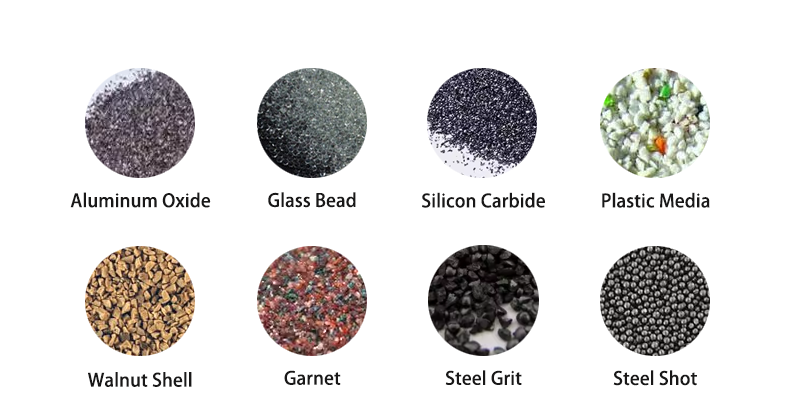
The right media comparison depends on the specific combination of substrate, contaminant, required finish, operating environment, and budget. The table below provides a direct comparison across the most common decision scenarios. For a comprehensive multi-media comparison tool, see the sandblasting media comparison chart.
| Comparison | Al₂O₃ Wins When… | Alternative Wins When… |
|---|---|---|
| vs. Glass Beads | Rust removal, heavy coatings, anchor profile needed for coating adhesion, hard substrates | Polishing, peening, smooth finish required, stainless steel aesthetic finishing, thin aluminum panels |
| vs. Steel Grit | Stainless steel, non-ferrous metals, no-iron-contamination applications, smaller batch / open blast | Very high volume structural steel in closed-loop system; lowest possible cost per m² |
| vs. Garnet | Higher throughput, harder substrates, tighter profiles, lower cost at equivalent hardness | Environmentally sensitive open-air sites; waterjet cutting applications |
| vs. Silicon Carbide | Most industrial metals and alloys; cost-effective performance across typical applications | Extremely hard substrates (tungsten carbide, technical ceramics) where Al₂O₃ cannot cut efficiently |
| vs. Crushed Glass | Recyclability, harder substrates, higher productivity, larger anchor profiles | Environmental compliance, single-use open-blast, lower-budget operations on concrete and masonry |
For guidance on selecting between these media in the specific context of automotive restoration projects, see our guide on sandblasting material for automotive restoration.
Preguntas frecuentes
F-grade (macro grits, FEPA F-series, e.g., F12–F220) is the standard specification for bonded abrasives, grinding wheels, and blasting media. P-grade (FEPA P-series, e.g., P40–P2500) is used for coated abrasives such as sandpaper and abrasive belts — it uses a different sieving methodology that produces a different particle distribution at nominally equivalent grit numbers. For blasting applications, always specify F-grade aluminum oxide. Mixing up the two specifications leads to surface profile inconsistency and poor process repeatability.
Yes — and this is one of aluminum oxide’s key advantages over steel abrasives. Because aluminum oxide contains no iron, it does not contaminate the stainless steel surface with ferrous particles that would subsequently oxidize and appear as rust staining (a common problem when carbon steel equipment or steel abrasives are used on stainless steel). For stainless steel applications, use white aluminum oxide (WFA, 99%+ Al₂O₃ purity) rather than brown, as brown grades contain small amounts of titanium oxide and other trace elements that could theoretically introduce contamination in the most demanding applications (pharmaceutical, food-grade, aerospace).
The correct grit size depends on the coating system being applied and its specified anchor profile requirement. As a general guide: for heavy-duty industrial epoxy and zinc-rich primers (typical anchor profile 40–75 µm Ra), specify F36–F46 aluminum oxide. For automotive primers and thin-film industrial coatings (anchor profile 20–40 µm Ra), F60–F80 is appropriate. For thin architectural coatings and powder coatings (anchor profile 10–25 µm Ra), F80–F120 works well. Always consult the coating manufacturer’s technical data sheet for the required surface profile range — this is the starting point for grit selection.
Yes. Jiangsu Henglihong Technology Co., Ltd. manufactures and exports brown aluminum oxide (BFA) and white aluminum oxide (WFA) in FEPA F-grade grit sizes from F12 through F220, in both 25 kg bags and bulk super-sack (1,000 kg) packaging. We serve B2B customers in the surface treatment, shipbuilding, oil & gas pipeline, and general metal fabrication sectors across Europe, North America, Southeast Asia, and the Middle East. Contact our team using the options below for pricing, technical data sheets, and sample requests.
Request a Quote
Specify your grit size, grade (brown or white), packaging format, and annual volume. We will respond with a competitive FOB/CIF price within 24 hours.
Get a Free Quote →Talk to a Technical Advisor
Not sure which aluminum oxide grade or grit size matches your coating specification? Our engineers will review your application and recommend the optimal solution.
Contact Our Team →Filtros