Silica Sand in Abrasive Blasting — Health Risks, OSHA Rules and Safe Alternatives Chart
Silicosis is irreversible, progressive, and has no cure. Abrasive blasting with silica sand is the single highest-risk occupational exposure route for crystalline silica dust worldwide, capable of delivering exposures 20–200 times the maximum permissible limit in the breathing zone of an unprotected blast operator. This guide explains the disease, the regulations, and the alternative media that eliminate the risk.
This page covers the complete regulatory and health picture for silica sand in abrasive blasting: what crystalline silica is, how blasting generates lethal exposures, the three forms of silicosis and their progression, the US OSHA Silica Standard requirements, an international regulatory summary by country and region, a direct comparison of safe alternative blast media, and the engineering controls and PPE hierarchy required to protect workers where silica is still in use.
For a full comparison of silica-free blast media options including hardness, grit size, profile depth, recyclability, and cost, see the complete abrasive blast media comparison and selection reference from Jiangsu Henglihong Technology Co., Ltd.
What Is Crystalline Silica and Why Is Blasting the Highest-Risk Activity?
Silicon dioxide (SiO₂) is one of the most abundant compounds in the earth’s crust. It occurs in two forms: amorphous silica (non-crystalline, glass-like arrangement of atoms — found in glass beads, crushed glass, and diatomaceous earth) and crystalline silica (atoms arranged in a regular repeating lattice — found in quartz sand, sandstone, granite, slate, and many industrial minerals). The health risk comes exclusively from crystalline silica, not from amorphous silica. Glass and crushed glass, for example, contain silicon dioxide but in the amorphous (non-crystalline) form — they carry no silicosis risk.
Three crystalline forms of silica exist in nature: quartz (by far the most common, present in most natural sands), cristobalite (a high-temperature phase), and tridymite (rare). Silica sand used historically in abrasive blasting is primarily quartz — typically 70–99% crystalline silica by composition, depending on the geological source. When this sand is propelled at high velocity against a steel surface, the impact shatters both the sand particles and the surface oxide, generating enormous quantities of fine particulate including respirable particles below 10 µm in diameter — the fraction small enough to penetrate deep into the lung.
Abrasive blasting generates silica dust at concentrations that dwarf those in any other common occupational setting. Air monitoring data from blasting operations consistently shows breathing-zone concentrations of 1,000 to 10,000 µg/m³ or higher during active blasting without controls — compared to the OSHA PEL of 50 µg/m³ and NIOSH’s recommended maximum of 50 µg/m³. A worker conducting unprotected blasting for a single day can receive a silica dose equivalent to years of exposure in other construction activities. The combination of very high airborne concentrations, very small particle size (maximum respirable penetration), and sustained exposure during full working shifts makes abrasive blasting with silica sand one of the most rapidly silicosis-inducing occupational activities ever identified.
NIOSH Position: The National Institute for Occupational Safety and Health (NIOSH) and OSHA jointly recommend that silica sand should not be used as abrasive blast media. This recommendation has been in place since 1974 and is reinforced by every subsequent epidemiological study of blasting worker populations. There is no safe way to use silica sand as blast media in open-air or enclosed blasting operations with manually operated blast equipment.
Silicosis: The Disease, Its Three Forms, and Associated Conditions
Silicosis develops when respirable crystalline silica particles are deposited in the alveoli — the tiny air sacs where gas exchange occurs in the lungs. Alveolar macrophages (the lung’s cleanup cells) engulf the silica particles but cannot destroy them. The silica particles are toxic to the macrophages and kill them, triggering an inflammatory cascade. Repeated cycles of macrophage death, inflammation, and fibroblast activation deposit collagen scar tissue (fibrotic nodules) that progressively replaces functional lung parenchyma. The fibrosis is irreversible — even after all silica exposure ceases, the inflammatory process continues and the disease progresses.
- Develops after 10+ years of low to moderate silica exposure
- Most common form
- Symptoms: progressive dyspnea (breathlessness), chronic cough, fatigue
- Can develop into progressive massive fibrosis (PMF) — large, confluent fibrotic masses
- Continues to progress after exposure stops
- Many workers unaware until severe disability present
- Develops within 5–10 years of high-concentration exposures
- Faster disease progression than chronic form
- Higher risk of PMF development
- Common in blasters working without adequate protection
- Often diagnosed at an advanced stage due to rapid onset
- Associated with high risk of secondary tuberculosis
- Develops within weeks to 5 years of very high exposures
- Alveolar lipoproteinosis pattern — lungs fill with fluid and protein
- Rapid progression to respiratory failure
- Often fatal within months to a few years of diagnosis
- Rare with modern controls but reported in developing countries and non-compliant operations
- No effective treatment once established
Associated Health Conditions Beyond Silicosis
Crystalline silica exposure causes health effects beyond silicosis. The International Agency for Research on Cancer (IARC) classified inhaled crystalline silica from occupational sources as a Group 1 definite human carcinogen for lung cancer in 1997 — a classification reaffirmed in subsequent reviews. Workers with silicosis have a 2–3× elevated relative risk of lung cancer even when controlling for smoking. Additional documented associations include:
- COPD (Chronic Obstructive Pulmonary Disease) — progressive obstruction of airflow independent of the fibrotic silicosis nodules; commonly co-present with silicosis.
- Secondary tuberculosis (TB) — silicosis dramatically impairs the lung’s immune defense against Mycobacterium tuberculosis; silicosis increases TB susceptibility 2–4× and TB accelerates silicosis progression, creating a deadly synergy particularly important in high-TB-burden countries.
- Renal disease — growing epidemiological evidence links cumulative silica exposure to chronic kidney disease and glomerulonephritis, though the mechanism is still under active study.
- Autoimmune conditions — statistically elevated rates of scleroderma (systemic sclerosis), lupus erythematosus, and rheumatoid arthritis in silica-exposed worker populations compared to controls.
US OSHA Silica Standard: Requirements and Compliance
The OSHA Silica Standard — 29 CFR 1926.1153 (Construction) and 29 CFR 1910.1053 (General Industry and Maritime) — was published in March 2016 and became fully effective for construction in September 2017 and for general industry in June 2018. It represents the most significant occupational silica regulation in decades, reducing the PEL by a factor of 2–5 compared to the prior standard.
| OSHA Requirement | Threshold / Value | Employer Obligation |
|---|---|---|
| Permissible Exposure Limit (PEL) | 50 µg/m³ (8-hr TWA) | Must not expose workers above this level; engineering controls are primary means |
| Action Level (AL) | 25 µg/m³ (8-hr TWA) | Triggers air monitoring, worker notification, and medical surveillance obligations |
| Exposure assessment | All workers potentially exposed | Assess exposure by air monitoring or objective data; reassess with process changes |
| Engineering controls | Required first | Wet methods, LEV, enclosed blast rooms, remote operation — before relying on PPE |
| Respiratory protection | When controls insufficient | Supplied-air respirator (SAR) minimum; fit-tested and maintained per 29 CFR 1910.134 |
| Medical surveillance | ≥ AL for 30+ days/year | Initial exam, periodic exams, records maintained 30 years (see Section 7) |
| Training | All exposed workers | Annual training on silica health effects, controls, and standard requirements |
| Hazard communication | SDS, labeling | Silica-containing materials must be identified and communicated to workers |
| Recordkeeping | Full program | Air monitoring, medical exams, objective data — retained per regulatory schedules |
Practical compliance reality for blasting: Achieving the 50 µg/m³ PEL during abrasive blasting with silica sand requires fully enclosed blast rooms with workers operating equipment remotely — not practical for the vast majority of field blasting applications on bridges, ships, pipelines, and outdoor structures. OSHA’s own compliance guidance for abrasive blasting specifically lists substitution of blast media as the preferred control measure. Switching to a silica-free alternative eliminates the compliance problem entirely and simultaneously removes the long-term disease risk from your workforce.
International Regulatory Status: Country-by-Country Summary
| Country / Region | Key Regulation | Status for Sand Blasting | OEL (Respirable Silica) |
|---|---|---|---|
| United States | OSHA 29 CFR 1926.1153 / 1910.1053 | Effectively prohibited — PEL unachievable with sand in field blasting | 50 µg/m³ (TWA) |
| European Union | Directive 2004/37/EC (Carcinogens & Mutagens); REACH | Prohibited / severely restricted — Group 1 carcinogen classification | 0.1 mg/m³ (EU OEL) |
| United Kingdom | COSHH Regulations 2002; HSE EH40 | Effectively banned — HSE guidance prohibits sand blasting | WEL: 0.1 mg/m³ |
| Australia | Safe Work Australia Model WHS Regulations 2022 | Prohibited — all states; “engineered stone” silica also banned in 2024 | 0.02 mg/m³ (TWA) — most stringent globally |
| Canada | Provincial OHS regulations (OHSA, WSHA etc.) | Effectively prohibited in most provinces; Ontario, BC, Alberta all restrict | 0.025–0.1 mg/m³ (varies by province) |
| South Korea | Industrial Safety and Health Act (MOEL) | Prohibited for abrasive blasting operations | 0.05 mg/m³ |
| Japan | Industrial Safety and Health Act; Ministerial Ordinances | Prohibited in enclosed blast environments; restricted elsewhere | 0.03 mg/m³ |
| China | GBZ 2.1-2019 (Occupational Exposure Limits) | Regulated — OEL significantly stricter than pre-2016 US standard | 0.7 mg/m³ PC-TWA (quartz) |
| Middle East / GCC | National OSH regulations (vary by country) | Regulated — international project specs typically require silica-free alternatives | Varies; many adopt ILO guidance |
OEL = Occupational Exposure Limit; TWA = 8-hour time-weighted average; WEL = Workplace Exposure Limit. Regulations are subject to amendment — verify current requirements with the relevant national authority for any specific project jurisdiction. Information current as of July 2026.
Safe Alternatives Chart: Silica-Free Blast Media Compared
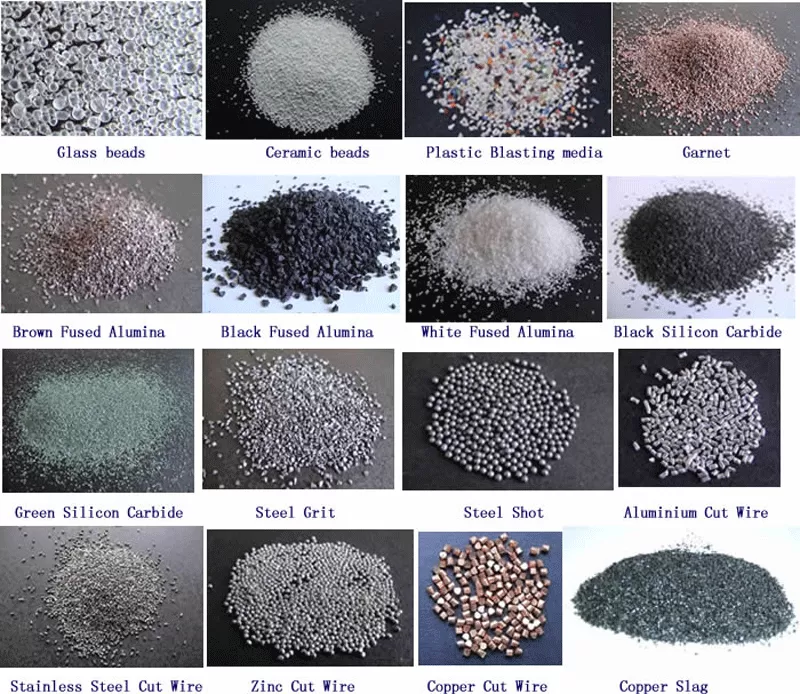
Every commercially significant blast media type other than silica sand and coal slag (coal slag may contain trace crystalline silica from quartz inclusions in the ore — always request elemental analysis) is either zero silica or contains only amorphous (non-crystalline, non-hazardous) silica. The table below compares the most practical safe alternatives on performance, cost, and environmental profile.
| Alternative Media | Crystalline Silica Content | Profile Capability | Cost vs Sand (per ton) | Reciclabilidad | Environment Rating | Best Application |
|---|---|---|---|---|---|---|
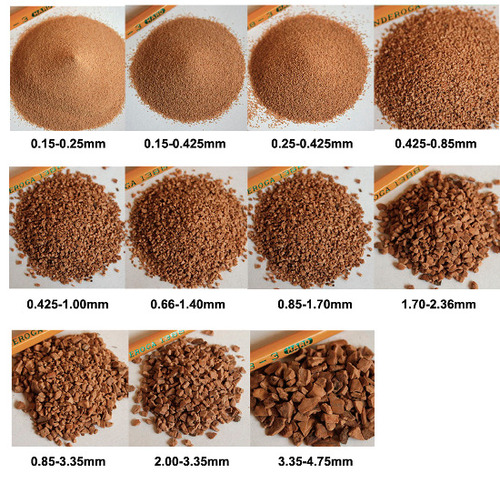
| Granate | <1% (amorphous) | Good — 1.0–3.5 mils | ~3–5× higher | 3–6 cycles | Excelente | Marine, bridge, field blasting — best single-use replacement for sand |
| Óxido de aluminio | Zero | Excellent — 1.5–5.0 mils | ~5–8× higher | 3–7 cycles | Bien | Steel prep, glass, concrete — widest grit range of any alternative |
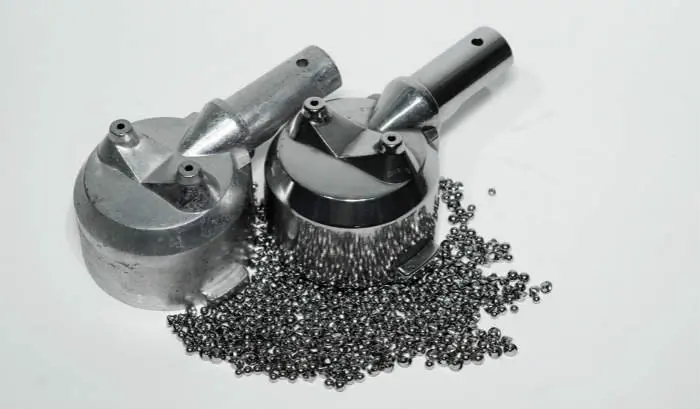
| Granalla de acero | Zero | Excellent — 2.5–6.0 mils | ~8–12× higher/ton | 100–300+ cycles | Very Good | High-volume production — lowest per-cycle cost; deep profiles |
| Disparo de acero | Zero | Moderate — 0.5–2.5 mils | ~8–12× higher/ton | 100–300+ cycles | Very Good | Foundry, shot peening, high-volume wheel-blast |
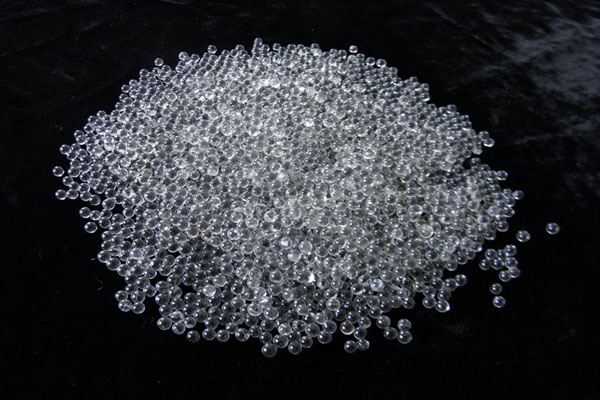
| Cuentas de vidrio | Zero (amorphous) | Limited — 0.5–1.5 mils | ~4–6× higher | 20–30 cycles | Bien | Stainless steel finishing; shot peening; decorative work |
| Crushed Glass | Zero (amorphous) | Moderate — 1.0–3.0 mils | ~1.5–2× higher | 1–3 cycles | Bien | One-pass outdoor blasting; lowest-cost silica-free option |
| Copper Slag | <1% (check by source) | Moderate — 1.5–3.5 mils | ~1.2–2× higher | 1–2 cycles | Poor (heavy metals) | Low-cost outdoor alternative; verify elemental analysis; declining regulatory acceptance |
| Silica Sand (reference) | 70–99% crystalline | 1.0–3.0 mils | Baseline | 1 cycle | Very Poor | ⛔ Prohibited or effectively banned in most major markets |
Key finding: Garnet and aluminum oxide match or exceed silica sand’s blasting performance in all categories — profile depth, cleaning speed, and surface quality — while generating no crystalline silica dust. For the vast majority of outdoor field blasting applications where sand has historically been used, garnet 16–30 grit is the direct functional replacement that requires no equipment changes and delivers superior environmental and health compliance.
Full Media Selection Guidance by Substrate For a complete matrix matching safe alternative media to specific substrate types and blasting objectives — including equipment considerations — see: Abrasive Blast Media Selection Chart by Material and Application
Engineering Controls and PPE Hierarchy
Where silica-containing materials are still used — or where silica dust may be generated from the substrate being blasted (concrete, granite, sandstone) even when using silica-free blast media — a hierarchy of controls must be applied in order of effectiveness. OSHA and NIOSH require that employers work through this hierarchy, not jump directly to PPE.
Elimination / Substitution — Most Effective
Substitute silica sand with a silica-free blast media. Garnet, aluminum oxide, steel grit, glass beads, or crushed glass all eliminate crystalline silica dust generation at source. This is OSHA’s preferred control — the one that removes the hazard rather than managing it. Substitution is the only control that achieves OSHA compliance in open-air field blasting without enclosed remote-controlled equipment. It also eliminates long-term liability and simplifies your OSHA compliance program significantly.
Engineering Controls
Where substitution is not possible and silica-generating processes continue: Wet blasting or vapor blasting suppresses dust at the point of generation — the most effective engineering control for blasting (reduces dust by 60–90% versus dry blast). Local exhaust ventilation (LEV) captures airborne particles close to the source in enclosed blast rooms with HEPA-filtered exhaust. Enclosed blast booths with automated or remotely operated equipment remove workers from the blast zone entirely. Vacuum blast tools (shrouded needle guns, vacuum-capture blast nozzles) recover dust at source in localized repair work.
Administrative Controls
Limit worker exposure duration through job rotation among tasks with different silica exposure levels. Schedule high-silica-exposure work when fewest workers are present. Establish regulated areas where silica-generating work occurs and prevent unprotected workers from entering. Implement thorough training programs on silica hazards, control methods, and PPE use before any worker is assigned to silica-exposure tasks. Clean up silica dust by wet methods or HEPA-filtered vacuum — never by dry sweeping, which re-suspends particles.
Personal Protective Equipment (PPE) — Last Resort
PPE is supplemental to engineering controls, not a substitute for them. For abrasive blasting, the minimum required respiratory protection is a supplied-air respirator (SAR), Type C, positive-pressure demand (NIOSH APF 1,000) with an abrasive blast hood or helmet (not a half-mask). A standard N95 or P100 filtering facepiece provides entirely inadequate protection against blasting dust concentrations (APF 10 — effective only up to 500 µg/m³ vs typical blasting concentrations of 5,000–50,000 µg/m³). The SAR airline hose must supply breathing-quality air meeting Grade D minimum — never compressed air directly from an oil-lubricated compressor without an in-line CO monitor and filtration system. Full body blast suits or protective coveralls, gloves, and hearing protection complete the blast operator PPE ensemble.
Medical Surveillance Requirements
The OSHA Silica Standard (29 CFR 1926.1153 and 1910.1053) requires medical surveillance for workers who may be exposed at or above the Action Level (25 µg/m³ as an 8-hour TWA) for 30 or more days per year. For most blasting operations involving silica-containing substrates or media, this threshold is exceeded. The surveillance program must be provided at no cost to the worker and conducted by or under the supervision of a licensed physician or other licensed health care professional (PLHCP).
| Surveillance Element | Timing | Content / Requirements |
|---|---|---|
| Initial medical exam | Within 30 days of assignment to silica-exposure work | Medical and occupational history; physical examination focused on respiratory system; chest X-ray (ILO classification, B-reader interpretation); spirometry (FVC, FEV₁); LTBI (latent tuberculosis) assessment |
| Periodic exams | Every 3 years (workers ≥40 years old); every 5 years (workers under 40) | Same elements as initial exam; compare to prior results for progressive change |
| Termination exam | Within 30 days of last day of employment if last exam was >3 years prior | Full exam as above; ensures exposure history is documented on leaving employment |
| PLHCP written report | After each exam | Results and interpretation; recommended limitations on exposure or use of respirators; whether referral to specialist is needed |
| Worker information | Within 30 days of exam | Employer must provide worker with copy of PLHCP’s written medical opinion |
| Recordkeeping | Minimum 30 years after employment ends | Medical surveillance records, exposure monitoring records, objective data used in lieu of monitoring |
The purpose of medical surveillance is not only regulatory compliance — it is early detection. Silicosis diagnosed in its early stages, before significant fibrosis has accumulated, allows the worker to be removed from further exposure and potentially slow disease progression through medical management. Workers with radiographic evidence of silicosis are also candidates for LTBI treatment to reduce the dramatically elevated tuberculosis risk associated with their silica burden. Surveillance records retained for 30 years allow epidemiological tracking of health outcomes in exposed worker populations — data that has historically been the basis for improving regulatory standards.
Preguntas frecuentes
Silicosis is a fibrotic lung disease caused by inhaling respirable crystalline silica particles. When these particles reach the alveoli (lung air sacs), they are engulfed by macrophage cells that cannot destroy them. The silica kills the macrophages, triggering inflammatory cycles that deposit collagen scar tissue (fibrosis) progressively replacing functional lung tissue. The process is irreversible and continues even after exposure stops. Abrasive blasting with silica sand creates this hazard at extreme scale: propelling sand at high velocity against a surface generates breathing-zone silica dust concentrations of 1,000–10,000 µg/m³ or higher — 20 to 200 times the OSHA permissible exposure limit — in the vicinity of the blast operator.
Silica sand is not named in a formal prohibition by OSHA, but the OSHA Silica Standard (29 CFR 1926.1153) sets a PEL of 50 µg/m³ — a level that is effectively impossible to meet during field blasting with silica sand using any manually operated equipment. Achieving compliance would require fully enclosed remote-controlled blast systems not practicable for the vast majority of field applications. NIOSH explicitly states that silica sand should not be used as abrasive blast media and has held that position since 1974. In practice, the combination of OSHA’s PEL and NIOSH’s guidance constitutes an operational prohibition for open-air and enclosed field blasting with silica sand in the United States.
The OSHA PEL for respirable crystalline silica is 50 µg/m³ as an 8-hour time-weighted average, established in the 2016 Silica Standard. The action level is 25 µg/m³ TWA — above which employers must implement air monitoring, medical surveillance, and worker training. The prior OSHA PEL was 250 µg/m³ for construction and 100 µg/m³ for general industry; the new standard is 2–5 times more stringent. NIOSH’s recommended exposure limit (REL) also stands at 50 µg/m³. Australia’s OEL is the world’s most stringent at 0.02 mg/m³ (20 µg/m³) — lower than OSHA’s action level.
Garnet, aluminum oxide, steel grit, steel shot, glass beads, and crushed glass are all commercially available, legally compliant silica-free alternatives. Garnet is the most direct operational replacement for field blasting — same equipment, same technique, same or better profile results, dramatically less dust, no crystalline silica. Aluminum oxide offers a wider grit range and excellent profile depth control for cabinet and pressure-blast systems. Steel grit and shot deliver the lowest per-cycle cost at production volume in wheel-blast equipment. Crushed glass is the lowest-cost single-use option. None of these require any silica exposure management programs, and all are compliant in every jurisdiction where silica sand is restricted.
Yes. All dry abrasive blasting generates dust, including dust from the substrate being blasted (which may itself contain silica if the substrate is concrete, stone, or weathered paint containing silica pigments). Supplied-air respiration (SAR) is required in all dry blasting operations regardless of the media type specified. The correct minimum for a blast operator is a supplied-air respirator, Type C, positive-pressure demand, with a blasting helmet or hood — not a filtering facepiece or half-mask. Silica-free media reduces the silica-specific component of the airborne hazard but does not eliminate all respiratory risk. Media types with the lowest overall dust generation — garnet, steel shot, steel grit — reduce the total dust load and improve visibility inside the blast hood, which has productivity benefits as well as health ones.
All 10 Safe Media Types: Full Properties Guide For detailed technical profiles of every silica-free blast media type — including hardness, recyclability, profile data, and cost analysis — see: 10 Types of Abrasive Blasting Media — Full Guide with Properties Chart
Switch to Silica-Free Blast Media — Source Direct from Jiangsu Henglihong Technology
We supply aluminum oxide, silicon carbide, glass beads, steel shot, and steel grit — all zero crystalline silica — direct from our Jiangsu manufacturing facilities. Full elemental certification provided. Competitive FOB pricing, SGS inspection available, responsive technical support for specification questions.
Request a Quote ← Complete Media Comparison ChartFiltros