Recyclable Sandblasting Media Comparison
Purchase price per bag is the wrong metric. True cost per blasted square foot — factoring in recyclability cycles, disposal cost, and consumption rate — tells a completely different story. Complete cost-per-cycle analysis for all major sandblasting abrasives.
Why Purchase Price Per Bag Is a Misleading Metric
The most common procurement mistake in abrasive blasting is evaluating media cost by purchase price per bag or per pound. This metric is accurate only for single-use media in field operations where recovery is impossible. In any other context — blast cabinets, blast rooms, wheel-blast lines, any enclosed system with media recovery — purchase price per bag systematically misleads buyers toward higher-cost choices.
Consider: coal slag at $0.08/lb with 1.5 average usable cycles costs $0.053/lb per cycle. Aluminum oxide at $0.38/lb with 22 usable cycles costs $0.017/lb per cycle. The media that appears 4.8× cheaper is actually 3.1× more expensive per unit of blasting work accomplished. Multiply this by tonnes of media consumed annually, and the financial impact is substantial — often exceeding $100,000/year for high-volume operations choosing the “cheap” option.
Five Factors in True Cost Calculation
- Purchase price per pound — the starting point, but not the whole story. Request FOB manufacturer pricing for your target volume to ensure you are comparing landed cost, not catalogue list price.
- Usable cycle count — the number of times the media can be recycled through the blasting system before the particle size distribution degrades below the minimum grit specification. This is the most important variable and varies enormously between media types.
- Media consumption rate per 100 ft² — the pounds of fresh media added per 100 square feet of blasted surface, accounting for the fraction lost to fracture, dust, and separator efficiency in each cycle. Different for each combination of media type, grit size, and equipment.
- Disposal cost per tonne — spent abrasive disposal ranges from near-zero (biodegradable garnet passing TCLP as non-hazardous) to several hundred dollars per tonne (hazardous waste classified media from lead-paint blasting projects). This cost is almost universally ignored in procurement decisions and almost universally significant.
- Equipment wear — harder abrasives (SiC, Al₂O₃) wear nozzles and hoses faster than softer media. A full cost analysis includes nozzle replacement frequency and associated downtime, particularly at high operating pressures.
Recyclability Cycle Data by Media Type
| Abrasive | Cycles (Enclosed System) | Cycles (Field) | Key Limiting Factor |
|---|---|---|---|
| Disparo de acero | 200+ | Not practical | Magnetic separator maintenance |
| Granalla de acero | 100–200 | Not practical | Working mix size distribution |
| White Aluminum Oxide | 25–30 | 5–10 | Particle fracture to sub-spec size |
| Óxido de aluminio marrón | 20–25 | 4–8 | Particle fracture & fines accumulation |
| Cuentas de vidrio | 20–30 | 3–5 | Sphere fracture, size distribution |
| Carburo de silicio | 10–15 | 2–4 | Aggressive fracture pattern |
| Granate | 3–5 | 1–2 | Sub-angular fracture, particle wear |
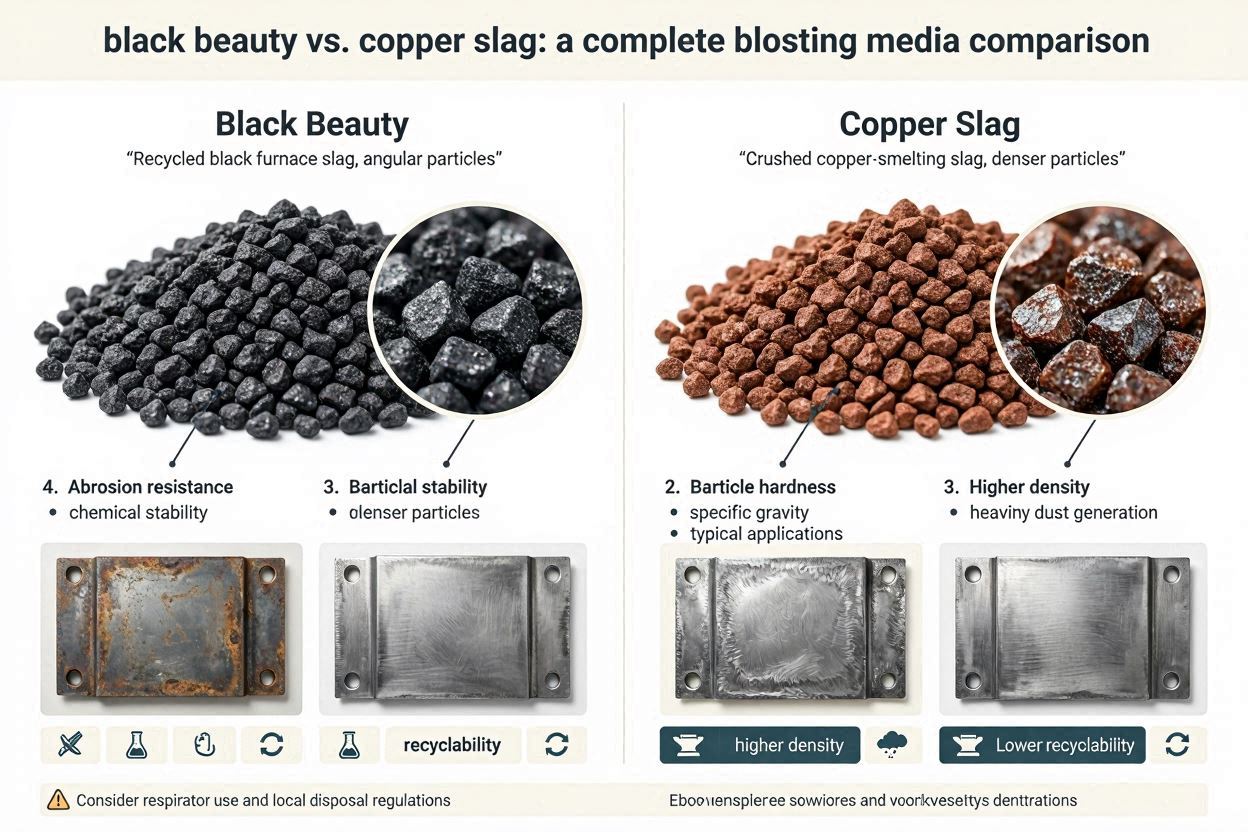
| Coal Slag | 1–3 | 1 | High fracture rate on impact |
| Copper Slag | 1–3 | 1 | High fracture rate on impact |
| Walnut Shell | 3–5 | 1–2 | Organic degradation, moisture |
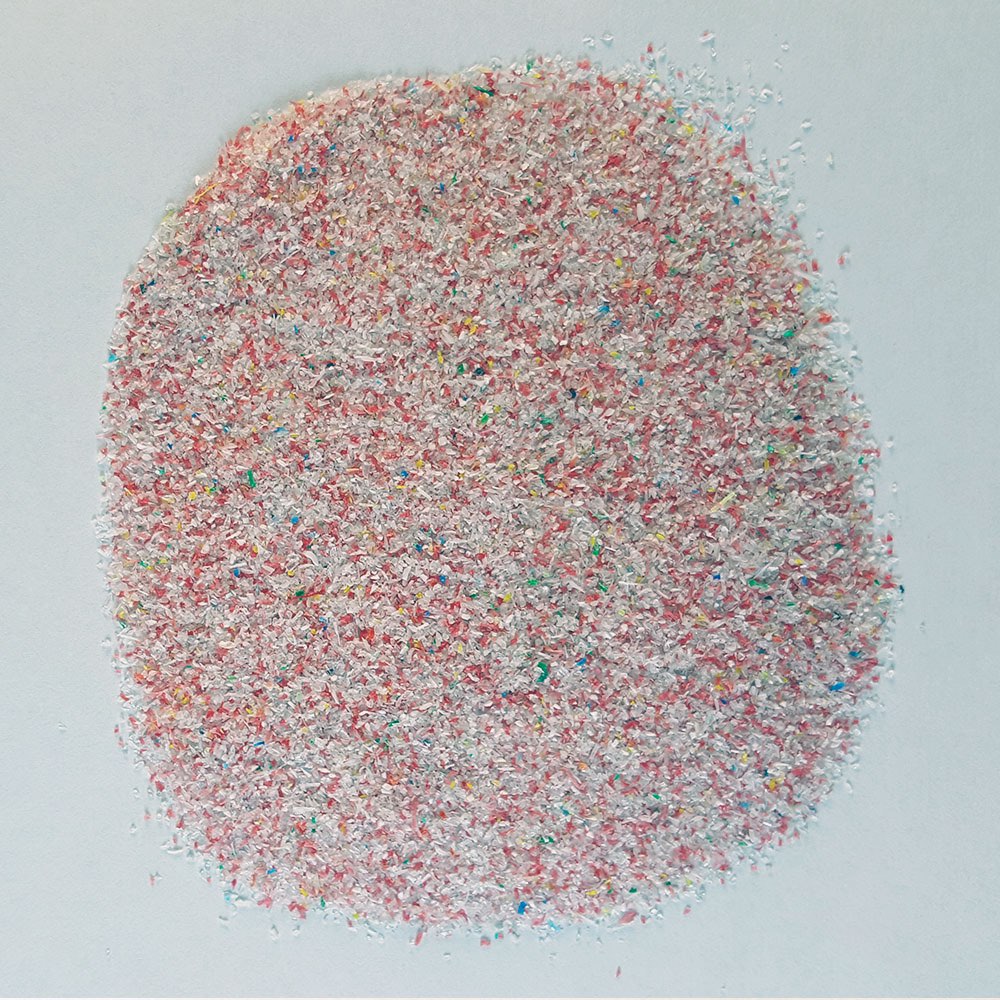
| Soportes de plástico | 5–10 | 2–3 | Size reduction on fracture |
| Bicarbonato sódico | 1 (by design) | 1 | Water-soluble, dissolves on impact |
Cost-Per-Cycle Comparison Model
The table below calculates effective cost per pound per cycle at typical April 2026 FOB pricing for each major media type. All prices are indicative — actual pricing depends on volume, grit size, grade, and supplier. Contact Jiangsu Henglihong Technology for current FCL export pricing.
| Abrasive | Price/lb (est.) | Avg. Cycles | Cost/lb/Cycle | Relative Cost Index |
|---|---|---|---|---|
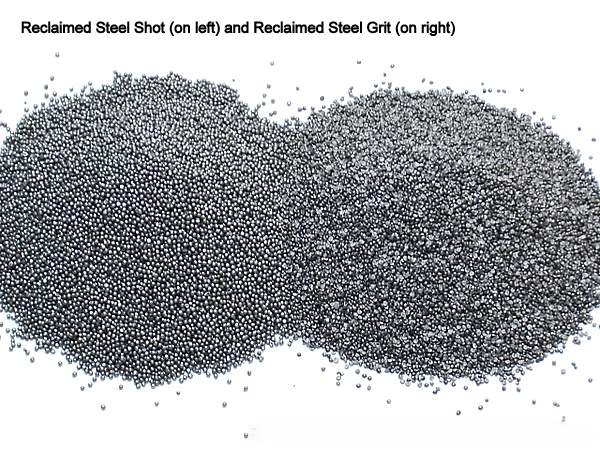
| Steel Grit (wheel blast) | $0.52 | 150 | $0.0035 | 1.0 (baseline) |
| Steel Shot (wheel blast) | $0.48 | 200 | $0.0024 | 0.7× |
| Óxido de aluminio marrón | $0.38 | 22 | $0.017 | 4.9× |
| White Aluminum Oxide | $0.55 | 27 | $0.020 | 5.7× |
| Garnet (GMA) | $0.24 | 4 | $0.060 | 17× |
| Cuentas de vidrio | $0.45 | 25 | $0.018 | 5.1× |
| Carburo de silicio | $0.90 | 12 | $0.075 | 21× |
| Coal Slag | $0.08 | 1.5 | $0.053 | 15× |
| Copper Slag | $0.10 | 1.5 | $0.067 | 19× |
| Walnut Shell | $0.60 | 4 | $0.150 | 43× |
| Soportes de plástico | $1.20 | 7 | $0.171 | 49× |
Important context: Walnut shell and plastic media’s high cost-per-cycle does not make them poor choices for their intended applications — there is simply no lower-cost way to strip paint from fibreglass or aircraft aluminium skin without substrate damage. Cost-per-cycle comparison is most meaningful when choosing between media that are technically interchangeable for a given application.
Field vs Enclosed Operations: Different Economics
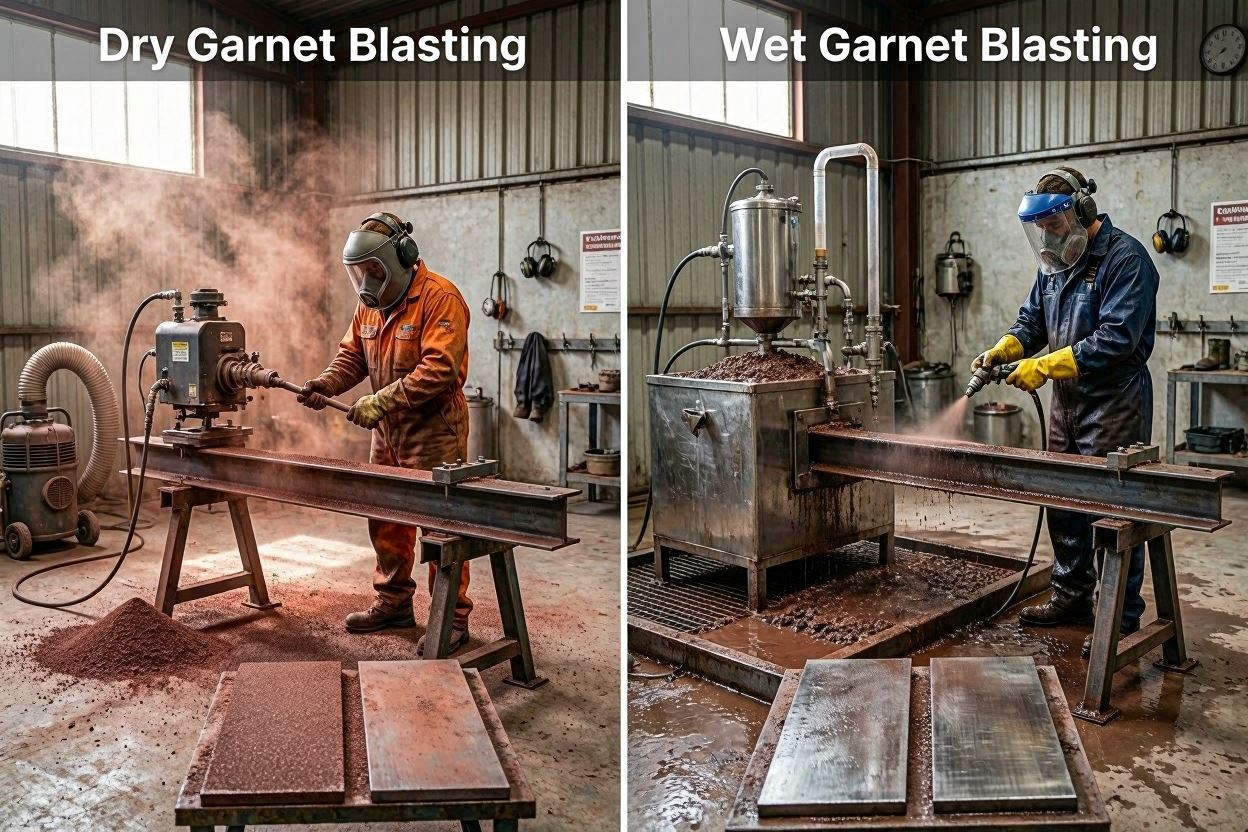
The recyclability advantage of aluminum oxide, glass beads, and metallic media disappears completely in field blasting where recovery is impractical. In those conditions, the comparison collapses to purchase price per pound and disposal cost per tonne — and coal or copper slag’s lower purchase price becomes genuinely advantageous. The key question to ask before any media selection decision: will this media be recycled, or is this a single-use application?
If recycling is possible (enclosed system, vacuum blasting, portable media recovery unit), always run the full cost-per-cycle calculation. If recycling is not possible, focus on purchase price, consumption rate, and disposal cost only. These two scenarios produce opposite media recommendations for the same application type.
Disposal Cost: The Hidden Variable
Spent abrasive disposal cost ranges from negligible (garnet from bare steel blasting, disposed as non-hazardous fill) to extremely high (slag or metallic media from lead-paint blasting, classified as RCRA hazardous waste at $300–600/tonne disposal). High-volume operations that ignore disposal cost in media selection decisions consistently underestimate total project cost.
The disposal cost advantage of garnet — which almost always classifies as non-hazardous and is accepted at standard landfills at minimal cost — can offset its lower recyclability versus aluminum oxide in projects involving heavily contaminated substrates where other media generates hazardous-classified spent media. For full disposal guidance, see the Environmental Compliance guide.
Best Value by Application Type
High-Volume Fixed Facility (Wheel Blast)
Steel grit or steel shot — by a wide margin. The combination of 100–200+ cycle recyclability and high throughput speed in wheel-blast machines produces the lowest cost per square foot of any blasting method for ferrous substrates.
Blast Cabinet / Blast Room (Air Blast)
Brown or white aluminum oxide. 20–25 cycle recyclability and wide grit range availability make it the most cost-effective mineral abrasive for enclosed recycling systems across the widest substrate range.
Field Blasting (Non-Recyclable)
Coal slag or copper slag for general steel. Garnet for environmentally sensitive sites or where dust must be minimised. The recyclability of other media is irrelevant when recovery is impossible.
Precision / Specialty Applications
Glass beads, walnut shell, or plastic media — selected for the surface outcome they produce, not cost. No alternative media can achieve the same result, so cost comparison is secondary to technical capability.
Calculate Your Real Abrasive Cost — Then Source at Volume
Jiangsu Henglihong Technology Co., Ltd. supplies all major blasting abrasive types in bulk FCL quantities. Request a multi-media comparison quotation and let our technical team help you identify the lowest true cost option for your operation.
Filtros