Using Silicon Carbide Blasting Media for Ceramic & Composite Surfaces
Process parameters, grit selection, and contamination control guidance for SiC blasting of advanced ceramics, CFRP, SiC/SiC CMC composites, and semiconductor substrates — for EV, 5G, power electronics, and precision manufacturing applications.
SECTION 01Why Silicon Carbide for Ceramic and Composite Surfaces?
Advanced ceramics and structural composites represent the fastest-growing application category for silicon carbide abrasive blasting media, driven by rapid expansion in three converging technology sectors: electric vehicle power electronics (SiC MOSFETs, GaN devices), 5G base station ceramic components (alumina, AlN substrates), and next-generation aerospace structures (CFRP airframes, SiC/SiC hot section components). All three sectors share a common surface preparation challenge: they involve extremely hard, brittle, or contamination-sensitive substrates that cannot be processed by conventional metallic abrasives or standard mineral abrasives without introducing unacceptable contamination or damage.
Silicon carbide — particularly high-purity Green SiC — is one of the very few abrasives that can effectively process these substrates because it is simultaneously harder than most advanced ceramics (enabling cutting), chemically inert (no reactive surface contamination), free of ferrous and metallic impurities (critical for semiconductor and clean-room environments), and available in ultra-fine grit sizes (enabling sub-micron surface finish targets).
For a full introduction to SiC abrasive properties: Complete Buyer’s Guide to SiC Abrasive Blasting Media.
SECTION 02Ceramic and Composite Substrate Overview
| Substrate | Hardness (Mohs) | Key Sensitivity | SiC Grade Required | Typical Application |
|---|---|---|---|---|
| Alumina (Al₂O₃ 96–99.9%) | 8.5–9.0 | Fracture toughness; surface integrity | Green SiC preferred | Semiconductor substrates, electronic packages, wear components |
| Silicon Nitride (Si₃N₄) | 8.5–9.0 | Micro-cracking under high impact | Green SiC | Bearing components, cutting tool inserts, engine parts |
| Aluminum Nitride (AlN) | 7.0–8.0 | Moisture sensitivity; very low KIC | Green SiC, ultra-fine | 5G power amplifier substrates, LED packages |
| Silicon Carbide (SiC) ceramic | 9.0–9.5 | Hardest common ceramic | Green SiC (matched hardness) | SiC power MOSFETs, kiln furniture, mechanical seals |
| Zirconia (ZrO₂) | 8.0–8.5 | Phase transformation under stress | Green SiC preferred | Dental zirconia, thermal barrier layers, structural ceramics |
| CFRP (standard) | ~3–5 (matrix) | Delamination; fiber damage | Black SiC, fine grit | Airframe structures, wind turbine blades, automotive panels |
| SiC/SiC CMC | 9.0–9.5 | Fiber architecture integrity | Green SiC, ultra-fine | Turbine hot section, exhaust components |
| Silicon wafer (Si) | 7.0 | Contamination; wafer breakage | Green SiC, ultra-fine | Semiconductor wafer processing (lapping, dicing prep) |
SECTION 03Alumina and Technical Ceramics
Alumina (Al₂O₃) ceramics at 96–99.9% purity are the most widely used technical ceramics globally, appearing as electronic substrate packages, semiconductor housings, vacuum components, wear plates, and cutting tool inserts. Despite its own Mohs 8.5–9.0 hardness, alumina can be effectively blasted with Green SiC because SiC (Mohs 9.3–9.5) maintains a sufficient hardness differential for controlled material removal.
The primary purpose of blasting alumina ceramics is surface conditioning — removing surface contamination, creating micro-roughness for adhesive bonding or metallization, or cleaning firing residue and handling contamination from ceramic surfaces. The challenge is controlling the surface micro-fracture pattern: alumina is brittle (low fracture toughness of 3–5 MPa·m½) and excessive impact energy can cause sub-surface cracking, edge chipping, and surface strength degradation.
Recommended parameters for alumina surface conditioning: Green SiC #150–240, 30–55 PSI suction or low-pressure direct blast, 250–400 mm standoff, 70–85° nozzle angle. Verify Ra target per downstream process specification. Avoid coarser grits or pressures above 60 PSI unless surface strength reduction is explicitly acceptable to the engineering team.
SECTION 04Silicon Carbide Ceramic Substrates
Blasting silicon carbide ceramic with silicon carbide abrasive presents a unique matched-hardness situation: both the substrate and the abrasive are at the same position on the Mohs scale (~9.0–9.5). This makes SiC one of the only practical abrasives capable of processing SiC ceramic substrates — aluminum oxide and most other abrasives are too soft to achieve meaningful surface conditioning of sintered SiC ceramics.
Green SiC abrasive at ultra-fine grit (#240–400) and carefully controlled low pressure (20–45 PSI) is used to clean SiC ceramic surfaces (kiln furniture, mechanical seal faces, SiC power device substrates) without introducing foreign contamination. The abrasive material that remains on the surface — any embedded SiC particles — is chemically identical to the substrate and does not cause contamination-type failures, which is a significant practical advantage.
For SiC power device substrates (SiC MOSFETs, SiC Schottky diodes) used in EV inverters and power conversion systems, ultra-fine Green SiC lapping (#400–1200) is used for pre-metallization surface preparation, achieving Ra values below 0.1 µm on single-crystal SiC wafer surfaces.
SECTION 05Semiconductor and Power Device Applications
In semiconductor manufacturing, SiC abrasive blasting and lapping are used at specific process steps where controlled surface conditioning is required. These include: wafer edge profiling (preventing edge chipping during slicing and handling), substrate surface preparation before epitaxial growth, back-grinding and thinning of packaged wafers, and dicing blade preparation for wafer singulation.
The purity requirements in semiconductor applications are the most stringent of any SiC blasting application. Green SiC must meet Fe₂O₃ ≤ 0.02–0.05% (tighter than aerospace), free silicon and free carbon must be specified and verified, and particle morphology must be well-controlled (no large outlier particles that could cause deep scratches in lapping). For dicing blade applications — which are a core product line at Jiangsu Henglihong Technology Co., Ltd. — the SiC abrasive quality directly determines blade cutting speed, kerf width consistency, and wafer edge quality.
EV context: Silicon carbide power semiconductors (SiC MOSFETs) are a critical enabling technology for high-efficiency EV powertrains — they operate at higher switching frequencies, higher voltages, and higher temperatures than silicon-based devices, enabling smaller, lighter, and more efficient motor drives and on-board chargers. Global SiC wafer demand has grown approximately 40% per year since 2020, driven primarily by EV adoption and 5G infrastructure build-out. SiC abrasive quality requirements from this sector are now among the most demanding in the global abrasives market.
SECTION 06CFRP and Glass Fiber Composites
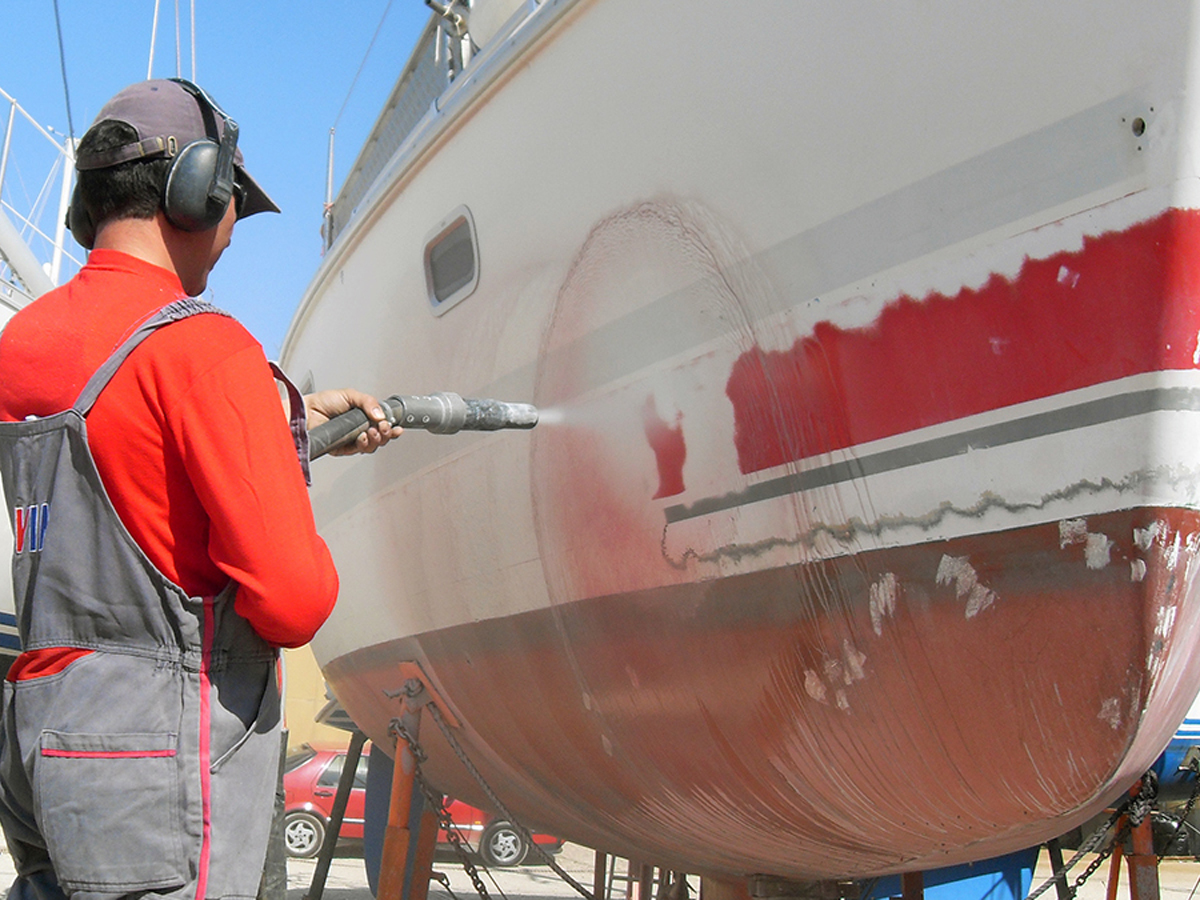
Carbon fiber reinforced polymer (CFRP) composites have become the dominant structural material in commercial aviation, wind energy, and performance automotive applications. Abrasive blasting of CFRP for surface preparation (prior to adhesive bonding, co-cured repair patches, or protective coating application) requires careful control of media selection and parameters to achieve adequate surface preparation without damaging the fiber architecture.
The challenge is that CFRP has a highly anisotropic structure: the carbon fibers (strong in tension along the fiber axis) are held in an epoxy matrix (brittle in transverse and through-thickness directions). High-energy abrasive impact can cause interfacial debonding between fiber and matrix — delamination — that weakens the structure without creating any visible surface defect. This damage is detectable only by ultrasonic C-scan NDI, making it a particularly insidious risk.
For CFRP blasting, use SiC #150–220 at 25–45 PSI with a large standoff (350–500 mm) and constant nozzle motion. Limit blast duration to achieve only the minimum surface conditioning required by the bonding specification. Validate parameters on CFRP test coupons with pre- and post-blast C-scan NDI before production blasting. For more context on why SiC is specified for composites over other abrasives: SiC for Aerospace Surface Prep
SECTION 07SiC/SiC Ceramic Matrix Composites (CMC)
SiC/SiC ceramic matrix composites — silicon carbide fibers embedded in a silicon carbide matrix — are the materials that enable the next generation of fuel-efficient aircraft engines. Used in turbine hot section components (high-pressure turbine blades, vanes, combustor liners, nozzle guide vanes), SiC/SiC CMCs can operate at temperatures 100–300°C above the capability of nickel superalloys, enabling higher turbine inlet temperatures and significantly improved engine thermal efficiency.
Surface preparation of SiC/SiC CMC components is among the most technically demanding blasting applications in existence. The target is to clean the component surface (removing oxide films, handling contamination, or machining residue) without disrupting the SiC fiber architecture or causing micro-cracking in the brittle matrix. Green SiC at ultra-fine grit (#320–600) and very low pressure (15–35 PSI) with extended standoff (400–600 mm) is used, typically with a wet/vapor blasting system that further reduces the kinetic energy of individual particles through the water cushion effect.
SECTION 08Clean-Room and Contamination Control Requirements
Advanced ceramic and semiconductor blasting operations often occur within or adjacent to clean-room manufacturing environments. In these contexts, SiC media purity is not just a process quality concern — it is a contamination control requirement that can affect entire production batches of devices if media-borne contamination reaches the wafer or substrate surface.
- Use Green SiC with documented Fe₂O₃ ≤ 0.05% for all semiconductor-adjacent applications. Request ICP-OES (Inductively Coupled Plasma Optical Emission Spectroscopy) analysis for critical trace metal content if specified by process engineering.
- Store SiC media in sealed, antistatic containers. Static charge on SiC particles can attract and concentrate airborne contamination particles, which are then delivered to the substrate surface during blasting.
- Use a dedicated blast cabinet with HEPA-filtered exhaust for all ceramic / semiconductor blasting operations. Never vent exhaust into the facility air space.
- Change gloves and use clean garments when handling SiC media intended for semiconductor applications. Skin oils, cosmetics, and handling-borne contamination on media can transfer to substrates during blasting.
- Quarantine and test new media lots before introducing them into production. Run a blank substrate blast test and perform surface contamination analysis (particle count, metal trace) before releasing a new lot for production use.
SECTION 09Process Parameters Summary Table
| Substrate | SiC Grade | Grit | Pressure (PSI) | Standoff (mm) | Ra Target (µm) |
|---|---|---|---|---|---|
| Alumina 96–99.9% | Green SiC | #150–240 | 30–55 | 250–400 | 0.5–2.0 |
| Silicon Nitride | Green SiC | #180–320 | 25–45 | 300–450 | 0.3–1.5 |
| AlN (5G substrates) | Green SiC | #220–400 | 20–35 | 350–500 | 0.1–0.8 |
| Sintered SiC ceramic | Green SiC | #240–400 | 20–45 | 300–500 | 0.1–1.0 |
| Zirconia (structural) | Green SiC | #150–280 | 30–55 | 250–400 | 0.5–2.0 |
| CFRP (bond prep) | Black or Green SiC | #150–220 | 25–45 | 350–500 | 0.5–2.0 |
| SiC/SiC CMC | Green SiC | #320–600 | 15–35 | 400–600 | <0.3 |
| Silicon wafer (lapping) | Green SiC | #400–1200 | Wet lapping | N/A | <0.05 |
Parameters are starting points: All values above are engineering starting points for process development. Final production parameters must be validated by coupon testing against the specific substrate lot, surface finish specification, and downstream process requirements. Substrate-to-substrate variation within the same material class can require significant parameter adjustment.
SECTION 10FAQ
SECTION 11Related Guides
High-Purity Green SiC for Ceramics & Semiconductor Applications
Jiangsu Henglihong Technology Co., Ltd. supplies Green SiC with Fe₂O₃ ≤ 0.08%, ultra-fine grit range (#240–1200), and full lot-level chemical analysis — designed for the purity requirements of advanced ceramic, power electronics, and precision manufacturing applications.
Request a Quote →Filter