Mold and die cleaning sits in a tight corner: you need residue gone, releases restored, and cavity geometry left alone. That is why buyers keep asking the same question—ceramic beads or plastic media?
Both can clean without the aggression of coarse aluminum oxide. But they are not interchangeable. This comparison breaks down finish quality, cycle time, tool-life risk, and operating cost so process engineers can choose with fewer trial-and-error loops.
Quick verdict
- Pick plastic media when flash, soft coatings, rubber, or paint must come off and the steel cavity cannot accept any meaningful texture change.
- Pick ceramic beads when you need faster cleaning of harder residues, a controlled satin reset, and longer media life in reclaim cabinets.
Many toolrooms keep both. Plastic protects the most delicate polished cavities. Ceramic beads win on speed and durability for production molds with tougher soils.
Head-to-head comparison
| Factor | Keramische Perlen | Plastische Medien |
|---|---|---|
| Cutting / cleaning power | Higher for baked-on residue and light oxide | Lower; gentler stripping action |
| Risk to polished cavity | Low to moderate (depends on size/pressure) | Very low when process is set correctly |
| Surface after cleaning | Uniform satin / matte reset | Closer to original polish if no overblast |
| Cycle time | Often shorter on stubborn soils | Often longer; may need multiple passes |
| Media durability | High; recycles well | Lower; breaks down into soft fines |
| Dust / workspace feel | Low dust when reclaim is healthy | Can create soft fines that load filters |
| Best applications | Injection molds with residue + light scale, die maintenance, tooling reset | Delicate polish preservation, coating/paint removal, soft flash |
| Cost pattern | Higher bag price, lower consumption | Lower aggression, often higher consumption |
What each media actually does on a mold surface
Keramische Perlen
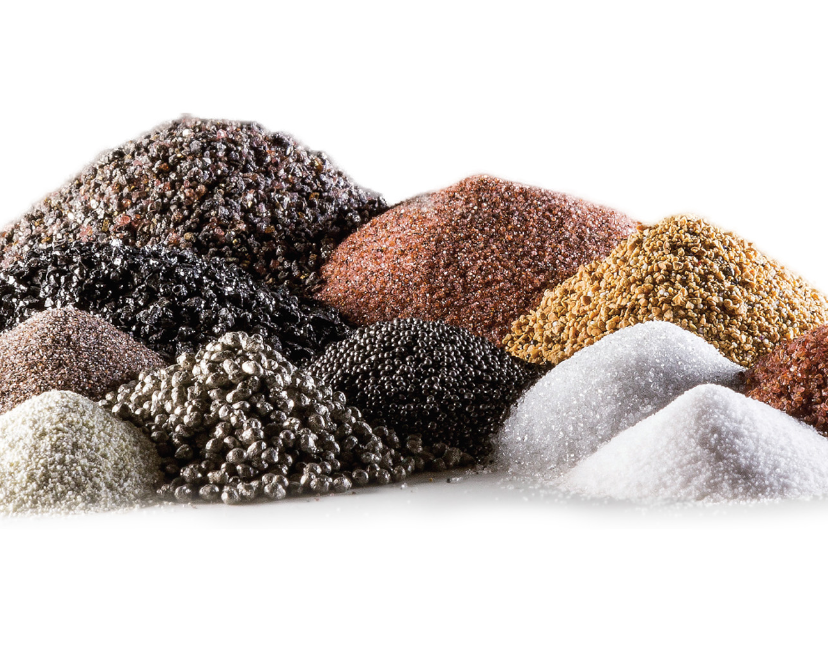
Ceramic beads are hard, spherical, and iron-free. They clean by repeated rounded impacts rather than sharp cutting. That is why they can remove release-agent buildup, light corrosion haze, and process residue while leaving a consistent satin that many production molds accept well.
Compared with angular abrasives, ceramic beads are far less likely to gouge. Compared with plastic, they clean faster when the soil is hard or thermally aged.
Plastische Medien
Plastic media is designed for soft stripping. It is the safer first choice when a high-polish cavity, optical surface, or coated tool cannot tolerate even a light satin rewrite. The trade-off is patience: stubborn carbonized residue may take longer, higher media flow, or a staged process.
Finish quality comparison
If the mold must return to a near-mirror polish: plastic media is usually safer. Ceramic beads can preserve geometry, but they typically rewrite gloss into satin unless you use a very fine grade at low pressure and short exposure.
If the mold needs a stable production satin and reliable release: ceramic beads often give a more repeatable look from cavity to cavity. Operators can standardize pressure and time more easily once the grade is locked.
Cycle time and throughput
Toolrooms care about press downtime. Here the comparison is practical:
- For lightly fouled tools, both can be close.
- For baked residue, ceramic beads usually finish earlier.
- For paint, soft coatings, or flash around delicate shutoffs, plastic may still be faster overall because you avoid polish recovery work afterward.
In other words: measure total turnaround, not only blast minutes. A “gentle” process that forces re-polish can lose the day.
Tool life and dimensional risk
| Risk type | Keramische Perlen | Plastische Medien |
|---|---|---|
| Edge rounding | Possible if size/pressure are too high | Rare at correct settings |
| Texture rewrite | Common and controllable | Minimal |
| Contamination | Iron-free; good for stainless inserts | Iron-free; also safe on that point |
| Overblast damage | From excess energy | From excessive time more than impact severity |
Rule of thumb: protect critical polish with plastic first. Use ceramic beads when the tool can accept a controlled satin or when residue toughness makes plastic inefficient.
Cost comparison beyond the bag
Plastic media often looks cheaper per bag, but consumption can climb because particles break down. Ceramic beads cost more up front and generally last longer in reclaim systems.
Choose ceramic when:
- You clean molds frequently
- You have reclaim classification
- Downtime cost is high
Choose plastic when:
- Polish recovery is expensive
- Jobs are delicate and infrequent
- Coatings or soft soils are the main target
Recommended decision flow
- Is the cavity high-polish / optical / texture-critical? If yes, start with plastic media.
- Is residue hard, carbonized, or mixed with light oxide? If yes, trial fine-to-medium ceramic beads.
- Can the tool accept a satin reset? If yes, ceramic beads usually improve throughput.
- Still unsure? Run one cavity half-and-half on coupons or a non-critical tool and compare release behavior after the next molding trial.
FAQ
Will ceramic beads ruin a polished mold?
They can change gloss into satin if parameters are aggressive. With fine grades, low pressure, and short exposure, many shops clean successfully—but plastic remains safer for mirror finishes.
Can I use ceramic beads after plastic media?
Yes. A common staged approach is plastic for delicate stripping, then a light ceramic pass only if a uniform satin is acceptable and residue remains.
Are ceramic beads better than glass beads for molds?
Often yes for reclaim systems, because ceramic lasts longer and stays rounder. Glass can work for light cosmetics, but breaks down faster and creates more dust.
If you are comparing media for a specific mold steel, cavity polish, and residue type, contact HLH with photos and current process settings. Explore ceramic beads for cleaning and related ceramic media options to match grade and application.
Filter