Blasting Sand Types Explained: Silica Sand vs Garnet vs Coal Slag (Which Should You Buy?)
A complete breakdown of every major abrasive blasting media type — hardness, shape, reusability, health profile, and best applications — so you can make the right purchasing decision for your specific project.
Why Media Type Matters More Than You Think
Walk into any hardware store and ask for “blasting sand.” You will likely walk out with a 100 lb bag of silica — and for basic projects, that works fine. But for anyone working to a coating specification, protecting workers from silica exposure, or trying to achieve a precise surface finish, media selection is not a casual decision. The wrong abrasive costs you in slow blasting speed, equipment wear, surface damage, coating failures, and health liability.
This guide covers every significant abrasive media type available on the market in 2026, explaining the properties that matter, the applications each type serves best, and what you should actually buy for your situation. For sourcing guidance once you have made your selection, see: Where to Buy Blasting Sand: The Complete Buyer’s Guide.
Key Properties to Evaluate
Every abrasive media type can be evaluated against the same set of properties. Understanding these properties helps you translate a product specification into a blasting outcome.
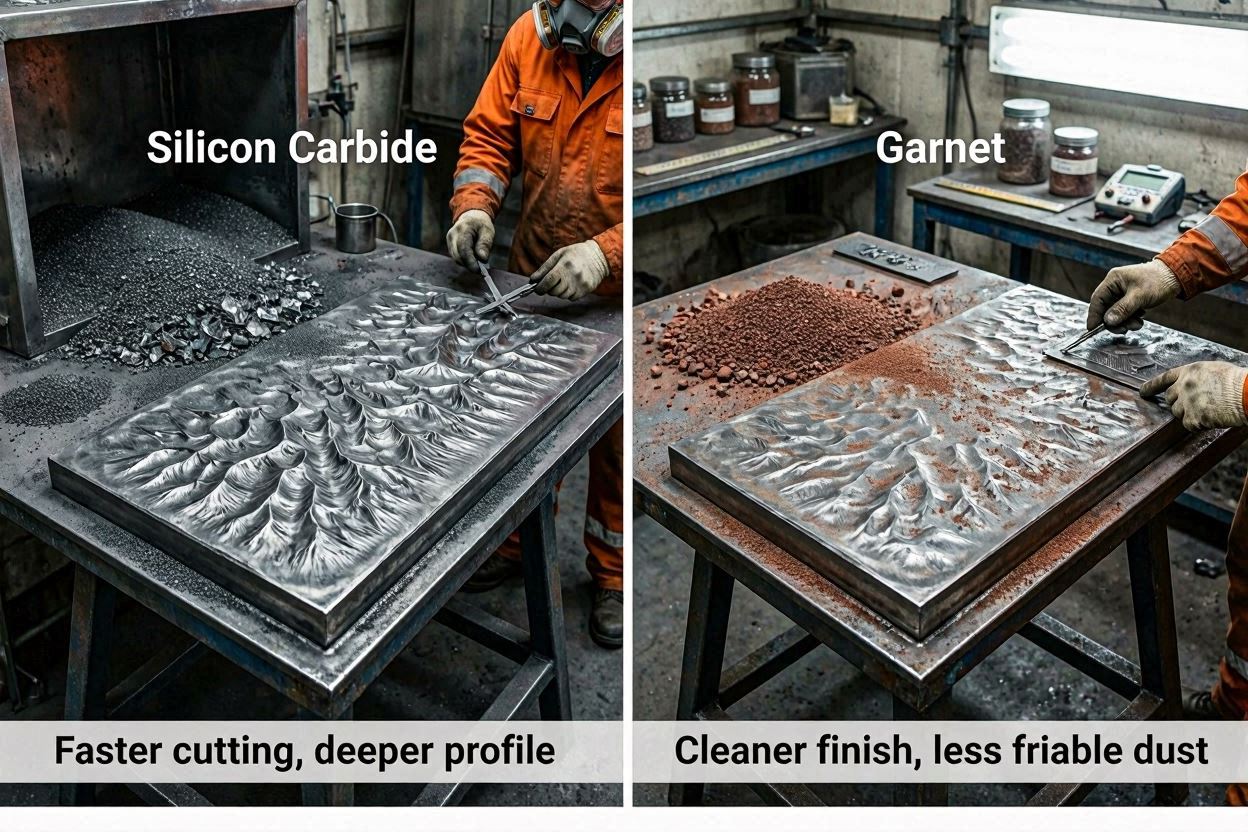
Mohs-Härte determines how aggressively the abrasive cuts the substrate. Higher hardness means faster cutting and deeper surface profile, but also more aggressive action on the substrate itself — relevant for thin metals and delicate surfaces.
Partikelform drives the type of surface effect produced. Angular particles cut and profile the surface, creating the anchor pattern that coatings need to bond. Spherical particles peen the surface, compressing and smoothing it — ideal for finishing, not profiling.
Spezifische Schwerkraft affects kinetic energy at impact. Higher density media delivers more energy per particle at the same blast velocity, increasing cutting efficiency — particularly relevant when comparing steel to mineral abrasives.
Reusability directly determines cost per effective use. Single-use media (silica, coal slag) must be disposed of after one pass. Recyclable media (garnet, glass beads, steel) can be screened, cleaned, and reused multiple times in closed-loop systems, dramatically reducing per-unit cost.
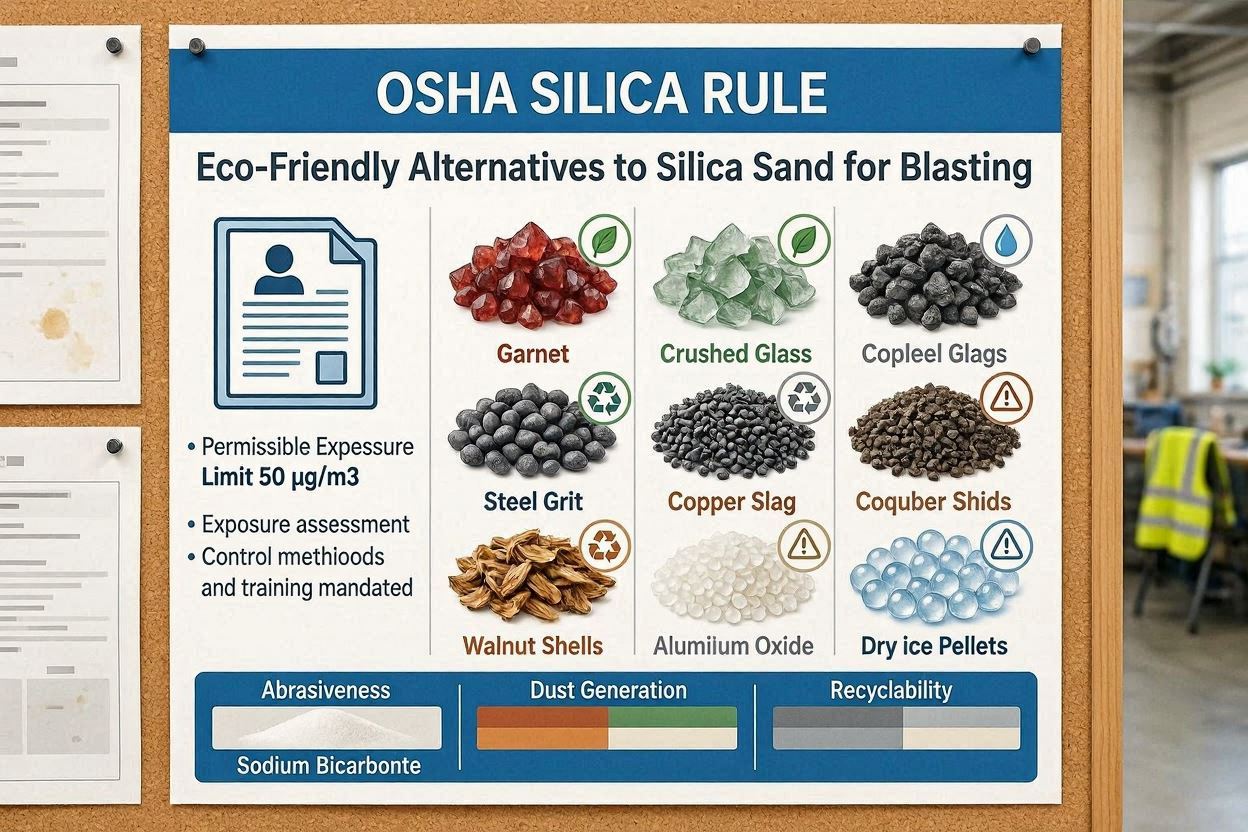
Free Silica Content is the primary occupational health indicator. Media with less than 1% free crystalline silica is considered low-risk. Silica sand is approximately 99% crystalline silica — the highest risk. Coal slag runs 0.1–0.5%. Garnet, glass beads, and steel media are all effectively silica-free.
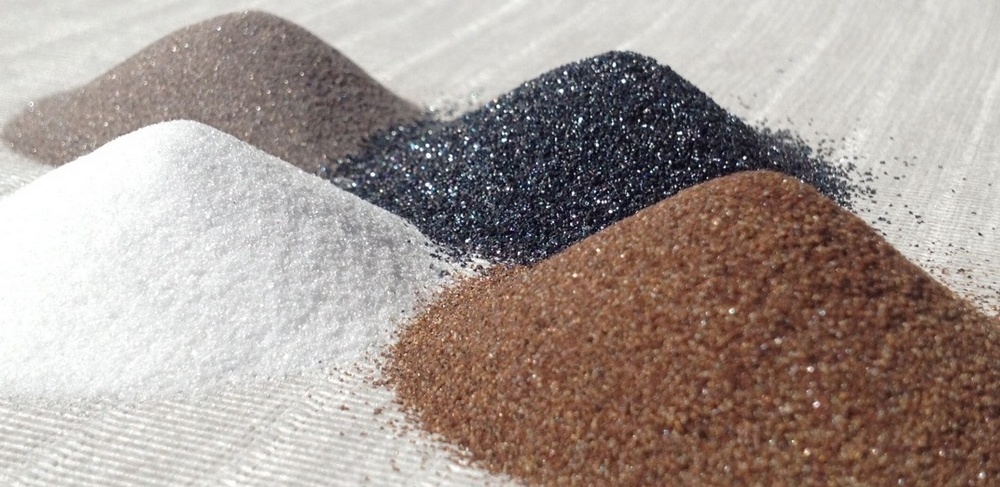
Quarzsand
Silica Sand (Quartz Sand)
Silica sand is the original sandblasting material — effective, widely available, and the cheapest option by purchase price. It cuts well on concrete and masonry, produces a consistent anchor profile in medium grit, and is available at virtually every hardware store. The problem is its health profile: crystalline silica dust causes silicosis, an incurable and potentially fatal lung disease, with documented cases among blasting workers globally.
Silicosis Risk
Silica sand blasting is banned or heavily restricted in many countries and U.S. states. OSHA enforces a 50 µg/m³ PEL for respirable crystalline silica. Supplied-air respirators — not dust masks — are required for compliant open blasting. For full safety detail, read: Is Blasting Sand Safe?
Best for: Concrete etching, masonry cleaning, open blasting with full PPE and engineering controls, situations where purchase cost is the primary constraint and appropriate health controls are in place.
Not suitable for: Any blasting in enclosed spaces without supplied-air respiratory protection, automotive panels (too aggressive), professional coating prep where silica regulation applies.
Coal Slag (Black Diamond)
Coal Slag — Black Diamond & Equivalents
Coal slag is a byproduct of coal-fired power generation that has been processed and graded for abrasive use. Black Diamond is the dominant brand in North America, widely available at Tractor Supply and Northern Tool. It performs similarly to silica sand — angular, fast-cutting — but with dramatically lower free silica content, making it a safer and regulatory-compliant alternative for most open blasting applications.
Coal slag generates more dust than premium abrasives, and its breakdown rate limits reusability to one or two passes. However, at $7–$12 per 50 lb bag it represents an excellent balance of cost, performance, and health profile for DIY operators and small contractors running open blasting systems. It is the most popular single-use abrasive in North America for good reason.
Best for: Rust removal from structural steel, fence and equipment cleaning, paint stripping from masonry, outdoor blasting where disposal is straightforward.
Granat
Garnet Abrasive
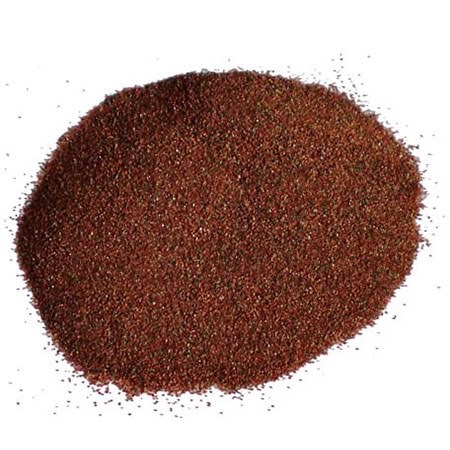
Garnet is the professional’s preferred abrasive for coating preparation on steel. Its sub-angular shape cuts aggressively enough to achieve deep anchor profiles (1.5–4 mil), while generating significantly less dust than silica sand or coal slag. It can be recycled 3–5 times with proper screening, making its true cost per use competitive with coal slag despite a much higher purchase price.
Garnet is the standard media for marine, bridge, and oil and gas coating projects where SSPC-SP 6, SP 10, or SP 5 surface preparation is specified. It is virtually free of crystalline silica, which dramatically simplifies respiratory protection requirements and regulatory compliance. For professional operators, switching from coal slag to garnet typically reduces total project cost once disposal, dust control, and replacement media costs are factored in.
Jiangsu Henglihong supplies industrial-grade garnet blasting media in a full range of mesh sizes for both abrasive blasting and waterjet cutting applications.
Best for: Steel surface preparation before high-performance coatings, marine and infrastructure projects, any operation requiring SSPC/NACE-compliant surface cleanliness, operations looking to reduce silica exposure.
Glasperlen
Glasperlen
Glass beads are the definitive choice when surface finish is the priority. Their perfect spherical shape means they do not cut the surface — they peen it, producing a smooth, bright, matte finish that enhances the appearance of stainless steel, aluminum, and decorative metals. In a closed cabinet system, glass beads are exceptionally recyclable (20–30 cycles), giving them by far the lowest cost per use of any common abrasive media despite a high purchase price.
Glass beads are chemically inert, free of heavy metals, and non-toxic — making them suitable for blasting food-contact surfaces, medical devices, and aerospace components. They are also the media of choice for shot peening, where the compressive stress induced on the surface improves fatigue resistance in critical metallic parts.
Henglihong’s glass beads for sandblasting meet MIL-PRF-9954 and AMS 2431 standards with consistent sizing and sphericity across production batches.
Best for: Cabinet blasting for finishing work, automotive restoration (body panels), stainless steel finishing, shot peening, medical and aerospace component cleaning.
Not suitable for: Heavy rust removal, achieving deep anchor profiles for industrial coatings, any application requiring aggressive cutting.
Aluminium-Oxid
Aluminum Oxide (Alumina)
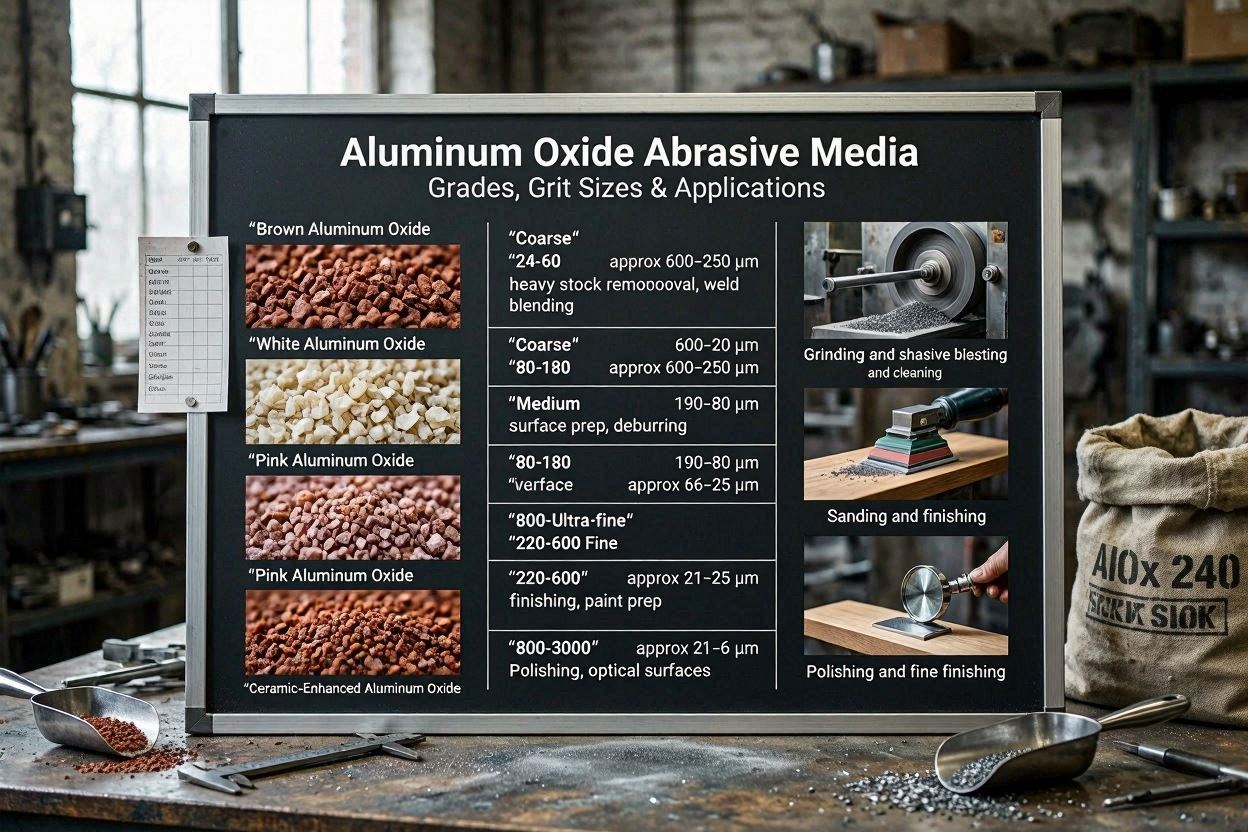
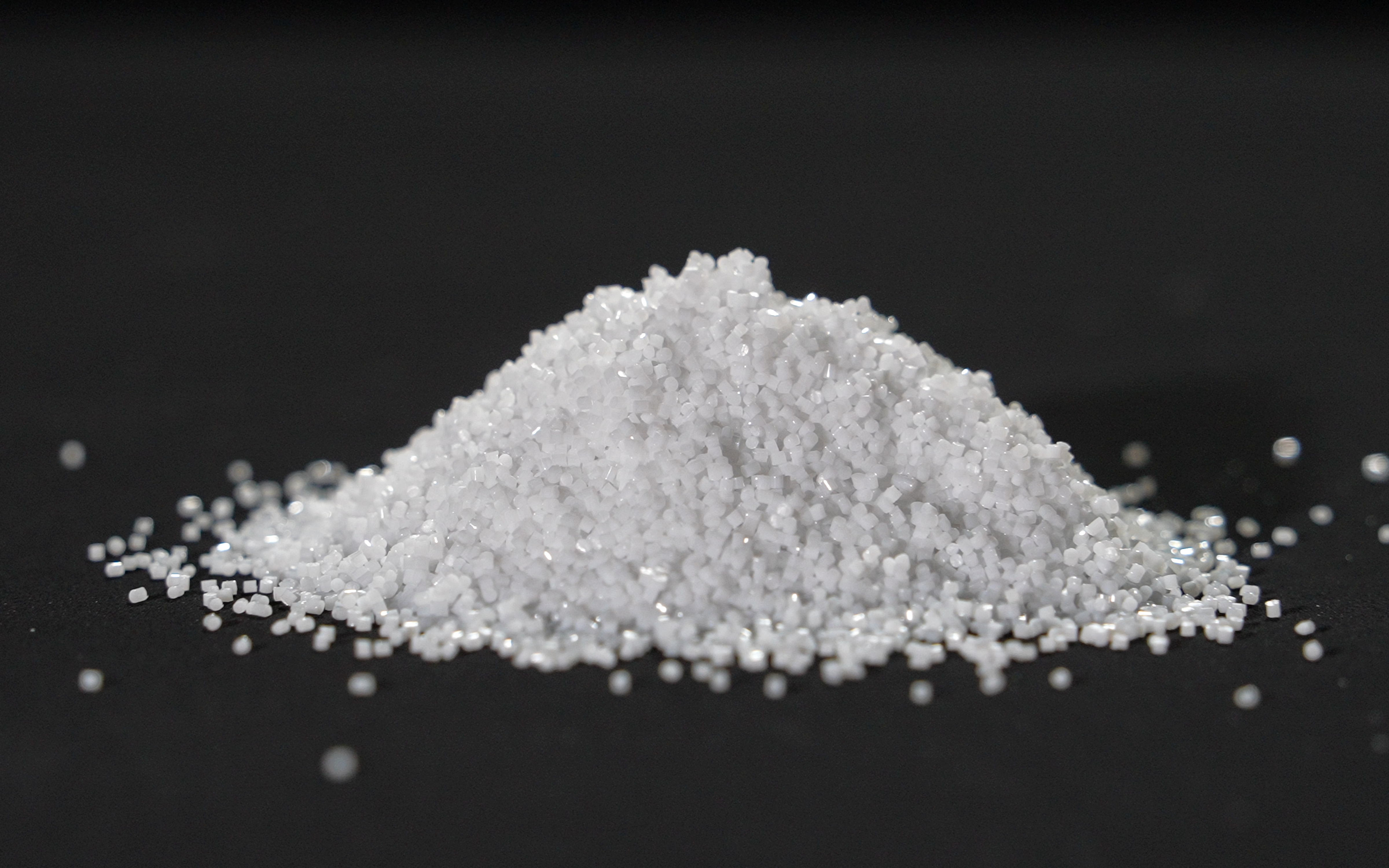
Aluminum oxide is one of the hardest abrasives available commercially — second only to silicon carbide and diamond. Its extreme hardness makes it the fastest-cutting media for hardened steels, ceramics, and glass etching. It is angular and aggressive, breaking down relatively slowly compared to softer abrasives, which accounts for its 10–20 cycle reusability in closed cabinet systems.
Aluminum oxide is the standard media for precision blasting cabinets in tool shops, job shops, and manufacturing environments. Its zero silica content, high reusability, and consistent cutting performance make it the preferred all-purpose cabinet media despite its higher purchase price. For operations that run a blasting cabinet regularly, the per-use economics of aluminum oxide typically beat coal slag within the first few uses.
Best for: Cabinet blasting on hard metals, ceramic and glass etching, tool reconditioning, precision part cleaning, general-purpose shop blasting where recyclability matters.
Steel Grit & Steel Shot
Steel Grit / Steel Shot
Steel media is in a category of its own for industrial surface preparation. Cast steel grit (angular) and steel shot (spherical) are the standard abrasives in shipyards, structural steel fabricators, foundries, and large-scale blast rooms worldwide. With reuse cycles exceeding 100 in properly maintained closed-loop systems, the cost-per-cycle economics are unmatched by any mineral abrasive. Steel grit produces the deepest anchor profiles of any common media — 2–5 mil at standard blast pressures — making it the correct choice before thermal spray, zinc-rich primers, and heavy-duty epoxy linings.
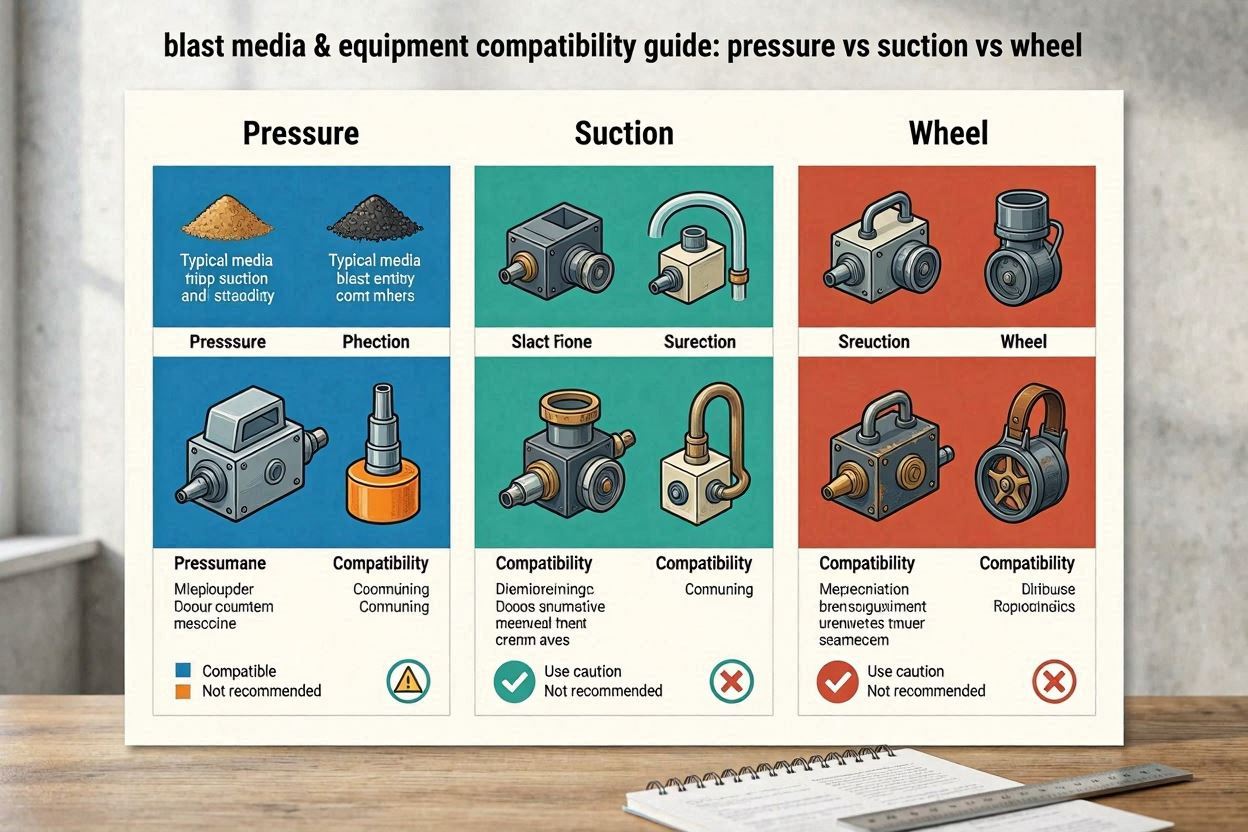
The principal limitation of steel media is the requirement for a closed-loop blast system with magnetic separator — steel cannot be used in open blasting where media recovery is impractical. For stationary blast rooms and wheel blast machines, however, steel is the economically and technically superior choice for heavy steel work.
Henglihong’s steel shot and grit is cast to SAE J444 standards across GP, GL, and GH hardness grades for demanding foundry and structural steel applications.
Best for: Blast rooms, wheel blast machines, shipyard surface prep, heavy structural steel fabrication, any operation with a closed-loop recovery system.
Organic Abrasives
Walnut shells, corn cob grit, and plastic media complete the abrasive media landscape for applications where the substrate cannot withstand aggressive cutting.
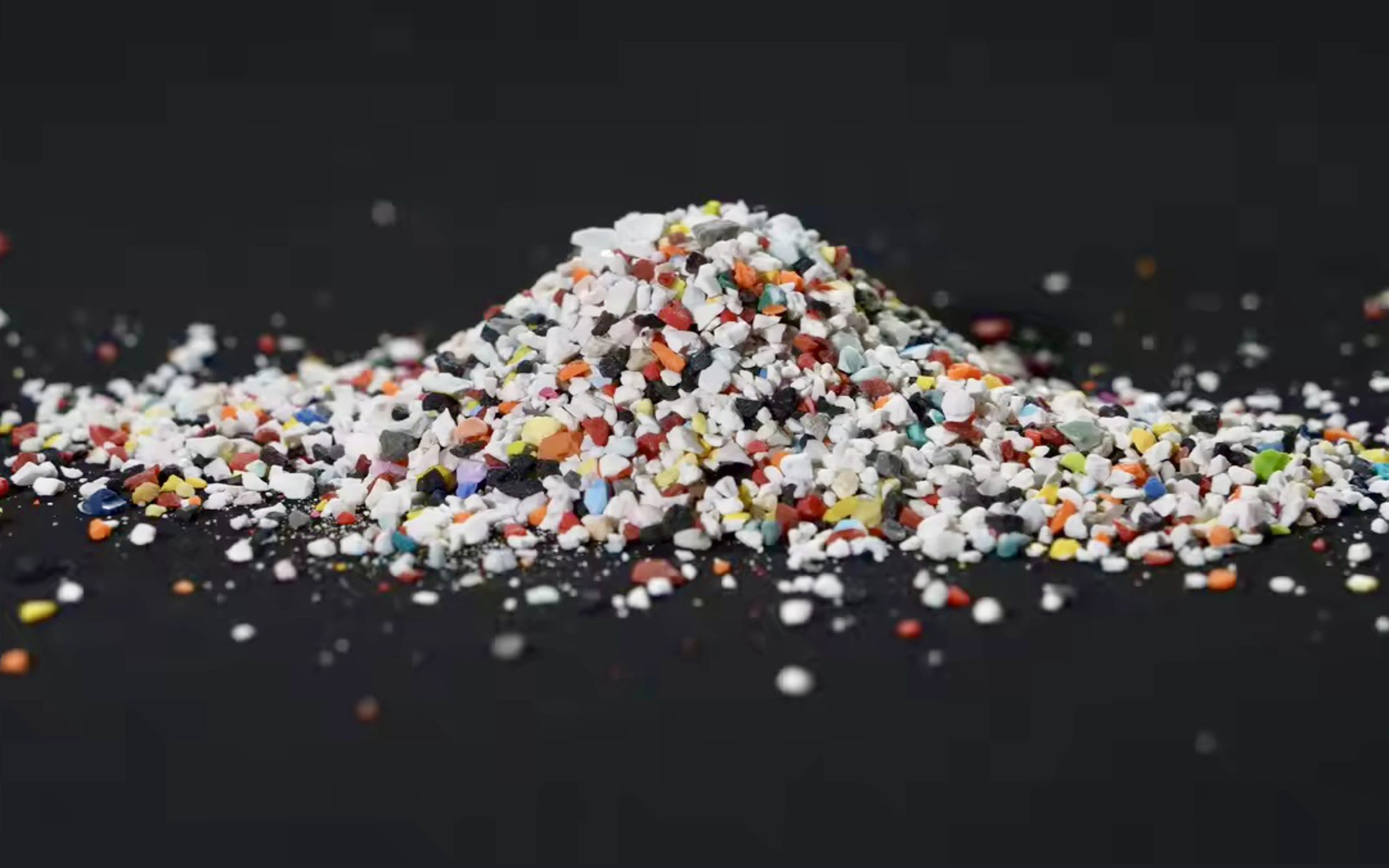
Walnut shells (Mohs 3–4) are the softest common abrasive and ideal for removing coatings from wood, fibreglass, and historical masonry without damaging the substrate. They are biodegradable, non-toxic, and produce minimal dust.
Corn cob grit is even softer than walnut shells and widely used for cleaning engine parts and delicate components without dimensional change. It absorbs oil during blasting, acting as a mild degreaser.
Plastische Medien (acrylic, urea, melamine) are the aerospace industry standard for paint stripping from aluminium airframes — hard enough to remove paint but soft enough to leave the substrate dimensionally unchanged.
Sodium bicarbonate is a water-soluble, ultra-soft abrasive used for food-processing equipment, sensitive surfaces, and restoration work where no abrasive residue can be tolerated. It dissolves after blasting, leaving no media recovery requirement.
Full Comparison Table
| Media | Mohs / Hardness | Shape | Reuse | Silica % | Best Application |
|---|---|---|---|---|---|
| Quarzsand | 7 | Eckig | 1× | ~99% | Concrete etching, masonry |
| Coal Slag | 6-7 | Eckig | 1–2× | 0.1–0.5% | Open blasting on steel, fences |
| Granat | 7.5–8 | Sub-angular | 3–5× | <1% | Steel coating prep, marine |
| Glasperlen | 5.5–6 | Spherical | 20–30× | Non-crystalline | Finishing, peening, automotive |
| Aluminium-Oxid | 9 | Eckig | 10–20× | Keine | Cabinet blasting, hard metals |
| Stahlkies | 40–65 HRC | Eckig | 100+× | Keine | Heavy steel, blast rooms |
| Stahlkugel | 40–50 HRC | Spherical | 100+× | Keine | Peening, descaling, foundry |
| Walnussschalen | 3–4 | Irregular | 3–5× | Keine | Delicate surfaces, wood, fibreglass |
| Natriumbikarbonat | 2.5 | Crystalline | Keine | Keine | Sensitive surfaces, food equipment |
Which Should You Buy? Decision Guide
Automotive restoration or finishing work: Glass beads (80–120 mesh) for panels and bright finishes. Fine garnet (60–80 mesh) for rust removal before painting.
Professional steel coating prep to SSPC standard: Garnet (30–60 mesh). Recyclable, low-silica, consistent anchor profile, regulatory-compliant.
Cabinet blasting, shop or tool reconditioning: Aluminum oxide (80–120 grit). High reusability makes it the best value for regular cabinet use.
High-volume industrial blast room: Steel grit or steel shot depending on profile requirement. Unmatched reusability and cutting efficiency at scale.
Delicate or historical surfaces: Walnut shells or sodium bicarbonate. Preserves substrate integrity.
For guidance on matching grit size to your specific surface profile requirement, see: Blasting Sand Grit Size Guide: Coarse vs Medium vs Fine. For a detailed comparison of safer alternatives to silica sand specifically, read: Best Alternatives to Blasting Sand.
Häufig gestellte Fragen
Bottom Line
There is no single best blasting abrasive — only the best abrasive for your specific application, substrate, finish requirement, and operational setup. Coal slag wins on upfront cost for open blasting. Garnet wins for professional coating prep. Glass beads win for finishing work. Aluminum oxide wins for cabinet reusability. Steel wins for heavy industrial volume.
Once you have identified your media type, return to the main guide for complete sourcing options across retail, online, and industrial procurement channels: Where to Buy Blasting Sand: The Complete Buyer’s Guide.
Filter