Jiangsu Henglihong Technology Co, Ltd.
Sandblasting Media Comparison Chart: Hardness, Cost & Recyclability
A comprehensive side-by-side comparison of all major sandblasting media types across six critical dimensions: hardness, surface profile capability, particle shape, reuse cycles, dust generation, and cost per effective blast cycle — the complete reference for informed media procurement decisions.
How to Use This Comparison
Choosing a sandblasting abrasive on price per kilogram alone is the most common — and most costly — mistake in surface preparation procurement. The media that appears cheapest per bag frequently delivers the highest total cost per square meter of finished surface when you account for recyclability (or lack thereof), throughput speed, disposal costs, equipment wear, and the quality of the surface finish produced.
This page presents all major media types across six key technical dimensions. Use it as a quick-reference comparison tool alongside the individual media guides linked below. For the complete media type overview and selection methodology, see our complete guide to sandblasting material. For the step-by-step selection process, see how to choose sandblasting material.
All cost rankings in this comparison are relative — expressed as a ranking from lowest to highest cost per effective blast cycle, not as absolute dollar figures. Actual pricing varies significantly by region, purchase volume, supplier, and market conditions as of April 2026. Contact Henglihong directly for current pricing on specific grades and volumes.
Master Comparison Table
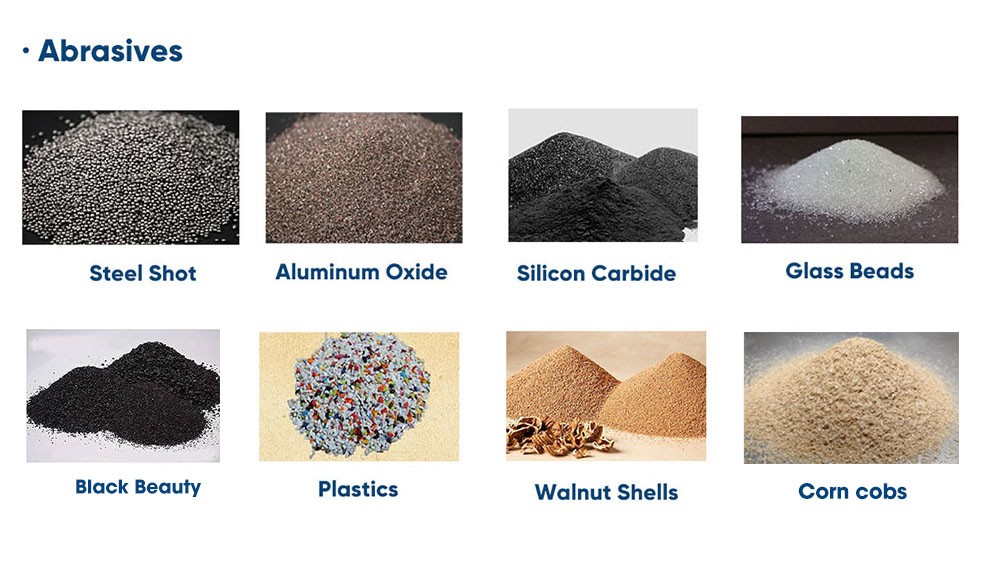
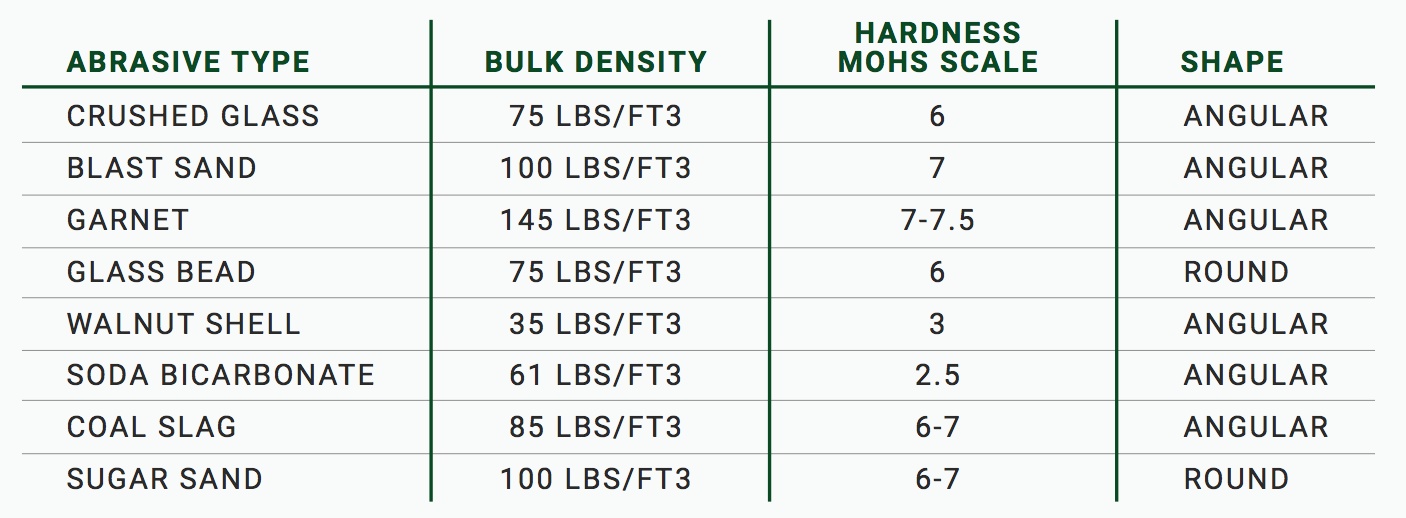
The table below covers all eight major commercially available blasting media types across the seven most decision-relevant technical parameters. Ratings are relative to each other within each column.
| Medienart | Hardness (Mohs / HRC) | Partikelform | Max Profile Ra (µm) | Reuse Cycles | Dust Level | Cost/Cycle Rank | Iron Contamination |
|---|---|---|---|---|---|---|---|
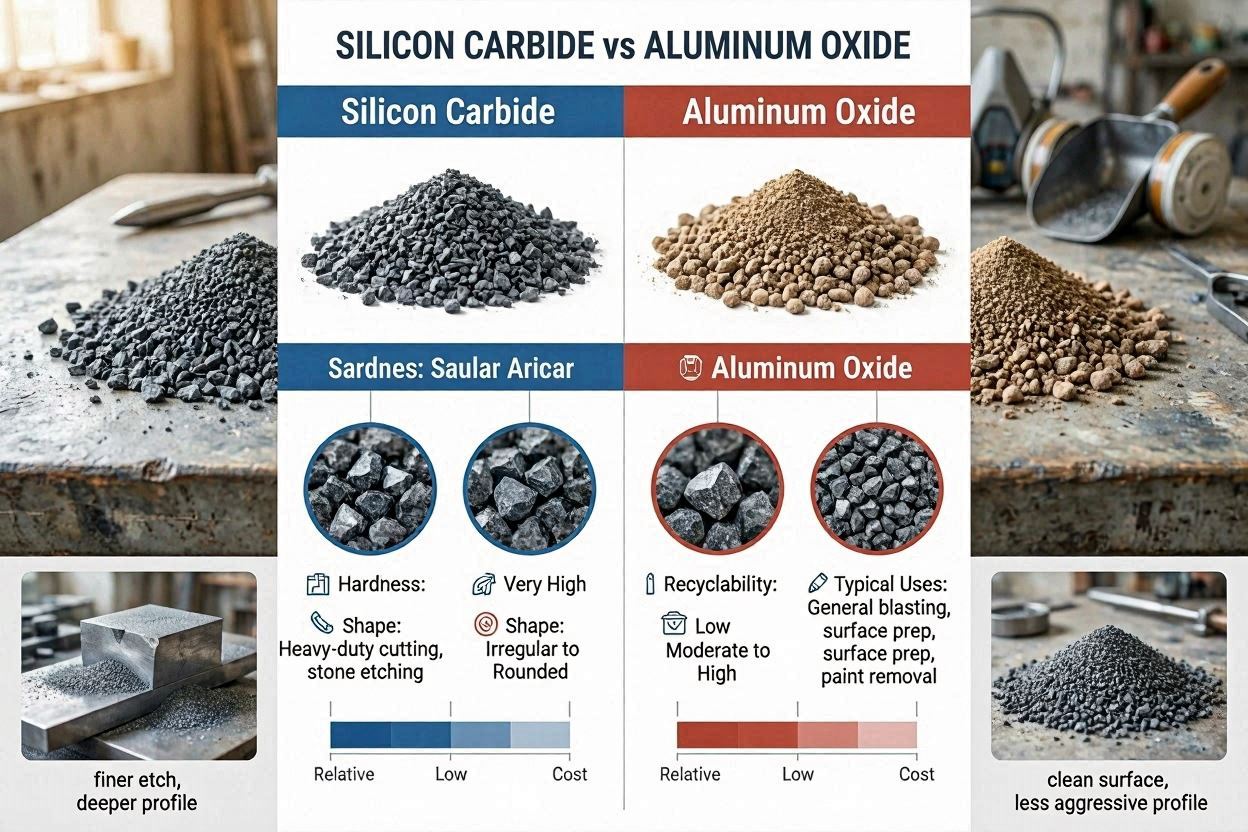
| Aluminium-Oxid | 9.0 Mohs | Eckig | 75 | 15–30 | Medium | Low ▼ | Keine |
| Glasperlen | 5.5–6.0 Mohs | Round (Spherical) | 5 | 10–20 | Niedrig | Medium | Keine |
| Stahlkugel | HRC 40–50 | Round | 15 | 200–300 | Sehr niedrig | Lowest ▼ | Yes — ferrous |
| Stahlkies | HRC 55–66 | Eckig | 50 | 100–200 | Sehr niedrig | Lowest ▼ | Yes — ferrous |
| Granat | 7.5–8.0 Mohs | Eckig | 55 | 3–5 | Niedrig | Medium | Minimal |
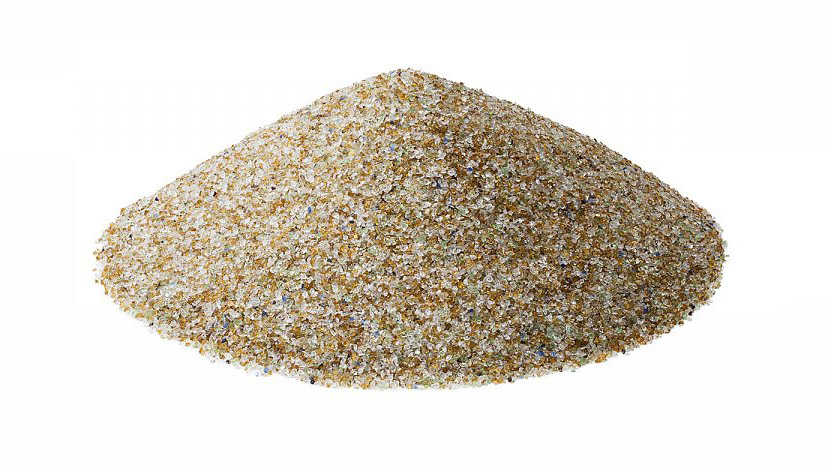
| Crushed Glass | 5.5–6.0 Mohs | Eckig | 38 | 1–3 | Medium | Low-Med | Keine |
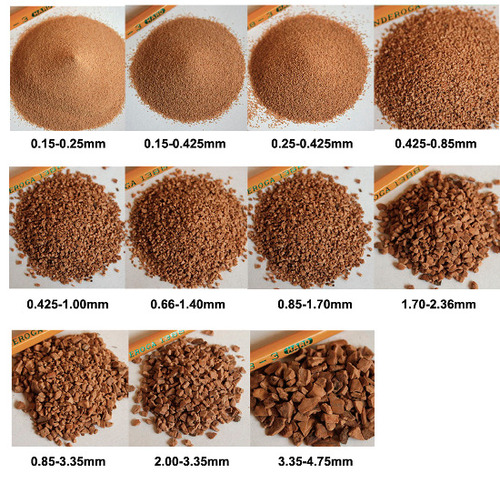
| Walnut Shell | 3.5–4.0 Mohs | Irregular | 0 | 2–4 | Medium | Medium | Keine |
| Siliziumkarbid | 9.0–9.5 Mohs | Eckig | 80+ | 5–10 | Hoch | Highest ▲ | Keine |
Hardness Comparison: Mohs Scale Ranking
Hardness is the single most important factor in determining how aggressively a media cuts into a surface and how long individual particles remain effective before fracturing into fines. A media must be harder than the contaminant it is removing, but using media harder than necessary for the substrate risks surface damage and unnecessarily high operating costs.
Surface Profile Capability
Surface profile capability depends on both hardness and particle shape. Angular particles cut into the surface to create an anchor profile; round particles peen and smooth rather than cut. The maximum achievable anchor profile (Ra in µm) at standard industrial blast pressures on carbon steel is shown below.
Recyclability & Reuse Cycles
Recyclability determines the true economic efficiency of a blasting media. A media with 200 reuse cycles is 200 times more efficient per kilogram purchased than a single-use media, assuming equal cleaning performance per cycle. The extreme recyclability of steel abrasives is the primary reason they dominate closed-loop blast room operations worldwide despite their higher per-kilogram cost versus slag or crushed glass alternatives.
Dust Generation Comparison
Dust generation directly impacts worker health, visibility, and equipment wear. The dust volume generated by a media type depends on its fracture behavior, density, and the blast pressure applied. Dense metallic abrasives that resist fracturing generate far less airborne dust than friable mineral or organic media at the same blast pressure.
Cost Per Effective Blast Cycle: Relative Rankings
Cost per effective blast cycle integrates purchase price, media consumption rate, and recyclability into the single most useful economic metric for media selection. The rankings below are relative — steel abrasives in high-volume closed-loop systems deliver the lowest cost per m², while silicon carbide in open-blast single-use applications delivers the highest. These rankings assume: equivalent cleaning performance per cycle, typical industrial blast parameters, and correct media condition monitoring.
Silicon carbide ranks highest in cost per cycle, but this ranking only applies when silicon carbide is used in applications where a cheaper alternative could achieve the same result. When SiC is the only abrasive that can process a very hard substrate (ceramics, tungsten carbide), its cost per unit produced may actually be lower than attempting to process the same material with aluminum oxide — because Al₂O₃ wears out too quickly to be economically competitive on those substrates.
Substrate Compatibility Matrix
| Substrate | Al₂O₃ | Glasperlen | Stahlkugel | Stahlkies | Granat | Crushed Glass | Walnut/Corn | SiC |
|---|---|---|---|---|---|---|---|---|
| Carbon Steel | Best | Polish only | Best | Best | Gut | Gut | Avoid | Overkill |
| Stainless Steel | Good (white) | Best | Never | Never | Gut | Gut | Limited | Possible |
| Aluminum / Thin Metal | Caution | Best | Caution | Avoid | Fine grade | Fine grade | Best | Avoid |
| Fiberglass / Composite | Avoid | Caution | Avoid | Avoid | Fine grade | Fine grade | Best | Avoid |
| Ceramics / Carbide | Limited | Ineffective | Ineffective | Limited | Ineffective | Ineffective | Ineffective | Best |
| Concrete / Masonry | Gut | Avoid | Caution | Caution | Gut | Best | Ineffective | Overkill |
| Wood / Soft Materials | Avoid | Caution | Avoid | Avoid | Fine grade | Avoid | Best | Avoid |
Decision Framework: How to Read These Comparisons
No single media type wins across all dimensions — every selection involves trade-offs. The following rules of thumb capture the most common decision patterns:
- High-volume structural steel in a closed-loop blast room: Steel shot or steel grit. Economics are unmatched; no other media comes close in cost per m² at scale.
- Open-air or job-site blasting (no reclaim system): Garnet or crushed glass. Low dust, no heavy metals, eco-compliant, adequate performance for most steel and concrete applications.
- Stainless steel, aluminum, or titanium: Glass beads (for polishing/peening) or white aluminum oxide (for surface profiling). Never use steel abrasives.
- Fiberglass, composites, delicate materials: Walnut shell. Nothing else produces acceptable results without substrate damage.
- Technical ceramics, carbide tooling, silicon: Silicon carbide. No other common abrasive is effective.
- Cost-sensitive, medium-volume industrial shop: Brown aluminum oxide with reclaim. Best all-round combination of performance, recyclability, and cost for non-stainless metal work.
For the complete step-by-step selection guide with substrate, contamination, and coating specification inputs, see how to choose sandblasting material: step-by-step selection guide.
Request a Quote
Know which media you need? Specify grade, grit size, and annual volume for a competitive FOB/CIF price within 24 hours.
Get a Free Quote →Talk to a Technical Advisor
Still comparing options? Our surface preparation engineers will review your application and recommend the optimal media type and grade.
Contact Our Team →Filter