How to Choose Aluminum Oxide Blast Media for Steel Surfaces
A practical, specification-grade guide for coating contractors, fabrication engineers, and procurement professionals — covering steel type, contamination grade, cleanliness standards, grit selection, blast parameters, and quality verification.
- Why Steel Surface Preparation Is Different from Other Substrates
- Steel Type Determines Grade Selection
- Understanding Cleanliness Standards: SSPC, ISO & NACE
- Assessing Initial Surface Condition
- Grit Size Selection for Steel: A Decision Framework
- Blast Parameters for Steel Applications
- Recommendations by Steel Application Type
- Quality Verification Before Coating
- Troubleshooting Common Blasting Problems on Steel
- Häufig gestellte Fragen
1. Why Steel Surface Preparation Is Different from Other Substrates
Steel is by far the most common substrate for aluminum oxide blast media applications worldwide — and it is also the substrate where specification errors carry the highest financial consequences. A poorly prepared steel surface leads to premature coating failure, corrosion penetration into the substrate, and costly maintenance interventions — sometimes within months of initial coating application.
What sets steel apart from glass, ceramics, or aluminum as a blast substrate is the combination of three simultaneously active variables: the type and extent of surface contamination (mill scale, rust grades A through D, old paint, oil, salts), the mechanical properties of the steel itself (hardness, section thickness, grain structure), and the service environment demands placed on the coating system that will be applied afterward. Getting the media selection right means addressing all three at once.
This guide is written for practitioners working with carbon steel, structural steel, stainless steel, cast iron, and galvanized steel — the five substrate types that account for the vast majority of aluminum oxide blast media consumption. For the full product background on aluminum oxide blast media, see: Aluminum Oxide Blast Media: The Complete Buyer’s Guide.
2. Steel Type Determines Grade Selection
The first decision in any steel blasting specification is determining the steel type — because this directly governs whether you should specify brown fused or white fused aluminum oxide. Using the wrong grade on an iron-sensitive steel type is the most expensive specification error in this category, generating re-work costs that routinely reach two to five times the original surface preparation budget.
3. Understanding Cleanliness Standards: SSPC, ISO & NACE
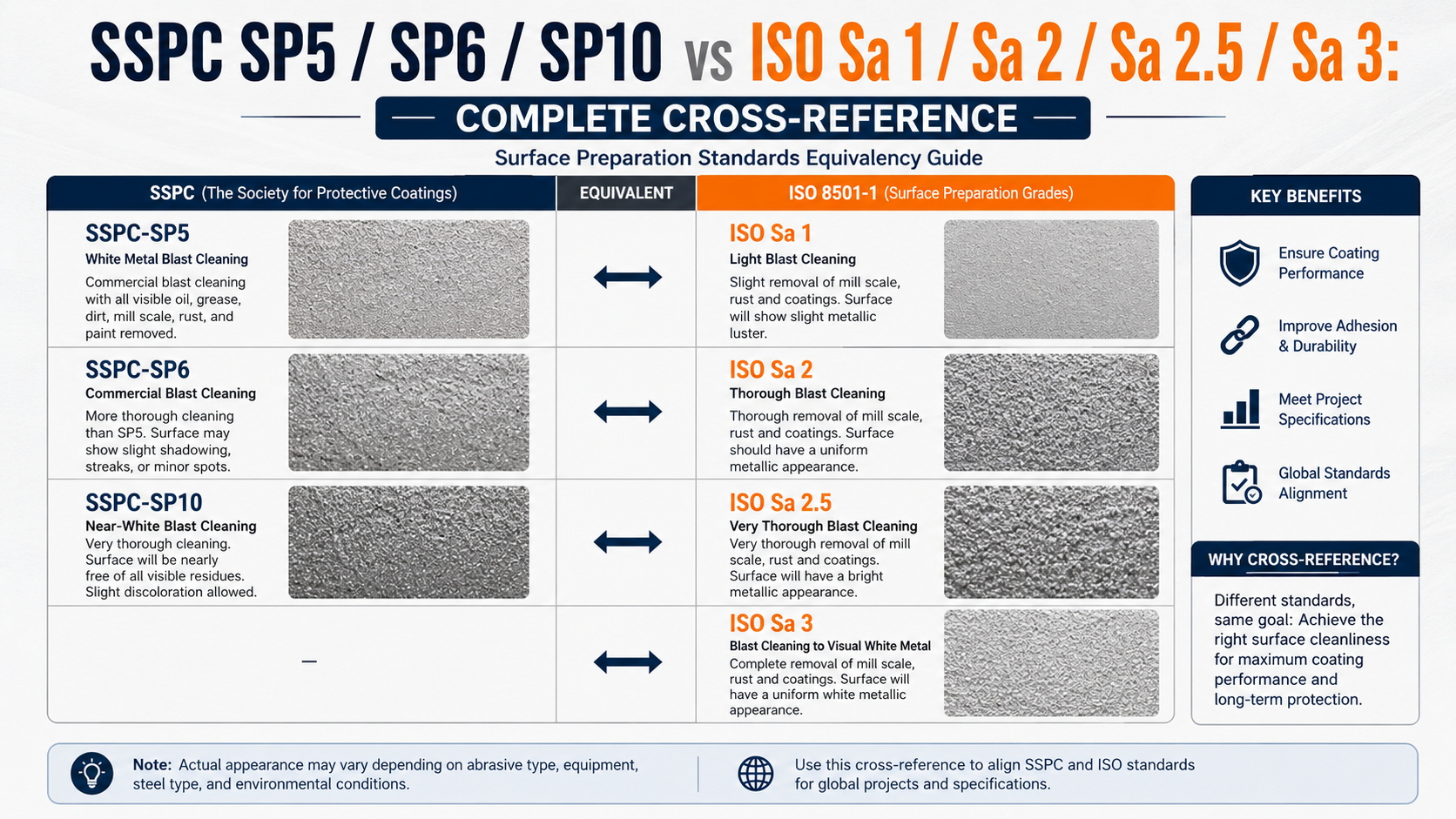
Before selecting grit size or blast pressure, you must identify the cleanliness grade required by the coating manufacturer’s Product Data Sheet (PDS) or the project specification. Cleanliness grade and anchor profile depth are the two outputs that must be achieved simultaneously — grit selection influences both.
ISO Sa 3
ISO Sa 2½
ISO Sa 2
ISO Sa 1
Power Tool
4. Assessing Initial Surface Condition
The initial condition of the steel surface — specifically its rust grade and mill scale coverage — directly affects the grit size you need and the blast time required per square meter. ISO 8501-1 defines four rust grades for steel prior to blasting, illustrated with photographic reference standards:
| ISO Rust Grade | Surface Description | Mill Scale Status | Recommended Grit | Expected Blast Time |
|---|---|---|---|---|
| Grade A | Steel with intact mill scale; little or no rust visible | Fully adherent, continuous | F16–F24 | Longer — scale must be mechanically broken |
| Grade B | Steel with some rust; mill scale beginning to flake | Partially adherent, starting to peel | F24–F36 | Mäßig |
| Grade C | Steel with rust; mill scale mostly removed by rusting | Mostly gone — rust throughout | F24–F36 | Moderate — rust removal more efficient than scale |
| Grade D | Steel with deep pitting and rust; no mill scale remaining | Absent — deep corrosion pits present | F36–F46 | Shorter overall, but pits need multiple passes |
Mill Scale: Why It Demands Special Attention
Mill scale is a thin layer of iron oxides (primarily magnetite, Fe₃O₄) that forms on the surface of hot-rolled steel during the manufacturing process. It is harder than the steel beneath it — approximately 500–600 HV versus 150–200 HV for mild steel — and is electrically cathodic relative to the underlying steel. This means mill scale, when left in place under a coating, acts as a cathode and drives accelerated anodic corrosion of the underlying steel at any point where the coating is breached. Removing mill scale completely is therefore not merely a surface cleanliness requirement — it is a corrosion protection requirement.
Mill scale is best removed with a coarser grit at higher pressure. For Grade A steel (intact mill scale), F16–F24 at 80–100 PSI is the standard approach. The angular grain of aluminum oxide is particularly effective at fracturing and undercutting scale — it physically wedges under scale edges and levers the scale free rather than simply abrading the top surface.
5. Grit Size Selection for Steel: A Decision Framework
Selecting the correct grit size for a steel blasting job requires integrating four pieces of information: the required cleanliness grade, the target anchor profile depth, the steel substrate type (hardness and section thickness), and the equipment type. The table below consolidates these variables into a practical decision matrix for the most common steel blasting scenarios.
| Anmeldung | Steel Type | Target Rz | Grade | FEPA Grit | Pressure |
|---|---|---|---|---|---|
| Structural steel — SP 5 / immersion | Carbon steel, Grade A–B | 70–100 µm | Braun | F16–F24 | 80–100 PSI |
| Structural steel — SP 10 | Carbon steel, Grade B–C | 50–75 µm | Braun | F24–F36 | 70–90 PSI |
| Structural steel — SP 6 | Carbon steel, Grade C–D | 35–55 µm | Braun | F36–F46 | 60–80 PSI |
| Pipeline — external FBE coating | Carbon steel pipe | 50–75 µm | Braun | F24–F36 | 70–90 PSI |
| Tank lining — immersion service | Carbon steel, Grade A | 65–90 µm | Braun | F16–F24 | 80–100 PSI |
| Stainless steel — general industrial | 304 / 316 SS | 25–45 µm | Weiß | F46–F80 | 50–70 PSI |
| Stainless steel — food / pharma | 316L / duplex | 20–35 µm | Weiß | F60–F80 | 40–60 PSI |
| Cast iron — pump / valve body | Grey / ductile cast iron | 40–65 µm | Braun | F24–F46 | 50–70 PSI |
| Hardened steel — mold / die | Tool steel, 45–65 HRC | 30–55 µm | Brown or White | F36–F60 | 60–80 PSI |
| Galvanized steel — sweep blast | Hot-dip galvanized | 15–30 µm | Brown or White | F46–F80 | 30–50 PSI |
| Thermal spray bond coat prep | Carbon / alloy steel | 55–80 µm | Weiß | F24–F36 | 70–90 PSI |
| Powder coating prep — thin section | Mild steel sheet <3 mm | 25–40 µm | Braun | F46–F60 | 40–60 PSI |
For the complete engineering reference covering all FEPA grit sizes, particle size data, and anchor profile depth ranges, see: Aluminum Oxide Grit Size Chart & Selection Guide.
6. Blast Parameters for Steel Applications
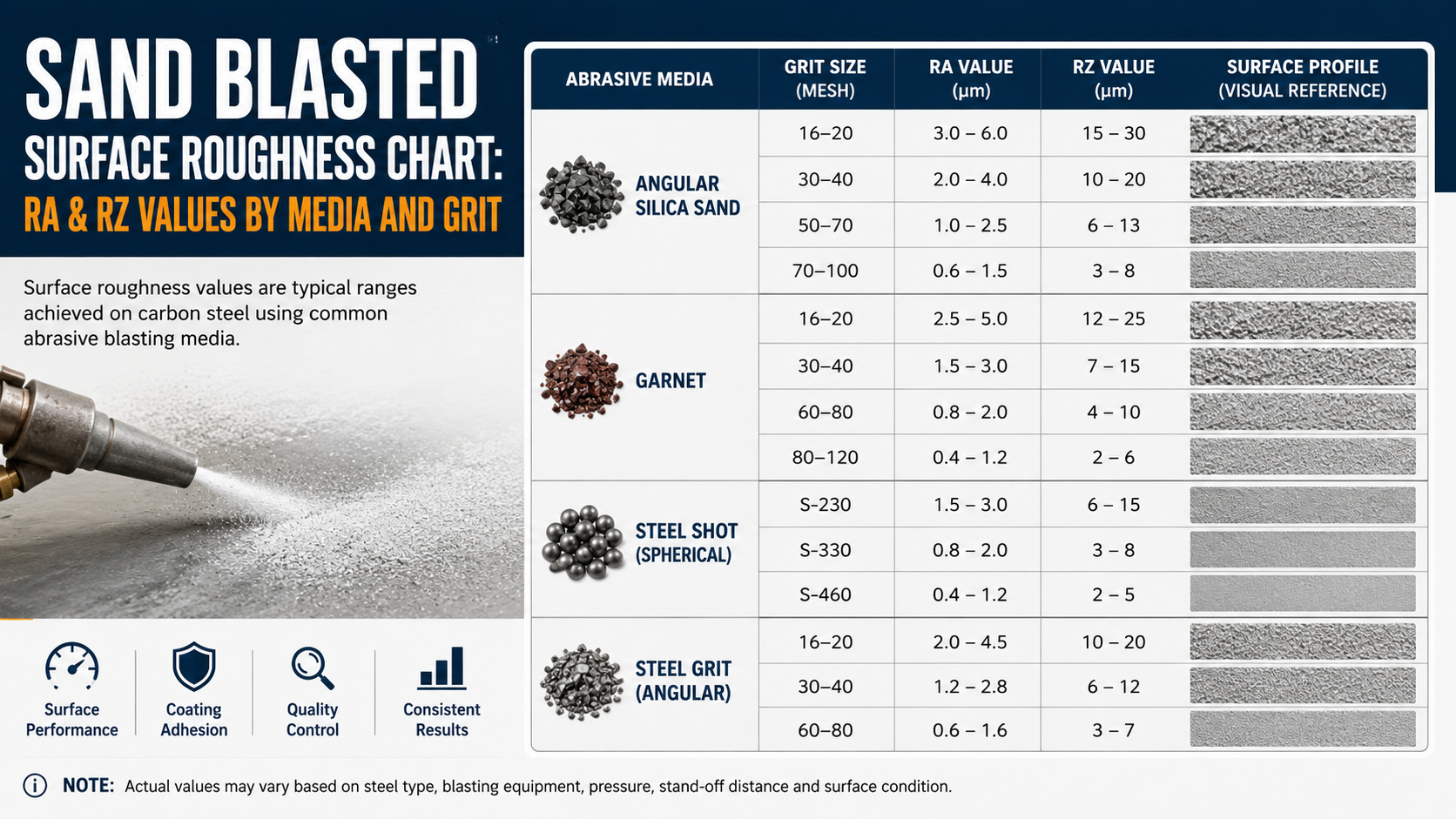
Grit size is the primary driver of anchor profile depth, but blast parameters — pressure, nozzle geometry, standoff distance, and nozzle angle — determine how much of the grit’s profile potential is realized. For steel applications specifically, these parameters also govern whether tightly adherent mill scale and hard rust layers are physically removed or merely polished.
Blast Pressure
Higher pressure accelerates media velocity and increases both cutting aggression and profile depth — but with diminishing returns above approximately 90 PSI (6.2 bar) for most aluminum oxide grits on steel. Beyond this threshold, additional pressure primarily increases media fracture rate, shortens nozzle life, and raises compressor energy cost without proportionally increasing profile depth or cleanliness grade. The practical working range for steel preparation is:
- 40–60 PSI (2.8–4.1 bar): light sweep blast, galvanized steel, thin sheet metal
- 60–80 PSI (4.1–5.5 bar): general SP 6 / SP 10 work on moderate rust and scale
- 80–100 PSI (5.5–6.9 bar): SP 5 / heavy mill scale / Grade A steel
Nozzle Type and Bore Diameter
For open-blast steel work, venturi-profile nozzles (also called laval nozzles) significantly outperform straight-bore nozzles. A venturi nozzle accelerates the media stream through a converging-diverging profile, producing exit velocities 40–60% higher than a straight-bore nozzle at the same inlet pressure. This translates directly into faster cleaning rates and deeper profiles per unit of media consumed. The nozzle bore diameter must be matched to the grit size: as a rule, the bore should be at least four to five times the D90 particle diameter to prevent bridging and inconsistent flow.
| FEPA Grit | D90 Particle Size | Minimum Nozzle Bore | Recommended Bore | Replace Nozzle When Bore Reaches |
|---|---|---|---|---|
| F16 | ~1,700 µm | 9 mm (⅜ in) | 10–11 mm | 12–12.5 mm (+25%) |
| F24 | ~1,000 µm | 6 mm (¼ in) | 7–8 mm | 9 mm (+25%) |
| F36 | ~710 µm | 4 mm | 6–7 mm | 7.5–8 mm (+25%) |
| F46–F60 | ~500 µm | 3 mm | 5–6 mm | 6.5–7 mm (+25%) |
Standoff Distance and Nozzle Angle
The optimal standoff distance for most steel blast work is 20–30 cm (8–12 inches) measured from nozzle tip to substrate. Shorter distances increase impact energy per unit area but reduce coverage rate and risk over-blasting on thin sections. Longer distances improve coverage rate but reduce profile depth — useful when a shallower profile is required without stepping to a finer grit.
Nozzle angle affects the cutting mechanism. A 90° perpendicular angle maximizes compressive impact energy and is preferred for deep profile generation and mill scale removal. A 15–30° oblique angle introduces a shearing component that is more effective at undercutting and removing tightly adherent scale and old paint at the edges of pits and surface irregularities. Many experienced blasters use a combination — perpendicular passes for initial cleaning, followed by oblique passes to clean out pit bottoms and recesses.
7. Recommendations by Steel Application Type
Structural Steel and Bridge Fabrication
This is the highest-volume application for aluminum oxide in steel surface preparation. New fabrication typically presents Grade A–B steel (intact or partially scaled mill scale). Brown fused aluminum oxide at F24–F36, 70–90 PSI, achieves SSPC-SP 10 in a single pass on most grades of structural mild steel — the most commonly specified standard for bridge and building structural coatings. For aggressive environments (marine atmosphere, acid industrial atmosphere), SP 5 may be required, in which case step up to F16–F24 at 85–100 PSI.
Pipeline and Vessel Coating
Pipeline coating specifications — particularly for fusion-bonded epoxy (FBE), three-layer polyethylene (3LPE), and liquid epoxy internal linings — are among the tightest in the industry. Most pipeline coating standards require SP 10 minimum with a specific anchor profile tolerance: typically 40–70 µm for FBE and 50–80 µm for liquid internal coatings. F24–F36 brown fused aluminum oxide in a centrifugal blast machine (wheelblast) or direct-pressure portable unit is the standard specification. Wheelblast systems in pipe coating plants typically use F24–F30 to achieve consistent profiles across the pipe circumference in a single pass.
Storage Tank Linings — Immersion Service
Tanks storing water, chemicals, hydrocarbons, or food products require the most demanding surface preparation — invariably SP 5 (White Metal) with an anchor profile of 65–100 µm depending on the lining system thickness. Brown fused aluminum oxide F16–F24 at 85–100 PSI is the specification of choice. The angular grain of aluminum oxide is particularly critical here: the sharp peaks of the anchor profile create maximum mechanical adhesion for thick film novolac epoxy, glass flake epoxy, and vinyl ester lining systems that may be 500–2,000 µm DFT.
Stainless Steel Process Equipment
Food and beverage vessels, pharmaceutical reactors, and chemical process columns in stainless steel require white fused aluminum oxide — no exceptions. The typical specification is F46–F80 at 50–70 PSI for general industrial stainless, and F60–F80 at 40–60 PSI for pharmaceutical-grade or food-contact surfaces. Post-blast verification with a ferroxyl test is mandatory before any coating application. For detailed guidance on stainless steel applications, see our aerospace and medical-grade media article: Aluminum Oxide Blast Media for Aerospace & Medical.
Powder Coating Preparation
Powder coating adhesion on mild steel requires a clean, oxide-free surface with moderate anchor profile — typically 20–40 µm for standard industrial powder. Thin-section sheet metal (1–3 mm) is sensitive to distortion from excessive blast pressure or coarse grit. F46–F60 brown fused aluminum oxide at 40–60 PSI in a suction-feed blast cabinet is the standard for most powder coat pre-treatment work. The key quality criterion before powder coating is surface cleanliness (SP 10 or better) and absence of oil — outgassing from residual oil beneath a cured powder coat causes fish-eye defects that cannot be repaired without stripping and recoating.
8. Quality Verification Before Coating
A correctly blasted steel surface must be verified against specification before any coating is applied. Coating application over a non-conforming surface — regardless of how good the coating system is — will result in premature failure. The following is the minimum verification sequence for specification-grade steel blasting work.
9. Troubleshooting Common Blasting Problems on Steel
| Problem Observed | Most Likely Cause | Corrective Action |
|---|---|---|
| Profile too shallow — Rz below specification | Grit too fine; blast pressure too low; nozzle worn; media degraded below effective D50; standoff too great | Step up grit size or increase pressure; measure nozzle bore and replace if worn beyond 25% of nominal; top up media charge; reduce standoff distance |
| Profile too deep — Rz above specification ceiling | Grit too coarse; blast pressure too high; standoff too short; multiple overlapping passes on same area | Step down grit size; reduce pressure; increase standoff; move nozzle at consistent rate; use a single pass strategy |
| Residual mill scale in pits and seams | Single-direction blast pass; perpendicular-only nozzle angle; pressure too low for Grade A scale | Add oblique-angle pass (15–30° off perpendicular) after primary pass; increase pressure to 85–100 PSI for intact scale; use coarser grit (F16–F24) |
| Flash rust forming before coating | Time between blasting and coating exceeded; humidity above dew-point control threshold; salt contamination not removed | Reduce time-to-coat; check and enforce dew-point conditions; test and treat for soluble salts before blasting; schedule blasting immediately before coating window |
| Rust halos appearing on stainless steel after coating | Brown fused aluminum oxide used instead of white; cross-contamination from shared equipment; ferroxyl test not performed | Strip coating; re-blast with white fused Al₂O₃ on dedicated clean equipment; perform and record ferroxyl test; review procurement and equipment protocols |
| Inconsistent anchor profile across the work area | Nozzle worn unevenly; media size distribution drifted; operator speed inconsistent; air supply pressure fluctuating | Replace nozzle; top up with fresh media; calibrate air supply pressure; train operators on consistent nozzle travel speed and pattern overlap |
| Substrate distortion on thin-section steel | Grit too coarse for section thickness; blast pressure too high; excessive dwell time per area | Step to finer grit (F46–F60); reduce pressure to 40–55 PSI; increase nozzle travel speed; blast from both sides alternately on thin sections |
| Media bridging in blast cabinet hopper | Media moisture content too high; grit too fine clumping under compression; hopper geometry inadequate for fine grits | Dry media before use (110 °C / 2 hours if severely damp); specify media moisture ≤0.3% on CoA; install vibrating hopper agitator for fine-grit applications |
10. Frequently Asked Questions
SSPC-SP 10 (Near-White Metal Blast, equivalent to ISO Sa 2½) requires that at least 95% of each unit area of the surface is free of all visible contamination — allowing light staining of rust or mill scale on the remaining 5%. SSPC-SP 5 (White Metal Blast, ISO Sa 3) requires 100% removal of all visible contaminants with no staining permissible. SP 5 is required for immersion service (tank linings, buried pipelines, offshore submerged zones, chemical plant vessels), where even minor residual contamination under a high-build coating will initiate osmotic blistering. SP 10 is the standard for most atmospheric-exposure structural steel, marine topside, and general industrial protective coating. SP 5 adds approximately 25–40% to blast time and media consumption compared to SP 10 — cost it into the specification before mandating it.
Yes, aluminum oxide is compatible with centrifugal wheelblast machines, which are widely used in pipe coating plants, steel service centers, and structural fabrication shops for high-volume continuous processing. The key consideration is that aluminum oxide’s higher hardness (Mohs 9) causes higher wear rates on wheelblast impellers, control cages, and blades compared to steel grit or steel shot. Tungsten carbide-lined or ceramic-lined blast wheels are recommended when running aluminum oxide continuously to achieve acceptable component life. The economics are typically favorable despite higher wear costs, because aluminum oxide’s media efficiency (faster cleaning, better profile consistency, multi-cycle recyclability) offsets the component maintenance cost at production volumes above approximately 200–300 m²/day.
The only reliable indicator is anchor profile measurement — not visual inspection of the media or elapsed time. Measure the achieved Rz using ISO 8503 replica tape at the start of each production shift, and again midway through if processing more than 100 m² per shift. When the mean Rz across five readings drops below the lower tolerance in your coating PDS, it is time to top up with fresh media. A secondary indicator is increased blast time required to achieve SP 10 on equivalent steel grades — this signals that the cutting efficiency of the media charge has degraded. Keep a production log of Rz readings versus cumulative blast area to predict top-up intervals on an empirical basis rather than guessing. For detailed guidance on media life management, see: Is Aluminum Oxide Blast Media Reusable? How Many Times?
Flash rust prevention requires managing three variables simultaneously: time, humidity, and salt contamination. Apply the first coat within the window specified in the coating PDS — typically 4 hours maximum at <60% RH, 2 hours at 60–85% RH, and sometimes as short as 30 minutes in marine conditions. Use a dew-point instrument (digital hygrometer with thermocouple) to verify that steel surface temperature is at least 3 °C above the dew point before and throughout blasting and coating. Eliminate salt contamination before blasting using a Bresle patch test — residual chlorides act as hygroscopic nuclei that dramatically accelerate flash rust formation on freshly blasted steel. In unavoidable high-humidity situations, some coating specifications permit application of a blast primer within minutes of blasting, which seals the surface before significant re-oxidation occurs — always check that the blast primer is compatible with the coating system being applied over it.
Yes — significantly. Coarser grits carry more kinetic energy per particle and remove more surface mass per impact event, which translates to faster cleaning rates on contaminated steel. On Grade A (intact mill scale) carbon steel at 80 PSI with a 7 mm bore venturi nozzle, a rough comparison: F16 achieves approximately 8–12 m²/hour; F36 achieves approximately 15–22 m²/hour. The finer grit is faster because it delivers more impact events per second over the blast pattern area, even though each event removes less material. The crossover point depends on the contamination type — for mill scale, which requires aggressive undercutting, F16–F24 is faster per unit of specification-grade area achieved; for light rust (Grade C–D), F36–F46 is faster per unit area because there is no hard scale layer to overcome. Match grit to contamination type, not just to the target profile depth.
For Sa 2½ (SSPC-SP 10) with a minimum 50 µm Rz on mild steel, the standard specification is brown fused aluminum oxide F24–F36 at 70–85 PSI. F36 will typically deliver Rz 40–65 µm on Grade B–C steel — the lower portion of this range may fall just under 50 µm on softer Grade D steel with minimal surface contamination. To ensure you consistently hit 50 µm minimum, order F24 if your steel is Grade A–B (significant mill scale present), or F36 if your steel is Grade B–D with moderate-to-heavy rust and minimal scale. Run a trial blast and measure with Testex replica tape before committing to full production — the combination of your specific steel hardness, blast equipment, and operating conditions will define the achieved Rz more precisely than any table can predict in the abstract.
Source the Right Grade for Your Steel Application
Jiangsu Henglihong Technology supplies brown fused and white fused aluminum oxide abrasives in the full FEPA grit range — with lot-specific Certificates of Analysis, ISO 9001:2015 quality management, and global export capability.
Related Resources
Continue with these related guides from the Henglihong resource library:
- Aluminum Oxide Blast Media: The Complete Buyer’s Guide
- Aluminum Oxide Grit Size Chart & Selection Guide
- Brown vs White Aluminum Oxide: Which Should You Use?
- Aluminum Oxide vs Garnet Blast Media: Full Comparison
- Is Aluminum Oxide Blast Media Reusable? How Many Times?
- Aluminum Oxide Blast Media for Aerospace & Medical
- Aluminum Oxide for Glass Etching & Frosting
- Bulk Aluminum Oxide Blast Media – Wholesale Pricing & RFQ
- Aluminum Oxide Anti-Slip Additive for Floor Coatings
Filter