Glass Bead Blasting Media: Surface Finish, Grades & Applications Guide
How spherical glass bead abrasive produces the smooth, satin, non-directional finish that angular media cannot — grade selection tables, substrate compatibility, application guidance for automotive, stainless steel, aerospace, and precision components, and how glass bead compares to aluminum oxide.
1. What Is Glass Bead Blasting Media?
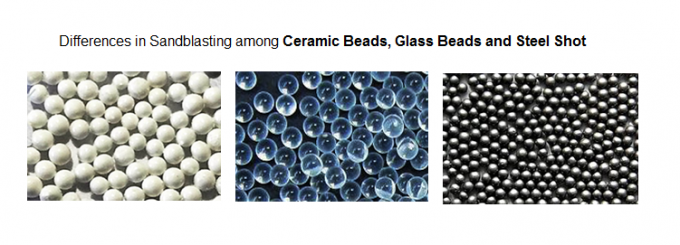
Glass bead blasting media consists of perfectly spherical particles manufactured from soda-lime glass — the same material used in everyday glass products — melted at high temperature and formed into uniform spheres through a controlled cooling process. The spheres are then sized into precise grade ranges for blasting applications ranging from heavy industrial cleaning to ultra-fine decorative finishing.
The defining characteristic that separates glass bead from every other major blasting abrasive is its perfectly spherical particle shape. Where angular abrasives such as 氧化铝 和 石榴石 cut into the surface and create a jagged, high-roughness anchor profile, glass bead peens the surface — compressing and smoothing it — producing a bright, uniform, non-directional satin finish that is consistent regardless of blast direction. This finish characteristic is irreproducible with angular media at any grit size.
Glass bead is manufactured from amorphous (non-crystalline) glass and contains no free crystalline silica, making it fully compliant with OSHA’s Respirable Crystalline Silica Standard (29 CFR 1926.1153), EU Directive 2017/2398, and equivalent regulations in Australia, Canada, and the UK — a critical compliance advantage over legacy silica sand blast media.
2. How the Spherical Shape Creates a Unique Finish
Understanding why glass bead produces a fundamentally different surface finish from angular abrasives requires a brief look at the mechanics of particle impact. The shape of the abrasive particle determines how kinetic energy is transferred to the surface on contact.
Angular vs Spherical Impact Mechanics
Peening action — smooth, consistent dimples
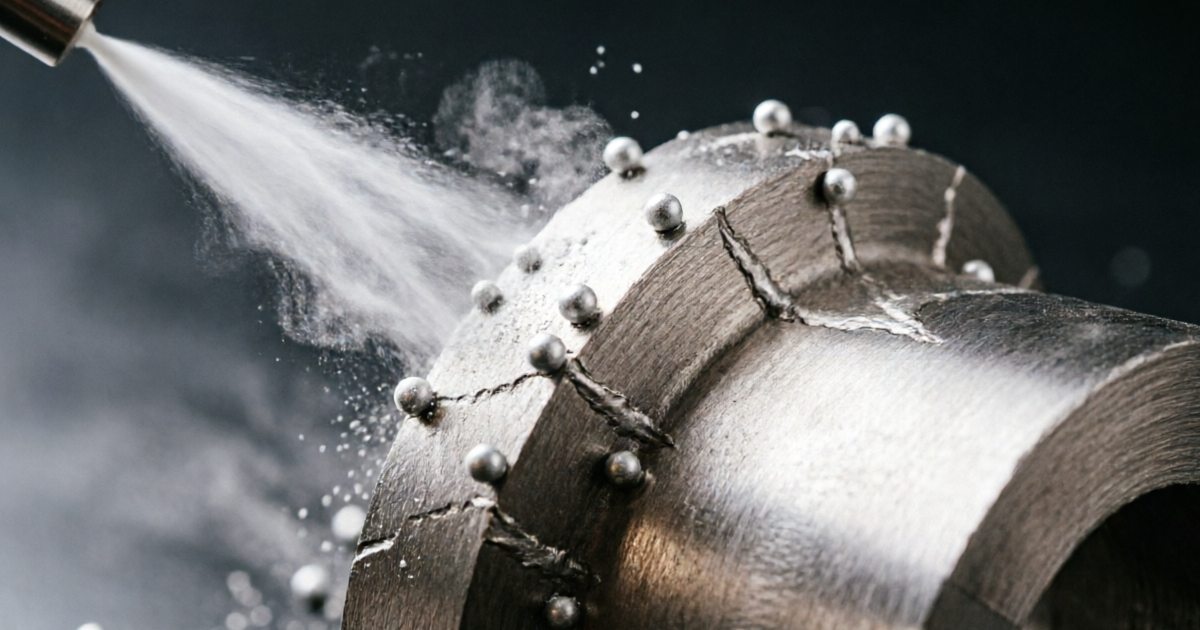
A spherical particle strikes the surface and transfers energy radially outward from the contact point, creating a smooth hemispherical impression. The surface is plastically deformed downward and outward, producing a uniform pattern of shallow, rounded dimples — the characteristic satin or matte finish. Compressive residual stress is induced in the surface layer, which improves fatigue resistance in load-bearing components.
Cutting action — jagged peaks and valleys
An angular particle (aluminum oxide, garnet, steel grit) strikes the surface with a sharp edge or corner, physically cutting into the metal and displacing material. This creates the jagged peaks and deep valleys of an anchor profile — ideal for coating adhesion but producing a rough, matte surface texture that may be visually or dimensionally unacceptable for precision or decorative applications.
The practical consequence is that glass bead produces a surface that is simultaneously clean, bright, and dimensionally consistent — it removes surface oxides, light contamination, and burrs without altering the part’s geometry or creating the rough texture that angular media leave behind. For components where appearance matters, or where dimensional tolerances are tight, this is a decisive advantage.
The peening action also imparts beneficial compressive residual stress to the surface layer — the same physical mechanism exploited in dedicated shot peening operations using steel shot. For certain applications (springs, gears, medical implants, aircraft fastener holes), this compressive stress layer measurably improves fatigue life and resistance to stress corrosion cracking.
3. Glass Bead Grade Selection Guide
Glass beads for blasting are graded by particle size, referenced against US mesh standards (MIL-G-9954A or SAE J1173) or European equivalents. The grade number runs inversely to particle size: lower grade numbers are coarser, higher numbers are finer. The most widely used industrial grades span from #4 (coarsest, approximately 850 µm) to #13 (finest, approximately 75 µm).
| Grade | Particle Size (µm) | Finish Texture | Aggression | Primary Applications |
|---|---|---|---|---|
| #4–#5 | 710–1,000 | Coarse satin | High | Fast cleaning of heavy oxidation, large structural components, coarse decorative finish |
| #6–#7 | 425–710 | Medium-coarse satin | Medium-high | Industrial cleaning, aluminum and stainless components, automotive restoration chassis parts |
| #8–#9 Most popular | 212–425 | Medium satin | Medium | Stainless steel equipment, aluminum wheels, motorcycle components, general surface conditioning |
| #10–#11 Most popular | 106–212 | Fine satin | Low-medium | Food processing equipment, pharmaceutical machinery, precision valve bodies, decorative finishing |
| #12–#13 Fine | 53–106 | Very fine / bright | Low | Medical implants, optical components, titanium parts, ultra-fine decorative metalwork |
Finish texture decreases (smoother) as grade number increases. Aggression ratings are relative within glass bead — glass bead at any grade is significantly less aggressive than aluminum oxide or garnet at equivalent particle size.
4. Substrate Compatibility
Glass bead’s moderate hardness (Mohs 5.5–6.0) and spherical shape make it compatible with a broad range of substrates — significantly broader than angular abrasives of comparable aggression. The substrate compatibility grid below covers the most commonly encountered materials in industrial finishing and maintenance operations.
5. Applications by Industry
Glass bead blasting media serves a specific and important role in applications where surface finish quality, dimensional precision, and cleanliness matter more than raw abrasive aggression. The following industry applications represent the most significant commercial uses as of March 2026.
Automotive & Restoration
Brightening aluminum alloy wheels, finishing engine covers and intake manifolds, cleaning carburetor bodies and cylinder heads between rebuild cycles, and cosmetic finishing of chrome and stainless trim. See the automotive restoration blasting guide for component-by-component guidance.
Food Processing & Pharma
Surface conditioning of stainless steel process vessels, pipe fittings, mixing equipment, and pharmaceutical reactor components. The smooth, non-directional finish created by glass bead minimizes bacterial adhesion surface area — a recognized hygiene benefit in FDA and EHEDG-regulated environments.
Aerospace Components
Shot peening of titanium fastener holes, aluminum landing gear components, and nickel alloy turbine disk bores to improve fatigue life. Fine grades (#12–#13) are also used for surface finishing of implant-grade titanium and high-strength steel aircraft hardware prior to inspection or coating.
Hydraulics & Precision Parts
Cleaning and surface conditioning of hydraulic cylinders, valve bodies, pump housings, and precision pneumatic components between service cycles. Glass bead cleans without altering bore dimensions or internal surface geometry — critical where tolerances are measured in microns.
医疗器械和植入物
Surface preparation of orthopedic implants (hip stems, knee components, spinal cages), dental abutments, and surgical instruments. Ultra-fine glass bead produces the controlled surface texture required for bone integration in porous titanium implants while meeting ISO 13485 and FDA 21 CFR Part 820 cleanliness requirements.
Architectural Metalwork
Decorative finishing of stainless steel architectural panels, handrails, elevator doors, and interior fixtures. The consistent, non-directional satin texture achieves a uniform appearance across large surface areas that would be impossible to replicate with hand polishing or directional abrasive methods.
6. Glass Bead vs Aluminum Oxide — Which Should You Choose?
Glass bead and aluminum oxide are frequently considered for the same surface preparation or finishing task, but they serve fundamentally different purposes. Choosing the wrong one for the application is one of the most common errors in blasting media specification — and it shows up immediately in the surface finish or in downstream coating adhesion failures.
- A smooth, satin, non-directional finish is required
- The substrate is stainless steel and iron contamination must be avoided
- Dimensional precision is critical — no substrate removal acceptable
- The goal is deburring or light cleaning, not rust or scale removal
- Shot peening for fatigue life improvement is the objective
- The final application is decorative, medical, or food-contact use
- A thin-film coating or anodizing will be applied and a shallow, smooth profile is required
- Heavy rust, mill scale, or thick coating removal is needed
- A deep anchor profile (40–120 µm) is required for coating adhesion
- High throughput and maximum recyclability are priorities
- The substrate is carbon or structural steel
- Aggressive deburring of hard materials is required
- A heavy-duty epoxy, polyurethane, or zinc-rich coating will be applied
- Sa 2.5 / SSPC-SP10 cleanliness grade must be achieved
For a broader multi-media comparison across all major abrasive types — including garnet, steel grit, silicon carbide, and plastic media — see the Blasting Media Comparison Chart. For a structured decision framework that walks you through the full selection process, refer to the complete blasting media selection guide.
7. Recyclability and Operating Tips
Glass bead achieves 30–50 recycle cycles in a well-maintained recirculating blast cabinet — significantly fewer than 氧化铝 (100–200 cycles) but substantially more than single-use abrasives. Each impact gradually rounds and then fractures the beads; the classifier continuously removes sub-size broken fragments to maintain a consistent working grade in the blast mix.
Key Operating Guidelines
- Blast pressure: Glass bead is most effective at 3–5 bar (44–73 psi). Higher pressures increase fracture rate dramatically and reduce recycle life without proportional improvement in finish quality. Avoid the instinct to “blast harder” when results are unsatisfactory — switch to a coarser grade instead.
- Moisture control: Glass bead absorbs surface moisture and can clump in humid conditions, causing feed inconsistencies in the blast pot. Ensure compressed air is dry (dew point below −10 °C) and store media in sealed packaging until use.
- Classifier tuning: Because broken glass bead fragments are sharp, it is especially important to ensure the classifier is removing sub-size material continuously. Accumulated broken fragments in the working mix can scratch sensitive surfaces and contaminate finishes.
- Nozzle wear: Glass bead wears blast nozzles more slowly than angular abrasives but still requires periodic nozzle inspection. A worn nozzle produces an inconsistent blast pattern and uneven finish — nozzle internal diameter should be checked regularly against the original specification.
- Contamination: Never mix glass bead with metallic abrasives in the same cabinet system without thorough purging. Even trace amounts of steel shot or steel grit mixed into glass bead will contaminate stainless steel or aluminum surfaces with iron particles.
8. Frequently Asked Questions
Related Resources
Explore the full blasting media resource library for further guidance on selection, cost analysis, and application-specific recommendations:
- Blasting Media: Complete Industry Guide — full overview of all media types and applications
- Types of Blasting Media: Complete Guide — how glass bead compares to all other abrasive types
- How to Choose the Right Blasting Media — step-by-step selection framework and substrate matrix
- Aluminum Oxide Blast Media: Uses & Grit Guide — the angular alternative for aggressive surface prep
- Garnet Blasting Media — eco-friendly angular abrasive for steel and pipeline applications
- Steel Grit vs Steel Shot — metallic alternatives for high-volume production peening and cleaning
- Plastic Blast Media — for composite and thin-gauge aluminum where glass bead may be too aggressive
- Blasting Media Comparison Chart — side-by-side data for all major abrasives
- Blasting Media Cost Guide & ROI Analysis — cost-per-m² modeling and price benchmarks
- Blasting Media Safety Guide — OSHA/EU compliance, PPE requirements, dust control
- Blasting Media for Automotive Restoration — component-specific media recommendations
- Industrial Surface Prep: Best Blasting Media for Metal
- Eco-Friendly Blasting Media: Low-Dust & Silica-Free Options
- Silicon Carbide Blast Media: Hardest Abrasive Explained
Source Glass Bead Blasting Media from a Trusted Manufacturer
Jiangsu Henglihong Technology supplies industrial-grade glass bead in MIL-G-9954A and SAE J1173 grades, with full batch documentation, sieve analysis certification, and reliable export logistics to North America, Europe, and beyond.
Request a Quote or Technical Sample过滤器