Silica Sand in Abrasive Blasting: Health Risks, OSHA Rules & Safe Alternatives
A comprehensive safety reference covering silicosis risk, OSHA crystalline silica PEL standards, international regulations banning silica sand blasting, and approved silica-free alternatives that deliver equal or superior surface preparation performance.
The Silica Blasting Health Risk
Crystalline silica (quartz) is classified as a Group 1 carcinogen — confirmed to cause cancer in humans — by the International Agency for Research on Cancer (IARC). It is also the causative agent of silicosis, a fatal and incurable lung disease. The use of silica sand as abrasive blasting media is one of the highest-risk sources of occupational crystalline silica exposure and has been banned or severely restricted in most industrialized countries. There is no safe level of crystalline silica dust exposure — risk increases with cumulative dose over a working lifetime.
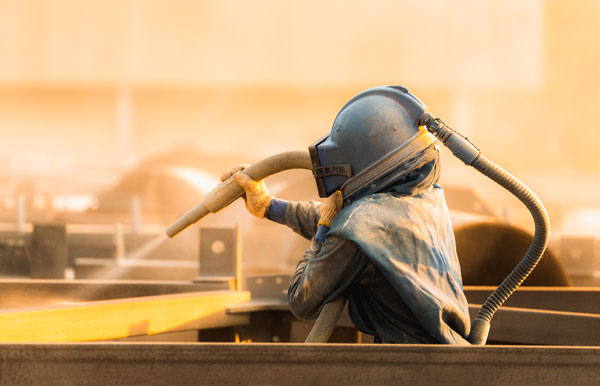
Silica sand — quartz sand — was historically the original blast abrasive, which is why the process became known as “sandblasting.” Today, its use as a blasting media is either illegal or subject to the most stringent engineering controls available in virtually all developed industrial jurisdictions. The reason is straightforward: when silica sand fractures under blasting impact, it generates respirable crystalline silica dust at concentrations that can be hundreds or thousands of times above safe occupational exposure limits.
Understanding the silica risk is important not just for regulatory compliance, but for appreciating why the alternatives described in this guide — steel grit, aluminum oxide, garnet, glass beads — are not compromises in blasting performance. They are superior choices on both health and economic grounds. For the complete media selection framework: Abrasive Blasting Media Complete Guide.
What Is Silicosis?
Silicosis is a progressive, irreversible, and incurable fibrotic lung disease caused by the deposition of crystalline silica (quartz or cristobalite) particles in lung tissue. When respirable silica particles — those small enough to penetrate deep into the alveoli of the lungs (typically <10 µm aerodynamic diameter) — are inhaled and deposit in lung tissue, they trigger an inflammatory response. The body cannot dissolve or remove silica, and the repeated inflammatory cycles result in the formation of fibrotic nodules — scar tissue — that progressively reduce lung function.
Three Forms of Silicosis
- Chronic silicosis: Develops over 10+ years of exposure to lower concentrations of respirable crystalline silica. The most common form. Symptoms (breathlessness, cough, fatigue) may not appear until the disease is significantly advanced. Continues to progress even after silica exposure ends.
- Accelerated silicosis: Develops within 5–10 years from exposure to higher concentrations. Progresses more rapidly than chronic silicosis.
- Acute silicosis: Develops within weeks to 5 years of exposure to very high concentrations of respirable crystalline silica — the type of concentrations generated by uncontrolled silica sand blasting in enclosed or poorly ventilated spaces. Can be rapidly fatal. Historically caused deaths in blasters working in confined spaces with silica sand in the 1930s–1960s.
In addition to silicosis, crystalline silica exposure is associated with: lung cancer (IARC Group 1 carcinogen in silicotic individuals), chronic obstructive pulmonary disease (COPD), pulmonary tuberculosis (silicosis dramatically increases susceptibility to TB), and systemic autoimmune diseases including scleroderma and lupus. There is no treatment for silicosis beyond management of symptoms and supportive care. The only effective measure is prevention through elimination of exposure.
Exposure Levels During Blasting
Measurements of respirable crystalline silica dust concentrations during abrasive blasting with silica sand — conducted by OSHA, NIOSH, and independent industrial hygienists over decades of research — consistently show airborne silica concentrations that dwarf safe exposure limits by enormous margins:
| Scenario | Typical Airborne Respirable Crystalline Silica (µg/m³) | × Above OSHA PEL (50 µg/m³) |
|---|---|---|
| Sandblasting in open field, operator 3m from blast | 500–2,000 | 10–40× |
| Sandblasting in partially enclosed space | 2,000–10,000 | 40–200× |
| Sandblasting in enclosed space (tank, vessel interior) | 10,000–100,000+ | 200–2,000× |
| OSHA PEL (permissible exposure limit, 8h TWA) | 50 | — |
| OSHA Action Level | 25 | — |
| NIOSH REL (recommended) | 50 | — |
| Non-silica abrasives (garnet, Al₂O₃) — typical | <50 (with PPE) | At or below PEL |
These concentrations make it clear why engineering controls alone cannot make silica sand blasting safe in practice. Even at the lowest measured concentrations in open-air settings, direct operator exposure vastly exceeds the OSHA PEL. Achieving the 50 µg/m³ PEL requires essentially isolating the operator completely from the blasting environment — supplied-air respirators, full encapsulating suits, or remote-controlled blasting equipment — controls that are impractical or uneconomic for most operations.
OSHA Crystalline Silica Standard (29 CFR 1910.1053 / 1926.1153)
In 2016, OSHA published its final rules on occupational exposure to respirable crystalline silica, replacing the previous standards that dated from 1971. The new rules represent the most significant occupational health regulation update for the blasting industry in over four decades.
Key Requirements
- Permissible Exposure Limit (PEL): 50 µg/m³ as an 8-hour time-weighted average (TWA). This is half the previous limit of 100 µg/m³.
- Action Level: 25 µg/m³ TWA — the threshold at which enhanced monitoring, medical surveillance, and worker training requirements are triggered even if the PEL is not exceeded.
- Exposure Assessment: Employers must assess worker exposure to determine whether it exceeds the action level or PEL, using objective data, historical monitoring, or personal air sampling.
- Engineering and Work Practice Controls: Where exposures exceed the PEL, employers must implement feasible engineering controls (isolation, enclosure, local exhaust ventilation) and work practice controls before relying on PPE. For abrasive blasting, this effectively means using supplied-air respirators and full containment for any silica sand operation.
- Medical Surveillance: Workers exposed at or above the action level for 30 or more days per year must receive medical examinations (including chest X-rays and spirometry) at specified intervals.
- Hazard Communication: Employers must include crystalline silica in their hazard communication programs, with updated Safety Data Sheets (SDS) and worker training.
- Recordkeeping: Employers must maintain air monitoring data, medical surveillance records, and training records.
The 2016 OSHA standard does not ban silica sand blasting outright in the US. However, achieving the 50 µg/m³ PEL during silica sand blasting requires: full operator enclosure or isolation (supplied-air respirator as the minimum); continuous air monitoring; medical surveillance programs; and extensive recordkeeping — engineering requirements that add $5–$15 per operator hour to blasting costs in most operations. When these costs are factored against the modest savings on media purchase price, silica sand is economically inferior to alternatives in virtually all commercial blasting applications.
International Bans & Restrictions
| Jurisdiction | Status | Legal Basis |
|---|---|---|
| European Union (all member states) | Banned | EU Carcinogens and Mutagens Directive 2004/37/EC; Council Resolution of 1995 |
| United Kingdom | Banned | Control of Substances Hazardous to Health (COSHH) Regulations 2002 |
| Australia | Banned | Model Work Health and Safety Regulations — Schedule 14 (prohibited substances) |
| Canada (most provinces) | Banned or restricted | Provincial OHS regulations vary — Ontario, BC, Alberta: prohibited or severely restricted |
| Saudi Arabia / UAE | Severely restricted | Ministry of Human Resources regulations; ARAMCO and ADNOC engineering standards |
| United States | Not banned — stringent controls required | OSHA 29 CFR 1910.1053 / 1926.1153 (2016) |
| Japan | Banned | Industrial Safety and Health Act — Ministry of Labour Ordinance |
| South Korea | Banned | Occupational Safety and Health Act |
Free Silica Content by Blast Media Type
Not all blast media presents the same silica risk. The key variable is the free crystalline silica content — the percentage of the media that consists of quartz or other crystalline silica polymorphs. Materials containing amorphous silica (such as glass beads, which are primarily amorphous SiO₂) present a substantially different and lower health risk than materials containing crystalline silica.
| 媒体类型 | Free Crystalline Silica | Regulatory Status | Silicosis Risk Level |
|---|---|---|---|
| Silica sand (quartz sand) | 70–99% | Banned in most jurisdictions | Extreme — confirmed silicosis cause |
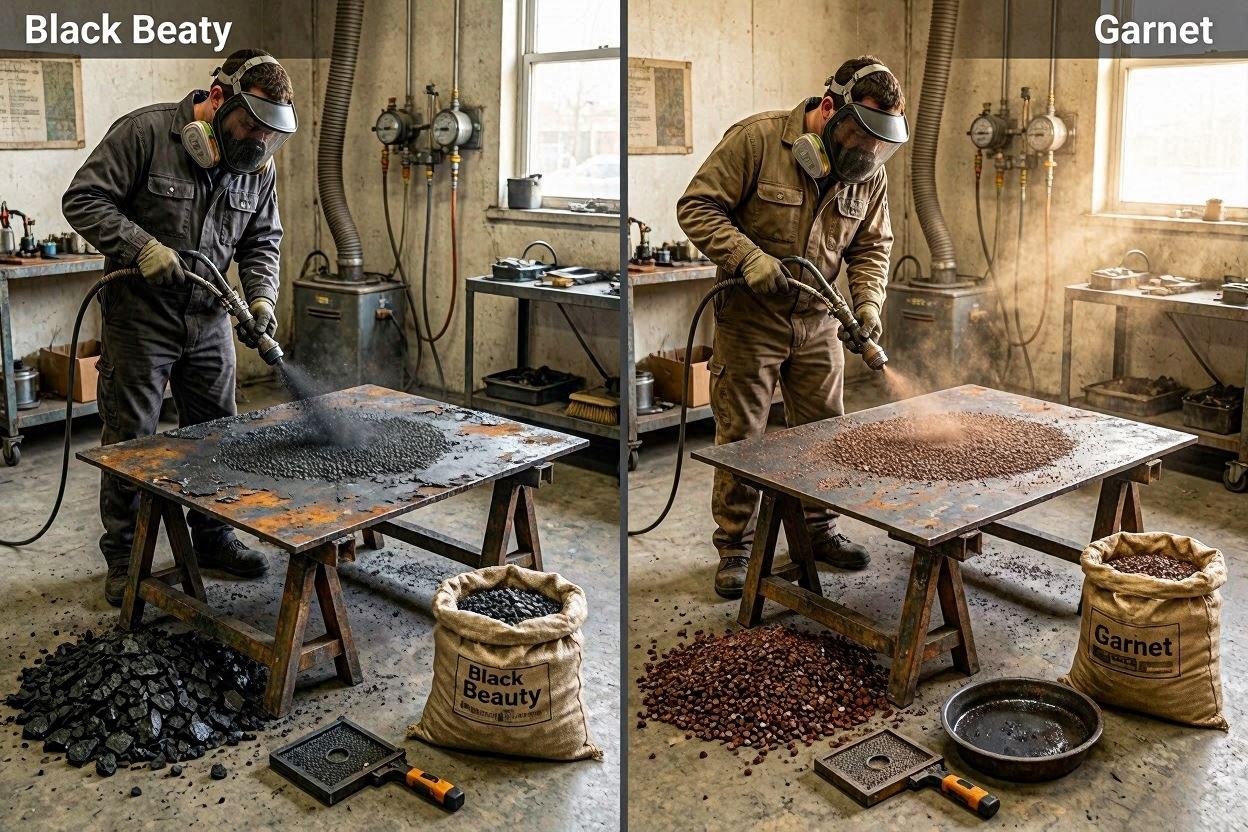
| Coal slag | 1–3% | Restricted in some areas; TCLP testing required | Moderate — requires controls |
| Copper slag | 1–2% | Varies by source — TCLP testing required | Low-Moderate |
| Garnet (almandine) | <1% | Approved in all jurisdictions | Very Low |
| 氧化铝 | <1% (brown); <0.1% (white) | Approved in all jurisdictions | Very Low |
| 碳化硅 | <0.5% | Approved in all jurisdictions | Very Low |
| Glass Bead | ~70% (amorphous only) | Approved — amorphous, not crystalline | Low (amorphous SiO₂ has lower risk than crystalline) |
| Steel Shot / Steel Grit | Zero | Approved in all jurisdictions | None from silica |
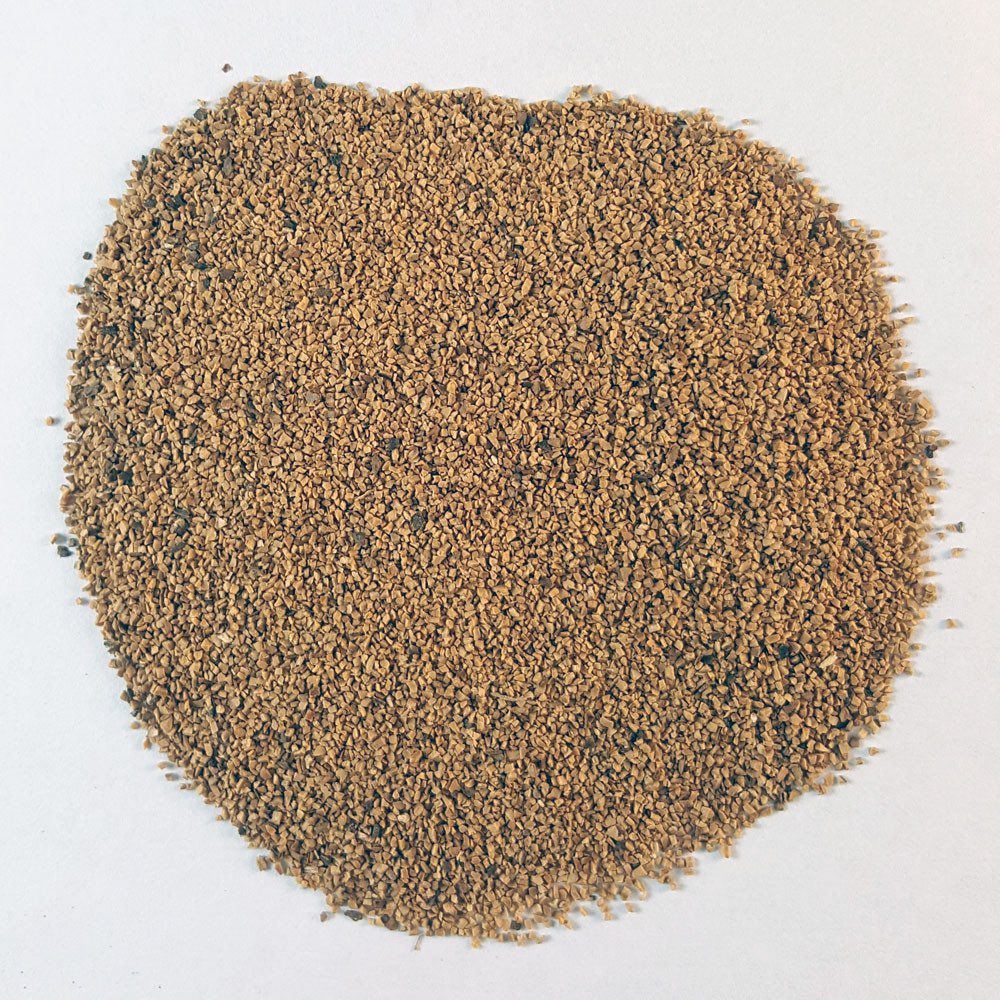
| Walnut Shell / Corn Cob | Zero | Approved in all jurisdictions | None from silica |
| Plastic Grit | Zero | Approved in all jurisdictions | None from silica |
Glass beads contain approximately 70% SiO₂ by composition — but this is amorphous silica, not crystalline quartz. The IARC Group 1 carcinogen classification and the silicosis mechanism apply specifically to crystalline silica (quartz, cristobalite, tridymite). Amorphous silica carries a substantially lower health risk than equivalent amounts of crystalline silica. Glass beads are therefore approved for industrial blasting in all jurisdictions where crystalline silica sand is banned. This distinction is important for correctly interpreting SDS free silica content information on glass bead products.
Safe Silica-Free Alternatives: Performance Comparison
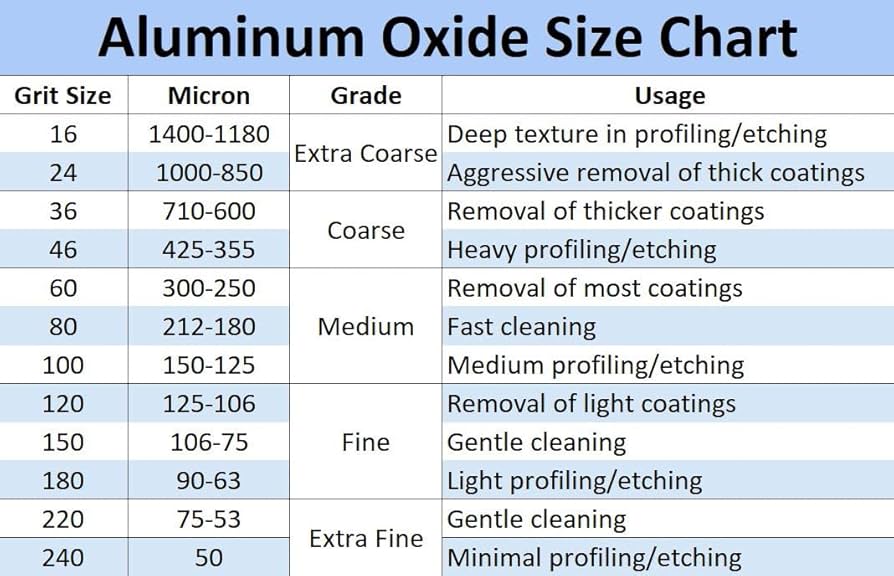
One of the persistent myths about silica sand is that it provides unique blasting performance that cannot be matched by safer alternatives. This is incorrect. Every performance characteristic of silica sand — cleaning speed, surface profile depth, anchor profile quality — is matched or exceeded by one or more of the following silica-free alternatives, in all practical blasting applications.
| Alternative Media | Free Silica | Hardness (Mohs) | Profile vs Sand | Cost/Cycle vs Sand | Best Use Case |
|---|---|---|---|---|---|
| 钢砂 | Zero | 7–8 (HRC) | Deeper (GH grade) | Much lower (200–300× cycles) | High-volume structural steel |
| 氧化铝 | <1% | 9 | Equal or deeper | Comparable | Precision blasting, cabinet work |
| 石榴石 | <1% | 7–8 | Equal | Comparable | Marine, offshore, eco-sensitive |
| 碳化硅 | <0.5% | 9–9.5 | Deeper | Higher | Hardest substrates only |
| Glass Bead | 70% amorphous | 5.5–6 | Peened (different) | Comparable | Peening, decorative finishing |
| Crushed Glass | 70% amorphous | 5.5–6 | Equal | Lower | General outdoor blasting |
For detailed technical guidance on each alternative, see the dedicated media guides: 氧化铝 · 石榴石 · 钢砂.
Engineering Controls & PPE
Where crystalline silica exposure cannot be eliminated through media substitution (for example, where legacy silica sand specifications are contractually mandated or where the blasted substrate itself generates crystalline silica dust — as with concrete or sandstone blasting), engineering controls and PPE remain essential:
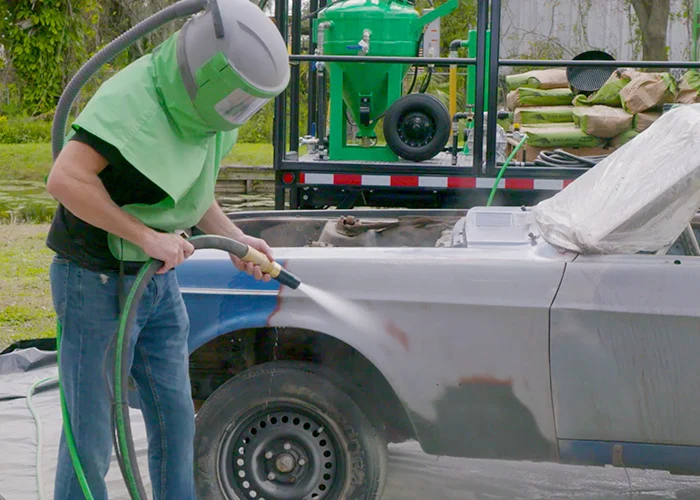
- Supplied-air respirators (SAR): The only form of respiratory protection adequate for silica sand blasting. Half-face or full-face air-purifying respirators (APF 10 or 50) are insufficient for the dust concentrations generated. OSHA specifies Type CE abrasive blasting respirators (APF 25 continuous flow; higher for pressure-demand) for abrasive blasting in enclosed environments.
- Engineering containment: Full enclosure of the blasting area with negative pressure and HEPA filtration to prevent silica dust escape to adjacent work areas.
- Local exhaust ventilation (LEV): Exhaust ventilation systems designed to capture silica dust at or near the point of generation.
- Wet blasting: Using water injection into the blast stream significantly reduces airborne dust. However, it does not eliminate silica risk — wet silica sand is still subject to the OSHA standard when the slurry dries and dust re-suspends.
- Isolation of operators from the blasting zone: Remote-controlled blasting equipment (robotic blasters for tank and vessel interiors) physically removes operators from the high-exposure zone.
For comprehensive PPE and safety protocols applicable to all blasting media types: Abrasive Blasting Media Safety: PPE, Ventilation & Dust Control.
Switch to Certified Silica-Free Blasting Media
Jiangsu Henglihong Technology supplies aluminum oxide, silicon carbide, glass beads, and steel shot/grit — all certified with free silica content documentation well below OSHA action levels. Our products come with full Safety Data Sheets, chemical analysis certificates, and SSPC-AB compliance documentation. Contact us for specifications and volume pricing.
Request Product SpecificationsFrequently Asked Questions
过滤器