Silicon Carbide Blasting Media: Hardness, Applications & Reusability
A complete technical reference for silicon carbide (SiC) abrasive blasting media — the hardest commonly available blast abrasive, engineered for the most demanding surface preparation and precision finishing applications.
What Is Silicon Carbide Blasting Media?
Silicon carbide blasting media is a synthetic abrasive material composed of silicon and carbon (chemical formula SiC), produced at extremely high temperatures in an electric resistance furnace. With a Mohs hardness of 9 to 9.5 — the highest of any commonly used blast abrasive — it is the material of choice when nothing softer can adequately process a substrate.
Unlike many abrasive materials, silicon carbide does not occur naturally in usable form for industrial abrasives; it must be synthesized. Its exceptional hardness, combined with a highly angular fracture pattern and low density relative to its hardness, makes it an unusually aggressive cutting abrasive. Each particle, when it fractures under impact stress, exposes new razor-sharp cutting edges — making silicon carbide effectively self-sharpening in service.
Silicon carbide is the hardest of the four abrasive blasting media manufactured by Jiangsu Henglihong Technology. While it is the most specialized and highest-cost option in our product range, it is indispensable for applications where aluminum oxide, glass beads, or steel-based media simply cannot generate the required surface condition on ultra-hard substrates.
For context on where silicon carbide fits within the full spectrum of blasting media options, see the Abrasive Blasting Media Complete Guide.
How Silicon Carbide Abrasive Is Made
Silicon carbide is produced via the Acheson process, named after the inventor Edward Goodrich Acheson who first synthesized SiC in 1891. In this process, silica sand (SiO₂) and petroleum coke (carbon source) are packed around a graphite resistance heating core in a large electric resistance furnace. An electrical current heats the core to temperatures between 1,600 °C and 2,500 °C, driving the reaction:
SiO₂ + 3C → SiC + 2CO
The resulting silicon carbide forms as a crystalline mass around the heating element. After cooling, the mass is broken apart, crushed, and screened to the desired particle size distribution. The crushing process naturally produces the sharp, angular morphology characteristic of SiC blast abrasive.
The color of the resulting SiC — black or green — depends on the purity of the raw materials and the temperature profile of the furnace run. Green SiC forms closer to the heating element where temperatures are highest and purity is greatest; black SiC forms in the outer zones at slightly lower temperatures with a higher level of trace impurities.
Key Physical & Chemical Properties
| Property | Black SiC | Green SiC |
|---|---|---|
| Chemical composition | SiC ~98% | SiC ~99%+ |
| Mohs hardness | 9.0–9.2 | 9.4–9.5 |
| Knoop hardness | ~2,400 kg/mm² | ~2,600 kg/mm² |
| Crystal structure | α-SiC (hexagonal) | α-SiC (hexagonal) |
| Bulk density | 1.56–1.70 g/cm³ | 1.56–1.68 g/cm³ |
| True density | 3.20–3.22 g/cm³ | 3.21–3.23 g/cm³ |
| Melting point | ~2,700 °C (decomposes) | ~2,700 °C (decomposes) |
| Particle shape | Sharp angular, blocky | Sharp angular, slightly finer fracture |
| Free silica content | <0.5% | <0.1% |
| 颜色 | Black / dark grey | Green / grey-green |
| Typical reuse cycles | 2–5× | 2–4× |
Beyond hardness, silicon carbide’s most operationally significant property for blasting is its friability: it fractures more readily than aluminum oxide under impact, generating new sharp cutting surfaces at a higher rate. This means faster material removal per pass on ultra-hard substrates, but also faster media consumption — a direct trade-off that determines whether SiC is the right economic choice for a given application.
Black vs Green Silicon Carbide: Which Grade to Specify?
Black Silicon Carbide
SiC ~98% purity. The standard grade for abrasive blasting, grinding wheels, and refractory applications. Slightly more brittle than green SiC — fractures more readily, producing sharp new edges but slightly faster breakdown. The cost-effective choice for most industrial blasting applications where maximum hardness is required.
Green Silicon Carbide
SiC ~99%+ purity. Slightly harder and tougher than black SiC. Reserved for the highest-precision applications: lapping and polishing optical components, processing technical ceramics, and applications where absolute purity is required. Carries a price premium over black SiC that is only justified in the most demanding use cases.
Unless your application involves optical or electronics-grade ceramic processing where purity is critical, black silicon carbide offers equivalent blasting performance at significantly lower cost than green SiC. The hardness and cutting action difference between the two grades is measurable in laboratory conditions but rarely decisive in production blasting environments.
Grit Size Chart
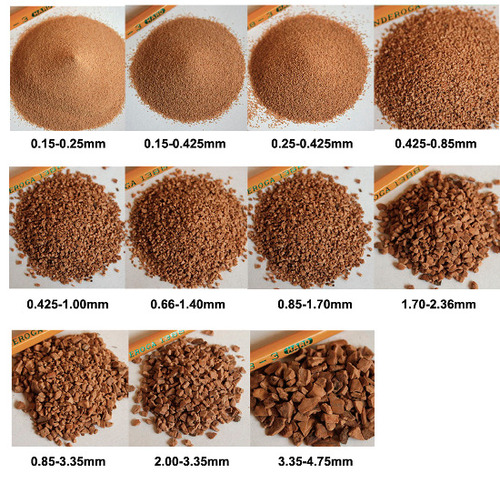
Silicon carbide is available in a wide range of grit sizes. The following table covers the sizes most relevant to blasting and surface finishing applications. For full cross-standard conversions (FEPA, ANSI, MESH, JIS), see the Blasting Media Grit Size & Mesh Size Guide.
| Grit (FEPA) | Particle Size (µm) | Surface Profile (Ra µm) | Primary Use |
|---|---|---|---|
| F16 / F24 | 850–2,000 | 100–160+ | Aggressive profiling of ceramics and carbide surfaces |
| F36 / F46 | 425–850 | 60–100 | Coating prep on hardened steel, heavy profiling of SiC/Al₂O₃ ceramics |
| F60 / F80 | 212–425 | 30–60 | General precision blasting on ceramics and composites |
| F100 / F120 | 106–212 | 15–35 | Precision surface conditioning, deburring hard components |
| F150 / F180 | 63-106 | 8–18 | Fine finishing of technical ceramics, lapping prep |
| F220 / F240 | 44–63 | 4–10 | Ultra-fine conditioning, optical surface prep |
| F280–F1200 | 4–44 | <5 | Lapping, polishing, micro-finishing of precision components |
Reusability & Cost Considerations
Silicon carbide’s high friability — the property that makes it such an aggressive cutter — is also what limits its reusability compared to aluminum oxide or steel media. Typical reuse cycles under a proper reclaim system are 2 to 5 passes, with performance declining noticeably after the 3rd or 4th cycle as particles break down below the effective blasting size for the application.
This means silicon carbide carries a higher effective cost per cycle than aluminum oxide for applications where the extra hardness is not strictly necessary. The key question when evaluating SiC versus Al₂O₃ for a given application is: can aluminum oxide achieve the required surface condition in an acceptable time? If yes, aluminum oxide is the economically rational choice. If the substrate is too hard for Al₂O₃ to process efficiently — as is the case with ceramics, tungsten carbide, and hardened tool steels above HRC 60 — silicon carbide is the justified selection despite its higher cost.
Silicon carbide typically costs 1.5 to 2.5× more per kilogram than equivalent-grit aluminum oxide. With 2–5 reuse cycles versus 4–8 for Al₂O₃, the effective cost-per-cycle premium for SiC is real and significant. In applications where both media could technically work, aluminum oxide is the preferred choice on cost grounds. Reserve silicon carbide for applications where nothing else can adequately do the job.
For a full cost-analysis framework comparing all major media types, see: Reusable vs Single-Use Blasting Media: Cost Analysis & ROI.
Industry Applications of Silicon Carbide Blast Media
Technical Ceramics & Advanced Materials Processing
Silicon carbide is the dominant blasting abrasive for processing technical ceramics — including sintered SiC, alumina ceramics, zirconia, silicon nitride, and boron carbide components. These materials are themselves extremely hard (often 8–9.5 on the Mohs scale), and only SiC abrasive can generate meaningful cutting action against them. Applications include surface roughening before brazing or bonding operations, cleaning ceramic kiln furniture, and conditioning ceramic cutting inserts.
Hardened Tool Steel & Tungsten Carbide
Hardened tool steels (HRC 60+), cemented tungsten carbide tooling, and hard chrome plating surfaces resist effective blasting by aluminum oxide, which cannot maintain sufficient cutting pressure to profile them efficiently. Silicon carbide’s superior hardness enables adequate surface profiling and cleaning of these extreme-hardness substrates, making it the media of choice for tool room and carbide tooling maintenance operations.
Composite Materials & Carbon Fiber
Carbon fiber reinforced polymer (CFRP) and other composite materials require careful abrasive selection for surface preparation prior to adhesive bonding or painting. Silicon carbide in fine grit sizes (F80–F150) is used to activate composite surfaces without delaminating or fraying fiber structures. Its sharp cutting action at lower pressures achieves the required surface energy increase with minimal substrate damage.
Glass Etching & Decorative Processing
SiC produces exceptionally crisp, sharp-edged etched surfaces on glass due to its angular fracture and high hardness. It is preferred over aluminum oxide for deep etching of architectural glass, crystal products, and display glass where edge definition is critical.
Lapping & Precision Finishing
In finer grit sizes (F220 through F1200), silicon carbide is a standard lapping abrasive for precision components in optical, semiconductor, and precision engineering industries. The flat lapping of ceramic substrates, sapphire wafers, and precision steel components relies on SiC’s consistent particle size distribution and hardness.
Silicon Carbide vs Other Abrasive Blasting Media
| Media | 莫氏硬度 | Friability | Reuse Cycles | Relative Cost | Best Application Fit |
|---|---|---|---|---|---|
| 碳化硅 | 9–9.5 | High | 2–5× | High | Ceramics, carbides, hardened steels >HRC 60 |
| 氧化铝 | 9 | Medium | 4–8× | Medium | General steel, coating prep, deburring |
| Glass Bead | 5.5–6 | Medium-High | 3–6× | Medium | Peening, decorative, stainless steel |
| 钢砂 | 7–8 | Low | 200–300× | Very Low/cycle | High-volume structural steel prep |
| 石榴石 | 7–8 | Medium | 3–5× | Medium | Marine, eco-sensitive, low dust |
The decision between silicon carbide and 氧化铝 is the most commonly encountered selection choice in precision industrial blasting. The rule is straightforward: if the substrate’s hardness or the required processing speed exceeds what aluminum oxide can deliver, silicon carbide is the next step. For a comprehensive side-by-side analysis of all blasting media: Abrasive Blasting Media Comparison Chart.
Safety & Handling
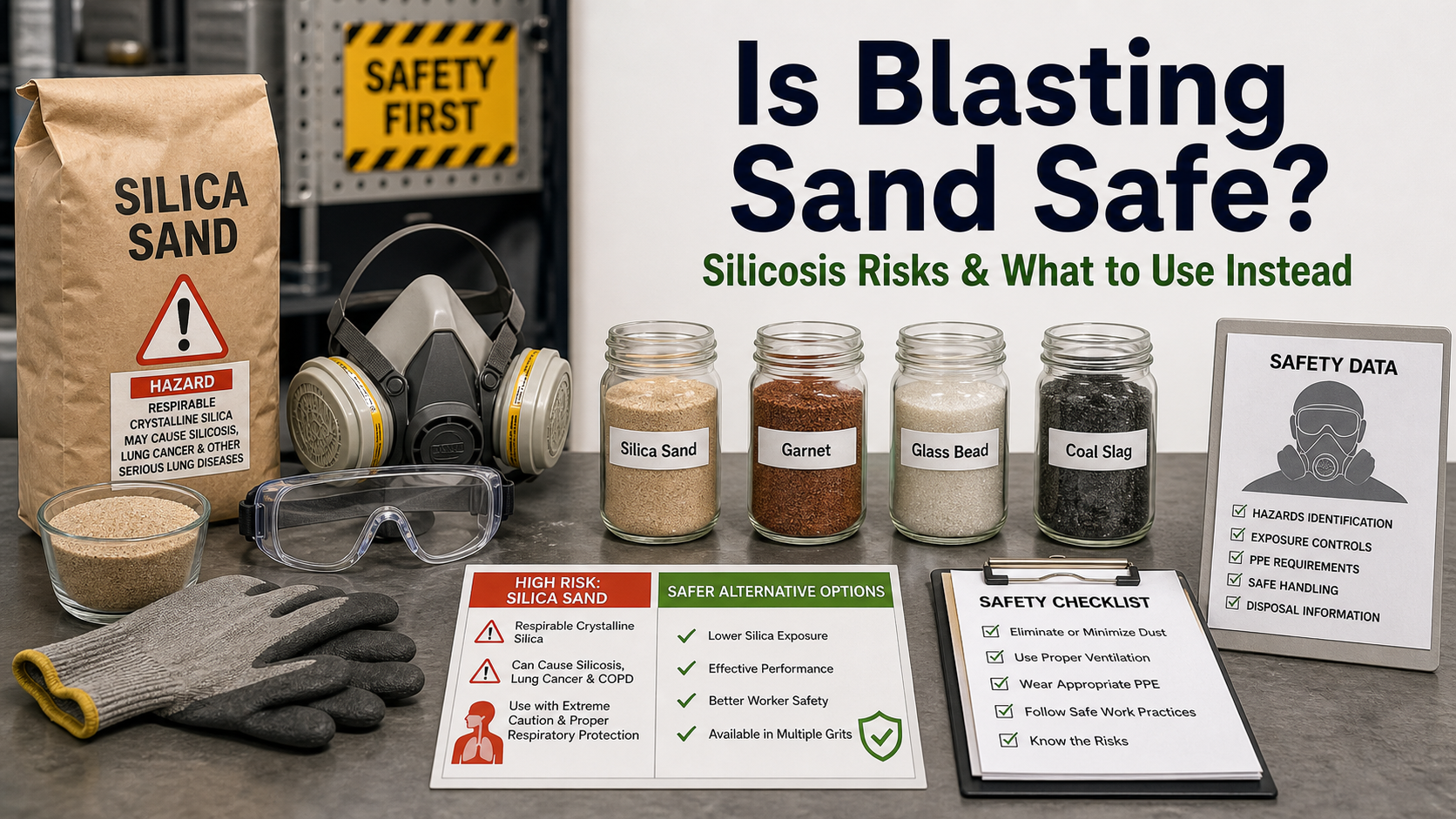
Silicon carbide blasting media is chemically inert, non-flammable, and non-toxic. Its free silica content is very low (<0.5% for black SiC, <0.1% for green SiC), substantially below the crystalline silica thresholds that trigger the most stringent OSHA regulatory controls. It does not contain heavy metals or hazardous chemical constituents that would require special waste disposal in most industrial jurisdictions.
However, standard blasting safety requirements apply regardless of media type:
- Use NIOSH-approved supplied-air respirators during all open blasting operations.
- Ensure adequate local exhaust ventilation in enclosed blasting environments.
- Wear appropriate eye and body protection including blasting helmet, gloves, and blast suit.
- Monitor ambient dust levels to remain within applicable occupational exposure limits.
- Handle spent silicon carbide in accordance with local solid waste regulations, taking into account any contaminants from the blasted substrate.
Full safety protocols for blasting operations: Abrasive Blasting Media Safety: PPE, Ventilation & Dust Control.
Source Silicon Carbide Blasting Media from Jiangsu Henglihong Technology
We supply both black and green silicon carbide in grit sizes from F16 through F1200, with full chemical analysis certificates and consistent particle size distribution data. Available in 25 kg bags and 1,000 kg bulk jumbo bags for global export.
Request a Quote or SampleFrequently Asked Questions
过滤器