10 Types of Abrasive Blasting Media: Pros, Cons & Best Uses
Not all blast media is created equal. This guide breaks down every major type — hardness, shape, recyclability, cost, and the exact applications each one handles best — so you can choose with confidence.
Why the Type of Abrasive Media You Choose Changes Everything
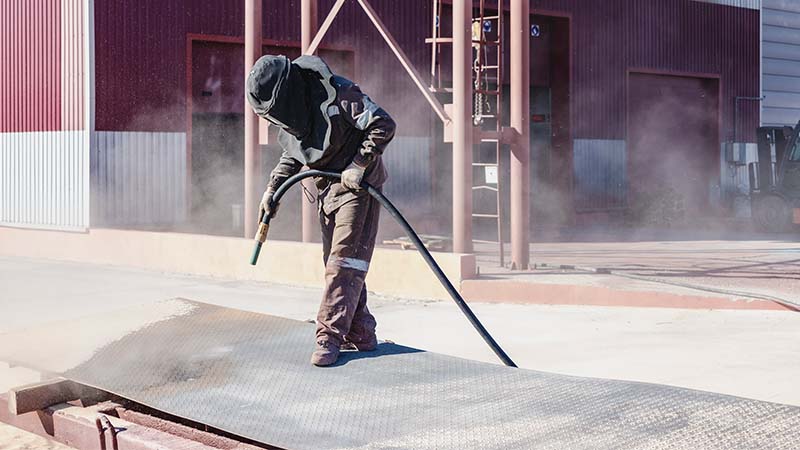
Walk into any industrial supply warehouse and you will find dozens of abrasive blasting media options arranged on the same shelf — bags of aluminum oxide next to steel grit next to walnut shells next to plastic pellets. They all say “blast media” on the label. They do not all do the same thing, and using the wrong one can cost you far more than the price of the media itself.
The type of abrasive media you select determines three critical outcomes on every project:
- Surface profile: Angular media bites into a surface and creates the microscopic peaks and valleys — called anchor profile — that coatings need to grip. Round media peens the surface smooth. Zero-profile media simply cleans without raising texture at all. Get this wrong and your coating system fails, regardless of how carefully it was applied.
- Substrate condition after blasting: An abrasive that is too hard or too angular will warp thin sheet metal, erode composite skins, or score precision tolerances off machined components. An abrasive that is too soft will leave the surface contaminated and inadequately prepared.
- Total operating cost: Single-use media consumed at 800 lbs per hour looks cheap per bag. Steel grit reused 200 times looks expensive per ton. The math almost always favors the recyclable option at production scale — but only if it is the right media for the job.
This guide covers all ten major types in full detail, with a complete pros and cons breakdown, key specifications, and specific application guidance for each. If you are new to surface preparation and want the full foundational context first, start with our complete abrasive media guide before returning here.
Jiangsu Henglihong Technology Co., Ltd. manufactures and supplies six of the ten media types covered below: aluminum oxide, glass beads, garnet, steel grit/shot, walnut shell/corn cob, and plastic media. Where our products are referenced, links to full product specifications are provided.
Aluminum Oxide (Corundum / Alumina Grit)
Aluminum oxide is the global standard for industrial abrasive blasting and finishing. Produced by fusing bauxite ore in an electric arc furnace at temperatures above 2,000°C, it forms the second-hardest synthetic abrasive available — and by far the most commercially versatile. Its angular, blocky fracture pattern delivers consistent, aggressive cutting action that bites into rust, mill scale, and old coatings with remarkable efficiency.
Two primary grades dominate the market. Brown fused alumina (BFA) — the familiar reddish-brown grit — is the cost-effective workhorse used in structural steel fabrication, ship hull preparation, heavy equipment maintenance, and general industrial coating prep. White fused alumina (WFA) is processed to higher purity (99%+ Al₂O₃), producing a white, ultra-hard grit used where contamination is not tolerable — aerospace alloy preparation, semiconductor substrate processing, medical device finishing, and precision ceramic grinding.
At Mohs 9, aluminum oxide can prepare virtually any metal substrate to SSPC-SP10 Near-White or SSPC-SP5 White Metal cleanliness standards. Its fracture pattern means that as particles break down during recycling, they create fresh sharp edges rather than dulling, maintaining cutting efficiency through multiple cycles. A well-operated reclaim system typically achieves 5 to 10 full reuse cycles before media replacement is necessary.
✅ Pros
- Extremely hard (Mohs 9) — aggressive and fast
- Sharp angular shape creates strong anchor profile
- Recyclable 5–10 cycles, low per-cycle cost
- Wide grit range (16–320) covers all applications
- Available in brown (general) and white (high-purity) grades
- Silica-free; OSHA compliant
- Works in both pressure blast and suction cabinet systems
❌ Cons
- Too aggressive for thin, delicate, or soft substrates
- Generates significant fine dust — requires good dust collection
- Not suitable for wheel-blast machines (use steel abrasives instead)
- Higher upfront cost than single-use mineral media
- Can become contaminated with iron from steel substrates over cycles
ガラスビーズ
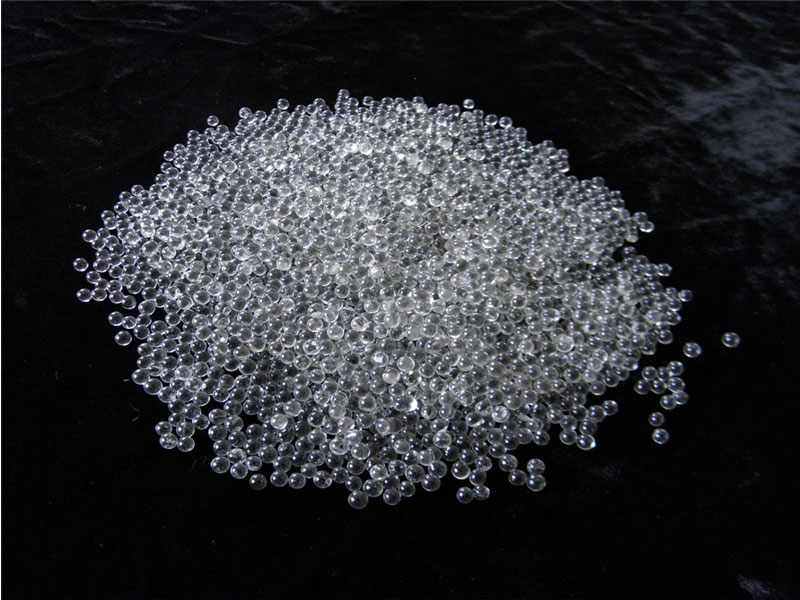
Glass beads are manufactured from lead-free, soda-lime glass melted and formed into perfect spheres. Their defining characteristic is that round shape: where angular abrasives cut into a surface, glass beads peen it — imparting thousands of tiny compressive impacts that burnish away contamination while leaving the surface smooth, bright, and dimensionally unchanged.
This peening action has two valuable consequences. First, it produces a smooth, uniform, satin-matte finish that requires no further treatment in applications where appearance matters — stainless steel food processing equipment, medical instruments, architectural hardware, and automotive restoration work where a bright surface is desired before painting. Second, the compressive stress introduced into the surface layer improves fatigue resistance by closing micro-cracks, making glass bead peening a standard quality process for precision-machined components.
Because glass beads contain no free crystalline silica in respirable form, they are a fully OSHA-compliant alternative to silica sand in any regulatory environment. The spherical shape also results in lower dust generation than angular media, improving visibility and air quality in blast cabinets. They are not suitable for applications requiring a coarse anchor profile — if you need profile for coating adhesion, angular media is required.
✅ Pros
- Produces smooth, satin finish without dimensional change
- Induces beneficial compressive stress (peening effect)
- Low dust generation — better visibility and air quality
- Silica-free; OSHA compliant
- Gentle on thin-walled and precision components
- Chemically inert; no contamination of substrate
❌ Cons
- Does not create anchor profile for coating adhesion
- Lower hardness limits effectiveness on heavy rust or scale
- Breaks down faster than angular media — 3–5 cycle limit
- Not suitable for wheel-blast equipment
- More expensive per lb than crushed glass or coal slag
ガーネット
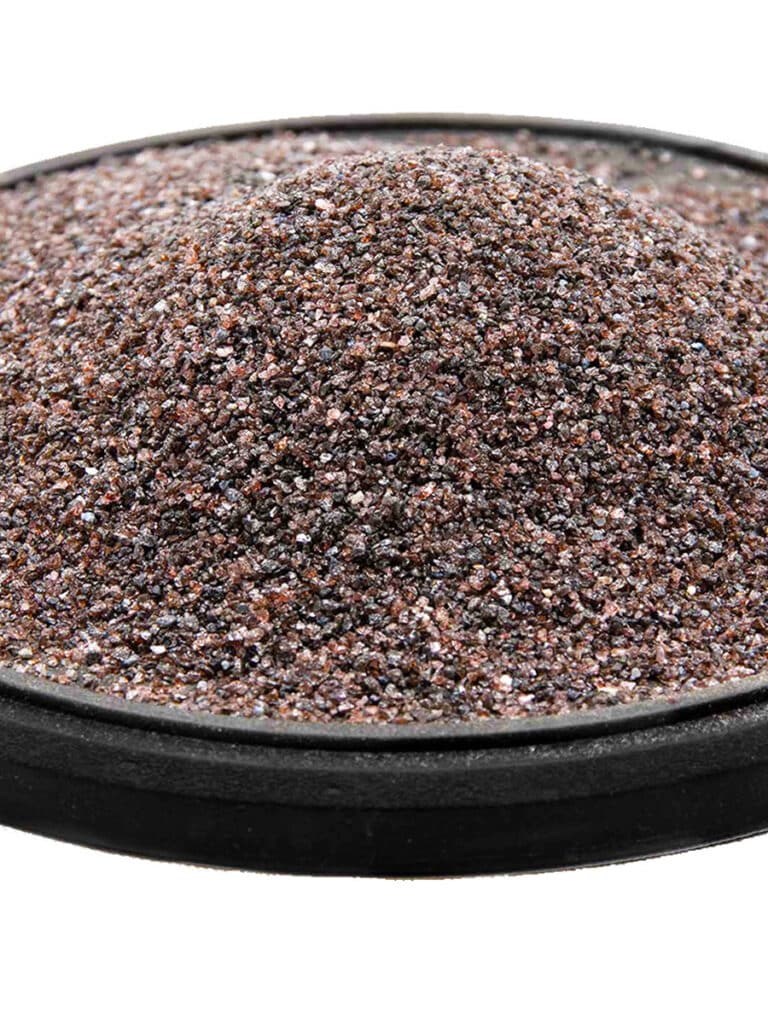
Garnet is a naturally occurring iron-aluminum silicate mineral mined primarily from almandine and andradite deposits in Australia, India, and North America. It is the preferred blast media wherever low dust generation, low chloride contamination, and clean surface chemistry are simultaneously required — making it the dominant choice for marine and offshore steel structures, oil and gas pipelines, and bridges scheduled for high-performance coating systems.
Garnet’s sub-angular particle shape is slightly less aggressive than aluminum oxide — it produces a clean, sharp anchor profile in the 1.5 to 2.5 mil range at standard operating pressures, which aligns precisely with the requirements of most zinc-rich epoxy and polyurethane coating systems. Its hardness of 7.5–8.0 Mohs is sufficient to achieve SSPC-SP10 Near-White cleanliness in a single pass on moderately rusted steel.
Garnet is also the standard abrasive for waterjet cutting — GMA (Garnet Manufacturers Association) garnet at 80 mesh is used in virtually every waterjet cutting machine worldwide for its combination of hardness, controlled particle size distribution, and low silica content. In this application it is used wet in a high-pressure abrasive waterjet stream.
Because garnet particles are denser than aluminum oxide and produce minimal friable fines, spent garnet is frequently classified as non-hazardous solid waste and can be repurposed as a construction aggregate, making disposal simpler and cheaper than many other media types.
✅ Pros
- Very low dust — excellent visibility and air quality in confined spaces
- Low chloride content — ideal for marine coating specs
- No heavy metals; environmentally favorable disposal
- Good profile creation (1.5–2.5 mil) for standard coating systems
- Waterjet cutting standard (80 mesh GMA)
- Self-sharpening fracture maintains cutting efficiency
❌ Cons
- Lower recyclability (1–3 cycles) than aluminum oxide or steel
- Cannot achieve very deep profiles (>3 mil) without high pressure
- Natural mineral — particle consistency varies by source/batch
- Less widely available in very fine grit ranges vs aluminum oxide
スチールグリット
Steel grit is manufactured by crushing and heat-treating high-carbon steel particles to produce angular, pyramid-shaped fragments with a Rockwell hardness of 55–66 HRC. This extreme hardness combined with an aggressive angular geometry makes steel grit the most powerful surface preparation abrasive for heavy industrial applications: it routinely achieves SSPC-SP5 White Metal cleanliness with deep anchor profiles of 2.5–5.0 mil on heavily rusted, scaled, or previously coated structural steel.
Steel grit is designed exclusively for centrifugal wheel-blast machines — the high-volume automated systems used in steel fabrication plants, shipyards, rail car manufacturing, bridge component fabrication, and structural steel service centers. Wheel-blast machines accelerate steel grit to impact velocities of 180–250 ft/s using a spinning impeller wheel, processing throughput rates that make manual blasting operations uneconomical by comparison.
The economic argument for steel grit is compelling at production scale. A single charge of quality steel grit lasts 100 or more blast cycles in a properly maintained machine with an effective media reclaim and replenishment system. The per-cycle media cost is often 10 to 20 times lower than equivalent single-pass mineral abrasives. Steel grit is also available in multiple hardness grades — GL (low, HRC 40–51), GM (medium, HRC 55–62), and GH (high, HRC 60–66) — allowing fabricators to select the aggressiveness appropriate for their steel grade and coating spec.
✅ Pros
- Extremely high recyclability (100+ cycles) — very low per-cycle cost
- Produces the deepest anchor profiles for heavy-duty coatings
- Fast cleaning rates in wheel-blast equipment
- Available in three hardness grades for different applications
- No silica; safe disposal as inert solid waste
❌ Cons
- Requires wheel-blast or pressure-blast equipment — not for cabinets
- High upfront equipment and media investment
- Introduces iron contamination — unsuitable for stainless steel
- Can cause surface warping on thin materials
- Requires dust collection and magnetic separation reclaim system
スチールショット
Steel shot is cast from molten carbon steel and quenched into spherical pellets, then tempered to a Rockwell hardness of 40–51 HRC. Its round shape means it does not cut or profile — instead, it hammers the surface with thousands of controlled impacts, inducing a deep layer of compressive residual stress that prevents fatigue crack initiation and propagation. This process is called shot peening, and it is a mandatory, specification-governed quality step in the manufacture of virtually every fatigue-critical metal component.
Shot peening with steel shot is specified by aerospace OEMs including Boeing and Airbus for landing gear components, turbine engine discs, and airframe structural members. Automotive manufacturers use it on transmission gears, crankshafts, connecting rods, and coil springs. The military applies it to aircraft carrier deck arresting gear, helicopter transmission gears, and naval ordnance components. In each case, shot peening extends service life by a factor of 2× to 10× compared to unpeened components.
Beyond peening, steel shot is widely used for descaling castings in foundry cleaning rooms and for general mill scale removal on steel plate. Its smooth shape leaves a relatively flat surface profile — typically 0.5 to 1.5 mil — which is appropriate for oil and gas pipeline internal coating and similar applications where a moderate, uniform anchor is required without the aggressive peaks left by angular media.
✅ Pros
- Induces compressive stress — dramatically extends component fatigue life
- Very high recyclability (100+ cycles)
- Consistent spherical shape; predictable peening results
- Low dust compared to angular media
- Available in wide size range (S70–S780) for precise Almen intensity control
❌ Cons
- Does not create a strong anchor profile — unsuitable for heavy-duty coatings
- Requires wheel-blast or specialized peening equipment
- High upfront media cost
- Unsuitable for stainless steel substrates (iron contamination)
Walnut Shell
Crushed walnut shell is the most widely used organic blast media. It is produced from the shells of English black walnuts — a dense, hard agricultural byproduct that would otherwise go to waste — ground and classified into angular particles with a hardness of 3 to 4 on the Mohs scale. Despite being classified as “soft” by blasting standards, walnut shell has enough hardness to clean oil, grease, carbon deposits, light paint, and surface oxidation from virtually any material without scratching or etching the substrate.
Its primary industrial role is in aircraft paint stripping for composite and soft aluminum structures where plastic media or hand-strip methods are required, turbine engine component cleaning in military and commercial MRO (maintenance, repair, overhaul) facilities, and automotive engine part cleaning in restoration shops. Walnut shell is naturally absorbent, which also helps it pick up and remove oils during the blasting process.
Because walnut shell is fully biodegradable and non-toxic, it is the preferred media for applications near water, in food production facilities, and in environmentally regulated workspaces. It produces no toxic breakdown products and can often be composted or disposed of as general organic waste — a significant advantage over mineral and metallic media that may require costly hazardous waste disposal after blasting coated surfaces.
✅ Pros
- Completely safe for delicate and soft substrates
- Biodegradable and non-toxic — easiest disposal of any media
- Naturally absorbs oils during blasting
- Low cost per bag
- No silica; no heavy metals
- Suitable for food and pharmaceutical environments
❌ Cons
- Very low hardness — ineffective on heavy rust or thick coatings
- Essentially single-use; limited recyclability
- Absorbs moisture — must be stored in dry conditions
- Slower blast rates than mineral or metallic media
Corn Cob
Ground corn cob is slightly softer and less dense than walnut shell, making it the gentlest blast media in the organic category. Corn cob granules are primarily used in vibratory tumbling and barrel finishing operations — applications where parts tumble against media in a rotating drum rather than being impacted by a pressurized stream — but they are also effective in suction-style blast cabinets for very delicate surface conditioning and polishing.
Its most distinctive application advantage over walnut shell is its superior polishing action. Corn cob has a slightly waxy surface chemistry and a less aggressive fracture pattern than walnut shell, which means it produces a noticeably brighter, more polished surface finish on non-ferrous metals, brass, bronze, and precious metals like gold and silver. This makes it the standard media in jewelry tumbling, coin cleaning, gun stock conditioning, and delicate souvenir or trophy finishing.
Like walnut shell, corn cob is biodegradable, non-toxic, and highly absorbent, making it suitable for removing light oils and moisture from parts during the tumbling process. In combination with polishing compounds, corn cob tumbling media produces mirror-like finishes on small components that would be impossible to achieve economically any other way.
✅ Pros
- Gentlest media available — no substrate damage risk
- Produces bright, polished finish on metals and non-metals
- Biodegradable, non-toxic, compostable
- Highly absorbent — removes oils during tumbling
- Low cost; widely available as agricultural byproduct
❌ Cons
- Not effective on rust, heavy contamination, or thick coatings
- Primarily suited to tumbling/vibratory — limited in blast applications
- Absorbs moisture if not stored properly
- Single-use in most applications
Plastic Media (Thermoset Resin Blast Media)
Plastic blast media (PBM) is manufactured from crushed thermoset resin — primarily urea formaldehyde, polyester, or melamine — into angular particles. The combination of low hardness and sharp angular shape creates a unique capability: effective paint stripping without substrate damage. Plastic media cuts through organic coatings cleanly while simply bouncing off or embedding harmlessly in soft substrates like aluminum alloy and composite materials, leaving the base material dimensionally intact and without work hardening.
This makes plastic media the only USAF and commercial aviation-approved media type for composite aircraft structure paint stripping. When an airline needs to strip and repaint an aircraft fuselage, which is built from carbon fiber reinforced polymer panels that cost millions of dollars per aircraft, plastic media blasting is the specified process. Chemical stripping alternatives introduce moisture and thermal risks; sanding by hand is impractical at scale. Plastic media blasting in an enclosed hangar environment, using a reclaim vacuum system, strips an entire wide-body fuselage in a fraction of the time of any alternative method.
Beyond aerospace, plastic media is widely used for stripping gelcoat from fiberglass marine vessels, deflashing injection-molded plastic components, stripping military vehicles and equipment in depot maintenance facilities, and cleaning electronic circuit boards from conformal coatings in military electronics repair.
✅ Pros
- Strips organic coatings without damaging composite or aluminum substrates
- FAA- and military-approved for aircraft paint stripping
- Recyclable 3–5 cycles with proper reclaim system
- Available in multiple hardness grades for different substrates
- No silica; no heavy metals in media itself
❌ Cons
- Higher cost per lb than mineral media
- Not effective on heavy rust or hard scale
- Plastic particle contamination in waste stream may complicate disposal
- Requires enclosure/recovery system for economical use
- Lower blast rates than harder angular media
炭化ケイ素
Silicon carbide (SiC) is the hardest synthetic abrasive commercially available, rating 9 to 9.5 on the Mohs scale — harder than aluminum oxide and second only to diamond. Its angular, needle-like fracture morphology makes it the fastest-cutting blast media available, capable of etching and profiling surfaces that no other abrasive can touch: hardened ceramics, tungsten carbide tooling, silicon nitride components, glass engraving, and stone carving.
In industrial blasting, silicon carbide is specified for very hard substrate applications where aluminum oxide would wear down too slowly to be economical: blasting thermal barrier coating bond coats onto turbine components, etching optical glass for anti-glare treatments, profiling refractory ceramics before bonding, and surface preparation of cemented carbide dies and punches. In the stone industry, it is the standard media for sandblast engraving of granite monuments and marble architectural features.
Silicon carbide’s primary limitation is its high friability — particles shatter on impact, generating significant fine dust and degrading rapidly, making recycling impractical in most applications. The high cost per lb combined with low recyclability limits its use to niche applications where its hardness advantage is genuinely irreplaceable.
✅ Pros
- Hardest synthetic abrasive available (Mohs 9–9.5)
- Can blast substrates too hard for aluminum oxide
- Excellent for glass and ceramic etching
- Available in extremely fine grits for precision lapping
❌ Cons
- Very high cost per lb
- Highly friable — extremely limited recyclability
- High dust generation
- Overkill for standard metal surface preparation
Silicon carbide is not currently part of our standard product range. For applications where it would be considered, we recommend evaluating whether white aluminum oxide (WFA) at a finer grit can achieve the same result at lower cost — in many cases it can.
Crushed Glass (Recycled Glass Abrasive)
Crushed glass abrasive is manufactured by processing post-consumer recycled glass — primarily from bottles and windows — through crushing, sizing, and washing operations. The result is an angular, moderately hard abrasive with a conchoidal (shell-like) fracture pattern that is effective for structural steel surface preparation, concrete etching, and general outdoor blasting operations.
Its primary appeal is economics and sustainability: crushed glass is one of the cheapest blast media options per pound, and using post-consumer recycled content appeals to contractors with environmental commitments or green building requirements. It is also a compliant silica-safe alternative to conventional sand, as the free crystalline silica content of properly processed recycled glass is very low — though operators should always verify the SDS for the specific product used, as processing quality varies.
Crushed glass is not recyclable in practical terms — it shatters completely on impact, making reclaim and reuse uneconomical. It is best suited to single-pass outdoor operations and should not be used where steel substrate contamination from glass fragments is a concern. It is not recommended for coating applications requiring very tight surface chemistry, as residual glass fines can interfere with some high-performance coating systems.
✅ Pros
- Lowest cost per lb of any effective blast media
- Manufactured from recycled post-consumer glass
- Low free silica content vs natural sand
- Effective for light-to-moderate surface prep
❌ Cons
- Single-use; no recyclability
- High dust generation on impact
- Processing quality varies — verify SDS for silica content
- Not suitable for precision or high-performance coating applications
- Glass fragment contamination risk on substrate
Crushed glass is not part of our standard product range. For budget-sensitive applications, we recommend garnet (single-pass, low dust) or aluminum oxide (recyclable, better long-term economics) as better-performing alternatives at a comparable or only slightly higher cost point.
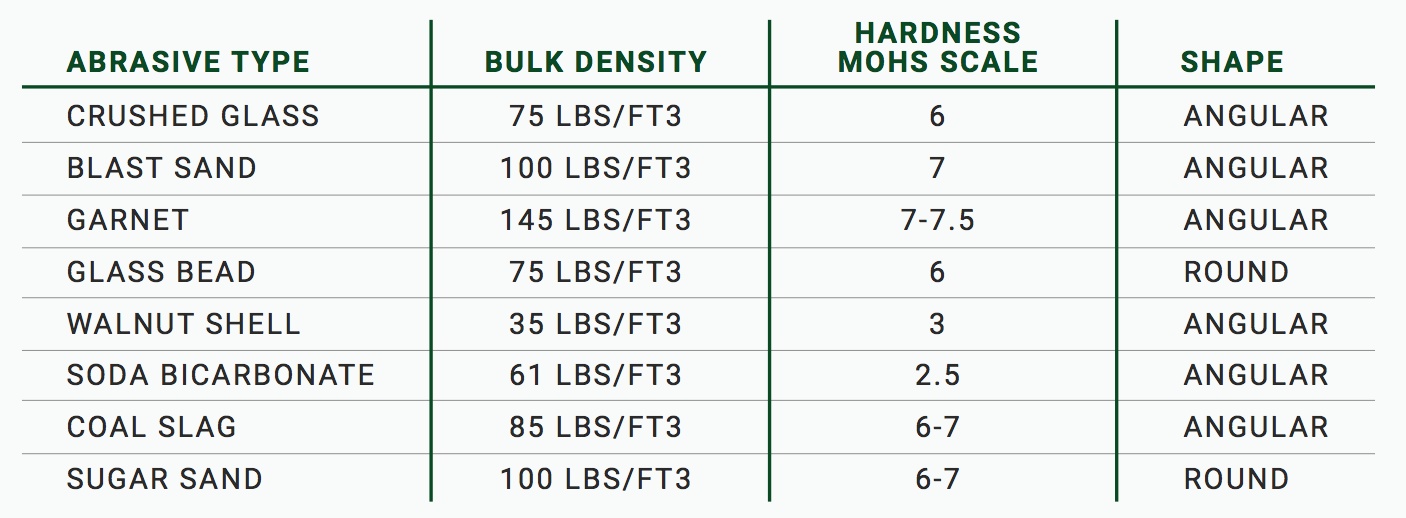
Side-by-Side Comparison: All 10 Types
Use this master reference table alongside the individual sections above. For a downloadable version suitable for print or job-site use, see our Abrasive Media Comparison Chart & PDF Download.
| Media | Mohs / HRC | Shape | Profile Created | リサイクル性 | Cost/Cycle | Substrate Risk | OSHA Silica |
|---|---|---|---|---|---|---|---|
| 酸化アルミニウム | 9 Mohs | アンギュラー | Deep (1.5–4 mil) | 5–10× | Medium | High on soft substrates | ✅ Compliant |
| ガラスビーズ | 5.5–6 Mohs | Spherical | None / satin peen | 3–5× | Medium | 低い | ✅ Compliant |
| ガーネット | 7.5–8 Mohs | Sub-angular | Medium (1.5–2.5 mil) | 1–3× | Medium | 中程度 | ✅ Compliant |
| スチールグリット | HRC 55–66 | アンギュラー | Very deep (2.5–5 mil) | 100+× | Very low | High — wheel blast only | ✅ Compliant |
| スチールショット | HRC 40–51 | Spherical | Low (0.5–1.5 mil) | 100+× | Very low | Low (peening only) | ✅ Compliant |
| Walnut Shell | 3–4 Mohs | アンギュラー | Negligible | 1–2× | 低い | Very low | ✅ Compliant |
| Corn Cob | 3–3.5 Mohs | アンギュラー | Negligible | 1–2× | 低い | Very low | ✅ Compliant |
| プラスチック・メディア | 3–3.5 Mohs | アンギュラー | Negligible | 3–5× | Medium-high | Very low | ✅ Compliant |
| 炭化ケイ素 | 9–9.5 Mohs | アンギュラー | Very deep | Very low | Very high | Extreme on soft substrates | ✅ Compliant |
| Crushed Glass | 5.5–6 Mohs | アンギュラー | Medium (1–2 mil) | 1× | 低い | 中程度 | ⚠️ Verify SDS |
How to Pick the Right Abrasive Media Type: A Quick Decision Guide
With ten options on the table, the fastest path to the right choice is a two-step filter: first identify what your substrate cannot tolerate, then identify what your surface outcome requires. The matrix below maps those two factors onto media recommendations.
| Substrate | Required Outcome | Recommended Media | Avoid |
|---|---|---|---|
| Structural carbon steel | Maximum rust removal + deep coating profile | Steel grit (wheel blast) or Aluminum oxide (pressure blast) | Glass beads, organic media |
| ステンレス | Cleaning + satin finish; no iron contamination | Glass beads or Aluminum oxide (WFA) | Steel grit, steel shot, crushed glass |
| Aluminum (thin panels) | Paint removal without warping or profile | Plastic media or Glass beads | Steel grit, aluminum oxide coarse, silicon carbide |
| Carbon fiber / composite | Coating strip without fiber damage | Plastic media or Walnut shell | All angular mineral media; steel abrasives |
| Marine / offshore steel | Prep for high-performance coating; low chlorides | ガーネット | Coal slag, crushed glass (verify chloride) |
| Brass, bronze, precious metals | Polish and brighten without scratching | Corn cob (tumbling) or Glass beads (fine grit) | Coarse angular media; steel abrasives |
| Ceramic / carbide tooling | Profile extremely hard surface | 炭化ケイ素 | Glass beads, organic media, plastic media |
| Wood / stone (historic) | Clean without surface erosion | Walnut shell (wood) or Garnet fine grit (stone) | Steel abrasives, coarse mineral media |
For a full step-by-step selection framework covering equipment type, coating specification requirements, and total cost of ownership calculation, see our dedicated guide: How to Choose the Right Abrasive Media for Your Project →
If your application falls into an edge case — unusual substrate, tight specification, or atypical operating environment — the right call is to consult before committing to a media type. Jiangsu Henglihong Technology provides free technical consultation for all customers and prospects. Contact our team →
よくある質問
What are the main types of abrasive blasting media?
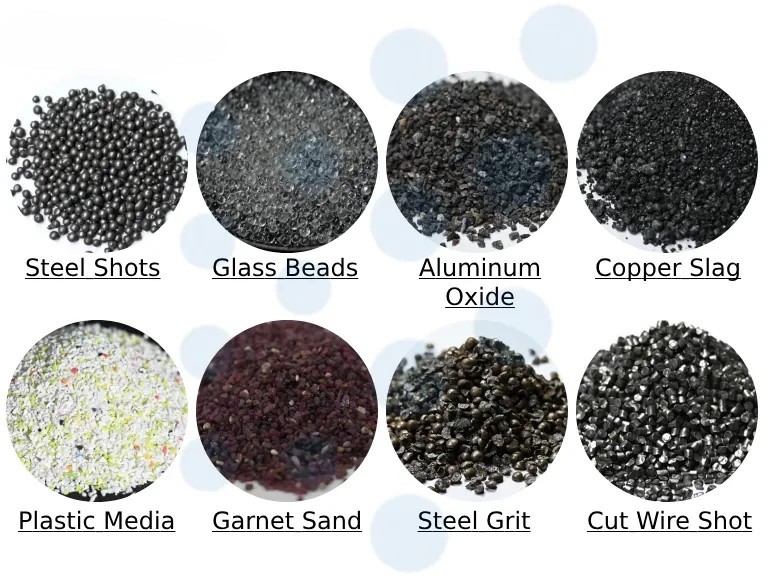
The ten primary types are: aluminum oxide, glass beads, garnet, steel grit, steel shot, walnut shell, corn cob, plastic media, silicon carbide, and crushed glass. Each has distinct hardness, particle shape, recyclability, and cost characteristics that make it best suited to specific applications and substrates. The six types manufactured and supplied by Jiangsu Henglihong Technology cover the vast majority of industrial, aerospace, automotive, and DIY applications.
Which abrasive media lasts the longest?
Steel grit and steel shot have by far the highest recyclability — typically 100 or more blast cycles in a properly maintained wheel-blast machine with an effective reclaim and replenishment system. Aluminum oxide follows at 5–10 cycles. Glass beads and plastic media achieve 3–5 cycles. Organic media (walnut shell, corn cob, sodium bicarbonate) and single-pass mineral abrasives (garnet, crushed glass, coal slag) are essentially single-use or very low-cycle.
What is the safest abrasive media for delicate surfaces?
For the softest, most delicate substrates — composite aircraft skins, fiberglass, thin aluminum panels, plastics, wood — plastic media or walnut shell are the safest choices. Glass beads (fine mesh) are appropriate for thin metal panels where a satin finish is acceptable. Corn cob is the gentlest option for very delicate finishing in tumbling operations. The key principle: always match media hardness to substrate hardness, choosing the softest media that can still achieve the required cleaning or stripping result.
Can I use the same abrasive media on different materials?
Some versatile media types — particularly aluminum oxide (coarser grits for steel, finer grits for softer metals) and glass beads — can be used across a range of substrates. However, there are firm restrictions: steel abrasives must never be used on stainless steel or aluminum (iron contamination risk); angular hard media must not be used on composites or thin panels (warping and damage risk); and media that has been used on contaminated surfaces (e.g., lead paint) may be classified as hazardous waste and should not be reused on clean substrates. Maintain separate media supplies for different substrate categories.
What is the difference between sandblasting and abrasive blasting?
The terms are often used interchangeably, but technically “sandblasting” refers to the historical process using silica sand as the abrasive. Because silica sand is now heavily regulated or banned in most industrial jurisdictions due to silicosis risk, the industry uses the broader term “abrasive blasting” to describe any process that propels abrasive media at a surface. The equipment and process are identical — the only difference is the media type used. All abrasive media supplied by Jiangsu Henglihong Technology are silica-free, OSHA-compliant replacements for silica sand.
How do I know what grit size to use?
Grit size selection depends on the required surface profile depth and the coating specification. Coarse grits (16–36) create deep profiles for heavy industrial coatings. Medium grits (40–80) are the standard for most structural steel prep. Fine grits (100–320+) are used for precision work, stainless steel finishing, and aerospace applications. Always check your coating manufacturer’s surface preparation datasheet for the specified profile range before selecting grit size. See our full grit size guide: Abrasive Media FAQ: Grit Size, Mesh, Recycling & Storage Tips →
Need Help Choosing the Right Abrasive Media?
Jiangsu Henglihong Technology supplies aluminum oxide, glass beads, garnet, steel grit/shot, walnut shell, corn cob, and plastic media — factory direct, with free technical consultation on every order.
Get a Free Quote View All Productsフィルター