Reusable vs Single-Use Blasting Media: Cost Analysis & ROI
A full economic analysis of abrasive blasting media recyclability — with per-cycle cost modeling, worked examples, reclaim system ROI calculations, and the total cost of use framework for making the right media investment decision.
Why Cost Per Cycle Is the Right Metric
The most common error in abrasive blasting media procurement is evaluating options on purchase price per kilogram. This metric is almost meaningless on its own — a media costing ten times more per kilogram but lasting forty times longer is four times cheaper in actual use. The economically correct metric is cost per effective blasting cycle.
Consider a simple illustration: Copper slag costs $0.10/kg and is used once. Aluminum oxide costs $1.20/kg but can be reused 6 times. On purchase price alone, copper slag appears 12× cheaper. On a cost-per-effective-cycle basis, copper slag costs $0.10/cycle while aluminum oxide costs $0.20/cycle — only 2× more expensive, not 12×. Factor in lower disposal costs for aluminum oxide in many jurisdictions, and the cost gap narrows further.
For steel grit at $1.50/kg with 250 reuse cycles, the cost per effective cycle drops to $0.006 — making it approximately 17× cheaper per cycle than copper slag, despite costing 15× more per kilogram. The raw purchase price comparison leads to exactly the opposite conclusion from the economically correct one.
This guide builds a complete total cost of use framework that accounts for all economic variables — not just purchase price — enabling defensible, correct media selection decisions. For context on which media types are available and their recyclability characteristics, see the Abrasive Blasting Media Complete Guide.
Reuse Cycles by Media Type
The reuse cycle count for any media type is not a fixed number — it varies based on blasting pressure, nozzle design, substrate hardness, reclaim system efficiency, and the quality threshold below which the media is considered too degraded to continue using. The figures below represent typical ranges for well-maintained operations with adequate reclaim systems.
| Type de média | Typical Reuse Cycles | Primary Degradation Mechanism | Reclaim Required? |
|---|---|---|---|
| Steel Shot / Steel Grit | 200–300× | Mechanical deformation; gradual size reduction | Yes — full closed-loop |
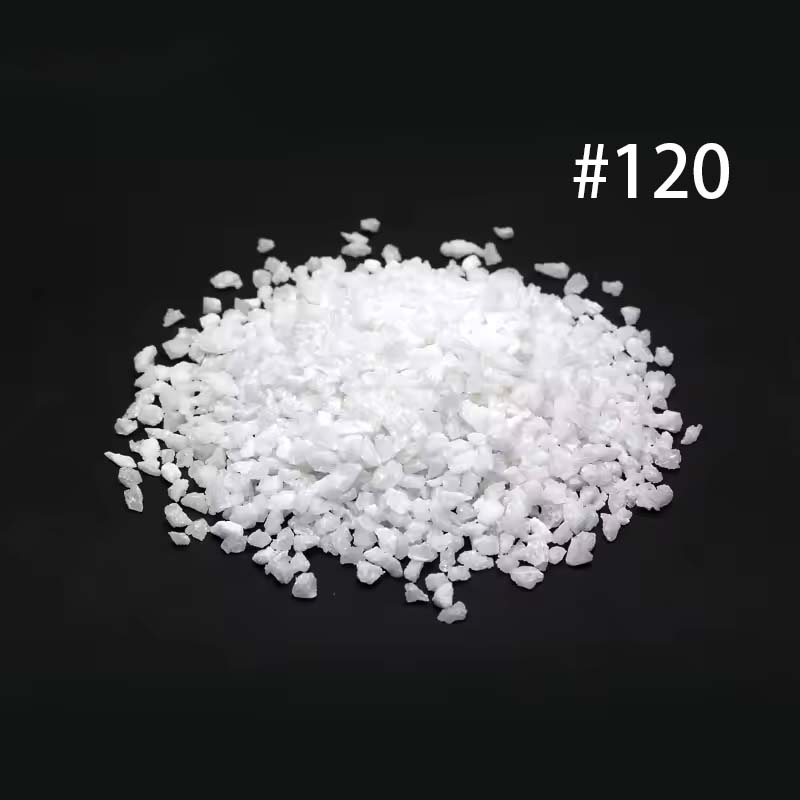
| Oxyde d'aluminium | 4–8× | Particle fracture into fines | Yes — air wash classifier |
| Glass Bead | 3–6× | Sphere fracture; non-spherical fragments must be removed | Yes — spiral or air wash separator |
| Grenat | 3–5× | Progressive fracture and size reduction | Yes — air wash classifier |
| Carbure de silicium | 2–5× | High friability — rapid fracture under impact | Yes — air wash classifier |
| Melamine Plastic Grit | 3–5× | Fracture and contaminant absorption | Yes — cabinet reclaim |
| Walnut Shell / Corn Cob | 1× (single) | Rapid fracture; high contaminant absorption | Not practical |
| Coal / Copper Slag | 1× (single) | High friability — designed for single use | Not practical |
| Bicarbonate de sodium | 1× (single) | Dissolves on impact | Not applicable |
The Cost Per Cycle Model
The basic cost per effective cycle formula:
Cost per cycle = Purchase price ($/kg) ÷ Reuse cycles
This formula captures the primary cost variable. For a more complete total cost of use analysis, expand to:
Total cost per cycle = (Purchase price ÷ Reuse cycles) + (Disposal cost per kg ÷ Reuse cycles) + Reclaim system amortized cost per kg + Equipment wear cost per kg
Worked Comparison Examples
Example 1: Steel Grit vs Copper Slag for Structural Steel Blasting
Scenario: A fabrication shop blasts 200 tonnes of structural steel per month. They are choosing between steel grit (closed-loop reclaim) and copper slag (single-use, open blast with containment).
| Cost Factor | Steel Grit (Closed-Loop) | Copper Slag (Single-Use) |
|---|---|---|
| Purchase price per kg | $1.50/kg | $0.12/kg |
| Media consumption per tonne of steel blasted | ~2 kg (with reclaim) | ~35 kg (single-use) |
| Media cost per tonne of steel blasted | $3.00 | $4.20 |
| Disposal cost per tonne of steel blasted | $0.20 (small volume spent media) | $3.50 (35 kg × $0.10/kg disposal) |
| Total media + disposal per tonne | $3.20 | $7.70 |
| Monthly media + disposal cost (200 t/month) | $640/month | $1,540/month |
| Annual savings with steel grit | $10,800/year | |
Note: The reclaim system capital cost (estimated $120,000 for a mid-size operation) would pay back in approximately 11 years at this throughput — steel grit makes stronger economic sense at higher throughput volumes. The break-even analysis is covered below.
Example 2: Aluminum Oxide vs Single-Use Garnet for Cabinet Blasting
Scenario: A precision engineering shop runs a blasting cabinet for approximately 8 hours per day, blasting machined steel parts before coating. Choosing between aluminum oxide with reclaim and single-use garnet without reclaim.
| Cost Factor | Aluminum Oxide (Reclaim) | Garnet (Single-Use) |
|---|---|---|
| Purchase price per kg | $1.20/kg | $0.35/kg |
| Reuse cycles | 6× | 1× |
| Cost per effective cycle | $0.20/kg | $0.35/kg |
| Media consumed per month | ~15 kg (with cabinet reclaim) | ~80 kg (single-use) |
| Monthly media cost | $18/month | $28/month |
| Annual media savings with Al₂O₃ | $120/year | |
At this scale, the annual savings are modest. The decision between aluminum oxide and garnet for a small cabinet operation may reasonably be driven by other factors — surface finish quality, dust generation, or substrate compatibility — rather than pure economics.
Hidden Costs Beyond Media Purchase Price
A complete total cost of use analysis must account for several cost factors that rarely appear in a simple media price comparison:
Equipment Wear Cost
Hard, angular media — particularly aluminum oxide and silicon carbide — wears blasting nozzles, hose linings, and blast cabinet internals faster than softer or less angular alternatives. For a pneumatic blasting operation using aluminum oxide at 80 PSI, a boron carbide nozzle might last 200–300 hours. The same operation using garnet would extend nozzle life to 400–600 hours. The annual nozzle replacement cost difference is a real cost that belongs in the total cost model.
Disposal Cost
Spent blasting media disposal cost varies significantly by media type and substrate contamination. Garnet and aluminum oxide spent media from clean steel blasting is typically classified as non-hazardous solid waste at $0.05–$0.15/kg disposal cost. Copper slag from the same operation may fail TCLP testing for heavy metals, triggering hazardous waste disposal at $0.30–$1.00/kg or higher. This 5–10× difference in disposal cost can make copper slag more expensive overall than aluminum oxide or garnet, despite its lower purchase price. See our full guidance on sustainable media choices: Eco-Friendly & Biodegradable Blasting Media: Green Alternatives Guide.
Labor Cost
Single-use media operations require more frequent media loading and more cleanup of spent media, both of which consume operator time. High-dust media also increases the frequency of dust collector filter changes and cleaning, adding further labor cost. These costs are often invisible in media procurement decisions but are real and measurable.
Regulatory Compliance Cost
Operations using silica sand or potentially hazardous slag abrasives incur additional regulatory compliance costs: more frequent air monitoring, enhanced respiratory protection programs, medical surveillance for workers, and more stringent waste disposal documentation. These costs can exceed the media price difference in heavily regulated jurisdictions.
Reclaim System ROI
The economics of investing in a media reclaim system depend on the media type, throughput volume, local media price, and disposal cost. The following framework provides a method for calculating payback period.
Annual savings = (Media cost without reclaim − Media cost with reclaim) + (Disposal cost without reclaim − Disposal cost with reclaim)
Payback period (years) = Capital cost of reclaim system ÷ Annual savings
Example: A garnet reclaim system costs $25,000 and saves $8,000/year in media cost plus $3,000/year in disposal cost = $11,000/year total savings. Payback period = $25,000 ÷ $11,000 = 2.3 years. Every year after that, the savings are pure cost reduction.
For guidance on reclaim system design, operation, and media classification to maximize effective reuse cycles, see: Abrasive Blasting Media Recycling & Reclaim Systems: Reduce Cost & Waste.
Break-Even Analysis: When Reusable Beats Single-Use
The economic break-even between reusable media (with reclaim system investment) and single-use media depends primarily on monthly throughput volume. Below the break-even throughput, single-use media may be more economical despite higher per-cycle cost, because the reclaim capital cost is not justified. Above the break-even, reusable media with reclaim delivers clearly superior economics.
| Media Comparison | Typical Reclaim System Cost | Annual Savings at Breakeven | Approximate Break-Even Throughput |
|---|---|---|---|
| Steel Grit vs Single-Use Slag | $80,000–$300,000 | $25,000–$100,000+ | 50–200 tonnes steel/month |
| Aluminum Oxide vs Single-Use Garnet | $5,000–$20,000 | $3,000–$15,000 | 5–20 tonnes steel/month |
| Garnet vs Single-Use Slag (light reclaim) | $3,000–$10,000 | $2,000–$8,000 | 10–30 tonnes steel/month |
| Glass Bead (cabinet reclaim) | $2,000–$8,000 | $1,000–$5,000 | 2–8 kg media consumed/day |
When Single-Use Media Makes Economic Sense
Despite the general economic advantage of reusable media at scale, there are genuine situations where single-use media is the rational economic choice:
- Portable and open-site blasting where media recovery is physically impractical — blasting pipelines in a field, bridge maintenance, or industrial facility maintenance where containment and reclaim infrastructure cannot be deployed economically.
- Very low throughput operations where the monthly media consumption is too small to justify even the smallest reclaim equipment investment — a small shop blasting perhaps 2–3 tonnes of parts per month.
- Contaminated substrate situations where the spent media will be classified as hazardous waste regardless of media type — making the disposal cost equal for both reusable and single-use options, eliminating one of the reusable media’s key economic advantages.
- Short-term or one-off projects where blasting will occur only once or for a limited time period, making capital investment in reclaim equipment unjustifiable on a discounted cash flow basis.
Disposal Cost Comparison
| Type de média | Typical Waste Classification | Typical Disposal Cost (USD/kg) | TCLP Risk |
|---|---|---|---|
| Steel Grit / Steel Shot | Non-hazardous (clean steel substrate) | $0.05–$0.15 | Faible |
| Oxyde d'aluminium | Non-hazardous | $0.05–$0.12 | Très faible |
| Grenat | Non-hazardous | $0.05–$0.12 | Très faible |
| Glass Bead | Non-hazardous | $0.05–$0.12 | Très faible |
| Carbure de silicium | Non-hazardous | $0.05–$0.15 | Très faible |
| Coal Slag | Varies — TCLP testing required | $0.10–$1.00+ | Medium–High |
| Copper Slag | Varies — TCLP testing required | $0.10–$1.00+ | Medium–High |
| Walnut Shell / Corn Cob | Organic waste (non-contaminated) | $0.02–$0.08 | Très faible |
| Plastic Grit | Solid industrial waste | $0.08–$0.20 | Faible |
Note: All spent media classifications are subject to the contamination content from the blasted substrate. Lead paint, chromate primers, cadmium coatings, and other hazardous substrate coatings will elevate the waste classification of any spent media, regardless of the media’s own characteristics. Always test spent media before disposal classification.
Source Cost-Effective Blasting Media from Jiangsu Henglihong Technology
We supply aluminum oxide, silicon carbide, glass beads, and steel shot/grit in bulk quantities with competitive pricing, full quality documentation, and technical support for reclaim system optimization. Contact us for volume pricing and per-cycle cost analysis for your specific application.
Request a Bulk QuoteQuestions fréquemment posées
Filtres