Abrasive Media Safety Guide: OSHA Standards & PPE Requirements
The complete operational safety reference for abrasive blasting — covering OSHA’s crystalline silica standard, required PPE by operation type, engineering controls, confined space permitting, hazardous waste rules, and a printable compliance checklist for blast operators and supervisors.
This guide is an educational overview of U.S. OSHA regulations and industry safety practices as of March 2026. It does not constitute legal advice or a substitute for a site-specific safety plan prepared by a qualified industrial hygienist. Regulations vary by jurisdiction — always verify current requirements with your local regulatory authority before beginning any blasting operation.
Primary Hazards in Abrasive Blasting
Abrasive blasting is one of the highest-risk routine industrial operations. The combination of high-velocity particles, airborne dust, heavy equipment, and potentially hazardous substrate coatings creates a multi-hazard environment that requires comprehensive controls. Understanding the specific hazard pathways is the foundation of an effective blast safety program.
The Six Core Hazard Categories
- Respiratory hazards — the primary risk: Airborne dust from the abrasive media, the substrate material, and particularly the stripped coating creates a complex inhalation hazard. Crystalline silica from silica-containing media causes irreversible progressive lung disease (silicosis). Heavy metals from old coatings (lead, chromium, cadmium) cause systemic toxicity. Even non-silica media generates general nuisance dust that requires respiratory protection.
- Physical impact hazards: Abrasive particles travel at 60–200 m/s at the nozzle. Unprotected skin, eyes, and ears are at severe risk within the blast zone from both direct blast stream contact and particle rebound.
- Hearing loss: Abrasive blast operations consistently generate noise levels of 90–115 dB(A) at operator position, well above the OSHA action level of 85 dB(A) and permissible exposure limit of 90 dB(A) for an 8-hour TWA.
- Confined space hazards: Blasting inside tanks, vessels, holds, and box girders creates atmospheric hazards (oxygen deficiency from dust accumulation, toxic gas from stripped coatings), limited egress, and restricted rescue access. Confined space permits and buddy systems are required.
- Ergonomic hazards: Handling blast nozzles, hoses, and bags of abrasive in awkward postures over extended shifts creates musculoskeletal strain. Blast hoses at operating pressure generate significant reaction forces.
- Fire and explosion (specific media only): Organic blast media — walnut shell, corn cob, and to a lesser extent plastic media — generates combustible dust that can form explosive concentrations in enclosed blast areas. Dust extraction, earthing, and no-ignition-source controls are required for organic media operations.
OSHA Crystalline Silica Standard — The Most Important Compliance Requirement
OSHA’s crystalline silica standards — 29 CFR 1910.1053 (General Industry) and 29 CFR 1926.1153 (Construction) — represent the most significant regulatory development in abrasive blasting safety since the phased-out use of silica sand as a blast media. These standards establish a Permissible Exposure Limit (PEL) of 50 µg/m³ as an 8-hour TWA for respirable crystalline silica — a reduction of 80% from the previous PEL — and require a comprehensive written exposure control plan for any operation with potential silica exposure.
The PEL in Context: What 50 µg/m³ Means in Practice
Crystalline Silica Exposure — OSHA Action Level & PEL in Context
What the Standard Requires When Silica Exposure Is “Above the Action Level”
- Written Exposure Control Plan: Documents all tasks that may expose workers to silica, engineering and work practice controls used, and respiratory protection provided.
- Air monitoring: Initial and periodic personal breathing zone air sampling to determine exposure levels.
- Regulated areas: Demarcated areas where silica exposure exceeds the PEL; restricted to authorised workers only.
- Engineering and work practice controls: Water suppression, local exhaust ventilation, or isolation before respiratory protection can be used as a primary control.
- Respiratory protection program: Written program, medical evaluation, fit-testing, and supplied-air respirators for abrasive blasting.
- Medical surveillance: Baseline chest X-ray; periodic evaluations; physician review for workers regularly exposed above the action level for 30 or more days per year.
- Housekeeping: No dry sweeping or compressed air cleaning of silica dust — use wet methods or HEPA vacuum.
- Hazard communication: Silica-containing products must be labelled; Safety Data Sheet must be accessible.
The combination of OSHA’s 50 µg/m³ PEL and the exposure levels generated by dry blasting with silica sand (potentially thousands of times above the PEL even with ventilation) makes silica sand use in abrasive blasting essentially non-compliant in any standard operating environment. OSHA has published guidance stating that engineering controls alone cannot reduce silica sand blasting exposure to the PEL in most situations. All OSHA-compliant blasting operations now use silica-free media — aluminum oxide, garnet, glass beads, steel abrasives, or similar. See our media selection guide for compliant alternatives.
Crystalline Silica Status by Blast Media Type
The most impactful single decision in abrasive blasting safety is media selection. The table and visual below classify all major blast media types by their crystalline silica content and OSHA compliance status.
Key Regulations & Standards
OSHA Crystalline Silica — General Industry
29 CFR 1910.1053PEL 50 µg/m³ TWA. Action Level 25 µg/m³. Written exposure control plan, air monitoring, medical surveillance, respiratory protection program.
OSHA Crystalline Silica — Construction
29 CFR 1926.1153Same PEL as General Industry. Table 1 specifies engineering control options by task type. Abrasive blasting with silica-containing media requires supplied-air respirator.
OSHA Lead Standard — General Industry
29 CFR 1910.1025PEL 50 µg/m³ for airborne lead. Action Level 30 µg/m³. Air monitoring, biological monitoring, medical surveillance, and hygiene facilities when disturbing lead coatings.
OSHA Lead Standard — Construction
29 CFR 1926.62Applies to blasting operations that disturb lead-based paint on bridges, structures, and vehicles. Same PEL as General Industry. Engineering controls, containment, and waste management required.
OSHA Noise Standard
29 CFR 1910.95Action Level 85 dB(A) 8-hr TWA triggers hearing conservation program. PEL 90 dB(A). Blast operations regularly exceed both — hearing protection required and hearing conservation program mandatory.
OSHA Confined Space
29 CFR 1910.146 / 1926.1201Permit-required confined space entry for blasting in tanks, vessels, holds. Requires written permit, atmospheric testing, ventilation, attendant, rescue plan, and authorised entrant training.
OSHA Respiratory Protection
29 CFR 1910.134Written respiratory protection program required. Medical evaluation before fit-test. Annual fit-testing. For abrasive blasting: Type CE supplied-air abrasive blasting respirator (NIOSH-approved) required — not just an APF dust mask.
EPA RCRA Hazardous Waste
40 CFR Part 261Spent blast media may be classified as hazardous waste if it fails TCLP testing for heavy metals (lead, chromium, cadmium, etc.) absorbed from stripped coatings. Characterisation required before disposal.
Required PPE by Operation Type
Personal Protective Equipment is the last line of defence in the hierarchy of controls — not the first. Engineering controls (enclosures, ventilation, water suppression) and administrative controls (restricted areas, exposure rotation) must be implemented to the extent feasible before relying on PPE. That said, properly selected and worn PPE is non-negotiable for all blasting operations regardless of engineering controls.
Supplied-Air Respirator
NIOSH-approved Type CE abrasive blasting respirator. Supplied-air only — air-purifying respirators DO NOT provide adequate protection for abrasive blasting. Continuous flow or pressure-demand mode required.
Blast Helmet / Hood
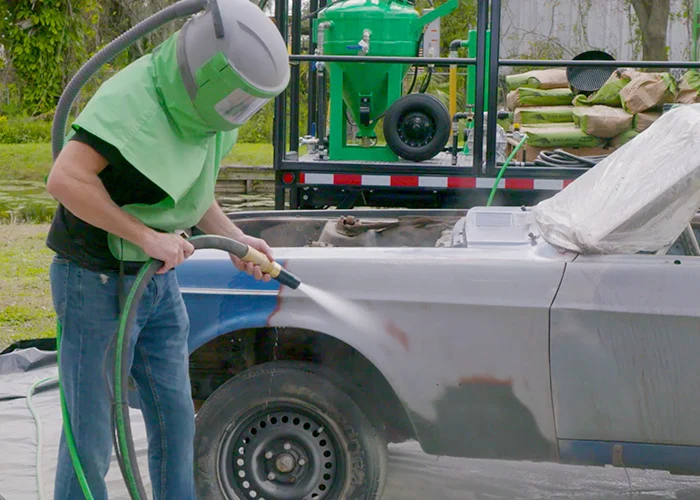
Full head, face, neck and shoulder protection. Must be NIOSH-approved with the supplied-air respirator as an integrated system. Separate safety glasses are NOT a substitute.
Blast Suit
Heavy-duty leather or canvas suit covering full body. Protects against abrasive particle impact, which causes lacerations at blast velocity. Heat-resistant for long shift operations.
Leather Gloves
Heavy leather blast gloves integrated with blast suit or separate gauntlet style. Protects hands and wrists from rebound particles and hose vibration.
Hearing Protection
Required whenever blast noise exceeds 85 dB(A) at operator position (virtually all production blasting). NRR 25+ hearing protection required. Double protection (muff + plug) for exposures above 105 dB(A).
Safety Boots
Steel-toed, puncture-resistant safety footwear. ASTM F2413 or equivalent. Metatarsal guards recommended in high-volume blast areas where heavy bags and hoses are handled.
Supplied-Air Line
Grade D breathable air from a compressor with appropriate filtration (oil, CO, water). CO alarm on supplied-air line strongly recommended. Air supply must not be drawn from the blast area.
Blast Operator Safety Valve
Dead-man (remote control) safety valve at nozzle required — blast stops automatically if operator releases grip. OSHA requires this for all abrasive blasting using blast hose and nozzle equipment.
| Operation Type | Respiratory | Head / Face | Body | Hearing | Additional |
|---|---|---|---|---|---|
| Open-air blasting (non-silica media, clean steel) | Type CE supplied-air | Full blast helmet | Blast suit + gloves | Required (85+ dB) | Safety boots, dead-man valve |
| Cabinet blasting (enclosed, with dust collector) | Half-face APF 10 minimum; Type CE if opening cabinet | Safety glasses | Standard work clothing | Situational | Anti-vibration gloves for long shifts |
| Confined space blasting (permit-required) | Type CE supplied-air + escape SCBA | Full blast helmet | Full blast suit + gloves | Required | Lifeline harness, attendant, rescue plan, CO monitor, permit |
| Lead paint disturbance blasting | Type CE supplied-air (minimum — may need SCBA per air monitoring) | Full blast helmet | Full impermeable blast suit + gloves | Required | Shower facility, change room, biological monitoring, medical surveillance |
| Wheel blast (automated, enclosed machine) | N/A during blasting cycle (interlocked doors) | Safety glasses during loading | Standard + dust coat | During maintenance near machine | Lockout/tagout for maintenance access |
Engineering Controls — First in the Hierarchy
Engineering controls are preferred over PPE because they reduce the hazard at the source rather than relying on individual worker compliance. OSHA requires employers to implement engineering and work practice controls to the extent feasible before supplementing with PPE.
Ventilation — The Most Critical Engineering Control
Adequate airflow through the blast area is the single most effective engineering control for controlling airborne dust exposure. OSHA’s guidelines for abrasive blasting recommend a minimum air velocity of 100 feet per minute (0.5 m/s) across the work area, directed away from the operator and other workers. For enclosed blast rooms, calculated air change rates based on the blast area volume, media type, and blast nozzle flow rate are required — a qualified industrial hygienist should specify the ventilation system for any new installation.
Blast Enclosures and Containment
Fully enclosed blast rooms or cabinets with negative air pressure prevent dust migration to adjacent work areas and protect bystanders. For field blasting on structures where full enclosure is not practicable, shroud systems around the nozzle and partial containment curtains reduce dust spread. Open-air blasting on elevated structures (bridges, towers) requires exclusion zones below and downwind of the work area.
Wet Blasting and Water Suppression
Wet abrasive blasting (introducing water into the air-abrasive stream) reduces airborne dust generation by approximately 85–95% compared to dry blasting, and is the most effective single engineering control available. Wet blast systems are increasingly specified for urban bridge rehabilitation, confined-space projects, and any site where dry blasting dust management is impractical. The trade-off is surface drying time before coating, which must be managed in accordance with the coating specification.
Confined Space Blasting — Special Requirements
Abrasive blasting inside a permit-required confined space — ship ballast tanks, storage tanks, pressure vessels, pipe internals, bridge box girders, tunnels — is one of the most hazardous industrial operations conducted and requires a level of planning and control beyond standard open-air blasting.
Atmospheric Hazards Specific to Confined Space Blasting
- Oxygen deficiency: Dust accumulation in a confined space can displace oxygen to dangerously low concentrations (<19.5% O₂ = IDLH). Continuous atmospheric monitoring is required throughout the operation.
- Carbon monoxide: CO from blast air compressor exhaust can enter the blast area if the compressor air intake is poorly positioned. CO monitors in the blast area and on the air supply line are essential.
- Toxic vapours from stripped coatings: Disturbing old lead-based, isocyanate-cured, or coal tar coating systems releases toxic vapour and particulate that accumulates in still air pockets within the confined space.
Written permit · Atmospheric testing before entry and continuous monitoring during blasting · Forced ventilation (mechanical, not natural) · Non-entry rescue capability · Trained attendant outside the space at all times · Communication system between entrant and attendant · Retrieval system (lifeline and harness) · Emergency rescue plan with emergency services notification. No exceptions for “small” spaces or brief entry.
Lead Paint & Other Hazardous Coating Disturbance
The most significant hazard amplifier in abrasive blasting is the coating being removed rather than the blast media itself. Pre-1980 structures and vehicles of all types — bridges, ships, aircraft, industrial equipment — may have lead-based chromate primer or other regulated coating materials that, when disturbed by blasting, create exposures that are independently regulated by OSHA, the EPA, and state environmental agencies.
Lead-Based Paint (LBP) Protocol
- Pre-blast assessment: Test paint chips by XRF (X-ray fluorescence) or laboratory analysis before blasting any pre-1980 structure. EPA RRP rule (40 CFR Part 745) governs LBP disturbance in residential settings; OSHA Lead Standard (1926.62) governs all construction including bridge work.
- Containment: Full containment systems (ground sheets, shroud panels, negative air containment tents) to prevent lead dust migration to adjacent areas and waterways.
- Air monitoring: Personal breathing zone sampling throughout the operation. Biological monitoring (blood lead levels) for workers regularly exposed above the action level (30 µg/m³).
- Hygiene facilities: Separate change rooms, shower facilities, no eating/drinking/smoking in the work area. Lead-contaminated clothing handled as hazardous material.
- Waste characterisation: TCLP testing of spent blast media and paint debris before disposal. Lead-contaminated waste is typically classified as hazardous under RCRA — specialist hazardous waste disposal required at $150–$400+ per ton.
Spent Blast Media Waste Disposal
| Type de média | Clean Steel (no old coating) | Pre-1980 Steel (possible LBP) | Typical Disposal |
|---|---|---|---|
| Oxyde d'aluminium | Non-hazardous solid waste | TCLP required — likely hazardous if LBP confirmed | Solid waste landfill ($30–$80/ton) or hazardous waste if contaminated |
| Grenat | Non-hazardous solid waste | TCLP required | Solid waste; sometimes reused as construction aggregate |
| Perles de verre | Non-hazardous solid waste | TCLP required | Solid waste landfill |
| Steel Grit / Shot | Non-hazardous (recycle preferred) | TCLP required — metal scrap recycler may refuse | Metal scrap recycling (clean); hazardous waste disposal if contaminated |
| Supports en plastique | Non-hazardous solid waste | TCLP required if stripping old coatings | Solid waste landfill; check for coating-specific contamination |
| Coal Slag / Copper Slag | TCLP recommended — may contain leachable heavy metals from slag | Likely hazardous — dual contamination risk | Characterise before disposal; may require hazardous waste treatment |
Safety Profile Summary by Media Type
| Media | Crystalline Silica | Dust Level | Iron Contamination | Waste Classification | Special Hazard |
|---|---|---|---|---|---|
| Al₂O₃ | Aucun | Medium-High | BFA: trace · WFA: none | Non-hazardous | High dust generation — ensure dust collection |
| Perles de verre | None (amorphous) | Faible | Aucun | Non-hazardous | Broken beads create sharp glass shards — reclaim promptly |
| Grenat | None (silicate mineral) | Faible | Trace (mineral iron) | Non-hazardous | Best choice for confined-space and indoor blasting |
| Steel Grit/Shot | Aucun | Low-Medium | High — not for SS or Al | Recyclable metal | Confined to wheel blast; heavy impeller/housing maintenance |
| Supports en plastique | Aucun | Medium | Aucun | Non-hazardous | Coating-specific hazards (lead, isocyanates) dominate |
| Walnut / Corn Cob | Aucun | Medium | Aucun | Non-hazardous | Combustible dust explosion risk — no ignition sources |
| Sable de silice | Very high — up to 100% | Very High | Aucun | Depends on substrate | Silicosis — do not use for blasting |
Pre-Blast Safety Compliance Checklist
The checklist below covers the minimum safety verification steps that should be completed before any abrasive blasting operation begins. Print and complete for each project or site set-up.
✅ Abrasive Blasting Pre-Operation Safety Checklist
1. Regulatory & Planning
2. PPE Verification
3. Equipment Safety
4. Area & Environmental Controls
5. Confined Space (if applicable)
Questions fréquemment posées
Is abrasive blasting with silica sand still legal?
While OSHA has not explicitly banned silica sand as a blast media by name, its crystalline silica standard (29 CFR 1910.1053 / 1926.1153) establishes an exposure PEL of 50 µg/m³ that is effectively impossible to meet when using silica sand in most blasting operations — even with ventilation and supplied-air respirators. OSHA has published guidance indicating that engineering controls alone are unlikely to reduce exposures to the PEL when blasting with silica-containing abrasives. In practice, most OSHA compliance officers treat dry blasting with silica sand as a de facto violation. All modern industrial blasting operations use silica-free media alternatives.
What respirator is required for abrasive blasting?
OSHA requires a NIOSH-approved Type CE abrasive blasting respirator with a supplied-air system operating in continuous-flow or pressure-demand mode. This is a full-head positive-pressure blast helmet integrated with the respirator — not a half-face or full-face air-purifying respirator. Air-purifying respirators (N95s, P100 cartridge respirators) are not approved for abrasive blasting because they cannot provide adequate protection against the high concentrations of mixed dust generated in the blast zone. The air supply must be Grade D breathable air from a compressor with a CO monitor on the supply line.
What is silicosis and why is it a risk in blasting?
Silicosis is an irreversible, progressive, and potentially fatal lung disease caused by inhaling respirable particles of crystalline silica (quartz). When crystalline silica particles deposit in the deep lung, they trigger an inflammatory response that causes fibrous nodules to form in lung tissue over time, progressively reducing lung capacity. There is no cure — only symptom management. Silicosis can develop after years of moderate exposure (chronic silicosis) or within months of very high exposure (accelerated silicosis). Abrasive blasting with silica sand has historically been the leading industrial cause of silicosis. Using silica-free blast media (aluminum oxide, garnet, glass beads, steel abrasives) eliminates this specific risk entirely.
Is spent blast media classified as hazardous waste?
It depends on the media type and, critically, on what coating was removed. Blast media itself — aluminum oxide, garnet, glass beads — contains no RCRA-regulated heavy metals and generates non-hazardous solid waste when used on clean, uncoated steel. However, when blasting removes lead-based paint, hexavalent chromium primer, or other regulated coating materials, the spent media absorbs heavy metals from the stripped coating and may fail TCLP testing, resulting in hazardous waste classification regardless of the media type. Always perform TCLP testing on spent media from any project involving pre-1980 structures or coatings of unknown composition before selecting a disposal route.
What are the OSHA requirements for blasting in a confined space?
Abrasive blasting inside a permit-required confined space (29 CFR 1910.146) requires: a written permit completed and signed before entry; atmospheric testing for oxygen, combustible gas, and toxic gases before entry and continuous monitoring during blasting; forced mechanical ventilation throughout the operation; a trained attendant outside the space at all times; a retrieval/rescue system (lifeline, harness, and non-entry rescue capability); communication between entrant and attendant; and an emergency rescue plan. Additionally, the supplied-air blast respirator must have a means of escape in the event of air supply failure. These requirements apply regardless of how small the confined space is or how brief the intended entry.
Which blast media produces the least dust?
Among the common industrial blast media options, garnet produces the least dust of any mineral or synthetic abrasive at equivalent blast conditions — a result of its high specific gravity (~4.0 g/cm³) and low friability that cause particles to fall out of air suspension quickly. Glass beads also generate low dust due to their spherical shape producing fewer fine particles on impact. The lowest dust option overall is wet abrasive blasting (any media with water), which reduces airborne particulate by 85–95% compared to dry blasting. For dry blasting in confined spaces where dust control is critical, garnet at 36–60 mesh is the standard industry recommendation. See our garnet media guide for details.
Need OSHA-Compliant Blast Media for Your Operation?
All Henglihong abrasive media — aluminum oxide, glass beads, garnet, steel abrasives, plastic media — is silica-free and supplied with full SDS and crystalline silica XRD certification documentation for your compliance files.
Request a Quote & Safety Documents View All Abrasive Media Products →Filtres